
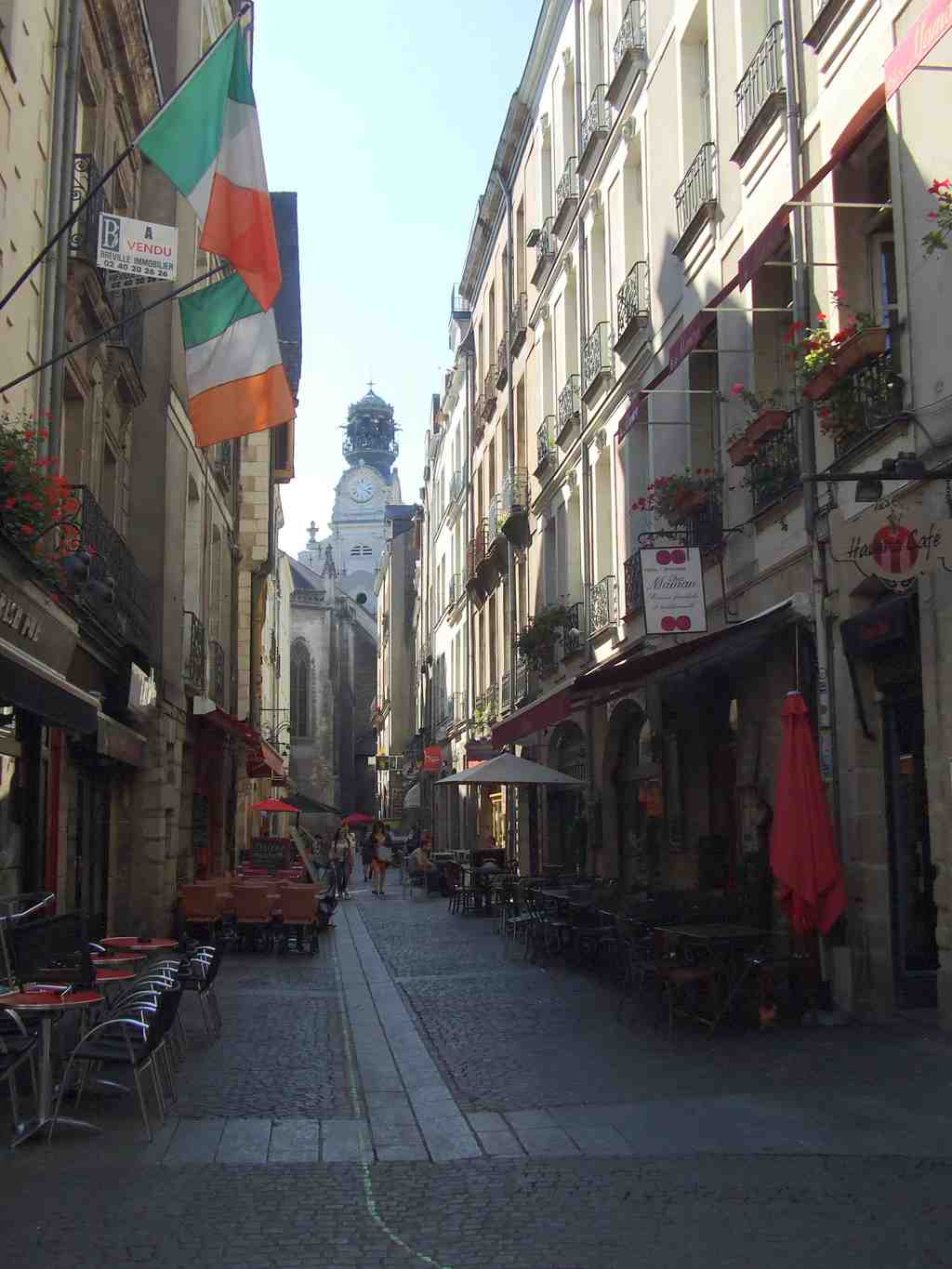
Look for a straight cobbled lane lined with narrow stone-and-timber facades, with the discreet opening of the covered Passage Bouchaud set into the row of old buildings.
Rue de la Juiverie can feel almost modest at first glance... just a rectilinear street in the old Bouffay quarter, paved underfoot, hemmed in by houses that have watched centuries pass. But this name carries far more than direction. In the Middle Ages, a “juiverie” meant the part of a city where Jewish residents lived, and the medieval Jewish community of Nantes belonged to the daily life of this neighborhood. They were not a rumor at the edge of town. They lived, traded, prayed, argued, raised children, and kept a synagogue here on this very street.
They also lived under rules that marked them as separate. The community had its own seneschal, a local judicial officer, and judges who could apply Jewish law. Yet the authorities fixed the hours when people could leave and return, and each evening two chains closed this street. The community even paid the count of Nantes for protection... a heartbreaking detail, because protection is never a simple gift when power can withdraw it.
Then the story turns hard. After the sixth crusade, some Breton nobles owed money to Jewish lenders. In twelve thirty-five, Pope Gregory the Ninth preached a new crusade, and before some crusaders left for the Holy Land, they murdered several Jews in Nantes. The next year, the duke of Brittany expelled the Jews from the city and canceled the debts Christians owed them; the expulsion came with more killings.
In twelve thirty-nine to twelve forty, an edict signed at Ploërmel pushed even further: it drove Jews out of Brittany, erased debts, returned pledged goods to their former owners, and even pardoned people who had killed a Jew before the decree. So this quiet street name preserves the outline of a community that violence, debt, and political convenience tried to erase.
And yet the name survived. That matters.
Later, Jewish lives touched Nantes again, though never securely. Henri the Fourth tolerated Portuguese and Spanish crypto-Jews here for a time - people forced to convert outwardly while keeping Jewish practice in secret - because he wanted commerce to grow. Then Louis the Thirteenth expelled them again in sixteen fifteen. In sixteen thirty-six, Jewish refugees from Bayonne arrived and suffered looting and street violence until a royal prosecutor wrote, in effect, that people abused them daily without any legitimate cause.
This street kept changing around those absences. In eighteen thirty-one, Jean-Baptiste Bouchaud opened the covered passage nearby, threading private commerce into the old lane. In eighteen sixty-nine, a young locksmith named Joseph Paris began his working life here, forging grilles, doors, and light iron frames in a modest workshop before moving on to something larger. Even the street name became contested in the twentieth century: officials renamed it rue de l’Emery, restored Juiverie, then changed it again under the German Occupation before bringing the old name back at the Liberation. A plaque can become a battleground for memory.
When you’re ready, continue to Decré, about a minute away, where local trade begins to open into a newer, more theatrical kind of shopping street. If you plan to pause nearby, note that one local venue closes on Monday and Sunday, then opens at midday and again in the evening on most other days.




