AudaTours logoAudaTours

Audioguía de Quito: Ecos de Imperios y Piedras Sagradas

Guía de audio18 paradas

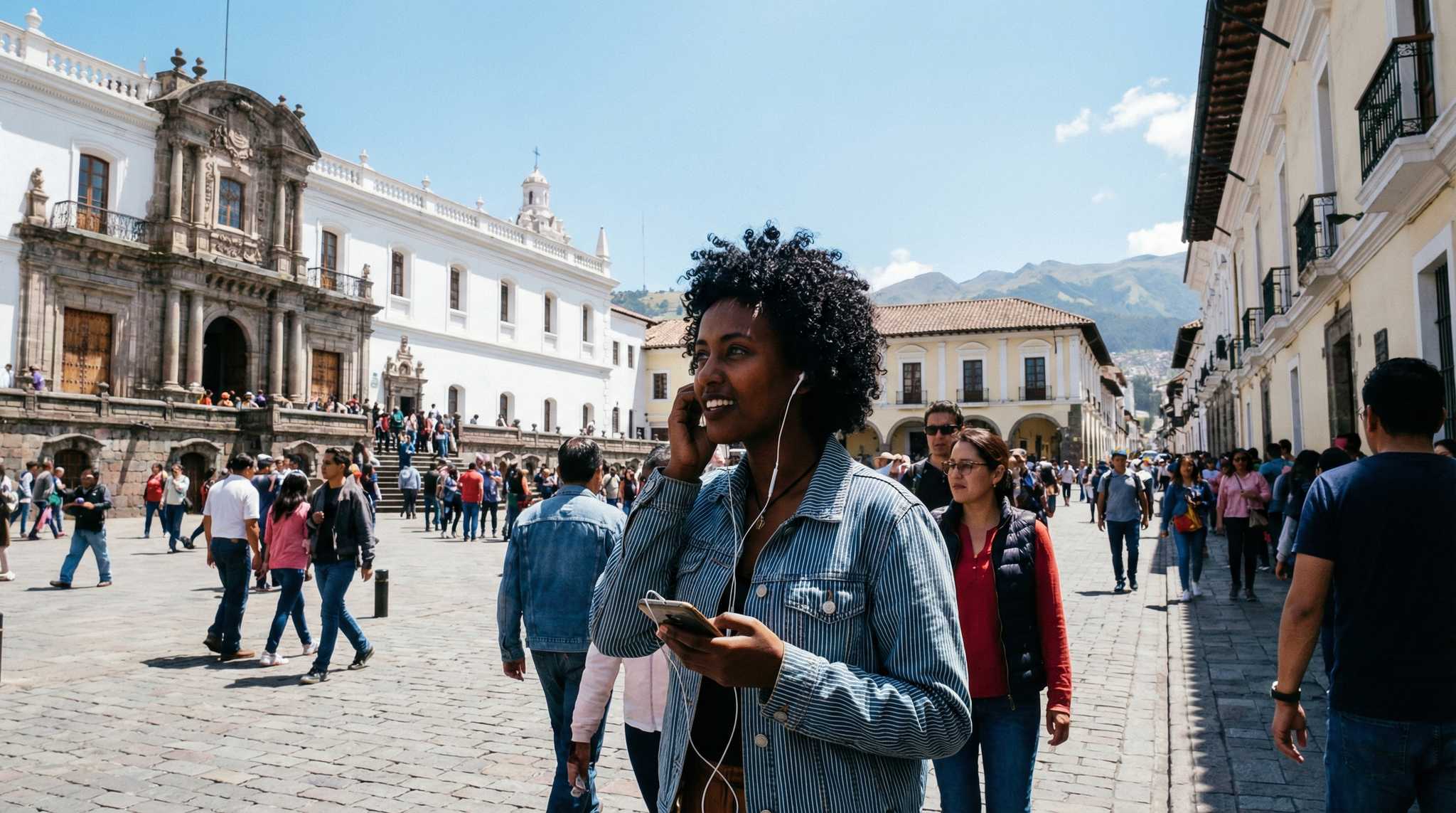
Descubre el vibrante corazón de Quito en este cautivador recorrido por sus joyas históricas. Comienza en el majestuoso Palacio de Carondelet, sede del gobierno de Ecuador, donde la arquitectura colonial se encuentra con una rica historia política. Pasea hasta la impresionante Iglesia de la Compañía, famosa por sus deslumbrantes interiores de pan de oro que brillan con la grandeza barroca. Luego, deambula por la encantadora Iglesia de San Francisco, uno de los complejos religiosos más antiguos y grandes de América Latina, lleno de fascinantes historias de arte y cultura. Este recorrido te sumerge en la esencia del encanto colonial y la vibrante herencia de Quito, un viaje inolvidable a través del tiempo y la belleza.

Vista previa del tour

map

Sobre este tour

  • schedule
    Duración 50–70 minsVe a tu propio ritmo
  • straighten
    3.3 km de ruta a pieSigue el camino guiado
  • location_on
    UbicaciónQuito, Ecuador
  • wifi_off
    Funciona sin conexiónDescarga una vez, úsalo en cualquier lugar
  • all_inclusive
    Acceso de por vidaReprodúcelo en cualquier momento, para siempre
  • location_on
    Comienza en Iglesia de San Francisco

Paradas en este tour

  1. To spot the Church of San Francisco, look for a grand staircase leading up to a massive stone facade with two white towers rising proudly above the main entrance, set directly…Leer másMostrar menos

    To spot the Church of San Francisco, look for a grand staircase leading up to a massive stone facade with two white towers rising proudly above the main entrance, set directly across from the wide-open plaza-honestly, it looks impossible to miss! Now, as you stand here, take a deep breath and listen to the bustling echoes of history swirling around you. Imagine the square filled with the sounds of merchants, townsfolk, and the occasional donkey braying impatiently at its owner. This is no ordinary church-this is San Francisco, the legendary “Escorial of the New World,” the largest historic complex in all the Americas, and Quito’s most storied architectural treasure. Picture the year 1535: Spanish friars, Jodoco Ricke and Pedro Gosseal, have just arrived from Europe, eyes wide at the sight of a land filled with Inca ruins and smoky memories of war. Centuries before, this very spot was the site of Huayna Cápac’s royal palace, long gone now-burned and buried under the ashes by the defiant general Rumiñahui to keep it out of conquistador hands. As legend goes, only a few locals, like Cantuña’s ancestor, knew what secrets remained hidden under the rubble. So, when the Franciscans chose this land for their new temple, they were literally building on layers of history: Inca, Caranqui, even mysterious fragments of panzalea ceramics uncovered by later archaeologists. Every stone you see whispers an ancient tale. But building San Francisco was never easy! They called in architects, maybe from Spain, and clever locals, taking advantage of the land’s slope to craft that dramatic staircase right in front of you. As the years rolled by-over 150 of them!-craftsmen hammered, chiseled, and sweated through earthquakes, shortages, and royal ambitions. Kings in Europe, like Charles V, boasted about these towers shining far away in his global empire. But even the grandest plans couldn’t foresee what Quito would throw their way. More than once, mighty earthquakes left sections in ruins. A little artistic improvisation followed-Renaissance, Mannerism, Mudéjar, and Baroque styles all mixing under one fabulously large, white roof. At its peak, this place was almost a city unto itself, with thirteen cloisters, three churches, a library famed as the best in South America, and an immense plaza that became the “living room” of Quito. Imagine the chaos: here, folks drew their water, held crowded markets, enjoyed political rallies, and even buried their loved ones. Even now, the building buzzes with activity-convent life, schools, healing, and prayer. Step inside, and your eyes would feast on a golden explosion: over 3,500 works of colonial art dazzle the walls and altars, most carved or painted by the legendary Quito School that started right here. The church’s choir still has its original sixteenth-century decorations, and the central nave gleams with a newer, post-earthquake Baroque ceiling. But the true stars are the masterpieces-you might spot the “Virgin of Quito” twirling on her globe, or the “Jesus del Gran Poder” whose annual procession packs the streets every Good Friday. Now, for a little mystery and mayhem-Quito wouldn’t be itself without a good old legend. Enter the infamous Cantuña, a local architect (and, according to some stories, a gifted drinker). Pressed to finish a chapel on time, rumor says he made a deal with none other than the Devil. Demons swarmed out from the ground, working at lightning speed, until-just in the nick of time!-Cantuña hid a single stone, outsmarting evil and saving his soul. They say you can still spot the “missing stone” if you look closely at the chapel that bears his name, the exquisite Capilla de Cantuña, famed as the “Sistine Chapel of America.” Whether you hear the echoes of Incas, the laughter from old convent kitchens, or the faint clatter of tiny demon feet, remember: as you stand on these stones, you’re walking through layers of genius, struggle, faith, and imagination. Welcome to San Francisco-where every step is a legend, and every legend, just another step. Now, keep your eyes open for the next surprise… and don’t make any deals you can’t get out of! For further insights on the architecture, art pieces or the related captions, feel free to navigate to the chat section below and inquire.

    Abrir página dedicada →
  2. Right ahead, you’ll spot a simple two-story colonial house with a plain façade, small balconies on the upper floor, and a tiled roof-just look for the quiet elegance tucked…Leer másMostrar menos

    Right ahead, you’ll spot a simple two-story colonial house with a plain façade, small balconies on the upper floor, and a tiled roof-just look for the quiet elegance tucked between the plazas. Standing here, you’re about to step into the secrets of the Pre-Columbian Art Museum Praise House, or Casa del Alabado-one of Quito’s oldest homes, dating back to the 17th century. Imagine the faint echo of footsteps on stone as this peaceful house kept its mysteries for centuries. Over the entrance, if you strain your eyes, you’ll see the words that inspired its name: “ALABADO SEA EL SANTISIMO SACRAMENTO… 1671”-blessed be the holy sacrament. Now, don’t be fooled by the quiet outside; inside, the museum bursts with life, filled with art that honors Ecuador’s first peoples and their sacred bond with the forces of nature. Unlike most museums, Casa del Alabado prefers to show off the beauty and spirit of each object, turning every room into a world of ancient creativity and mysticism. Walk through its 14 galleries, peek into two sunlit courtyards, and-my personal favorite-don’t miss the heady smell of coffee from its café on a crisp Quito morning. Restored in 2006 and reborn as a museum in 2010, it’s now a bridge across time, connecting us to both ancient magic and new discoveries. So step closer-who knows what ancient spirits might be watching you admire their treasures?

    Abrir página dedicada →
  3. To spot the Plaza de San Francisco, look ahead for a wide, open cobblestone square surrounded by old colonial buildings and dominated by the grand white façade and twin towers of…Leer másMostrar menos

    To spot the Plaza de San Francisco, look ahead for a wide, open cobblestone square surrounded by old colonial buildings and dominated by the grand white façade and twin towers of the Church and Convent of St. Francis-it’s right in the heart of Quito’s historic center and stands out from the denser rooftops around it. Welcome to the Plaza de San Francisco, where every stone and breeze seems to whisper a secret from the past! Imagine you’re standing on what was once the mighty palace of the Inca Emperor Atahualpa-yes, right under your feet are the hidden layers of ancient history. After the Spanish arrived, they began building this square in 1537, though-maybe they stopped for too many coffee breaks-it wasn’t finished until 1680, and the official party didn’t happen till 1705! The impressive Church and Convent of St. Francis stretches its beautiful façade before you, while the elegant Palace Gangotena watches from the corner, and the Chapels of Villacís and Cantuña add a hint of mystery and legend around the plaza's edges. Picture dusty horses trotting across the stones, lively markets filling the air with shouts, and a place that saw the rise and fall of empires-from Incan royalty to Spanish conquerors to modern-day Quito’s vibrant pulse. Whether you come by day to feel the sun bounce off the white stones or at night when the lamps make everything look a bit enchanted, the Plaza de San Francisco has been captivating hearts for centuries. Soak it in-you’re walking through history itself, and if you feel a slight rumble under your shoes, don’t worry, it’s just the echoes of the Incas complaining about their lost palace!

    Abrir página dedicada →
Mostrar 15 paradas másMostrar menos paradasexpand_moreexpand_less
  1. Right in front of you, the Church of the Company stands out with a mesmerizing grey stone façade, lavishly carved with swirling columns, statues of saints, and dramatic Baroque…Leer másMostrar menos

    Right in front of you, the Church of the Company stands out with a mesmerizing grey stone façade, lavishly carved with swirling columns, statues of saints, and dramatic Baroque details-just look for the intricate, almost lace-like patterns etched into the volcanic rock! Now, I hope you’re ready to step into a story so extravagant and sparkling it could out-glitter a treasure chest-welcome to La Compañía de Jesús! Imagine, for a moment, you’re standing on this very spot four centuries ago: the air is thick with the scent of incense, the echoing clip-clop of horses fills the street, and rumors are swirling about the legendary temple rising on the corner of García Moreno and Sucre. This church, lovingly called La Compañía, isn’t just any old church... oh no, it’s often called the “Temple of Solomon of South America.” Some even say it’s the most beautiful Jesuit temple in the whole world-Ernesto La Orden, Spain’s ambassador, certainly did! And honestly, with its front door unveiling six mighty spiral columns and statues of saints peeking out from shadowed niches, it’s not hard to see why. Let’s set the stage: the Jesuits arrived in Quito in 1586 on a mission to amaze, to educate, and-well-maybe to show off a bit. They didn’t exactly get the best plot of land at first, but after some shuffling, they wound up right here. There was just one teeny problem: their new property was sliced through by a deep gully called the Zanguña. So what did they do? They built giant brick arches to level it out. Not only did they get a flat piece of land, but they also created space for a college, hospital, monastery, and even a university-complete with a library of 20,000 books that dropped the jaws of visiting French scientists in the 1700s. But back to the main show-the church itself. Construction started in 1597, with Spanish, Italian, and even Basque architects arguing (politely, I hope) over plans. The Italian brother Marcos Guerra is the one who stamped the temple with its dazzling Renaissance and Baroque flair: arches, domes, and chapels that catch the light just so. And all the elaborate stonework? Carved by the hands of indigenous and mestizo artists who slipped secret local symbols among the saints and cherubs. Oh, and here’s a royal rumor for you-the King of Spain, anxiously eyeing his treasury, used to gaze out west from his palace in El Escorial and joke, “With all that money, I should be able to see their towers from here!” He needn’t have worried. The church’s real value was never size, but overwhelming beauty: its volcanic stone front glows under the sun, alive with carvings of flowers, angels, and intricate scrolls. But like any grand tale, there’s been more than a little drama. Earthquakes have shaken-and sometimes broken-the belfry and domes. The original bell tower once towered above the city but fell after an 1859 quake. The bells now sit on display nearby; one even became a cannon for Quito’s defense during historic battles! Fires and rain threatened the painted and gilded wood inside, but thanks to determined restoration teams-and even an emergency gold-leaf shipment from UNESCO-the church’s glimmer remains undimmed. Step inside (if you get the chance), and prepare for your jaw to drop: every inch inside gleams with 23-karat gold leaf-walls, altars, even the pulpit, which is guarded by 250 tiny carved cherub faces. The whole place shines so much, you’ll feel like you’ve wandered into a sunbeam you can’t escape! And when the sunlight pours through the precisely placed windows, the church practically sings with golden light. Throughout its halls are masterpieces of painting, haunting oil portraits, and a dazzling carved screen that once kept out both street noise and the “unbaptized” (talk about an exclusive guest list). Over the centuries, this has been a place of learning, worship, and even papal visits-yes, both Pope John Paul II and Pope Francis prayed beneath these gilded arches. So as you stand here, let your mind wander back through time... can you hear the echoes of lessons in the university next door, the laughter of artists climbing scaffolds, and the hopeful prayers rising among clouds of incense? This isn’t just a building-it’s a living legend in stone and gold, proof that when art, faith, and a pinch of ambition come together, history leaves us a spectacle to remember! Wondering about the architecture, interiors or the paints? Feel free to discuss it further in the chat section below.

    Abrir página dedicada →
  2. To spot the Church of El Sagrario, just look for the tall, ornate stone facade with dramatic columns and detailed carvings, right in front of you on García Moreno street-it’s…Leer másMostrar menos

    To spot the Church of El Sagrario, just look for the tall, ornate stone facade with dramatic columns and detailed carvings, right in front of you on García Moreno street-it’s sandwiched between white walls and boasts a grand arched doorway that’s hard to miss. Now, imagine you’re transported back to the heart of Quito’s old city, where cobblestones echo footsteps and the scent of incense drifts through the air. You’re standing before the Church of El Sagrario-no, not a forgotten sidekick but a star in its own right, even though it’s officially an annex of the mighty Cathedral next door. This special church is so large and impressive, most people mistake it for an independent temple-and honestly, who could blame them! Let’s add a little drama: back in 1617, workers set up towering wooden scaffolds, hammering away as they built the church over the deep ravine of Zanguña, a spot once haunted by secret streams and whispered legends. Led by the determined Jesuit priest Marcos Guerra from Naples, they laid foundations that go as deep as fourteen meters in some spots, following the sloping landscape as if the earth itself was daring them to build higher. Picture it: for nearly a century, the site bustled with artisans, stonecutters, and a few nosy llamas, until 1694 when architect José Jaime Ortiz, fresh from Spain, arrived with an Italian neorenaissance dream. He sketched a vision that soared skyward-classical columns, rich decorative details, and symmetry that would make the Cathedrals back home jealous. By 1706, the impressive facade was finished-a grand statement under Quito’s ever-watchful sky. But wait for the real show! Step inside (in your imagination), and you’ll find the main nave enclosed by a screen worthy of a royal ball-crafted by Legarda, a legend of Quito’s baroque scene. Instead of ordinary columns, you’ll see wooden forms twisting into fantastic plants, bursting up to meet capricious capitals and cornices. Look up: in the vast dome, painter Francisco Albán (no pressure!) painted biblical scenes that would leave pilgrims gaping while candle flames flickered below. All around the church, altars glow with golden leaf applied by Cristóbal Gualoto’s team, and if you spot the retablo of Our Lady of the Sacred Heart-look for its spiraling columns and delicate niches-you’re seeing the masterwork of Gaspar de Zangurima, a sculptor so skilled you might wonder if the angels had a hand in his chisel. So as you stand here today, feel the old stones underfoot and imagine centuries of prayers, secrets, and silent awe-where El Sagrario stands not just as an annex, but as the beloved, awe-inspiring heart of its own quiet miracles.

    Abrir página dedicada →
  3. Look ahead to spot a grand, white neoclassical building with a row of impressive stone columns, intricate railings, and the bright Ecuadorian flag waving proudly from the…Leer másMostrar menos

    Look ahead to spot a grand, white neoclassical building with a row of impressive stone columns, intricate railings, and the bright Ecuadorian flag waving proudly from the rooftop-this is the Palacio de Carondelet. Now, take a breath and step into history! Imagine the crisp mountain air swirling around you in the Plaza Grande, the heart of old Quito, as you gaze up at the Palacio de Carondelet. Sunlight glints off its white columns, and if you close your eyes, you might hear distant echoes of bustling city life and proud military parades. This isn’t just a building-it's the beating heart of Ecuadorian politics! Carondelet stands as both the residence and working quarters of Ecuador’s president, a role it's proudly held since the early days of the republic. But before presidents took up residence, Spanish conquerors ran the show here, when it was known as the Royal Palace during the colonial era. The plots beneath your feet were once the site of the city's “primeras casas reales,” owned by Diego Suárez de Figueroa, whose humble home became a royal outpost-take that, real estate agents! When the earthquake of 1627 hit, it shook the palace to its core, literally! After a patchwork of renovations and expansions, the palace evolved into its current neoclassical elegance, with Francisco Luis Héctor, the fifth Baron of Carondelet, ordering up the show-stopping columned façade you see today. Legend says the famous freedom fighter Simón Bolívar was so smitten with its looks, he christened it “Carondelet.” Not a bad review for an 18th-century makeover. But don’t be fooled by the calm exterior-these walls have seen drama fit for a telenovela. Imagine the hushed whispers of revolution echoing through grand halls, as independence leaders plotted and, on the fateful night of August 10, 1809, made their move to end Spanish rule. Then, just a year later, chaos erupted as shots rang out from the palace windows during the Masacre of August 2, 1810. In the gilded hallways, new nations were born, constitutions signed, and, just as often, presidents grumbled about the need for renovations. When Ecuador won its independence in 1822, the palace became the home for leaders of the new nation-even Simón Bolívar himself hung his hat here on occasion. But the drama didn’t end with the Spanish! The palace was witness to the assassination of President García Moreno in 1875, right on the southern steps you can see. Imagine the sound of his hurried footsteps and the confusion among guards, followed by stunned silence in the plaza. It was this very president who gifted the palace its public clock and campanario, and, perhaps less commonly, imported decorative ironwork straight from the ruins of Paris’ Tuileries Palace-talk about recycling in style! Inside, the palace smells of polished wood and history, with masterpieces from artists like Oswaldo Guayasamín glimmering on the walls. The grand staircases brag the stories of countless politicians and heroes, while the courtyards burst with Ecuador’s native flowers and the gentle splash of neocolonial fountains. And the tension of leadership still vibrates here-in the twentieth and twenty-first centuries, protests, coups, and uprisings have shaken Carondelet again and again. Yet each time, with a bit of a makeover and a dash of Latin American flair, the palace stands proud and ready for the next chapter. So, as you gaze at those columns and the waving flag, remember: you’re not just looking at a government building. You’re standing in front of a living, breathing witness to centuries of dreams, battles, betrayals, and hope. Now, shall we carry on with our adventure? No sword or political intrigue required-just comfortable shoes and a thirst for stories! Ready to delve deeper into the the building, palace interiors or the opening to the public? Join me in the chat section for an enriching discussion.

    Abrir página dedicada →
  4. To spot the Centro Cultural Metropolitano, just look ahead for a grand building with a bold stone lower level and elegant white upper stories decorated with arches and tall…Leer másMostrar menos

    To spot the Centro Cultural Metropolitano, just look ahead for a grand building with a bold stone lower level and elegant white upper stories decorated with arches and tall windows-this impressive facade stretches widely along the cobblestone street. Now, let’s imagine you’re stepping through a portal back in time, because this place has seen centuries of drama, learning, and a bit of trouble! The Centro Cultural Metropolitano was born out of colonial ambition way back in 1622. Picture the air, thick with the smell of ink and parchment, as Quito’s brightest minds gathered here in what became the city’s very first university. Young scholars probably struggled with exams-so some things never change, right? But this building isn’t just about books; it’s about bold spirits, too. During the turbulent days of Ecuador’s fight for independence, these very walls echoed the footsteps of rebels and rulers. There was real danger here: this building doubled as a jail, and Spanish authorities decided the fate of many insurgents inside-some paid with their lives for daring to dream of freedom. In the 20th century, the facade got a stylish facelift, but beneath that fresh exterior beats the heart of Quito’s complicated history-where education and revolution, hope and sorrow, all brushed shoulders. Today, it’s a hub for art, creativity, and culture, but just imagine the whispers of the past swirling around you as you stand here. If these walls could talk, I bet they’d have quite a few secrets-and maybe even a punchline or two!

    Abrir página dedicada →
  5. To spot the Alberto Mena Caamaño Museum, look for a tall white-and-grey stone façade with bold columns, baroque decorative swirls, and an old carved coat of arms right above a…Leer másMostrar menos

    To spot the Alberto Mena Caamaño Museum, look for a tall white-and-grey stone façade with bold columns, baroque decorative swirls, and an old carved coat of arms right above a heavy arched doorway on Espejo Street. Now, take a deep breath and step back in time, because the story of this place is filled with twists, secrets, and a touch of dramatic flair-sort of like Quito’s answer to a blockbuster film set. Right in front of you stands the old Cuartel Real de Lima, built all the way back in the late 1500s. Imagine the cold stone beneath your feet and the echo of boots from soldiers who once guarded the very heart of colonial Quito. Here, within these thick adobe and wood walls, orders were barked, arms were stored, and, if you listen closely, you might hear the distant jangle of keys as prisoners were led down to the dank, chilly dungeons below. But not all stories in this building were as dark as its infamous cellars. Fast-forward to the 20th century, when a generous aristocrat named Alberto Mena Caamaño decided Quito’s history was just too colorful to be kept hidden away. He donated more than 600 treasures-paintings, sculptures, ancient weapons, curious relics-to the city, and in 1959, the old barracks threw open its big stone doors as a dazzling new museum. Suddenly, what was once the realm of guards and prisoners now held art, mystery, and a few golden candlesticks. If that isn’t a glow-up, I don’t know what is! But let’s not glaze over the building’s emotional heart: the massacre of August 2, 1810. The air was thick with tension; a group of Quito’s bravest revolutionaries had formed the city’s first autonomous government. The people wanted freedom from colonial rule, and this old barracks became the stage for their dreams and their sorrows. When rebel supporters stormed the building, hoping to set these patriots free, royalist guards responded not with mercy, but with violence. The massacre left the city weeping-and out of this pain, the famous wax figures came to life. Inside, you’ll find over twenty uncannily lifelike wax people frozen mid-struggle, mid-hope, mid-heartbreak-all sculpted to keep the memory alive. Through the years, the museum’s collection grew. Its archaeological finds whisper stories from before the Spanish ever arrived. Wander the old halls and you’ll notice oil portraits of generals and freedom fighters, haunting sculptures of saints and martyrs with glassy eyes, and elegantly embroidered textiles fit for a bishop’s wardrobe. The city council even threw in a few oddities: ancient pistols, fragile radios, clunky telephones, silverware polished to a shine, even travel souvenirs and trinkets that now seem classic and mysterious. Here’s a little twist: in 1987, an earthquake rattled Quito and left the old Cuartel with more than just a bruised ego. The museum closed for repairs, then reopened stronger and safer in 2002. Today, alongside the original collection, you can tour the permanent exhibit “From Quito to Ecuador (1736-1830),” where a mix of paintings, maps, and wax figures lead you from the days of colonial tyranny right up to the birth of the Ecuadorian republic. It’s kind of like speed-running two centuries, only with cooler hats. One moment you’re rubbing elbows with rebels plotting independence, the next you’re viewing detailed city plans from the 1800s. In the garden, you’ll find a touch of France added in the 1950s, and the old stone fountain offers a peaceful moment for reflection-or a quick selfie if that’s your style. So as the traffic and chatter of modern Quito swirl around you, remember: these walls once saw the hopes, struggles, and dreams that shaped a country. History here isn’t just something you see-it’s something you feel in the air, under your feet, and maybe even in a goosebump or two. Ready to see some wax figures that look so real, you’ll want to check if they blink? Let’s head inside!

    Abrir página dedicada →
  6. Right in front of you, you’ll see a long, majestic white building with classical domes, sculpted figures atop its roofline, and a tall bell tower on the right side, all running…Leer másMostrar menos

    Right in front of you, you’ll see a long, majestic white building with classical domes, sculpted figures atop its roofline, and a tall bell tower on the right side, all running along the southern edge of Independence Square-just let your eyes follow the line of statues and domes above the leafy trees. Welcome to the Metropolitan Cathedral of Quito, the grand old heart of the city and the highest-ranking Catholic church in all of Ecuador! Try to imagine the scene here almost 500 years ago: newly founded Quito, muddy streets, wooden houses, and a humble little temporary church built with adobe, wood, and a thatch roof to shelter the city’s very first faithful. That little church stood right about where you are now. It may not have looked like much, but it was the beginning of a cathedral that would outlast earthquakes, volcanoes, and the passing of mighty empires. Let’s crank up the time machine. By 1545, Quito was important enough to get its own bishop-and as soon as Bishop García Díaz Arias set foot in town, people decided: Quito needed a cathedral as impressive as its ambition! Between 1562 and 1565, under the leadership of one very industrious Pedro Rodríguez de Aguayo, the city’s people came together to haul huge stones, mix mortar, and start building-using the traditional minga system of community work. Ready for your first sound effect? Imagine the as the first stones were laid. But trouble lurked on the horizon! Nature, you know, has a sense of drama. In 1660, the Pichincha volcano erupted, shaking the city and, well... giving the cathedral its first major facelift. Bits and pieces were rebuilt, glammed up, and even the famous painting of the Virgin in the choir was added then by the renowned Miguel de Santiago. If you look up, spot the domes and that tall, somewhat odd-looking tower-there’s a story there. Earthquakes in 1755 and again in 1797 kept the masons and artists busy. During the grand “third reconstruction,” they called in help from faraway Popayán, and an engineer named Antonio García reimagined the temple, adding the elegant Carondelet Arch and the stunning central altar, decorated by some of Quito’s artistic rock stars, Caspicara and Manuel de Samaniego. The altar’s blend of baroque and neoclassical styles is a delicious mix of gold, color, and drama-perhaps only topped by the glittering pulpit carved with wood and covered in dazzling gold leaf. Don’t be fooled by the stately white neoclassical look. This place is a survivor-inside, the soaring wooden ceilings have a Moorish flavor, and the thick stone walls are pure 16th century muscle. With every eruption and earthquake, the cathedral was patched up, especially after the quake in 1868 that toppled the bell tower. It was rebuilt by 1930, and if the top looks a little like a Prussian helmet-well, blame the German architect who finished the job! Stories whisper around every corner. On the walls outside, plaques tell you that this is where explorers once claimed Quito discovered the mighty Amazon River; where the first President of Ecuador and heroes of independence rest in peace. Inside, the remains of Mariscal Antonio José de Sucre, the legendary liberator, are honored by flags from all the nations he helped free. Should you feel a chill, it may be the spirits of bold bishops, presidents, and even an artist or two whose stories are forever entwined with this place. Step closer to the entrance, and listen for the -a sound that has echoed through centuries of celebrations, revolutions, tragedies, and daily life. Walk around to spot a curious iron rooster perched atop one dome, supposedly there to warn citizens about the wind’s direction. Over the years, that metal bird has become a city legend-a silent sentinel watching over Quito. And if you were here centuries ago, peeking in when the fresh gold gleamed on the altars and artists like Samaniego and Rodríguez finished a new mural, you might spot bishops in ceremonial robes, artists with paint-stained hands, and faithful locals marveling at the majestic mix of history and devotion. Now, the cathedral stands as both a symbol of endurance and a living, breathing part of Quito-its story told every time the wind rattles its domes or sunlight glints off the statues. So next time you hear a bell echo across the plaza, remember-it’s not just sound; it’s centuries of drama, disaster, renewal, and faith, all coming together in this remarkable cathedral. Now, take it all in, snap a photo, and let’s keep wandering. Quito has more secrets to share! Fascinated by the background, construction or the structure? Let's chat about it

    Abrir página dedicada →
  7. Picture the clack of boots and shoes on polished marble floors, mixed with the low hum of debate and the occasional joyful shout of “approved!” This is where the magic (and…Leer másMostrar menos

    Picture the clack of boots and shoes on polished marble floors, mixed with the low hum of debate and the occasional joyful shout of “approved!” This is where the magic (and paperwork) of local government happens. The Mayor of Quito-currently Pabel Muñoz-sits at the top of this buzzing operation. Not only does he juggle city affairs like a circus performer with a lot of responsibility (and no safety net), but he also leads the Metropolitan Council: 21 elected councilors from all corners of this sprawling city, from the bustling north to the tranquil rural south. Imagine them gathered at a long table, the mayor banging his gavel-no, not for a dramatic TV moment, but to keep everyone on track. Their mission? To make laws, pass resolutions, and wrestle with everything from city safety to cultural celebrations. The council is split into commissions, tackling topics like mobility (who else would brave Quito’s hills and traffic?), environment, inclusion, and even communication. But wait, the plot thickens! The sheer size of Quito means it’s sliced into ten different zones, each with its own administrator appointed by the Mayor. These zones have mysterious, almost poetic names: La Delicia, Calderón, Eugenio Espejo, Manuela Sáenz, Eloy Alfaro, Quitumbe, Tumbaco, Los Chillos, and the wild, forested Chocó Andino. Picture the administrators as neighborhood superheroes, zipping around to make sure their areas get the right services-sorting disputes, organizing festivals, or simply making sure streets are clean and parks are safe. And then there are the 13 Metropolitan Secretariats. Each one sounds like it could be a secret society, but instead of passwords and mysterious handshakes, their job is to set policies for everything: health, education, sports, cultural events, habitat, security, and even new technologies. It’s a real-life game of “who does what?” but everyone actually wins. Of course, every city needs its own team of city-owned companies. Here, they’re swirling with acronyms and serious business, running water services, trash collection, the famous Metro de Quito (all aboard!), markets, street cleaning, tourism, even the big public concerts in the plaza. Imagine trucks rumbling out at dawn, street cleaners singing as they work, and somewhere, a team coordinating new art in a local museum. Behind the scenes, there are even more specialized groups-from agents who keep the city secure and honest to public planners who make sure Quito keeps growing and glowing without losing her past. So as you stand here, listen to the subtle chorus of civic life swirling through the building: meetings, decisions, and plans to make sure Quito remains one of South America’s most enchanting capitals. And remember: next time you see a newly cleaned street or hop onto a city bus, you’ll know where it all began. Now, on to our next adventure-let’s see what stories await! Exploring the realm of the metropolitan mayor, metropolitan council or the metropolitan secretariats? Feel free to consult the chat section for additional information.

    Abrir página dedicada →
  8. To spot the Camilo Egas Museum, just look for a bright white, historic house with a wooden door, flower-filled balcony, and rough stone walls right on the corner-almost as if it’s…Leer másMostrar menos

    To spot the Camilo Egas Museum, just look for a bright white, historic house with a wooden door, flower-filled balcony, and rough stone walls right on the corner-almost as if it’s keeping an eye on two streets at once. Now, let’s imagine stepping into a time machine-except instead of gears and buzzing lights, all you have to do is close your eyes and listen. The walls you see have stood since the 1700s, back in the days when Quito’s streets echoed with the clatter of horse hooves and the swirl of colonial capes. Fast forward, and this old colonial residence transformed from creaky, candle-lit halls into a gleaming hub for creativity. It’s now home to the vibrant art of Camilo Egas, a bold Ecuadorian painter who painted everyday life with touches of modern magic. But here’s the twist-at one point, the muse for this place wanted everyone involved! So by 2004, the museum wasn’t just about staring at paintings; it started welcoming children and young dreamers to join workshops, get messy with paints, and maybe interrupt a silent gallery with laughter. The Central Bank of Ecuador swooped in to restore these walls, making sure the spirit of both art and ancient Quito lived on together. Today, the Ministry of Culture throws open the doors and-surprise!-there’s no charge. It’s truly a museum that wants people to wander in, feel inspired, and leave a little more colorful than when they arrived.

    Abrir página dedicada →
  9. To spot the Church of San Agustín, look for a striking white facade with elaborate stonework, a tall, square bell tower topped with a dome, and a dark stone entrance standing out…Leer másMostrar menos

    To spot the Church of San Agustín, look for a striking white facade with elaborate stonework, a tall, square bell tower topped with a dome, and a dark stone entrance standing out vividly against the white walls on the corner of Chile street. Now, take a step closer and imagine: the street beneath your feet buzzing with voices, a faint echo of horses' hooves, and, towering before you, the grand Church and Convent of San Agustín-a place that holds secrets, echoes of revolution, and the weight of centuries. If these stones could talk, they’d have enough drama for an entire season of historical soap operas. Picture the year 1569. The Augustinians arrive in Quito, only to find-oops!-all the best plots of land have already been snapped up, like the world’s slowest real estate race. It takes some churchly negotiation, but finally by 1573, they find their home right here, slowly gathering more land until they have enough space to build something truly grand. But construction wouldn’t start until 1606, with Juan del Corral making a deal-an architect’s handshake that’s still on record today in the National Archives. Just imagine the sound of hammers and voices, stone against stone, rising up from morning to dusk. This church has been through more shakeups than a maraca at a fiesta. The great earthquake of 1859 nearly toppled it, and yet again in 1868! Each time, government support brought it back. And during its 1916 rebuild, the church was stretched-so don’t be shy, take in the full length, and maybe feel a little taller yourself. Now, look closely at the entrance. See the neoclassical touches? That’s Diego de Escarza’s handiwork, mixing Spanish and Indigenous designs. And rising up above you, the bell tower-37 meters tall-houses bells that have rung since the 1600s. Just imagine the bells pealing! Step through the doors in your mind and you’ll find the nave, originally crafted by master stonemasons. The original stone vault collapsed in the Ibarra earthquake of 1868, but it was replaced with a clever “fake vault”-made from wood, reeds, and stucco to mimic real stone. So, if the ceiling looks suspiciously light and airy, you’re not being tricked, you’re just experiencing 19th-century special effects! But the spiritual heart of San Agustín is its chapter hall, built in the mid-1700s, and not just because of its golden thrones and rich wood carvings. Imagine August 16th, 1809-a date buzzing with tension. Revolutionaries gathered here, the air thick with nervous excitement as they ratified Ecuador’s first movement toward independence, just days after the famous “First Cry of Independence.” Imagine heated whispers, footsteps echoing on the wooden floor, and somewhere, a heart pounding loud enough to drum out a march. On the walls you’d see two plaques-one detailing those revolutionary meetings, with names of the brave, the hopeful, and the nervous. The other commemorates a tragedy: the massacre of independence heroes at the Cuartel Real in 1810. Even today, many of those heroes are laid to rest in the crypt below your feet. Heroes like Manuel Cajías, Juan Larrea y Guerrero, Juan de Dios Morales, and more-each with stories as dramatic as any hero in a legend. Wander through the halls and you’ll discover art at every turn. Miguel de Santiago, a celebrated artist, was commissioned to paint the life of Saint Augustine for these very walls. Some say you can still feel the creative energy lingering, just waiting to jump out and inspire the next artist-or unsuspecting tourist! So as you stand here, listen to the faint ring of bells, the hush of restless history, and the walls whispering tales of power, loss, and hope. Quito’s revolution may have started with a shout, but in San Agustín, it resonated like a promise: strong, proud, and impossible to ignore. For further insights on the construction, chapter house or the crypt, feel free to navigate to the chat section below and inquire.

    Abrir página dedicada →
  10. Directly ahead, you’ll spot the Monastery of Santa Catalina de Siena by its pink-and-white facade, classical columns, and wooden doors, standing proudly on the corner where the…Leer másMostrar menos

    Directly ahead, you’ll spot the Monastery of Santa Catalina de Siena by its pink-and-white facade, classical columns, and wooden doors, standing proudly on the corner where the sunlight gleams off its triangular pediment. Welcome! Take a deep breath, and imagine the air humming with centuries of whispered prayers and clattering footsteps echoing off these stone streets. The Monastery of Santa Catalina de Siena, right in front of you, is more than just a beautiful building-it’s a living legend, one of the oldest and most mysterious women’s cloisters in Quito. Its story begins over 430 years ago, when Doña María de Silíceo, a determined and devout woman, decided Quito needed a place just like this. Back then, the city was gripped by the turmoil of the “Revolution of the Alcabalas”-a perfect time for a bit of divine intervention! Now, picture the year 1592. The streets are lined with mud and stone; the air smells of wood smoke and hope. Originally, this monastery stood between the busy plazas of Santa Clara and San Francisco-prime real estate, right by the city’s pulsing heart. Its first home stretched from what we now call Rocafuerte Street to Bolívar Street, and the entrance faced the vast Plaza de San Francisco. Behind it, gardens flourished, chickens clucked, and, I imagine, a few sneaky cats hunted for morsels. The community of nuns, under the rule of Saint Dominic and dedicated to Our Lady of Peace, quickly grew. By 1597, there were 19 professed sisters-not counting novices, who were probably up to some holy mischief. In 1601, this convent was officially accepted into the Dominican Order. The news traveled all the way back to Rome, where a general chapter nodded its approval. But, as all good tales go, the monastery soon needed a new home. In 1613, it moved to where you’re standing now-between Flores and Espejo streets. These walls were first humble adobe, but by the late 1600s, they’d transformed into solid stone and mortar, with the roof replaced more robustly in 1794. The site itself once belonged to Lorenzo de Cepeda, brother of the mystical Spanish saint, Teresa of Avila, so you could say holiness runs in the bricks! What’s that? You think the story’s over? Not even close! Jump forward to the 1800s, and the revolutionary José Ascásubi Matheu built a tiny chapel right next to the monastery, thanking the Virgin for helping him escape the notorious massacre of August 2, 1810. But wait, there’s a twist shrouded in mystery. After Ecuador’s president Gabriel García Moreno was assassinated in 1875, his followers hid his body to protect it. For a century, no one quite knew where his remains had ended up. That is, until 1975, when the persistent Sister Mercedes Quintana noticed a stone slab with some curious initials: G.G.M. She had stumbled on the sanctuary’s greatest secret-part of the president’s remains had lain hidden in this very church, right near the altar, for one hundred years before being moved to the grand Cathedral. Today, the monastery isn’t just home to ancient secrets. Its recently restored church gleams with Baroque treasures, and inside, the Santa Catalina Museum displays over 100 artworks-paintings and sculptures, some created by master hands… and some by mysterious, uncredited artists lost to time. If you’re lucky, maybe you’ll hear soft hymns or the nuns bustling as they craft herbal medicine, anti-wrinkle creams, turrón treats, or that legendary guava jam. Yes, even the most pious souls can’t resist a good dessert! The sisters still watch over the place, holding catechism classes and maintaining recipes as old as the city itself. So while you’re here, give a silent hello to all those generations of women who turned prayer, resilience, and a touch of magic into Quito’s living history. If you're curious about the situation, present or the monastic museum of st. catherine of siena, the chat section below is the perfect place to seek clarification.

    Abrir página dedicada →
  11. To spot the Theater Bolívar, look for a tall, light pink Art Deco building with ornate ironwork above the entrance and a vertical sign that spells out “BOLÍVAR” jutting out above…Leer másMostrar menos

    To spot the Theater Bolívar, look for a tall, light pink Art Deco building with ornate ironwork above the entrance and a vertical sign that spells out “BOLÍVAR” jutting out above your head-it's impossible to miss! Now, let’s step into the limelight for a moment and imagine the Theater Bolívar in its 1930s glory. Designed by the American firm Hoffman and Henon, this grand stage opened its doors in 1933, shimmering with Art Deco style, pink walls, and seating for over two thousand excited guests-more than enough for the whole town and your nosy neighbor! Picture the buzz on opening night, the smell of fresh paint and popcorn, the deep velvet seats-and everyone craning their necks as the first film flickered onto the massive screen: Cecil B. DeMille’s “The Sign of the Cross.” Over the years, legends from across the globe performed here: the Russian Berioska Ballet danced, the Prague Black Theater amazed, and even the New York Philharmonic swept crowds into a musical frenzy. But every theater has its drama-even off stage. In 1999, disaster struck when a gas leak from a nearby pizzeria sparked a fire that wounded 70% of this beauty. Picture smoke, sirens, and hearts breaking as Quito nearly lost its crown jewel. Enter, the brave folks of the Teatro Bolívar Foundation, led by Rosa Victoria Pardo, who have spent over two decades restoring it piece by piece. Thanks to their stubborn dedication, the show will go on-with the restoration on track to wrap up by 2026. So as you stand here, you’re outside more than bricks and balconies-you’re looking at a survivor, a phoenix in pink, ready to shine again!

    Abrir página dedicada →
  12. To spot the Museum House of Sucre, look for the grand white building on the corner with black iron balconies draped in flowers and a bold sign above the arched doorway reading…Leer másMostrar menos

    To spot the Museum House of Sucre, look for the grand white building on the corner with black iron balconies draped in flowers and a bold sign above the arched doorway reading “Museo Casa de Sucre.” Imagine you’re standing at the heart of Quito, right where footsteps from centuries ago still seem to echo on the cobbled street. This stately white house once belonged to Marshal Antonio José de Sucre, a true superhero of South American independence. Now, before you go expecting a cape and tights, Sucre’s superpowers were strategy and courage-he was one of Simón Bolívar's closest allies and helped liberate Ecuador from Spanish rule. Inside this mansion, the air almost crackles with stories. You would see his actual sword, military maps where the fate of nations was drawn, and old uniforms that still seem ready to march out the door. Upstairs, the rooms are frozen in time, with all the original furniture; you can almost picture Sucre and his wife, Mariana Carcelén, sitting together, maybe plotting the next step of a revolution… or arguing over what’s for dinner! Every lamp, every creaking floorboard, whispers a piece of their life here. Some say, if you listen closely by the old maps, you might still hear the rustle of secret plans being made. Today, the house stands not just as a museum, but as a portal-step inside, and you’re walking with heroes whose choices changed a continent forever.

    Abrir página dedicada →
  13. To spot the Ecuador National Museum of Medicine, look for a stately building with large grid-patterned windows and a modern, angular staircase visible through the entrance,…Leer másMostrar menos

    To spot the Ecuador National Museum of Medicine, look for a stately building with large grid-patterned windows and a modern, angular staircase visible through the entrance, inviting you to step into a world where science and history come alive. Welcome to a place where medicine’s past breathes just beneath the surface! Imagine stepping through these doors as a curious explorer, the echoes of countless footsteps tracing their way through time. Here in Quito’s heart stands the Ecuador National Museum of Medicine, dreamt up and brought to life by Dr. Eduardo Estrella back in 1982. He wasn’t just a doctor-he was a history detective with a stethoscope, searching for every story from Ecuador’s native healers right up to modern scientists with white coats and thick glasses. Picture glass cases filled with odd treasures: ancient medicine bottles, microscopes so old they look like pirate spyglasses, and even 300-year-old dental equipment that might scare a dentist today. You’ll find medical textbooks with recipes for herbal cures collected from Ecuador’s mountains and jungles, where even the plants whisper secrets of healing. If walls could talk, they’d tell you how indigenous healers used the power of local plants, or how colonial doctors mixed Old World potions with local remedies, learning and arguing their way forward. You wouldn’t believe the archives-tucked away are over 10,000 hefty books and records, each one crackling with the stories of Ecuador’s hospitals, epidemics, and wild experiments. Fancy a medical mystery? Try to solve how ancient surgeons stitched wounds without the fancy gadgets of today. Dr. Estrella himself traveled the world, learning high-tech science in Boston, studying minds in Spain, and bringing it all back home. His dream? To protect the knowledge of Andean medicine and keep it alive for future generations. Today, kids, doctors, and nosy tourists (like you!) come to marvel, study, and sometimes just gasp at how far we’ve come. And one thing’s for sure: medicine here isn’t just about pills-it’s a living, breathing storybook. So, while you peer up those grand staircases or peer at the sunlight filtering through the windows, remember, you’re standing in a temple of Ecuadorian health and hope. No need to knock on wood-but you might want to thank it for surviving so many centuries! Want to explore the mission, archives or the exhibits and collections in more depth? Join me in the chat section for a detailed discussion.

    Abrir página dedicada →
  14. To spot the City Museum, look for a modern building with vertical metal slats and pops of blooming red flowers along the balconies, just next to a large burgundy banner saying…Leer másMostrar menos

    To spot the City Museum, look for a modern building with vertical metal slats and pops of blooming red flowers along the balconies, just next to a large burgundy banner saying "Museo Ciudad" right above the street. Welcome to Quito’s City Museum! Imagine for a moment that under your feet lies centuries of history and maybe even a ghost or two-this place has seen it all. Once upon a time, this modern-looking spot wasn’t just a hub of city tales; it used to be the San Juan de Dios Hospital, where doctors bustled and the sick whispered prayers. If you listen carefully, you might almost hear the echoes of nurses’ footsteps on the ancient stone floors-those same stones you can still see in the courtyards, restored lovingly using the original materials after hundreds of years! It’s no wonder UNESCO marked it as something worth saving. Step inside and suddenly Quito reveals itself like a magician’s trick. Walk through rooms where thick stone Doric columns cool the air, and let your imagination whisk you back to the days when the hospital was in full swing. One exhibit follows the hospital’s journey from the 1600s all the way to the late 1900s, weaving in stories of doctors who stashed peculiar tools-who knows, maybe a few leftover leeches! But that’s only part of the adventure. The museum bursts with the traditions, festivals, and even the gossip that shaped Quito. Fancy meeting a 19th-century revolutionary? There’s an exhibit for that too, showing how a new social order once rumbled the city’s sleepy streets. In 2020, a little mystery was solved when a group of 69 artifacts, smuggled away decades ago by a London diplomat, finally found their way home. Now, you can see Catholic icons from the days of the Spanish conquest and even pre-Columbian treasures glimmering through the cases. With ten exhibition halls, rotating special displays, and over 10,000 square meters to explore, you might need more than a day-or at least a comfy pair of shoes. So, are you ready to time travel? Just don’t try to check in as a patient!

    Abrir página dedicada →
  15. Look for a grand white church with a tall square bell tower and a dramatic stone entrance, standing proudly on the right side of the open Santo Domingo Plaza-right ahead of…Leer másMostrar menos

    Look for a grand white church with a tall square bell tower and a dramatic stone entrance, standing proudly on the right side of the open Santo Domingo Plaza-right ahead of you. Ah, here we are, at the legendary Church and Convent of Santo Domingo! If walls could talk, these would definitely have quite the booming voice-big enough to fill this vast plaza with stories from nearly 500 years ago! Now, imagine standing in the middle of Quito back in 1540. The air is alive with the clang of hammers and the shouts of builders as Dominican friars hustle about, their black-and-white habits fluttering in the mountain wind. The land here was tricky-a big, bumpy patch in the heart of Quito. But did that stop them? Not at all! They brought in an architect named Francisco Becerra, whose vision eventually birthed this remarkable church. When Becerra passed away, a string of talented friars stepped up: Father Rodrigo, Brother Antonio, and finally Brother Juan Mantilla, who completed the church in 1688. Now, if you’re wondering why this place looks so unique-thank those Italian friars who showed up in the 1800s! President García Moreno, determined to shake things up, imported these stylish reformers who decided the grand old baroque altar simply didn’t fit their taste. Out with the frills, in with the sharp neogothic lines you see today! Just imagine the sound of the old wooden choir loft being taken down, making way for something new. Step closer and peek through the entry-inside, it’s like stepping into a dazzling treasure chest. Everything is cloaked in glimmering gold leaf, especially the sacred cedar wood, and every wall is alive with paintings and sculptures. The church is lined with ten side chapels, each more beautiful than the last. But none quite compares to the magnificent Rosary Chapel-ask any local, they’ll tell you it’s the jewel of Santo Domingo! Built on three levels, the lower floor was once packed with everyday townsfolk, the middle with priests and officials, and the very top reserved for the stunning Virgin of the Rosary herself, decked in robes and crowns glittering with jewels. But there’s more! The architects had to play a clever game with the city’s steep slopes-beneath the Rosary Chapel, they built the famous Arco de Santo Domingo, a grand arch that lets the street below whisk through uninterrupted. Head towards the southern side and picture the arch beneath your feet, once a lookout point, now a bridge between centuries. This church isn’t just about gold and glory-it’s a patchwork of Quito’s people. Three cofradías, or religious brotherhoods, met right here: Spanish nobles, freed slaves and mixed-race artisans, and Indigenous worshippers all had their own little chapels, united by faith beneath these high, painted ceilings. During Holy Week, the Plaza would swarm with the faithful, following solemn processions and ritual prayers, the air scented with incense and emotion. Now, take a glance around the square. Straight ahead stands a monument to Antonio José de Sucre, the independence hero-he seems to be holding a silent conversation with the church itself. Quito’s oldest university and the home of an Ecuadorian president sit nearby. If you listen closely, you might hear the echo of horse hooves and trolley bells, back when the Plaza was a busy bus station and park. Lastly, don’t miss the museum housed in the northern cloister-inside, masterpieces of the famous Quito School nestle beside European treasures, quietly awaiting curious eyes. Whether you came chasing history, art, or ghost stories, Santo Domingo promises amazement. And remember-if you spot a pigeon wearing rosary beads, you might have stayed in this mystical plaza a little too long!

    Abrir página dedicada →

Preguntas frecuentes

¿Cómo empiezo el tour?

Después de la compra, descarga la app AudaTours e ingresa tu código de canje. El tour estará listo para comenzar de inmediato - solo toca play y sigue la ruta guiada por GPS.

¿Necesito internet durante el tour?

¡No! Descarga el tour antes de empezar y disfrútalo completamente sin conexión. Solo la función de chat requiere internet. Recomendamos descargar en WiFi para ahorrar datos móviles.

¿Es un tour guiado en grupo?

No - esta es una audioguía autoguiada. Exploras de forma independiente a tu propio ritmo, con narración de audio reproduciéndose en tu teléfono. Sin guía, sin grupo, sin horario.

¿Cuánto dura el tour?

La mayoría de los tours toman 60–90 minutos para completar, pero tú controlas el ritmo completamente. Pausa, salta paradas o toma descansos cuando quieras.

¿Qué pasa si no puedo terminar el tour hoy?

¡No hay problema! Los tours tienen acceso de por vida. Pausa y continúa cuando quieras - mañana, la próxima semana o el próximo año. Tu progreso se guarda.

¿Qué idiomas están disponibles?

Todos los tours están disponibles en más de 50 idiomas. Selecciona tu idioma preferido al canjear tu código. Nota: el idioma no se puede cambiar después de generar el tour.

¿Dónde accedo al tour después de comprarlo?

Descarga la app gratuita AudaTours desde App Store o Google Play. Ingresa tu código de canje (enviado por email) y el tour aparecerá en tu biblioteca, listo para descargar y comenzar.

verified_user
Satisfacción garantizada

Si no disfrutas el tour, te reembolsamos tu compra. Contáctanos en [email protected]

Paga de forma segura con

Apple PayGoogle PayVisaMastercardPayPal

AudaTours: Audioguías

Tours a pie autoguiados entretenidos y económicos

Probar la app arrow_forward

Amado por viajeros de todo el mundo

format_quote Este tour fue una excelente manera de ver la ciudad. Las historias fueron interesantes sin parecer demasiado guionadas, y me encantó poder explorar a mi propio ritmo.
Jess
Jess
starstarstarstarstar
Tour de Tbilisi arrow_forward
format_quote Esta fue una forma sólida de conocer Brighton sin sentirme como un turista. La narración tenía profundidad y contexto, pero no se excedía.
Christoph
Christoph
starstarstarstarstar
Tour de Brighton arrow_forward
format_quote Empecé este tour con un croissant en una mano y cero expectativas. La app simplemente vibra contigo, sin presión, solo tú, tus auriculares y algunas historias geniales.
John
John
starstarstarstarstar
Tour de Marsella arrow_forward

Audioguías Ilimitados

Desbloquea el acceso a TODOS los tours del mundo

0 tours·0 ciudades·0 países
all_inclusive Explorar Ilimitado

