
Frederick Audio Tour: Echos und Ikonen der geschichtsträchtigen Straßen der Innenstadt
Unter dem Charme der roten Backsteine von Downtown Frederick brodeln Geheimnisse – jahrhundertealte Machtkämpfe, vergessene Friedhöfe und Heiligtümer, die Geschichten erzählen, die nur wenige je hören. Auf dieser selbstgeführten Audiotour schlendern Sie durch die verwinkelten Straßen der Stadt und lauschen den Flüstern der Geschichte, die die meisten Besucher übersehen. Diese Ecken und Gedenkstätten bergen Geschichten, die Leben verändert und Schicksale geprägt haben. Warum hallte ein vergrabener Skandal auf den Laboring Sons Memorial Grounds durch Generationen? Welcher alte Pakt in der All Saints Church veränderte den Verlauf der Regierungsführung von Frederick für immer? Und welche verborgenen Kunstwerke warten hinter verschlossenen Türen in der Congregation Kol Ami? Bewegen Sie sich durch das Herz von Frederick und folgen Sie den Spuren von Rebellion und Offenbarung. Jeder Schritt enthüllt Momente von Drama und Widerstandsfähigkeit – und verwandelt Ihre Sicht auf das Vertraute in etwas Elektrisierendes und Neues. Die Geheimnisse der Stadt sind näher, als Sie denken. Drücken Sie auf Play und lassen Sie Frederick die verborgenen Geschichten enthüllen, die seine Seele geformt haben.
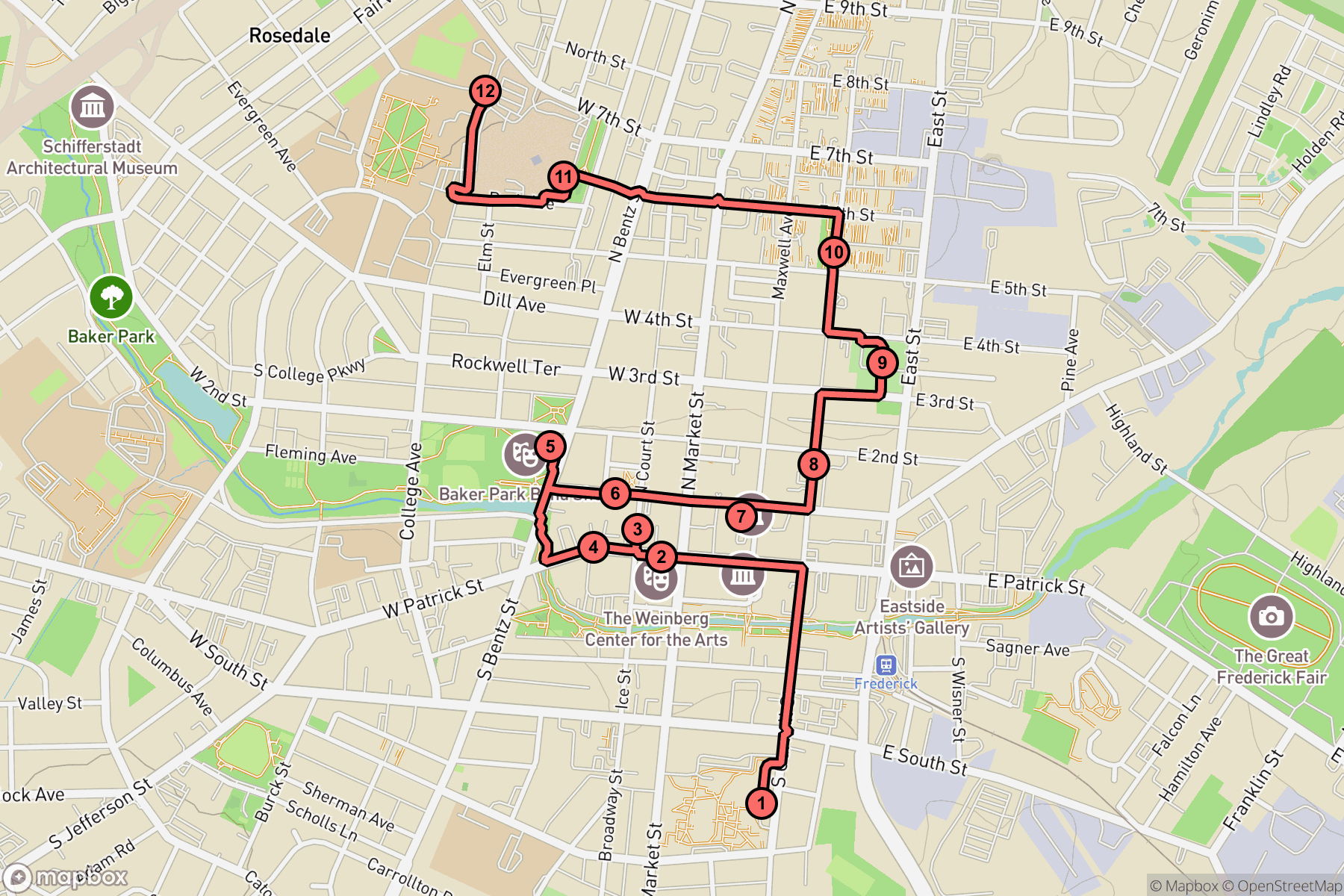
Tourvorschau
Über diese Tour
- scheduleDauer 40–60 minsEigenes Tempo
- straighten5.6 km FußwegDem geführten Pfad folgen
- location_onStandortFrederick, Vereinigte Staaten
- wifi_offFunktioniert offlineEinmal herunterladen, überall nutzen
- all_inclusiveLebenslanger ZugriffJederzeit wiederholen, für immer
- location_onStartet bei Loats Waisenhaus für Mädchen der Stadt Frederick
Stopps auf dieser Tour
To spot the Loats Female Orphan Asylum, look for a grand, pale brick mansion with three tall dormer windows peeking out from its red roof and elegant black shutters on each…Mehr lesenWeniger anzeigen
To spot the Loats Female Orphan Asylum, look for a grand, pale brick mansion with three tall dormer windows peeking out from its red roof and elegant black shutters on each window, right at the corner near a fire hydrant and a small tree. Now, take a moment to imagine the year is 1879: horses’ hooves clop along cobbled streets, and this massive brick house is bustling-not with the laughter of a family, but with the quiet footsteps of young orphaned girls. This place started as the home of Dr. John Baltzell, a local doctor with an eye for stately architecture; if you stand outside and admire the solid brickwork and the crisp symmetry, you can almost picture his patients nervously arriving for appointments in the small side addition used as his office. But the real twist arrives with John Loats, a railroad president with a heart as big as his fortune, who decided, in his will, that this house would become a safe haven for girls without families. Imagine the strong scent of fresh bread, the creak of these old stairs under busy feet, and the sense of secret adventure whenever the girls caught a glimpse of the passing trains-no WiFi, just pure imagination! These days, the only “hustle” inside is the Historical Society of Frederick County keeping stories alive instead of children, but if these bricks could talk, I bet they’d have enough secrets for a dozen lifetimes. It turns out even an orphanage can become one of history’s favorite hideouts!
Eigene Seite öffnen →To spot All Saints Church, just look ahead for a striking red-brick building with a super tall, pointy spire that seems to almost poke the sky; you can’t miss its grand arched…Mehr lesenWeniger anzeigen
To spot All Saints Church, just look ahead for a striking red-brick building with a super tall, pointy spire that seems to almost poke the sky; you can’t miss its grand arched doorway and the golden cross above the entrance. Welcome to the legendary All Saints Church-your introduction to what locals call Frederick’s “Clustered Spires!” Okay, take in this stunning brickwork and the tower that stretches up, up, up-if it went much higher, it might brush against a passing cloud! But let’s rewind the clock. Imagine, way back in 1742, Maryland’s General Assembly was getting creative with its churches, carving out All Saints Parish from the wild western reaches. Back then, Frederick was barely more than a patchwork of farmland, a place where the air was thick with the scent of fresh-cut wood and the sound of horse hooves. The church didn’t always stand exactly here. The first All Saints building, crafted in 1750, was about four blocks away-think of it as All Saints “version 1.0.” Frederick’s parish was rich, thanks to fertile land and a congregation that liked to donate. The third rector, Reverend Thomas Bacon, was so busy compiling Maryland’s laws that he hired a helper, which caused a bit of local grumbling. You know you’ve made it when the church gossips are keeping tabs on your side gigs! Now, if you hear echoes of a particularly rowdy Sunday, that’s possibly the ghost of Bennet Allen, who got literally locked out of the church by the vestry for... let’s just say, “creative job management.” He even climbed through a window to try to reclaim his spot! That’s commitment-or perhaps just a serious case of Sunday scaries. As Frederick grew in the 1800s, so did its need for a bigger church. Enter “All Saints 2.0” in 1814-thanks to church subscriptions, a lottery, and a dash of Palladian style. You might not see it from here, but the older building got a glow-up as the parish hall. The design details? Those fanlights, architraves with intricate wooden weaves, and high stuccoed pilasters-imagine how grand it must have looked when parishioners first gathered inside. But the drama was just getting started. In the mid-1800s, the parish ricocheted between worship styles and political debates-including heated arguments about slavery and even a future Confederate general at the pulpit! I wish the walls could talk... but actually, maybe it’s better they don’t, or we’d never get to the next stop. So why does All Saints look SO impressive today? That’s thanks to the 1856 Gothic Revival masterpiece in front of you, guided by Richard Upjohn’s plans-and built with a nave so long, the congregation could practically hold a marathon inside! The soaring bell tower and spire help make Frederick’s skyline famous. During the Civil War, with Reverend Marmaduke Dillon (yes, with that name he just had to be a Unionist), the church turned into a field hospital. You can almost hear the rattle of stretchers and low voices echo off the fieldstone foundation as wounded soldiers arrived from the fierce battles of South Mountain and Antietam. But after chaos came calm. Reverend Osbourne Ingle brought forty years of stability, and his family marked this church’s history in America… and all the way to China. Don’t forget to check out those windows-the ones above the quire glimmered their way here from Munich in 1910, the east windows sparkle in Tiffany style, and the western side reels you back to medieval days. Standing here, you’re in the shadow of centuries: the prayers of colonial settlers, the sighs of wounded soldiers, and even a few arguments that shook the rafters. Next time someone tells you Frederick is just famous for its clustered spires, you can let them know-inside every brick is a story waiting to ring out. And speaking of ringing, do you think the spire really does touch the sky, or is it just trying to eavesdrop on the next heavenly choir practice?
Eigene Seite öffnen →To spot the Frederick Armory, look for a sturdy-looking brown brick building with dramatic castle-like towers and flagpoles waving above its battlements-almost as if you're about…Mehr lesenWeniger anzeigen
To spot the Frederick Armory, look for a sturdy-looking brown brick building with dramatic castle-like towers and flagpoles waving above its battlements-almost as if you're about to storm a medieval fortress hiding in plain sight here in Frederick! Imagine standing here a hundred years ago-you’d probably hear the stomping boots and echoing shouts of young soldiers lining up for drills, their uniforms crisp, their nerves a mix of excitement and worry. Doesn’t this building look like it’s straight out of a knight’s tale? That’s no accident! The Frederick Armory was actually designed to copy the look of medieval fortresses with its tall crenelated towers and solid battlements. Instead of fending off dragons or bandits, it helped protect the town by serving the Maryland National Guard. Its thick brick walls and imposing entrance were built to withstand trouble, but don’t worry-no boiling oil or drawbridges here! Over the years, the biggest battles fought inside might have been fierce basketball games or lively town meetings, because the armory now buzzes with laughter and energy as a city recreation center. It’s a proud reminder of Frederick’s past-serious when it needed to be, but full of new life now. And if those old towers could talk, I bet they'd have quite a few tall tales to tell!
Eigene Seite öffnen →
9 weitere Stationen anzeigenWeniger Stationen anzeigenexpand_moreexpand_less
Look ahead for a simple, tan-brick building with a steep, shingled roof and a small sign near the door reading “Kol Ami”-it’s right where the ramp meets the wall, tucked behind…Mehr lesenWeniger anzeigen
Look ahead for a simple, tan-brick building with a steep, shingled roof and a small sign near the door reading “Kol Ami”-it’s right where the ramp meets the wall, tucked behind tidy bushes. Alright, step closer and imagine you’re walking into a story that’s still being written! Congregation Kol Ami of Frederick began back in 2003-not in a grand, old building, but with just eight families, buckets of hope, and maybe a few folding chairs that wobbled more than they should have. These folks didn’t even have their own synagogue! So, they gathered inside the Unitarian-Universalist church, sharing space, laughter, and the occasional “Wait, which room are we in this week?” Picture those early days: families arriving with armfuls of food for Shabbat, little kids racing each other through the hallways, someone waving a borrowed Torah with the care you’d give your grandma’s best china. In 2005, they hired Daniel Sikowitz as their trainee rabbi-a fellow with perhaps more energy than experience. But hey, sometimes enthusiasm is the secret ingredient! That same year, Kol Ami opened their religious school and joined the larger Jewish Reform world, which meant more folks, more bagels, and even more stories to share. Then came a moment that would add real drama for any history buff: the quest for their very own Torah. And not just any scroll, but one said to be rescued from the ashes of war-torn Lviv, Ukraine-a Torah that had supposedly survived Nazis, monasteries, and enough close calls to fill a spy novel. But, ah, here’s the mystery: the scroll’s dramatic past unraveled under investigation. Turns out, the man who sold them this Torah, Rabbi Youlus, was more of a storyteller than a treasure hunter. His wild tales didn’t match the truth and, after some serious detective work, he was found guilty of fraud. Now that’s a plot twist you don’t see coming in most religious classrooms! Yet, even through all the ups, downs, and Torah mix-ups, Kol Ami stood strong. Today, you’re standing at a spot filled with warmth-the sound of children’s laughter, the buzz of social action projects, and a community that says, “Even if our building’s borrowed, our spirit is all our own.” Talk about heart, history, and a touch of adventure!
Eigene Seite öffnen →To spot the Frederick Historic District, just look up and ahead for the tall, white steeple with a big black clock face and gold-topped spire-it stands high above the nearby brick…Mehr lesenWeniger anzeigen
To spot the Frederick Historic District, just look up and ahead for the tall, white steeple with a big black clock face and gold-topped spire-it stands high above the nearby brick buildings, almost like Frederick’s way of pointing the direction for your adventure! Welcome to the heart of Frederick’s story! You’re standing where centuries of footsteps have echoed before you-merchants, ministers, mayors, and maybe even a mischievous teenager or two sneaking out past curfew. The Frederick Historic District is a treasure chest of architectural wonders, from grand old Queen Anne homes with fancy trim to sturdy American Foursquare houses that look ready to host a family dinner-or maybe a secret mystery meeting. Can you feel the tickle of the past in the air as you stroll past the soaring church steeples? Gothic arches and Romanesque stonework stand side by side, as if having a friendly debate about whose style is the fanciest. On the east side, you might catch a whiff of history that smells a bit like old gears and smokestacks-that’s where the city’s industrial soul once clattered and hummed. This place was buzzing from the late 1700s right up to the 1940s, and every cobblestone and window has a tale to tell. Officially recognized in 1973 and even expanded in 1988, the district keeps its secrets close, but if you listen carefully, you might just hear whispers from the past inviting you to explore further!
Eigene Seite öffnen →You’ll spot the Weinberg Center by its grand old-fashioned marquee sign and elegant brick façade right ahead-just look for the building that looks like a glamorous theater…Mehr lesenWeniger anzeigen
You’ll spot the Weinberg Center by its grand old-fashioned marquee sign and elegant brick façade right ahead-just look for the building that looks like a glamorous theater straight out of a black-and-white movie. Now pause for a moment and imagine yourself back in 1926. The streets are bustling, and right here stands the sparkling new Tivoli Theatre, turning heads with its dazzling lights and whispers of Hollywood glamour. Everyone wanted a seat for the opening night-Frederick had never seen anything so lavish! For almost fifty years, the Tivoli was the city’s premiere place for movies and events. If these walls could talk, they’d tell tales of laughter, tears, and popcorn thrown in excitement. But in 1976, disaster struck-floodwaters stormed in and nearly claimed the old theater, leaving the city’s beloved movie palace waterlogged and shuttered. There was a dramatic pause: Would the Tivoli curtain fall for good? But just in the nick of time, the Weinberg family, who owned the place, gave it to the city as a gift. Cue the heroic music! Today, the Weinberg Center shines once more, hosting everything from wild concerts to elegant weddings. And if you’re lucky, you might even hear the original 1926 Wurlitzer organ-the only one still in its original spot in Maryland-filling the air with music, just like it did nearly a hundred years ago. Now, that’s what I call a standing ovation in history!
Eigene Seite öffnen →Look for a large, L-shaped two-story stone building with long wooden porches and a sloped roof-just ahead and to your right, you’ll see it proudly flying the American flag. Now,…Mehr lesenWeniger anzeigen
Look for a large, L-shaped two-story stone building with long wooden porches and a sloped roof-just ahead and to your right, you’ll see it proudly flying the American flag. Now, as you stand here at the Hessian Barracks, let me whisk you back to the summer of 1777-imagine the ground buzzing with construction, the clatter of hammers echoing through the warm Maryland air. This striking stone fortress was built to hold British and German prisoners of war during the American Revolution, and I bet those Hessians never expected such a lengthy stay in Frederick! If these old stone walls could talk, what stories they’d tell: from the thick smell of gunpowder when it was a state armory, to the strange quiet of silk worms munching on mulberry leaves when the place was briefly a silkworm farm. Fast forward to the chaos after the Battle of South Mountain and Antietam, and you’d hear the moans of wounded soldiers as the barracks became a military hospital. Later, children from the new Maryland School for the Deaf filled the area with laughter, as the west wing made way for a Victorian school. Through every twist and turn, this sturdy old building has stood as a witness to hope, hardship, and-of course-some rather interesting city planning decisions!
Eigene Seite öffnen →To spot St. John the Evangelist Catholic Church, just look ahead for the tall, cream-colored building with classic columns and a broad pediment displaying carved figures, crowned…Mehr lesenWeniger anzeigen
To spot St. John the Evangelist Catholic Church, just look ahead for the tall, cream-colored building with classic columns and a broad pediment displaying carved figures, crowned by a golden cupola and a cross soaring above the city skyline. Now, step a little closer and imagine yourself standing right here... Not too far back in time, this very spot would’ve been abuzz with whispers and nervous glances! Back in 1763, Maryland’s Catholics couldn’t exactly put up a neon “church open!” sign, thanks to strict British laws that banned open worship. Instead, the first local Catholics squeezed into a brick house nearby, quietly gathering, hoping no one would peek in. Time marched on, those pesky laws loosened, and Catholics could finally put away their “incognito” disguises. In the early 1800s, a new church sprouted up on these grounds, led by Reverend John DuBois-whose cornerstone, believe it or not, was lost and rediscovered like a hidden time capsule in 1904! Today, you’ll find it right at the doorway, waiting to greet you. By 1837, under Rev. John McElroy, this grand Greek Revival beauty rose like a giant’s birthday cake, becoming-drum roll please-the biggest parish church in the whole United States and the first Catholic church ever consecrated in the Diocese of Baltimore. That’s quite a claim to fame for Frederick, don’t you think? Take a slow look up: those stately columns with Ionic tops, the symmetrical grandeur, and high atop, a powerful relief of St. John with his eagle buddy and an angel-probably pondering if Baltimore’s crab cakes really are the best. The church stretches 104 feet long and its bell tower, built in 1857, shoots up 145 feet-making it, officially, the tallest thing in Frederick. But let’s not forget when the church moonlighted during the Civil War-not as a choir hall or concert space, but as a jail for captured Confederate soldiers! Imagine hushed voices echoing under the marble arches, an unlikely peace settling over sturdy pews now holding far more than parishioners. The inside is just as stunning. You’d find paintings fit for a gallery: the Ascension of Jesus, painted on the ceiling for the 75th birthday of this proud building, and a Crucifixion scene by Pietro Gagliardi. The high altar gleams with both Egyptian and Italian marble, and each window is crowned by St. John, keeping a heavenly eye on things. The Stations of the Cross here? A special gift, straight from Bishop Byrne of Little Rock. For centuries, this place has seen joy, risk, secrecy, and celebration-all beneath that grand gold-capped spire. As you stand here, imagine the echoes of footsteps past, the whispered prayers, and the chime of the city’s tallest bell, all stories layered into the very stones. Frederick just wouldn’t be Frederick without it!
Eigene Seite öffnen →To spot St. John’s Cemetery, look for the old-fashioned wrought iron gate topped with a gold cross, set between pillars of red brick and stone, with rows of gravestones just…Mehr lesenWeniger anzeigen
To spot St. John’s Cemetery, look for the old-fashioned wrought iron gate topped with a gold cross, set between pillars of red brick and stone, with rows of gravestones just beyond in the green grass. Now, take a moment to listen as you stand at the entrance to one of Frederick’s most storied and intriguing places-St. John’s Cemetery. Imagine the gentle creak of that iron gate swinging open, inviting you to step into a patchwork of history, mystery, and tales of triumph and tragedy. Let’s start at the very beginning: before “St. John’s Cemetery” was even a thought, these grounds cradled the resting place of Henry, a free black man who died of cholera in 1832. Back then, Frederick was a patchwork of hope and hardship, and these very grounds bore witness to the community’s first quiet acts of laying someone to rest. Fast forward to 1845 and the official founding of St. John’s Cemetery, and you’ve got yourself a prime ticket to a who’s-who of Frederick’s past-everyone from refugees to revolutionaries decided this was where their stories would end (and maybe begin again in whispers). Walk a little further, and you might imagine the distant accents of French aristocrats-yep, you heard me right, sacrés bleus! French families fleeing the chaos of the St. Domingue Slave Revolt in 1791 journeyed all the way to Frederick, probably after stopping for some Charleston grits. The Bellumeau de la Vincendière family, for instance, got so attached to Frederick they chose these soils for their family plot. Etienne, the patriarch, is here, resting with his wife Marguerite, their daughters, and even Enoch Louis Lowe, who later became Maryland’s 29th Governor. Now-here’s a plot twist-Etienne’s brother, Jean Payen de Boisneuf, helped make the decision to send Marie Antoinette to the guillotine. Imagine all the “family reunions” going on under your very feet! But that’s just the French flavor. There are also soldiers here who definitely earned some epic battle scars: veterans from the French and Indian War, the Revolutionary War, the War of 1812, both the Union and Confederate sides of the Civil War (talk about awkward neighbors!), and heroes of world wars right up through Vietnam. A sprinkle of mystery lingers over the cemetery too. In 1998, ten Union soldiers, forgotten for 138 years in unmarked graves, finally received the recognition they deserved, thanks to the stubborn determination of local funeral director and amateur historian Keith Roberson. You can almost picture him poring over dusty records, determined to let no hero be forgotten. Their new headstones now stand proudly in the grass. And right in the heart is the St. John’s Cemetery Chapel, a humble structure that’s had more glow-ups than a reality TV star. Once just a storage shed, it’s now a pocket-sized sanctuary with a flagstone courtyard and benches perfect for pondering eternity-or just enjoying a quiet moment. There’s a small iron cross above the door, once marking the grave of an unknown Union soldier. The entrance swings wide with old gates salvaged from Fourth Street, and, stepping in, you’d notice a ceiling of yellow pine and exposed rafters that smell faintly of wood and history. The altar, lovingly crafted by a local artist, supports a crucifix that hung above the entrance-a continual watcher of the comings and goings among the stones. But wait, there’s more: long before the cemetery even got its own gates, the Jesuits set up a little graveyard back in 1805. When that novitiate on East Second Street closed a century later, 79 Jesuits and some notable figures-including Chief Justice Roger Brooke Taney-were relocated right here. Let’s not forget the town celebrities: senators, governors, architects, electricity pioneers, and an Army chaplain who founded Boston College all rest here, gazing skyward from their very own slices of Frederick’s earth. So, whether you’re looking for ghosts, heroes, or just a quiet spot to practice your best Sherlock Holmes impression, St. John’s Cemetery always has another story waiting under the next stone. Eager to learn more about the st. john’s cemetery chapel, jesuit novitiate cemetery or the notable burials? Simply drop your inquiries in the chat section and I'll provide the details you need.
Eigene Seite öffnen →Now, close your eyes for a moment and imagine Frederick in the mid-1800s. The cobbled streets were alive with people, and for the free Black community here, hope was found through…Mehr lesenWeniger anzeigen
Now, close your eyes for a moment and imagine Frederick in the mid-1800s. The cobbled streets were alive with people, and for the free Black community here, hope was found through unity. In 1837, a group known as the Laboring Sons Beneficial Society was founded by free and enslaved Black members of Frederick. Their goal? To lift their community “spiritually and temporally”-basically, to help each other out and, when the time came, to see that everyone was laid to rest with dignity. Not a small mission in the 19th century! By 1851, these men and women pooled their resources and bought this very patch of ground-1.17 acres, for $265, which, by today’s standards, wouldn’t even get you a month of rent in downtown Frederick. They turned it into a cemetery because at the time, there were hardly any places where Black people could be buried respectfully in the city. Plots were carefully measured, white marble cornerstones were placed, and a little hillside in the middle soon became the resting place for generations. As the decades wore on, the society went through its own share of drama and divisions. In 1862, about half the members broke away to form the Workingmen’s Society. But still, the grounds remained-buying plots, selling some to support the society’s work, and providing solace to grieving families. Fast forward to the late 1940s. Time had taken its toll, leaving the cemetery overgrown and forgotten. You can almost hear the whisper of the wind through tall grasses, and maybe the rustle of a forgotten headstone settling into the earth. By 1949, about 1,500 souls were buried here, but the city saw less connection to its history and much more to weeds and neglect. The Laboring Sons’ last caretakers had moved away or passed on, and the city offered to take over with promises to preserve the space. Promises, however, are sometimes easier to make than to keep. Instead of restoration, city workers removed gravestones, buried them under a fresh layer of blacktop, put up swings and basketball hoops, and-believe it or not-called it a whites-only park. The echoes of laughter on the playground must have been an eerie contrast to the silent stories below. The city even stopped making a full list of the deceased after only 161 names. For decades, the original purpose of this land faded from memory. But history loves a good mystery, and in the 1990s, it was rediscovered almost by accident. Jackie Berry, tracing her great-great-uncle’s burial records, noticed something curious-his death certificate said Laboring Sons Cemetery, but no one seemed to know where that was. Through her research, and with a little help from some old maps (and a lot of determined folks), the truth came out. This was no ordinary playground; it was sacred ground, layered with the history of Black Frederick. The city, after some soul-searching and urging from community activists, finally decided to make amends. In 2000, there was a unanimous vote to transform the land back into a place of memory and honor. That meant peeling up the asphalt, removing the playground equipment, and turning back time as best they could. They brought in archaeologists to find the lost burial shafts and painstakingly researched each name they could. By 2003, after obstacles, discoveries (including, yes, more bodies), and a whole lot of hard work, the site was rededicated as the Laboring Sons Memorial Grounds. A new granite monument stands in the center hill, listing 117 names that could be identified and sharing the story with everyone who walks these paths. Benches and winding sidewalks were laid thoughtfully, making sure they wouldn’t disturb those still at rest below. Today, these 1.17 acres are at last a place of peace-surrounded by sidewalks, the hum of the city, and the knowledge that, even if history tries to hide, someone, somewhere, will always uncover the truth. As you walk these grounds and read these names, remember: It’s sometimes the quietest places that hold the loudest stories. And who knows-maybe you’ll be the next detective to uncover a Frederick mystery.
Eigene Seite öffnen →Take a look up at Frederick Health Hospital, standing proud and tall as the only hospital in all of Frederick County. If you listen closely, maybe you can hear the beeps and…Mehr lesenWeniger anzeigen
Take a look up at Frederick Health Hospital, standing proud and tall as the only hospital in all of Frederick County. If you listen closely, maybe you can hear the beeps and bustling footsteps inside-it's a place where hopes are mended, babies are born, and the occasional hospital drama plays out (and not just on TV, I promise!). The hospital has been here for generations, caring for the whole community. Imagine doctors racing through the halls, nurses cracking a caring smile, and families anxiously waiting for good news. Now, here’s a twist worthy of a movie. In January 2025, this very hospital faced a high-tech villain: a ransomware attack! Suddenly, computers were frozen, alarms blared, and everyone had to act fast. The ever-capable president and CEO, Tom Kleinhanzl-think of him as Frederick’s health superhero-had to spring into action. It was tense, but the whole staff pulled together, working around the digital chaos to keep everyone safe. As if that wasn’t dramatic enough, lawsuits started flying after, and those are still being sorted out. It’s a modern reminder that even places built for healing aren’t immune to a little mystery and mayhem. You’d almost expect to see someone in a cape dashing out the doors, but around here, superpowers come in the form of stethoscopes and community spirit!
Eigene Seite öffnen →Well, look at you-you’ve made it to the big finale, the Woodsboro Bank Arena! Take a good look at this modern sports palace. Picture the thump of basketballs, the shrill of…Mehr lesenWeniger anzeigen
Well, look at you-you’ve made it to the big finale, the Woodsboro Bank Arena! Take a good look at this modern sports palace. Picture the thump of basketballs, the shrill of sneakers on polished wood, and cheers bouncing off the seats-yes, all 1,600 of them, with room for 500 more on the floor if there’s a serious game-night crowd. You’re standing where college basketball dreams and volleyball victories play out on Hood College’s campus. Since 2011, after some serious building magic by Warner Construction and Zavos Architecture, this arena has been the stomping ground for Hood’s basketball and volleyball teams. And, if you hear a wild moo, don’t worry-it’s just the Frederick Flying Cows, the hometown pros from The Basketball League. No joke-they really are called the Flying Cows! Originally, people called this place BB&T Arena, but in April 2024, they decided the arena needed a new jersey. Thanks to a five-year partnership, it’s now the Woodsboro Bank Arena-new name, same electrifying energy. You can almost feel the anticipation of a close game or the nerves of a final serve. Just imagine the floodlights, the smell of popcorn, and the sound of whistles as fans ride the roller coaster of every point and play. Quite a transformation for what started as just a plot of land not so long ago! Soak it in-you’re standing where sports legends of Frederick are made.
Eigene Seite öffnen →
Häufig gestellte Fragen
Wie starte ich die Tour?
Laden Sie nach dem Kauf die AudaTours-App herunter und geben Sie Ihren Einlösecode ein. Die Tour ist sofort startbereit – tippen Sie einfach auf „Play“ und folgen Sie der GPS-geführten Route.
Benötige ich während der Tour Internet?
Nein! Laden Sie die Tour vor dem Start herunter und genießen Sie sie vollständig offline. Nur die Chat-Funktion benötigt Internet. Wir empfehlen den Download über WLAN, um mobiles Datenvolumen zu sparen.
Handelt es sich um eine geführte Gruppentour?
Nein – dies ist ein selbstgeführter Audioguide. Sie erkunden unabhängig in Ihrem eigenen Tempo, wobei die Audioerzählung über Ihr Telefon abgespielt wird. Kein Reiseleiter, keine Gruppe, kein Zeitplan.
Wie lange dauert die Tour?
Die meisten Touren dauern 60–90 Minuten, aber Sie kontrollieren das Tempo vollständig. Pausieren Sie, überspringen Sie Stopps oder machen Sie Pausen, wann immer Sie wollen.
Was, wenn ich die Tour heute nicht beenden kann?
Kein Problem! Touren haben lebenslangen Zugriff. Pausieren Sie und setzen Sie sie fort, wann immer Sie möchten – morgen, nächste Woche oder nächstes Jahr. Ihr Fortschritt wird gespeichert.
Welche Sprachen sind verfügbar?
Alle Touren sind in über 50 Sprachen verfügbar. Wählen Sie Ihre bevorzugte Sprache beim Einlösen Ihres Codes. Hinweis: Die Sprache kann nach der Tour-Generierung nicht mehr geändert werden.
Wo greife ich nach dem Kauf auf die Tour zu?
Laden Sie die kostenlose AudaTours-App aus dem App Store oder von Google Play herunter. Geben Sie Ihren Einlösecode (per E-Mail gesendet) ein, und die Tour erscheint in Ihrer Bibliothek, bereit zum Download und Start.
Wenn Ihnen die Tour nicht gefällt, erstatten wir Ihnen den Kaufpreis. Kontaktieren Sie uns unter [email protected]
Sicher bezahlen mit 


