
London Audio-Tour: Bühnen-, Stahl- & Flusswege-Pfad
Ein Theater, das aus einer Wagnerwerkstatt entstand, eine Kirche, die dort emporragt, wo einst Gefangene ihre Ketten rasselten, und ein Markt, der niemals schläft – Stratford birgt mehr Geheimnisse, als seine gläserne Skyline vermuten lässt. Begeben Sie sich auf eine selbstgeführte Audio-Tour durch das schlagende Herz von Newham, schlängeln Sie sich zwischen Ikonen und unterschätzten Ecken hindurch, um Geschichten zu entdecken, die dem typischen Besucher entgehen. Warum bedrohte ein einfacher Satz Initialen die Existenz des Theatre Royal Stratford East? Welche Mitternachtsechos spuken in der Krypta von St. John unter all den Hymnen und Gitarren? Und was genau geschieht im Stratford Centre, wenn der letzte Laden für die Nacht schließt? Wandeln Sie im Schatten von Rebellion, Überleben und unaufhaltsamer Neuerfindung. Bewegen Sie sich von großen Bühnen zu versteckten Friedhöfen und leuchtenden Märkten und verfolgen Sie Momente, die die Geschichte Londons Block für Block neu schrieben. Bereit, tiefer einzutauchen und Stratford bei jeder Wendung mit neuem Leben pulsieren zu sehen? Beginnen Sie jetzt – die unerzählten Geschichten der Stadt warten direkt unter Ihren Füßen.
Tourvorschau
Über diese Tour
- scheduleDauer 40–60 minsEigenes Tempo
- straighten4.8 km FußwegDem geführten Pfad folgen
- location_onStandortLondon, Vereinigtes Königreich
- wifi_offFunktioniert offlineEinmal herunterladen, überall nutzen
- all_inclusiveLebenslanger ZugriffJederzeit wiederholen, für immer
- location_onStartet bei Theatre Royal Stratford East
Stopps auf dieser Tour
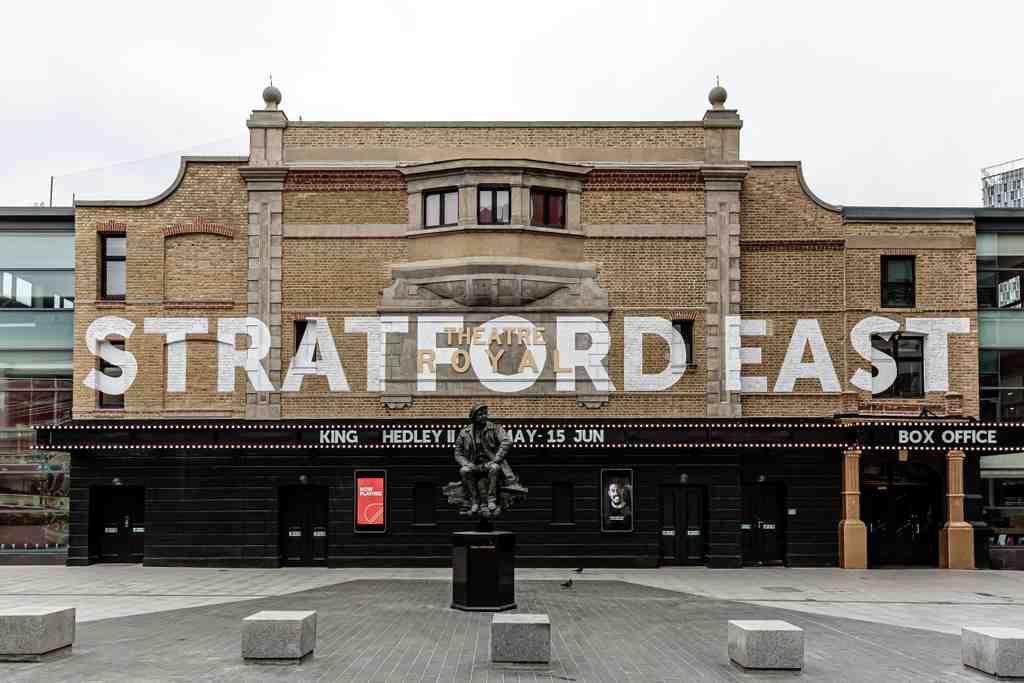
To spot the Theatre Royal Stratford East, look for a big old brick building with the words “STRATFORD EAST” painted in huge white letters across the front, and a statue sitting…Mehr lesenWeniger anzeigen
To spot the Theatre Royal Stratford East, look for a big old brick building with the words “STRATFORD EAST” painted in huge white letters across the front, and a statue sitting just in front of the entrance. Welcome! As you stand here, take in the warm honey-coloured bricks of this grand Victorian theatre, proudly displaying its name across the facade, with a friendly figure keeping watch on the square-that’s the legendary director Joan Littlewood in bronze, still looking for the next big star. Imagine it’s 1884: the bustle of carriages and the chatter of market stalls fills Salway Road, while workers pound and saw away, transforming what was once a humble wheelwright’s workshop into a glittering palace for drama. Designed by the little-known architect James George Buckle (this is his only surviving piece of theatre magic!), the building has witnessed over a century of East End stories, laughter, and a fair bit of backstage chaos. The Theatre opened its doors one frosty December night in 1884 with Richelieu blazing across the stage, lights flickering and the sound of applause echoing through the new auditorium. In its earliest years, the building changed hands-one owner even added extensions for all those variety and vaudeville acts. Fun fact: the letters “FF” still sit perched up above the proscenium arch as a superstitious nod to the Fredericks family, who ran the place; legend has it that if those letters are ever taken down, the whole theatre will crumble into dust. Not a risk worth taking, I think! But it wasn’t all smooth sailing. In 1921, disaster struck-smoke curled into the midnight air when a fire tore through the back of the stage after a Bank Holiday performance. Miraculously, the safety curtain was down, so the grand old auditorium survived. After repairs, the Fredericks family hung on a little longer, but by the 1930s, the theatre went through a moody phase-financial troubles meant long, lonely stretches when the building sat silent except for the occasional ghost story. I suppose every theatre needs a good ghost, right? Then there came Joan Littlewood and her Theatre Workshop, swooping in with a crew of energetic actors in 1953. Suddenly, Theatre Royal was breathing again-filling with working-class tales, new musicals, and the laughter of folks who'd never even dreamed of a night out at “the theatre.” Littlewood’s productions like Oh, What a Lovely War! and A Taste of Honey made this place famous-she even gave a young Michael Caine the rather blunt advice to “P*ss off to Shaftesbury Avenue, you’ll only ever be a star!” (And that prediction turned out alright!) But the road was bumpy: the building nearly disappeared under a shopping centre in the 1970s until a band of local heroes saved it-earning the theatre a Grade II* listing. Over the decades, the stage has seen everything from classic pantos to pioneering Black British musicals like The Big Life, which took the West End by storm. The reggae-fueled hit The Harder They Come had the whole building swaying in time. Despite money troubles and political debates (like the recent ‘Black out’ nights that sparked citywide conversation), the heart of Stratford East beats on. Recent directors have brought fresh voices and vibrant stories to the stage-from bold modern dramas to community shows, this is a building that truly belongs to its people. So as you stand outside, imagine the thunder of a big West End hit, the quiet nerves before opening night, the scent of paint and dust backstage, and the echoing footsteps of famous actors-and not-so-famous ones-heading towards their big moment. You’re at the first stop on a journey where everyone really can have a seat in the stalls. Now, who’s ready for Act Two? Let's keep walking!
Eigene Seite öffnen →To spot St John's Church, glance up to see a tall grey brick building topped with a dramatic spire and flying buttresses, standing right on Stratford Broadway and framed by leafy…Mehr lesenWeniger anzeigen
To spot St John's Church, glance up to see a tall grey brick building topped with a dramatic spire and flying buttresses, standing right on Stratford Broadway and framed by leafy trees on either side. Now let’s step back in time-right where you stand, imagine the clanking of iron bars and the echoing footsteps of prisoners, because before St John’s Church graced this spot, there was a ‘Forest Prison.’ Back in the 17th century, wrongdoers against the mighty Royal Forest of Waltham (today’s Epping Forest) were locked away here, listening not to church bells, but guard’s keys rattling! The prison finally gave way to higher hopes in 1832, and Edward Blore-who definitely never spent a night behind bars-built this church using strong grey brick in a style fit for kings and queens. Look up at that epic three-stage tower with its clock; the flying buttresses hold up the sharp spire so confidently, it’s almost showing off. But here’s a secret: St John’s was made because the old All Saints West Ham was just too far for locals, so this chapel came to the rescue-no marathon Sunday walks here! Over the years, St John’s became a place where big and small stories unfolded: Baby Gerard Manley Hopkins, who grew up to be a famous poet, was baptized here in 1844. And the churchyard? That’s where naturalist Antonio Brady rests in peace, with a special extension built just for him. Oh-and if you’re feeling brave, check out the memorial to the Stratford Martyrs, adding a whiff of mystery to the peaceful grounds. During WWII, as bombs howled through London, locals squeezed into the crypt to shelter. Imagine the tension, the hush, the distant thunder above. Yet after the war, the church stood firm. In a twist of modern history, from 1988 to 1994, the crypt rocked with the music of Bark Psychosis-yes, a post-rock band practiced right down there, just above the ghosts of prisoners and prayers whispered in the dark. From fierce forest laws to gentle hymns and the thunder of guitars, this spot is packed with drama-makes you wonder what the walls would say if they could talk, right? Now, are you ready to move on or would you like to soak in just a bit more holy rock history?
Eigene Seite öffnen →
9 weitere Stationen anzeigenWeniger Stationen anzeigenexpand_moreexpand_less
To spot the County Borough of West Ham, look for the grand old stone building with tall arched windows, a flag flying out front, and a striking domed tower rising above the…Mehr lesenWeniger anzeigen
To spot the County Borough of West Ham, look for the grand old stone building with tall arched windows, a flag flying out front, and a striking domed tower rising above the street-just ahead of you, standing proudly on the corner. Here you are, standing in front of a building that’s more than bricks and mortar-it’s the centrepiece of a wild and wonderful chapter in London’s history. Imagine, if you will, a chilly morning in 1886. The streets are alive with the hammering of factory machinery, the rattle of carts, and the steady buzz of a growing Victorian town-West Ham, or as it was often nicknamed, “London over the border.” Back then, this area pulled in people from all over, drawn by jobs in the booming factories, churning out pharmaceuticals, chemicals, and food. This might sound quite industrious, but trust me, the marshy grounds weren’t always sweet-smelling-thanks to the Victorian habit of moving all the smelly, dangerous industries out of central London and right over here! West Ham started off as part of Essex, balanced right at the edge of London, with the River Thames to its south and the River Lea to the west. The surrounding area grew so quickly that by the 1901 census, it was the ninth most populous spot in all of England, home to more than a quarter of a million people. You could say it was the hotspot of the industrial revolution-if by hotspot you mean factories springing up everywhere and neighborhoods popping up so fast the map-makers almost gave up. But as the factories flourished, so did the problems. Imagine crowded houses, poor plumbing, and outbreaks of illness sweeping through the muddy streets. A group of determined local residents thought, “Enough is enough!” and took matters into their own hands. These folks pushed for change, and soon a medical officer named Alfred Dickens-yes, the brother of the famous Charles Dickens-showed up to investigate the grim living conditions. His 1855 report was more damning than a rainy London afternoon, leading to a fresh start: new health boards, better water supply, paved streets, and even a fire brigade. By 1886, local pride ran deep, and so did the desire for independence. The people here wanted nothing to do with being swallowed up by London’s government. Instead, they fought for-and won-their own charter, electing their very first mayor, John Meeson. He was a local lime-burning and cement-making man, and I dare say, probably always had dust on his coat and a strong handshake. Later on, Daisy Parsons would make history as West Ham’s first woman mayor in 1937, bringing a fresh voice (and probably some much-needed sense) to the job. West Ham’s council grew fast-new wards popped up like mushrooms after rain, each one with its own lively characters and tales. The area also ran its own trams, which clanged along the streets, first pulled by horses, later powered by electricity. At their peak, these rattling cars zipped across more than 16 miles of tracks, making sure every corner of West Ham could hear their cheerful bells. And the politics! After the famous London Dock Strike in 1889, Labour Party councillors made their way into local government, squaring up against a Municipal Alliance who wanted to keep things old-fashioned. For decades, the council’s chambers rang with the debate: progress or tradition, change or comfort? Labour eventually held on to power for good after the First World War, but not before more than a few spirited arguments and dramatic council meetings. Take a good look at the building’s coat of arms if you can spot it-the crossed hammers represent the mighty Thames Ironworks, and the ship speaks to West Ham’s connection to London’s docks. The Latin words below, “Deo Confidimus,” mean “In God We Trust”-probably a handy phrase on days when the river threatened to flood or the factories belched out a new smell. By 1965, a new chapter began. West Ham’s days as a county borough ended, as it was swept into the newly formed London Borough of Newham. Yet, whenever you pass this grand old building, you get a sense of all those bustling factories, smoky skies, and the voices of a community that cherished its independence-and always managed to stand out in the great story of London. For a more comprehensive understanding of the area and boundaries, predecessors or the incorporation, engage with me in the chat section below.
Eigene Seite öffnen →Look ahead for big white, tent-like canopies stretching overhead and a crowd of red London buses lining up in a neat row just under them - that’s the Stratford Bus Station right…Mehr lesenWeniger anzeigen
Look ahead for big white, tent-like canopies stretching overhead and a crowd of red London buses lining up in a neat row just under them - that’s the Stratford Bus Station right in front of you! Picture this: it’s the early 1990s, and this very spot was once the ground floor of a rumbling old multi-storey car park - not quite the glamorous welcome to Stratford we know today! Enter Soji Abass, a clever London Transport architect, who had a vision for a brighter, airier place for buses and busy Londoners. With a touch of swagger and maybe a few pots of tea, his team whipped up this futuristic bus station with five sleek stands, all under these unusual, sail-like roofs that seem ready to launch into the London skies. It opened its doors on a chilly November day in 1994, goodbye grumpy old car park, hello transport hub of the future! Now, with over 20 million passengers a year (imagine if everyone brought their pet hamster-that’s a lot of hamsters!), Stratford Bus Station is a buzzing hive, connecting folks to all corners of London, day and night. And speaking of night, the next time you see one of those red buses heading off into the dark, just imagine where that adventure might lead! Where would you be off to, if you could board any bus right now?
Eigene Seite öffnen →To spot the Carpenters Estate, just look ahead for the cluster of brown and white low-rise housing mixed with three tall tower blocks rising above them-it's an unmistakable slice…Mehr lesenWeniger anzeigen
To spot the Carpenters Estate, just look ahead for the cluster of brown and white low-rise housing mixed with three tall tower blocks rising above them-it's an unmistakable slice of classic London sky. Welcome to the Carpenters Estate! Right in front of you is an entire chapter of East London’s history, full of more ups and downs than a ride on the London Eye. Imagine the late 1800s: there’s nothing here but farmland, the air fresh and open. Suddenly, the industrious Carpenters’ Company swoops in, buying land so that factories can spring up along the River Lea and around the thunderous new railroads. If you’d been standing here at that time, instead of tower blocks and car parks, all you’d see is a patchwork of fields and new construction-maybe even a carpenter or two with a saw and a dream! As the factories fired up, Victorian terraced houses appeared, spreading across Carpenters Road and into Stratford. The Company didn’t just put people to work; they built schools, a social club, and a community with laughter and hard graft echoing through these very streets. Imagine: horses clopping down the cobblestones, children’s shouts on the way to school, and the low hum of industry in the air. But things weren’t always so peaceful. When the Second World War hit, Stratford found itself right in the path of air raids. By war’s end, much of the original Carpenters Estate had been destroyed or left in ruins-a ghost town of broken windows and hope waiting to be rebuilt. The 1960s brought a fresh start: three new tower blocks-James Riley Point, Lund Point, and Dennison Point-rose up, joining rows of modest homes on Doran Walk. The estate wasn’t just buildings; it had a school, a college, businesses, and a sense of community like a shared cup of tea. Yet, trouble lurked beneath the bricks. For decades, people wondered if Carpenters Estate would be mended, demolished, or transformed. By 2004, the council reckoned it needed a whopping £25 million per tower just to modernize. James Riley Point’s residents were moved out, but the rest of the work stalled, falling into the “tomorrow” pile. With London’s Olympic dreams swirling in 2012, the estate found itself in another spotlight. Grand ideas came and went-like University College London nearly building a new campus here-yet the future felt wobbly as a jelly on a bus ride. All that change left many of the homes empty by the time the Olympic flame blazed nearby. And then came 2013, when a group of determined young mothers, facing eviction themselves, banded together as Focus E15, demanding proper housing for families. They made headlines by camping out in the empty flats right in this estate, transforming one block into a buzzing social centre. The estate wasn’t just in the news now-it was a battleground. The council eventually asked them to leave, but the fight wasn’t over, with Focus E15 challenging the council at every corner, always fighting for a fairer future. Throughout it all, the Carpenters Estate stayed in people’s hearts-and in pop culture too! Pieces of science-fiction film “Attack the Block” and the thriller “The Capture” were shot right here, giving the estate a bit of silver-screen magic. And in 2018, Funky DL, a music producer who grew up in Dennison Point, dropped an album all about life here. Even the local theatre scene couldn’t resist: a production called “Legacy” told the tale of a family defying eviction, their story echoing the real struggles of residents. The estate has witnessed laughter, loss, resistance, and resilience-so when you look around, you’re not just seeing some buildings; you’re standing in the middle of a living, breathing story. Now, with new regeneration plans aiming for at least half of all homes to be affordable, the story isn’t over-it’s just turning the page. As you walk away, listen closely; perhaps the walls whisper tales of old factories, the clatter of children’s shoes, or the rising cheer of community voices demanding to be heard.
Eigene Seite öffnen →The London Stadium is a massive, glimmering oval structure with a wide, sweeping roof and distinctive steel latticework, so look straight ahead for the enormous arena that seems…Mehr lesenWeniger anzeigen
The London Stadium is a massive, glimmering oval structure with a wide, sweeping roof and distinctive steel latticework, so look straight ahead for the enormous arena that seems to hug the ground with its sprawling embrace. Alright, now that you’re standing outside this giant ring of sporting glory, let’s imagine the epic scenes that have played out right where you are! The London Stadium isn’t just another sports ground-it’s the beating heart of the Queen Elizabeth Olympic Park, the crowning jewel of East London’s transformation. Once upon a time, not so long ago, this was a collection of gritty industrial plots-think muddy old rivers, railway sidings, and if you can believe it, even a university nuclear reactor humming quietly in the background. Then, the world changed when London won the right to host the 2012 Olympic and Paralympic Games. Suddenly, diggers rolled in, whistles blew, and ambition echoed through the Lower Lea Valley. In 2008, builders broke ground, and more than just steel and concrete went into these walls; they poured hope, sweat, and a little bit of British stubbornness. The stadium grew-faster than you’d expect-a giant sunken arena with 25,000 permanent seats and room for 80,000 fans, all ready for the planet's greatest athletes to sprint, throw, and leap into history. The roar of the crowd during the opening ceremony in 2012? They say you could feel it in your bones, rattling the stadium’s clever steel skeleton, most of which had been recycled from old gas pipeline projects. After the Games, when the world’s eyes moved on, the question of “what now?” turned this place into a hotbed of intrigue, legal twists, and late-night negotiations. Would it be demolished, shrunk, or stay a sports cathedral? It took not one, but two rounds of furious bidding and courtroom drama (as if the Olympics weren’t thrilling enough) to decide. Tottenham Hotspur wanted football only; West Ham United promised to keep the running track. There were complaints, court cases, and even whispers of Formula One races looping inside. Sometimes, it felt like an episode of ‘EastEnders’ with more spreadsheets. When the dust finally settled, it was West Ham United-proud and noisy-who marched in with claret and blue banners flying. The stadium was transformed, its mammoth roof stretched and tweaked, the seats reshuffled for football, while still keeping a running track for world-class athletics. Here’s a fun twist: athletics fans get their turn every year when the London Grand Prix rolls into town, with the likes of Mo Farah and Usain Bolt once flying down those red lanes. Let’s not forget the incredible innovations: during the 2012 Games the seats lit up and pulsed with patterns, creating a dazzling live video display that bagged a Guinness World Record. Rumour has it, it looked so good they copied the trick in Pyeongchang for the Winter Olympics later on. Talk about leaving a glowing legacy. The stadium changed owners and managers more than a Premier League manager changes formation-starting from Olympic committees, through local councils, French construction giants, and finally landing in the hands of the Greater London Authority. All in all, this place is a bit like a well-loved football-passed around but always in play. It’s seen drama off the field as well as on it: rent deals, financial losses (let’s not talk about the yearly costs, unless you fancy a headache), and heated debates about its long-term future. Yet on matchdays, you can still feel that Olympic electricity in the air. The crowd builds, scarves wave, and the East End explodes with song and laughter. So, whether you’re here for sport, music, or just to soak up the view, remember: beneath your feet is the soil that hosted victories, heartbreak, and unforgettable human stories. The London Stadium stands as proof that, with enough grit and a dash of spectacle, you can turn an ordinary patch of ground into a global stage. Now, shall we see what’s next on our tour? If you're curious about the stadium operator, design and construction or the post-olympic games use, the chat section below is the perfect place to seek clarification.
Eigene Seite öffnen →You’re looking for a stretch of calm water, flanked by neat concrete walls and guardrails, with a modern lock structure and pathways running alongside - direct your gaze ahead and…Mehr lesenWeniger anzeigen
You’re looking for a stretch of calm water, flanked by neat concrete walls and guardrails, with a modern lock structure and pathways running alongside - direct your gaze ahead and slightly down to spot this unique waterway feature, surrounded by railings and walkways. Now, as you stand in front of the Bow Back Rivers, imagine you’re at the entrance to a true maze of London’s watery past and present, where history and industry ripple out together just like the water at your feet. Picture yourself centuries ago, walking not on solid ground but atop the marshy wetlands of Stratford. The Bow Back Rivers, a network of channels winding between Bow and Stratford, have connected the River Lea to the Thames for well over 800 years. Can you hear it? That sound would once have been mixed with the turning of ancient mill wheels, as these waterways were carved out to drain the marshes and power watermills starting in the twelfth century. It wasn’t just any marsh, though - this damp expanse was common land, where cattle would graze in the summer and hay would grow tall for winter feed. In those early days, there was no Olympic Park, only a stone causeway stretching between settlements, and people forded the river where Viking ships once sailed. As early as 896, Alfred the Great, keen to outfox invading Danes, ordered the river to be split, stranding enemy ships on receding tides, their angry shouts likely echoing much like the squawks of gulls today. Fast forward to Queen Matilda, a medieval lady with a taste for bridges and a knack for splashing out on infrastructure. Legend says she funded the first ‘Bow’ Bridge after falling into the river herself - I guess even queens can’t avoid a soggy accident! The ‘bow’ shape of the bridge, elegant and arched like a drawn bow, may have inspired the name for this spot, setting herself apart from those straight-laced Anglo-Saxon structures. As you scan the water, imagine tidal mills clattering along the banks, tidepools swirling with the movement of grinding stones and bargemen shouting as they ferried grain, chalk, coal, and even timber up to London. By the 1700s, the waterways were crucial for getting food and supplies to the growing city, all while dodging tolls and keeping ahead of the ever-annoyed millers, who preferred their water nice and high for milling, not lowered by passing boats. The river experienced highs of commerce and lows of neglect. Picture the 1930s, with workers desperately digging and reshaping the banks during hard times, rebuilding locks and channels to stave off unemployment. In the 1960s, though, commercial boats dwindled, and the waterways shrank to tired tidal creeks. But these rivers refused to be forgotten. By the 21st century, British Waterways saw their potential; the Olympic bid offered a second act. For the London 2012 Olympics, builders imagined the rivers bustling again, barges carrying in stadium steel instead of just carrying away history’s silt. Although the barges’ grand return was more of a trickle than a flood, the restoration transformed the rivers. The aquatic planting here was the largest in Britain - hundreds of thousands of water-loving plants now tremble in the breeze, providing havens for fish and birds that weren’t invited to the party back when it was all locks and sluices. Standing here now, you’re on ground once unreachable, above channels that shaped the landscape for centuries. The locks in front of you are part of the latest changes, their up-and-over gates lifting and clanking to manage both floods and boats. Sometimes, when the gates rise and the water swirls, you might imagine echoes of Alfred’s strategy or Queen Matilda’s watery mishap, all woven together in the gentle swirl and splash of the Bow Back Rivers. So, while these rivers might look calm today, they carry stories of industry, invention, royal drama, and even Olympic dreams riding just beneath their surface. And if you listen closely, you might just catch the timeless chorus of water, wind, and the endless movement of London itself. Exploring the realm of the name, olympics or the locks? Feel free to consult the chat section for additional information.
Eigene Seite öffnen →

Häufig gestellte Fragen
Wie starte ich die Tour?
Laden Sie nach dem Kauf die AudaTours-App herunter und geben Sie Ihren Einlösecode ein. Die Tour ist sofort startbereit – tippen Sie einfach auf „Play“ und folgen Sie der GPS-geführten Route.
Benötige ich während der Tour Internet?
Nein! Laden Sie die Tour vor dem Start herunter und genießen Sie sie vollständig offline. Nur die Chat-Funktion benötigt Internet. Wir empfehlen den Download über WLAN, um mobiles Datenvolumen zu sparen.
Handelt es sich um eine geführte Gruppentour?
Nein – dies ist ein selbstgeführter Audioguide. Sie erkunden unabhängig in Ihrem eigenen Tempo, wobei die Audioerzählung über Ihr Telefon abgespielt wird. Kein Reiseleiter, keine Gruppe, kein Zeitplan.
Wie lange dauert die Tour?
Die meisten Touren dauern 60–90 Minuten, aber Sie kontrollieren das Tempo vollständig. Pausieren Sie, überspringen Sie Stopps oder machen Sie Pausen, wann immer Sie wollen.
Was, wenn ich die Tour heute nicht beenden kann?
Kein Problem! Touren haben lebenslangen Zugriff. Pausieren Sie und setzen Sie sie fort, wann immer Sie möchten – morgen, nächste Woche oder nächstes Jahr. Ihr Fortschritt wird gespeichert.
Welche Sprachen sind verfügbar?
Alle Touren sind in über 50 Sprachen verfügbar. Wählen Sie Ihre bevorzugte Sprache beim Einlösen Ihres Codes. Hinweis: Die Sprache kann nach der Tour-Generierung nicht mehr geändert werden.
Wo greife ich nach dem Kauf auf die Tour zu?
Laden Sie die kostenlose AudaTours-App aus dem App Store oder von Google Play herunter. Geben Sie Ihren Einlösecode (per E-Mail gesendet) ein, und die Tour erscheint in Ihrer Bibliothek, bereit zum Download und Start.
Wenn Ihnen die Tour nicht gefällt, erstatten wir Ihnen den Kaufpreis. Kontaktieren Sie uns unter [email protected]
Sicher bezahlen mit 


