
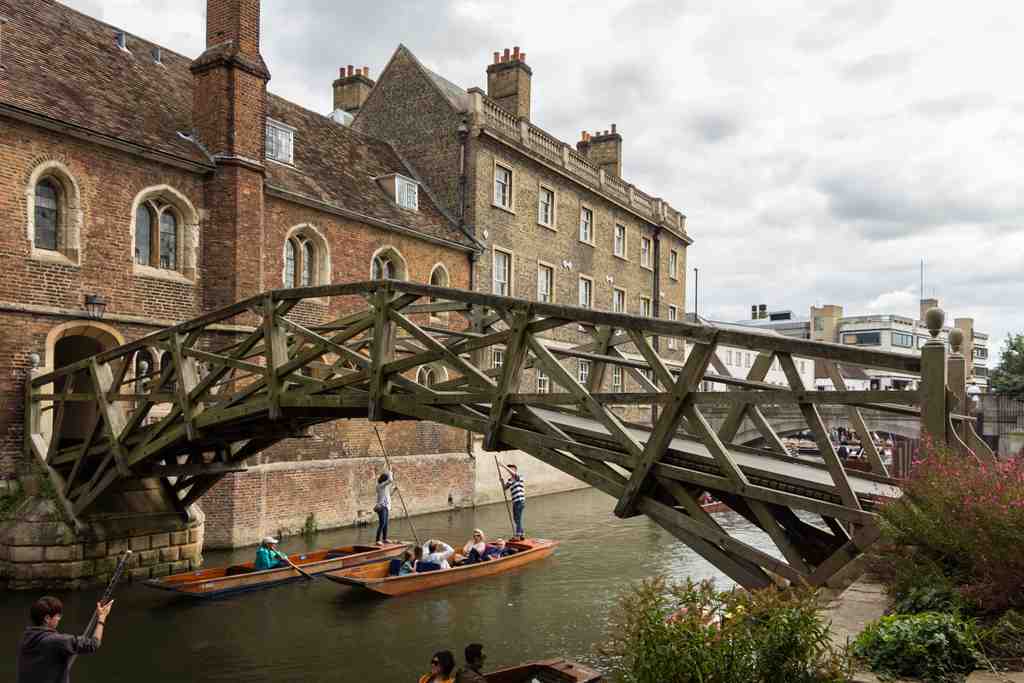
You are standing before a distinctive wooden footbridge composed of straight crisscrossing timbers arranged to form an elegant arch complete with a sloped wooden walkway. This is the world famous Mathematical Bridge. It is a marvel of eighteenth century engineering that has sparked some of the University's most stubborn legends.
The bridge was designed in 1749 by William Etheridge and built by a local master carpenter named James Essex. For the brilliant design Queens College paid Etheridge twenty one pounds, which equates to a few thousand pounds today. But the true triumph belonged to Essex. In an academic world dominated by wealthy scholars and ancient traditions, it was a local working class builder who erected this masterpiece. His success was so undeniable that it forced the university elite to respect him, launching his career as a prominent architect and challenging the strict social boundaries of the era.
So how does a bridge made entirely of perfectly straight pieces of wood form an arch? It uses a highly sophisticated system called tangent and radial trussing. To put it simply, the straight pieces of wood acting as tangents are squeezed tightly together by gravity, a force called compression. Meanwhile, the radial pieces linking them together like the spokes of a wheel are pulled tight under tension. This isolates the forces so perfectly that you could, in theory, remove one decaying piece of timber and replace it without dismantling the whole structure.
But university scholars have always loved a good myth, perhaps preferring a magical academic origin over the brilliant logic of a local carpenter. For generations, students have passed down the fable that Sir Isaac Newton himself designed this bridge entirely without nuts or bolts. The story goes that curious, rebellious students took the bridge apart in the dead of night to see how it worked, but could not figure out how to put it back together, forcing them to hammer ugly metal bolts into the wood just to keep it from collapsing into the river.
It is a wonderful tale, but completely false. Newton died twenty two years before the bridge was even built. Furthermore, metal fasteners were always part of the design. Originally, iron spikes were driven into the joints from the outside, hiding them from pedestrians walking across. The myth of the failed student restoration only took off in 1905, when the bridge was rebuilt using highly durable teak wood instead of oak, and prominent coach bolts were installed that were suddenly visible to everyone.
Speaking of reconstructions, the bridge you see now is slightly different from the original. It used to have a stepped deck, forcing pedestrians to climb up and down as if on stairs. Have a quick look at the historic image in your app to see those old stair steps before they were replaced by today's smooth ramp.
Just so you know, Queens College is open for visitors Monday through Saturday from ten in the morning until four in the afternoon, though it is closed on Sundays.
Looking at that complex wooden web, does the structure seem perfectly mathematical to you, or just a little bit chaotic? Let us wander along the water now, moving toward the riverbanks where nature and architecture meet, as we take a nine minute walk toward The Backs.




