
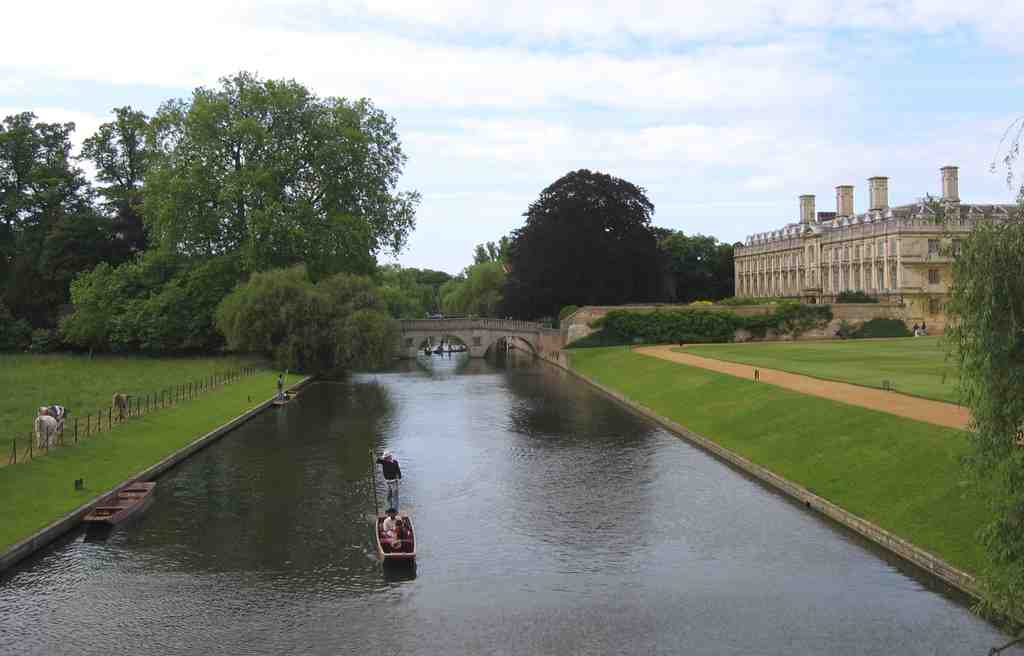
Look ahead along the gentle curve of the river framed by wide green lawns to see a pale stone building with tall chimneys on the right and an elegant arched stone bridge spanning the water in the distance. Welcome to The Backs, the beautiful stretch where the grand colleges of Cambridge present their private, tranquil faces to the River Cam.
This sweeping landscape was not always a serene park. In 1349, the Black Death devastated the city, leaving busy commercial wharves along the water entirely abandoned. The colleges swiftly moved in, buying up the empty land to transform the riverbanks into their own private estates.
These institutions were fiercely territorial. When the celebrated landscape architect Lancelot Capability Brown proposed flooding this entire area in 1779 to create one magnificent shared lake, the colleges flatly refused. They were far too proud to surrender their hard-won boundaries to a unified project.
That intense competition shaped the very skyline. St John's College was the first to build across the water, erecting a grand Neo-Gothic building, styled with ornate medieval spires, affectionately called the Wedding Cake. But notice its central tower. It has decorative clock faces, yet absolutely no hands. According to local lore, their bitter rival Trinity College built a bell tower first and secured a strict legal monopoly on bell-ringing in the area. St John's was permanently banned from installing a working timepiece of their own.
This environment of rigid academic rules constantly provoked the brilliant, unruly minds living within. In the early 1800s, the poet Lord Byron resided at Trinity. Informed that university rules strictly forbade keeping dogs, Byron gleefully found a loophole and purchased a live bear. Since the ancient texts mentioned nothing about bears, he paraded his massive pet on a chain along these very lawns, leaving the furious authorities powerless to intervene.
That rebellious urge only grew over time. A clandestine student group known as the Night Climbers made a tradition of scaling these sheer stone facades in the dark. They once placed a traffic cone high atop a spire of King's College Chapel. When the college spent a fortune hiring scaffolding to remove it, the climbers simply returned the next night and moved the cone to a different spire, rendering the expensive operation useless.
Even the river crossings became targets for elaborate mischief. Down the water, students managed to dangle full-sized cars, including a 1928 Austin Seven, right beneath the stone arches of a college bridge. The fire brigade had to be called to winch the vehicles out of the air.
Rebellion is practically built into the architecture. Clare Bridge features rows of large stone spheres, yet one is noticeably missing a wedge. The enduring story goes that the builder was shortchanged and chiseled out a chunk of stone as an act of petty revenge.
As you admire the view, you might even spot cattle grazing on the manicured lawns, a nod to the area's agricultural past. The Backs are open 24 hours a day for you to wander at your leisure. Now, let us walk just a bit further along this stretch to examine a true architectural masterpiece, the Wren Library.




