
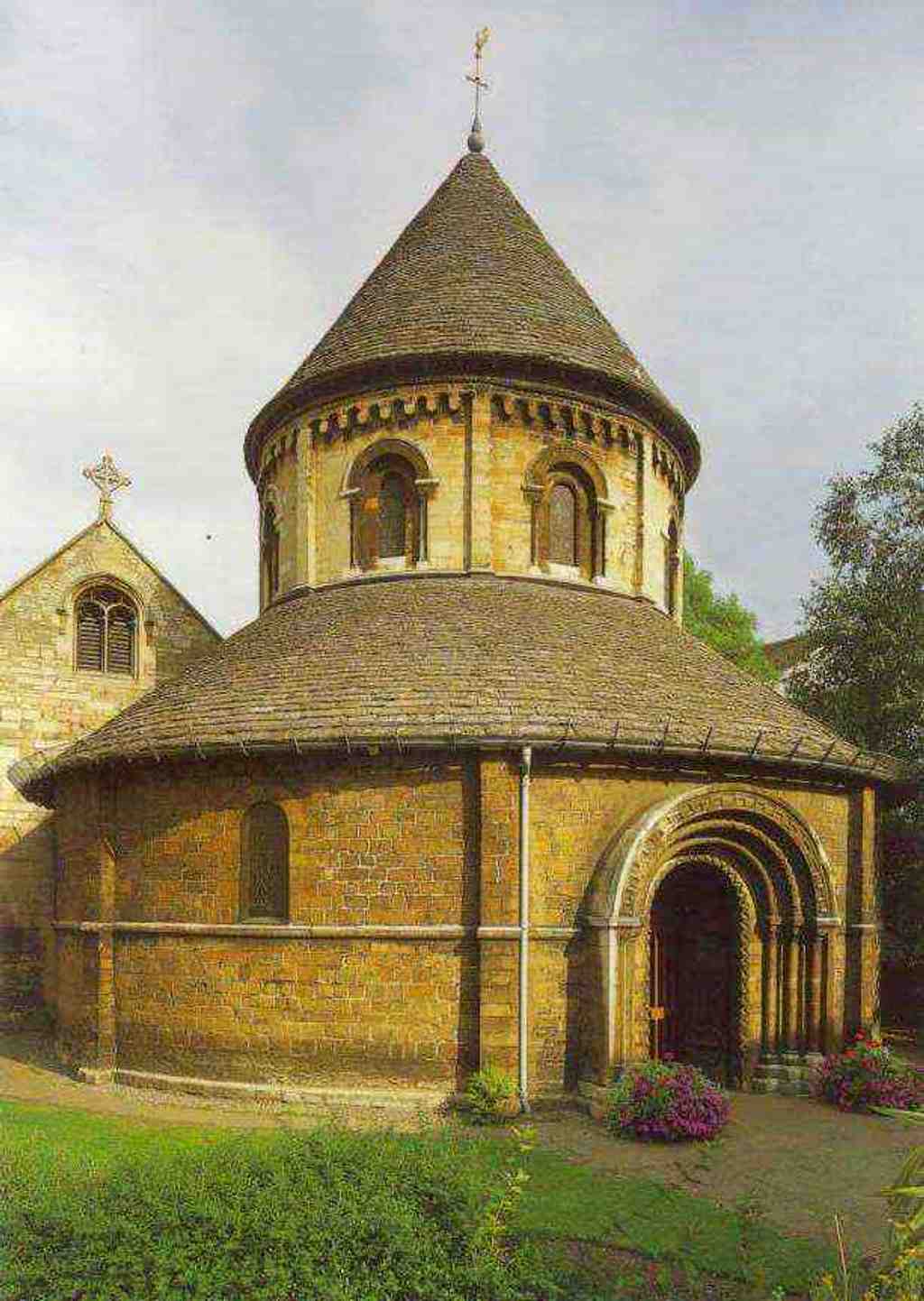
Look to your right and you will spot a stout circular building made of golden stone, crowned with a pointed conical roof and entered through a deeply layered arched doorway. This is the Church of the Holy Sepulchre, fondly known by locals as the Round Church. It is one of only four medieval round churches still in use in England.
Its unusual shape immediately brings to mind the legendary Knights Templar, those fierce warrior monks of the Crusades. But there is actually no evidence the Templars ever set foot here. Instead, it was built around the year 1130 by a mysterious group known only as the Fraternity of the Holy Sepulchre. They were likely local pilgrims who had returned from Jerusalem, eager to recreate the circular tomb of Christ right here in Cambridge.
Can you trace the deeply carved zigzags around that heavy western doorway? Those thick rounded arches are a hallmark of the Norman architectural style, built for sheer imposing strength rather than delicate beauty.
But that ancient strength was severely tested by the rebellious spirits of the city. Enter the Puritan Iconoclasm. In the winter of 1644, a violent wave of Puritan destruction scarred the churches of East Anglia, driven by men who sought to strip religion of all its visual glory. The most ruthless among them was a strict official named William Dowsing, terrifyingly nicknamed Smasher Dowsing. He and his troops despised anything they deemed superstitious or overly decorative. They tore into this very church, obliterating fourteen historic images of Christ and the Apostles, leaving behind the permanent scars of history upon the stone. Dowsing was famously thorough. Yet, the tiny round nave, the main central hall of the church, was so tightly packed with targets that Dowsing somehow overlooked the dark wooden ceiling in the chancel, the eastern space reserved for the clergy. Up in the shadows, beautiful fifteenth century carved angels holding musical instruments miraculously escaped his hammer. They survived the rampage and still look down today.
By the nineteenth century, the building was on the brink of collapse. A radical architect named Anthony Salvin stepped in to save it, but his methods were deeply controversial. Salvin ruthlessly stripped away centuries of genuine architectural additions to force the building back into an imagined, pure Norman state. The original estimate was one thousand pounds, but his ideological pursuit ballooned the cost to four thousand pounds, which is roughly half a million pounds today. He even added carved stone heads inside the walls, some of which are actually cheeky caricatures of local Victorian officials staring down from above.
The Round Church is open to visitors most days between ten in the morning and five in the afternoon, except on Sundays and Tuesdays, should you wish to look inside. Now, let us walk on toward our final monumental college of the tour, a short two minute stroll away to the grand gates of St John's College.




