
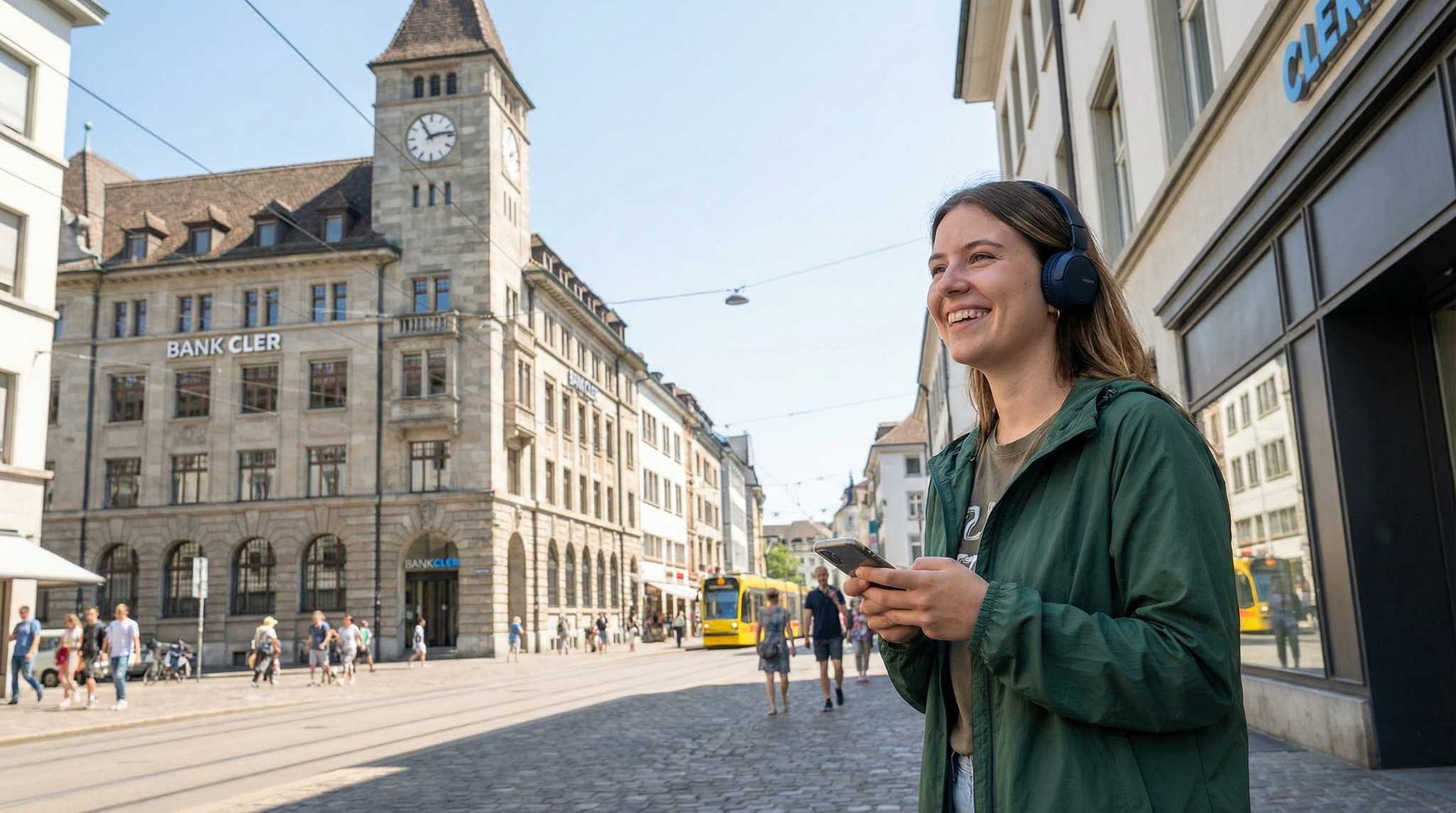
Basel Audio-Tour: Geschichten & Echos von Vorstädtes ikonischem Durchgang
Entdecken Sie auf dieser inspirierenden Tour das pulsierende kulturelle Herz der Vorstädte, Basel! Beginnen Sie mit einer Reise durch die Kunstgeschichte im renommierten Kunstmuseum Basel, das Meisterwerke vom Mittelalter bis zu zeitgenössischen Werken beherbergt. Bestaunen Sie anschließend die beeindruckende Architektur der Bank J. Safra Sarasin, einem Symbol des Schweizer Finanzwesens. Tauchen Sie schließlich ein in die reichen Erzählungen des Jüdischen Museums der Schweiz, wo Kultur und Geschichte lebendig werden. Diese fesselnde Tour bietet eine perfekte Mischung aus Kunst, Architektur und Kulturerbe in einem der dynamischsten Viertel Basels!
Tourvorschau
Über diese Tour
- scheduleDauer 40–60 minsEigenes Tempo
- straighten4.1 km FußwegDem geführten Pfad folgen
- location_on
- wifi_offFunktioniert offlineEinmal herunterladen, überall nutzen
- all_inclusiveLebenslanger ZugriffJederzeit wiederholen, für immer
- location_onStartet bei Straßburger Denkmal
Stopps auf dieser Tour
To spot the Strasbourg Monument, look for a striking white sculpture of several life-sized figures standing atop a pink stone base, surrounded by colorful flowers and shaded by…Mehr lesenWeniger anzeigen
To spot the Strasbourg Monument, look for a striking white sculpture of several life-sized figures standing atop a pink stone base, surrounded by colorful flowers and shaded by large trees-it's right by the park near the Basel main station. Alright, get ready to time-travel with me-because this monument isn’t just a slice of marble, it’s the heart of a story with more drama than your favorite weekend soap opera! Picture yourself in the Elisabethenanlage, at the edge of Centralbahnplatz. It’s the late summer of 1870, and Strasbourg is under siege during the Franco-Prussian War. Artillery thunders through the city, and fear hangs thick as smoke. People are desperate-mothers clutching their children, the elderly seeking shelter. Now, here’s where the Swiss come riding in-not on horses, sadly, but with compassion that could melt even the hardest cheese. A French baron, Hervé de Gruyer, wanted to thank Switzerland for bravely stepping in as heroes. After some tough negotiations (seriously, Swiss diplomacy could sell fondue to a lactose intolerant!), Swiss delegates convinced the authorities next door to let 1,400 women, children, and elderly escape from Strasbourg. Their destination? Safety in Switzerland, where batches of kindness were bigger than the mountains! Artist Frédéric Auguste Bartholdi-who later went on to design the Statue of Liberty, talk about a résumé!-created this monument in 1895. Take a close look: You’ll see a winged angel-called a genius here-guiding Alsatia, who represents the region of Alsace, and a weeping child, all making their way to Helvetia, the personification of Switzerland herself. Helvetia's holding out a shield, ready to cover her newfound friends like the world’s most protective umbrella, and reaching to grasp Alsatia’s desperate hand. Check out the relief panels-one honors Switzerland’s rescue convoy, and another pays tribute to centuries-old friendship. And that row of shields wrapping around? Those are the Swiss cantons, Strasbourg, and even Switzerland’s coat of arms, banding together like a superhero team. Now, imagine if monuments like this could talk… I bet they'd have plenty of heartwarming tales and maybe just a dash of Swiss sarcasm. Ready for the next stop? Let’s go!
Eigene Seite öffnen →As you stand here in front of the mighty, glass-and-stone presence of Bank J. Safra Sarasin, let’s take a trip-you don’t need a passport or francs, just your imagination! Picture…Mehr lesenWeniger anzeigen
As you stand here in front of the mighty, glass-and-stone presence of Bank J. Safra Sarasin, let’s take a trip-you don’t need a passport or francs, just your imagination! Picture the early morning streets of Basel in 1841. The scent of bakeries drifts down cobbled lanes, and the clatter of horse-drawn carts rings out. In this bustling town, a young man named Johannes Riggenbach-Huber, son of a humble worker at a ribbon factory, dreams of something more-much more-than ribbons. He trains at a local bank, learns the business, and with the courage of an entrepreneur (and maybe a little Swiss chocolate for energy), he strikes out on his own. This marks the birth of a business that will become today’s J. Safra Sarasin. Johannes starts his company focusing on trading, shipping, and banking. It’s a family affair, and soon his son, Fritz, joins him, like many of us who secretly hope our parents’ jobs involve less paperwork and more treasure. By the mid-1800s, their bank is thriving, and they’re bustling onto the floors of the Basel stock exchange. Try to imagine the chaotic but exciting energy as traders call out prices, shuffle papers, and occasionally, perhaps, hope for an extra-long lunch. But the real twist comes in 1900, with a change as dramatic as swapping fondue for feijoada. Alfred Sarasin-Iselin takes over and partners with Arthur Streichenberg-Mylius, creating A. Sarasin & Cie. Under Alfred, the bank sails smoothly into the 20th century and soon gains a citywide reputation for trust and excellence. Alfred’s grandson, Alfred Emanuel Sarasin, keeps the spirit alive and even becomes president of the Swiss Bankers Association-a bit like being the boss of all the bosses. Maybe he got to wear a special Swiss banker’s hat. Over the years, the bank adapts, modernizes, and even changes shapes: turning into a corporation, issuing shares, and attracting big investors like the Dutch Rabobank. Picture strategy meetings, the swirl of international calls, and deals signed with ceremonial pens. All seems serene until 2011 shakes things up-Brazil’s Safra Group swoops in like a tropical storm, buying out Rabobank for over a billion Swiss francs. That’s a lot of bank notes; if stacked, it might reach the top of the Basel Münster! The Sarasin name remains, but Safra’s energy and resources turbocharge the operation. Don’t be fooled by the tranquil exterior-behind these walls, there’s been no shortage of drama. In 2012, a bit of “James Bond” meets “IT guy” action breaks out: confidential client data is stolen and leaks its way into a political scandal involving the Swiss National Bank. Suddenly, headlines splash, and tense conversations echo through these halls. There’s mystery, there’s mischief, and-like any good thriller-someone gets caught, the police are involved, and the Swiss calm is slightly ruffled. And if that’s not enough, the bank has danced through storms of its own making: allegations of questionable investment practices, debates about palm oil companies and ethical standards, and legendary stories of tax scheme lawsuits involving celebrities, billionaires, and more than a few spilled cups of espresso. There was even a peculiar extortion plot, where someone threatened to expose scandalous trading deals if not paid off-a story worthy of a Swiss noir! Despite these wild chapters, the bank has moved with the times. They were one of the first banks to sign the United Nations Principles for Responsible Banking, pledging to support sustainability and align with global goals on climate change. Their portfolio isn’t just money and gold bars anymore-it’s increasingly green and forward-thinking. Today, this Basel-based institution is part of a globe-spanning banking empire, with branches everywhere from Zurich to Dubai, London to Hong Kong. It employs thousands and manages nearly 200 billion Swiss francs in clients’ fortunes. Imagine all the trust placed right here, behind these doors-more than the combined value of every cheese wheel in Switzerland! So, as you look up at this modern fortress, think of its journey: from a baker’s son’s dream, through decades of family ambition and risk, through scandals and reinvention, to a powerhouse serving clients around the world. And hey, if the walls could talk, I’m sure they’d have a few great punchlines-after all, in Swiss banking, the suspense is always compound interest!
Eigene Seite öffnen →To spot Bank Cler, just look for a large modern building on the corner, with crisp white stone walls covered in grid-like windows and “CLER” shining in big, bright blue…Mehr lesenWeniger anzeigen
To spot Bank Cler, just look for a large modern building on the corner, with crisp white stone walls covered in grid-like windows and “CLER” shining in big, bright blue letters. Ah, here we are at Bank Cler, a spot that’s seen more comebacks than a boomerang! Picture yourself in 1927: the world’s roaring with jazz, and here in Switzerland, the local cooperative movement and unions decide it's time for their own bank - the Genossenschaftliche Zentralbank. People had dreams of fairness and a bank run for regular folks, not just the top hats! Stand here and imagine the first customers nervously walking through glass doors, coins jingling in their pockets. Over decades, the bank kept changing its face like a chameleon at a disco: after Coop Schweiz took over, it became Coop Bank, then Bank Coop, and finally in 2017, with a flick of marketing magic, Bank Cler-cler, like “clear, simple, direct” in Romansh. So if you ever felt lost with complex banking, this place wants to make it all as easy as a Sunday stroll. But life at Bank Cler hasn’t always been so, well, clear. The building you see has weathered its share of storms-some a bit more literal and some more like “paperwork hurricanes!” In 2013, for example, a sneaky computer glitch got cheeky and mailed thousands of customers’ statements to all the wrong people-imagine opening your mail and finding someone else’s bank secrets inside! Talk about an “oops” moment. As you can guess, the coffee machines worked overtime that week. Comedy aside, there were some dramas, too. The bank faced a slap on the wrist from the Swiss financial watchdog for buying its own shares to keep up appearances-a bit like giving yourself a shiny star sticker to impress the teacher. These moments, both comic and tense, have turned Bank Cler into a legend in Swiss banking circles. And yet, as trams glide past and the sun casts lines on those blue CLER signs, the bank has pushed forward: it’s now 100% owned by Basler Kantonalbank, won awards for climate neutrality, and is zipping into the future with voice authentication for customer calls and a special app launching soon. So next time you walk by, picture all the stories buzzing behind those windows-from clumsy postmen to boardroom nail-biters. And remember, with Bank Cler, things are (mostly) clear… unless there’s another envelope mix-up! Shall we continue to the next stop?
Eigene Seite öffnen →
10 weitere Stationen anzeigenWeniger Stationen anzeigenexpand_moreexpand_less
Take a look at this striking blend of glass, steel, and history-the Pax Swiss Life Insurance Company, standing tall at Aeschenplatz. If you listen closely, I think you can almost…Mehr lesenWeniger anzeigen
Take a look at this striking blend of glass, steel, and history-the Pax Swiss Life Insurance Company, standing tall at Aeschenplatz. If you listen closely, I think you can almost hear the echoes of busy typewriters and the shuffling of old Swiss francs-well, either that or it's just the city traffic! Now, let’s take you back to 1876, when life insurance wasn’t just a business, but a security blanket for Swiss civil servants. Imagine dusty rooms filled with stoic gentlemen in buttoned coats, pouring over ledgers by candlelight. Actually, the very first version of this company, set up in 1870, operated from the living room of its president-no fancy offices or ergonomic chairs there! They soon outgrew his home and moved things to Schützenmattstrasse, steadily becoming a fixture of Basel’s civic life. Life insurance might not sound thrilling, but here at Pax, business was anything but boring. With every new law or world event, the company had to reinvent itself. After the First World War, when government subsidies vanished overnight, the folks at Pax had to get creative. Instead of sticking to their old client list, they flung open the doors to all of Switzerland. In 1926, they snapped up the old Simon'sche Villa and relocated their headquarters right here, where you’re standing. Fast forward to 1936, when the company rebranded as "Pax." No, not like the Roman goddess of peace, but close! The whole idea was to be a steadfast protector-think less superhero cape, more actuarial tables. In 1950, their original villa was swapped out for a modern five-story building, setting the stage for the architectural mash-up you see today. Speaking of advancements, in 1951, Pax became the first Swiss insurance firm to offer profit sharing on lifetime annuities. Suddenly, insurance meetings were a lot more fun-you might even say people stayed awake for the whole thing. But progress wasn’t always smooth. In the 1960s, when inflation threatened to gobble up people’s retirement savings, Pax responded by founding new companies, investing in prime Basel real estate, and even expanding operations to Munich. Now that’s what I call playing the long game. The eight-story tower that dominates today’s site was crafted in the 1990s by the renowned architects Bürgin Nissen Wentzlaff, connecting the old with the new in dramatic fashion. Take in that sweeping curve of glass; it’s designed to welcome the busy life of Aeschenplatz, with the older brick-faced structure standing guard at its side. If these walls could talk, they’d probably offer you a sensible pension plan. Imagine also, amid Basel’s bustling insurance trade of the 1980s, Melanie Münzer-Meyer sat atop the board-she was the first female head of a Swiss insurance company, causing quite the stir! And while the faces have changed-today’s boss is Peter Kappeler-you get the sense this place has always been at the forefront, evolving with the times. The 21st century? Pax went digital, founded the InsurTech company Creadi, and started investing in digital art. Yes, life insurance might sound unglamorous, but they sponsor everything from the Swiss Sustainability Challenge to a major digital art prize, and even Basel’s own hackathon. I like to imagine a crowd of programmers and artists gathering in the glassy atrium, arguing passionately about blockchain-and then accidentally breaking out into a heated game of Swiss Jass. All these changes have paid off. Today, the Pax group handles nearly nine billion francs in assets, with yearly profits to delight any accountant. Their bold green and purple logo is everywhere in Basel. And if you squint, you might even spot a subtle reference to their old values-the dot in their logo representing focus, the name echoing reliability. Their motto these days is “Security on point.” Though between you and me, if I had a franc for every time a Swiss company promised security, I could buy my own insurance company. So as you stand here, take a moment and imagine the layers of history swirling around you-the accountants with their ledgers, the visionaries dreaming of digital futures, the gentle clink of coffee cups from the company canteen. Pax isn’t just a business; it’s a slice of Swiss resilience and reinvention, perched right in the heart of Basel. Now, ready to see what else Vorstädte is hiding? Let’s stroll on! Wondering about the company organization and purpose, management or the logo and corporate design? Feel free to discuss it further in the chat section below.
Eigene Seite öffnen →Up ahead, you’ll spot a bold, pale stone building with tall arched windows and a banner draped across the upper façade-look just to your left to see the entrance, sitting right…Mehr lesenWeniger anzeigen
Up ahead, you’ll spot a bold, pale stone building with tall arched windows and a banner draped across the upper façade-look just to your left to see the entrance, sitting right alongside the tramlines. Welcome to the Kunstmuseum Basel, where art history likes to shake off its dust and throw a party every day! Before you walk in-imagine the air buzzing with whispers of creation and centuries of creativity swirling overhead. If you stood here in 1661, you might have caught the city council patting themselves on the back for buying the legendary Amerbach Cabinet, making this place the oldest public art museum in the world. That’s right, London and Paris can take a seat-Basel started early! The building you see now was constructed between the wars, opening its neoclassical embrace in 1936. With solid stone and straight, elegant lines, it looks serious-like an art-loving uncle who won’t laugh at your knock-knock jokes, but secretly collects rubber ducks. The museum was designed to be a fortress for masterpieces, a three-story treasure chest bursting with color and intrigue. But its roots stretch much deeper-long before the current building, paintings and precious drawings were tucked away in scholars’ houses, libraries, and even an entire house called “zur Mücke.” The Amerbach Cabinet, packed with the works of Holbein and ties to Erasmus, set the stage for Basel’s unparalleled love affair with art. Inside, you’ll find the largest public art collection in Switzerland: over 4,000 paintings and sculptures, more than 300,000 drawings and prints-enough to wallpaper a few neighborhoods! You’ll walk among spellbinding medieval pieces by Hans Holbein, dramatic Dutch and Flemish masters, Impressionists, and modern giants. Fancy seeing a Picasso? How about several? Thanks to a heartwarming twist in the story, you can do exactly that. In 1967, two prized Picassos-Les deux frères and Arlequin assis-were almost snatched away in a sale. The people of Basel rallied, digging deep into pockets so the city could keep them. Picasso himself was so touched he gifted four more works, including a design for his world-famous Les Demoiselles d’Avignon. Imagine the local museum director, Franz Meyer, wandering the maestro’s studio, picking out masterpieces like a kid in a candy store! Step to the side for a moment-can you hear the tram’s electric hum and the distant chatter? Once inside this “art mothership,” you’ll find yourself toe-to-toe with Rodin’s Les Bourgeois de Calais in its dramatic stone courtyard, or awestruck by fragile Renaissance sketches. Let’s not forget the Kupferstichkabinett, where Germany’s Albrecht Dürer and Switzerland’s Paul Cézanne line up their finest works alongside modern legends like Andy Warhol and Joseph Beuys. The museum is so overflowing, they had to expand-just across the way is a 2016 new wing, linked underground, plus Basel’s own Museum of Contemporary Art at St. Alban-Rheinweg, the first in Europe totally dedicated to contemporary art. If you’d visited in recent years, you might’ve joined half a million others gazing at Van Gogh’s fields or lost yourself in a whirlwind of cubist masterpieces shipped in from MoMA, the Musée d’Orsay, and more. Or maybe you’d have witnessed history as precious Ukrainian artworks sought safety here during conflict, their colors shielding stories of resilience and hope for all to see. So, from ancient Holbein to a surprise Picasso, Basel’s Kunstmuseum is where art’s oldest stories meet its wildest dreams. And remember: next time you see a crowd cheering at a painting, it might just be Basel’s citizens guarding their treasures like it’s the city’s very own superhero movie-with brushes, not capes! Want to explore the collection, print room and specialist library or the architecture in more depth? Join me in the chat section for a detailed discussion.
Eigene Seite öffnen →You’re looking straight ahead at a charming, narrow building with green shutters and steep, red-trimmed dormer windows; just make sure you spot the sign above the door that reads…Mehr lesenWeniger anzeigen
You’re looking straight ahead at a charming, narrow building with green shutters and steep, red-trimmed dormer windows; just make sure you spot the sign above the door that reads “Cartoonmuseum Basel” before your imagination starts adding speech bubbles! Now, take a deep breath and imagine yourself not just standing on St. Alban-Vorstadt, but standing at the quirky, beating heart of narrative art in Switzerland. Here, in this surprisingly unassuming old house with its friendly green shutters and playful roofline, you’re about to cross a bridge into a world entirely devoted to cartoons, comics, caricature, and graphic storytelling-a place more colorful on the inside than a spilled box of crayons. Once upon a time, long before anyone thought of “graphic novels” as high art, there was a man named Dieter Burckhardt. He wasn’t your average comic fan; no, Dieter was a true Basel original-a philanthropist with a brilliant sense of humor and a deep love for comic art. In 1979, he decided his own remarkable collection of comics and funny drawings shouldn’t just be stashed away for a rainy day, but should be enjoyed by everyone. So, he set up a foundation and, by 1980, opened the very first exhibition of what was then called the Caricature & Cartoon Museum Basel, just a stone’s throw from where you’re standing. But let’s add a little tension-and some renovation drama. In 1991, Dieter’s foundation took a bold leap and bought this Gothic house at number 28. It was beautiful but needed work, so Basel’s now-famous architects Herzog & de Meuron (yes, the same ones who dream up architectural marvels!) came to the rescue. Together, they gave this old structure a gleaming new lease on life with a sparkling blend of old and new. In 1996, the museum reopened here, and the city didn’t just gain an art space-it gained a vibrant new stage for visual storytelling. Today, this is Cartoonmuseum Basel-now proudly subtitled the Centre for Narrative Art, to make sure everyone knows just how ambitious it is. The museum is packed to the rafters with more than 12,000 works, not just from Switzerland but from all around the world. Inside, you’d find everything from delicate ink drawings to laugh-out-loud cartoons, thought-provoking comics, edgy zines, and animations that’d make Walt Disney blink. There are curated exhibitions that explore everything from the big social questions of the day to the quirkiest corners of counter-culture, plus workshops, talks, and-would you believe it-a library that covers everything from bestselling comics to underground cult classics. Whenever there’s a national symposium about comics (what they call the “ninth art”), the whole scene looks to Basel-and this museum helps lead the conversation. And if you thought all you’d find here were a few funny doodles, think again: this place has played host to international legends and homegrown heroes alike, each exhibition a wild new adventure. Oh! And before you go-peek into the museum shop. Whether you want a postcard, a comic book you can barely pronounce, or a brilliant monograph that makes you stroke your chin wisely, you’ll find something. You might just leave this place with a little more spring in your step and a new respect for the power of a good cartoon to say everything words can’t. Isn’t it amazing what can hide behind a pair of green shutters and a friendly sign?
Eigene Seite öffnen →Theater Basel is a bold, modern building with a softly curving white facade and wide steps, just behind the whimsical, mechanical Tinguely Fountain-look for the large, angular…Mehr lesenWeniger anzeigen
Theater Basel is a bold, modern building with a softly curving white facade and wide steps, just behind the whimsical, mechanical Tinguely Fountain-look for the large, angular structure and the lively sculpture-filled pool right in front of you. Welcome, theater adventurer! Take a moment to soak it all in: the cool splash and clatter of the Tinguely Fountain at your feet--and the majestic presence of Theater Basel just beyond it. Now, imagine you’re in the heart of a story that stretches back over 200 years, where actors, opera divas, ballet dancers-and maybe a mischievous ghost or two-have all taken a bow. In the early days, back in the 1700s, theater in Basel was truly for the hardy: performances happened outside, with actors battling wind, rain, or the occasional squawking pigeon for the spotlight. That all changed in 1807, when performers got a roof over their heads in the Ballenhaus-originally built for ball games! Basel’s first proper theater had three rickety balconies and a little wooden stage. Not exactly Broadway, but hey, you worked with what you had. Eventually, the city decided it could do better, and by 1834, the “Theater auf dem Blömlein” opened. It had 1,300 seats-huge for a city of only 26,000! But the show didn’t go on uninterrupted. The original building transformed into a school, stages went up and came down, and in 1904, a mysterious fire turned the then-modern Neo-Baroque theater into a smoldering memory overnight. Picture townsfolk, in dressing gowns and nightcaps, huddling by the ruins at dawn, whispering about the ghost of the Ballenhaus still haunting the backstage. But Basel bounced back with spirit and style. In 1909, a new theater rose from the ashes, only to make way for today’s striking modern home, which opened in 1975 after a dramatic demolition-imagine 230 kilograms of dynamite and more than a thousand drill holes reducing the old theater to dust in seconds! The cost? Sixty million francs. Not exactly pocket change, but, as every theater lover will tell you: “The show must go on.” And what a show! Today, Theater Basel dazzles as a “three-in-one” stage, hosting opera, theater, and ballet. Each year, its three stages-Big Stage, Small Stage, and the Schauspielhaus-are home to 600 performances and over 40 sparkling new productions. If you peek inside (don’t worry, no ticket check at the door while I’m guiding), you’d find a beehive of 400 busy staff behind, under, and on stage, plus world-class visiting orchestras, from the Sinfonieorchester Basel to Baroque specialists like La Cetra. It’s been named “Opera House of the Year” not once, but twice-maybe they have a trophy room that’s starting to look like a Swiss chocolate shop: packed and irresistible. The awards keep rolling in, too: “Theater of the Year 2018,” “Opera Chorus of the Year 2013.” Imagine legendary productions that thrilled critics and sometimes confused audiences-like avant-garde operas or inventive takes on Shakespeare, where sometimes the only thing more dramatic than the play was the fashion in the foyer. Over the years, the theater was led by visionaries, each putting their stamp on its story. Since 2020, Benedikt von Peter has held the reins as director-perhaps right now, he’s somewhere backstage passionately urging a soprano to hit that extra high note. And don’t miss the quirky square right at your feet: it’s decorated by Richard Serra’s gigantic steel Intersection and the famously whimsical Fasnachts-Brunnen, or Tinguely Fountain, whose whirring, bubbling sculptures seem to rehearse their own little mechanical ballet-sometimes stealing the show from anyone on two legs! So, as you gaze at this palace of the performing arts, picture swirling costumes, thunderous applause, and-just maybe-the faint echo of ghosts from long-lost stages, still hungry for one last encore. After all, at Theater Basel, the only thing older than the walls is the city’s love for a good, spectacular, slightly unpredictable show. And with your feet on the square and your imagination on its toes, you’re already part of the story. To delve deeper into the structure and cooperation, reception or the name, simply drop your query in the chat section and I'll provide more information.
Eigene Seite öffnen →To spot St. Elizabeth’s Church, just look straight ahead for the towering stone spire with its pointed arches, ornate gothic details, and a big blue clock face near the top-it’s…Mehr lesenWeniger anzeigen
To spot St. Elizabeth’s Church, just look straight ahead for the towering stone spire with its pointed arches, ornate gothic details, and a big blue clock face near the top-it’s hard to miss, looming above the trees and neighboring buildings like a medieval crown. Alright, you’re standing in front of Basel’s mighty St. Elizabeth’s Church-impressive, isn’t it? Take a moment and imagine you’ve slipped back in time… way back, before the trams and coffee shops, when this spot was just a quiet edge of town and the stories of St. Elizabeth were just getting started. Back in the 1200s, there was a small chapel here, built when people still thought “Wi-Fi” was just a knight’s battle cry. The city’s hospital cared for the poor and needy-imagine rows of straw beds and smells of herbs-and right next door, this little chapel offered a bit of spiritual comfort. Hidden behind its doors, two nuns kept watch and, by 1315, a priest was employed to handle the endless requests for blessings and masses. Over centuries, that humble chapel changed. In the early 1500s it was torn down, making way for something much more ambitious-thanks to a generous fellow named Hieronymus Bär. He donated so much money, it took just a year to build a whole new, bigger church. The neighborhood cemetery was next door, and if you’re feeling a chill right now, maybe it’s just the spirits lingering from those who once rested here. But history isn’t just peaceful prayers! After the sweeping shock of the Reformation, this new church got roped into being a branch of the Basel Minster. In the 1600s, it was jazzed up and expanded. Soldiers from the nearby barracks even had their own special balcony (probably for keeping an eye on each other when the sermons got too long). The church was continually spruced up, each renovation layering on a fresh chapter. Can you picture it? Uniformed soldiers on the gallery, strict sergeants shooting grumpy glances at anyone dozing off… Now, let’s fast forward-camera flash!-to the invention of photography. Herr Jakob Höflinger set up a photo lab nearby, snapping some of the first ever pictures of this church, capturing Basel as it changed. Talk about Instagram before it was cool! But the real showstopper was still to come. The St. Elizabeth’s Church you see before you now rises up thanks to the generosity of Christoph Merian and his wife, Margaretha. In the late 1850s they dreamed of a spiritual beacon, a “monument against the dark spirit of the times”-no pressure! They hired star architect Ferdinand Stadler. His ideas beat out Joseph Jeuch in a competition… though Jeuch managed to sneak in a few tips on the final design. Poor Merian didn’t live to see his church finished-he passed away just before the first stone was laid. Still, his vision pressed on. Over seven years, a bustling workshop of craftsmen, much like those at Cologne Cathedral, hammered stone and bent steel, trying to outdo the budget like contestants on a builder’s reality show. Just imagine the noisy, busy scene as the tower grew: The final spire, topping out at 72 meters, even beat Basel’s own Minster for height. That spire is pieced together with clever steel beams, much like the Eiffel Tower-now that’s what I call “Swiss innovation meets Parisian flair.” Inside, the tallest gothic arches you’ll find in Switzerland, a brick vault where most churches only dreamed of real brick (other churches had painted wood pretending to be stone-sneaky savings!). Of course, not all the savings plans worked: even the stone pulpit’s grand canopy is actually made from wood. Through the centuries, St. Elizabeth’s Church has had a bit of an identity crisis-nearly razed in the 1980s to make way for urban development! Thank goodness, history-loving locals protested, saving the building from the wrecking ball. In the 1990s, it was lovingly restored. If you peek at the old door lock, you’ll spot the date “1863”-original hardware, with as much drama as a soap opera. Today, this church is a place for everyone, run by a lively ecumenical team and hosting not just services but concerts, weddings, and even the occasional art installation. Its famous organ, first installed by Joseph Merklin over 150 years ago, still fills the air with powerful music. Imagine the deep whoosh of its pipes and the click of its keys echoing off ancient stones. And don’t forget-below your feet, in the church’s crypt, the Merians rest side by side in marble coffins, eternal VIP guests at their own gothic masterpiece. Take a breath! Basel’s past and present really echo around you here. Shall we move on to the next stop? For a more comprehensive understanding of the chapel of st. elisabeth, parish church of st. elisabeth or the st. elizabeth's church from 1864, engage with me in the chat section below.
Eigene Seite öffnen →To spot the Music Academy Basel, look straight ahead for a stately, light yellow building with tall green window shutters, beautiful decorative details around the windows, and an…Mehr lesenWeniger anzeigen
To spot the Music Academy Basel, look straight ahead for a stately, light yellow building with tall green window shutters, beautiful decorative details around the windows, and an ornate wooden door in the center. Ah, welcome to the Music Academy Basel, the beating musical heart of this city! Imagine for a moment that you’re transported back over 150 years, when the echoes of piano and violin first began to spill out of these elegant windows. It was 1867 - a year when carriages clattered over cobbles and young musicians, some nervous, some excited, hurried here to find their first notes. Picture a local teacher and orphanage director, Johann Jakob Schäublin, standing right in front of you, full of hope and determination. Inspired by a belief that music could transform lives, he teamed up with the Society for Good and Useful Things of Basel. It sounds like the name of a superhero league, doesn’t it? But instead of masks and capes, his team wielded sheet music and violins. They founded the “Allgemeine Musikschule,” and soon, melodies began rising from these classrooms, swirling through the city streets. The first head of this fledgling school was Selmar Bagge, a composer, cellist, and - probably - an absolute whiz at finding lost sheet music under desks. Under his direction, students filled the halls, practicing scales and dreaming big dreams, until 1896, when a man named Hans Huber took the baton. Huber was a Swiss composer and pianist, and he had a wild idea: what if Basel had the first ever conservatory for advanced music studies in all of German-speaking Switzerland? In 1905, he made that dream a reality, and soon, even more ambitious students began crowding the corridors, their hearts set on the world’s grandest concert halls. Jump forward to the 1950s, and listen closely, because things are about to get even more magical. Paul Sacher, a legendary patron and founder, brought together the historic school with the Schola Cantorum Basiliensis - a treasure-trove for lovers of early and baroque music. Since then, the Music Academy has lived many lives in one: a classical music school, a home for jazz lovers, and a world-renowned conservatory, all sharing space under one roof. Over the years, these walls have echoed with the mastery of some of the most famous musicians you’ve probably never heard of (unless you have extremely niche playlists!). Take, for example, classical pianist Ronald Brautigam, jazz drummer Jeff Ballard, early music pioneer Amandine Beyer, or cellist Sol Gabetta. You could meet a Swiss saxophonist walking to class right next to a Turkish jazz composer or a French organist, all brought together by the love of music - and maybe the lure of a good practice room. You probably wouldn’t guess it just by looking, but here’s a secret: this quiet campus hides Switzerland’s biggest music library, the Vera Oeri Library, opened in 2009. Imagine row upon row of notes, scores, and musical mysteries, ready for anyone brave enough to read a clarinet part from the 17th century. In 2014, jazz musicians got their own playground too: a purpose-built Jazzcampus where improvisation is king, and out-of-tune notes are just a part of the fun. Change has always been a loyal friend to the Academy. In 2022, it was announced that the campus would get a futuristic new extension, including a “Salle Modulable” - a modular concert hall that will float right above the music library. So soon, you could witness a jazz trio jamming just above a student frantically looking for a lost Beethoven sonata! But it’s not all glitz and glamour. Imagine the nerves of the audition day, the endless hours of finger exercises echoing down the polished corridors, and the flutter of excitement before the lights go down and the first note sings out. Every student here is part of a living tradition, carrying forward the hopes of Schäublin, Bagge, Huber, and Sacher, in a building where the music never truly stops. So as you stand in front of this beautiful building, remember - behind those windows, there’s a whole world of sound, history, and dreams, waiting to burst out onto the Basel streets. And who knows? The next musical legend might be practicing just inside, right now! To delve deeper into the about the academy, well-known lecturers (selection) or the principals and principals, simply drop your query in the chat section and I'll provide more information.
Eigene Seite öffnen →To spot the Jewish Museum of Switzerland, look to your right for a big, bold sign with geometric blue-and-white patterns and huge letters spelling “Jüdisches Museum der Schweiz”…Mehr lesenWeniger anzeigen
To spot the Jewish Museum of Switzerland, look to your right for a big, bold sign with geometric blue-and-white patterns and huge letters spelling “Jüdisches Museum der Schweiz” along a simple, modern ramp. Now, take a step back and imagine you’re opening the door to one of the most incredible time machines in Switzerland… and no, I don’t mean a Swiss watch that accidentally ticks backward! When this museum opened in 1966, it wasn’t just a collection of old stuff - it was the very first Jewish museum in the entire German-speaking world after World War II. You’re standing somewhere that was, and still is, a symbol of hope, memory, and remarkable resilience. Picture the echoes of voices in the city back in the 1960s, as members of the Jewish society “Espérance” heard news from Cologne: ritual objects from their own Basel collection had starred in a big exhibition there! The idea began to bubble up - why not bring those stories and objects home, and tell them right here in Basel? That’s how this museum was born, two rooms at Kornhausgasse 8, designed by Christoph Bernoulli in a plain but welcoming style - a bit like the friendly neighbor who never runs out of tea. Throughout the years, the collection grew. If walls could talk, these ones would whisper the secrets of Jewish life across Switzerland, from the medieval ages right to today! Inside, you find silver ceremonial pieces that shine like tiny stars, richly embroidered textiles from the 17th to the 20th century, and the “Lengnauer Mappot”-218 Torah binders, each with their own story, woven over nearly three centuries. If you’re counting, that’s the biggest single community collection of its kind in the world. Go on, try saying “Mappot” three times fast - I promise you’ll smile. But wait, there’s more! The museum also keeps letters written by Theodor Herzl-yes, the very founder of modern Zionism-and documents from the famous Basel Zionist conferences. For a moment, imagine the sound of passionate debates echoing, as history unfolded in these very streets. The museum even features monumental medieval gravestones, Basler Hebrew prints, and contemporary art - making it a living bridge from past to present. Even Anne Frank’s story made it here, in an exhibition about her family’s connection across borders. And every few years, clever curators kept things fresh: from magical amulets, cosmic zodiac signs, to love and partnership in Jewish life, and even a special installation wishing Theodor Herzl a happy 150th birthday (which is a lot of candles, even for Basel's firefighters!). Now, a twist… The museum is temporarily closed for a grand move, soon to reopen at Vesalgasse 5, even closer to the University of Basel. But think back further - in medieval times, there was a Jewish cemetery right here. Quietly, centuries of stories rested beneath your feet. As you stand here, the echoes of laughter, learning, struggle, and hope surround you. So, whether you came for glittering history or just to see the world’s most famous Torah ribbons, you’ve uncovered a place where memory meets adventure
Eigene Seite öffnen →Take a look straight ahead-see that tall, impressive stone structure with a square central tower flanked by two round towers, both topped with pointed, crenellated crowns? That’s…Mehr lesenWeniger anzeigen
Take a look straight ahead-see that tall, impressive stone structure with a square central tower flanked by two round towers, both topped with pointed, crenellated crowns? That’s the Spalentor, rising over 40 meters into the air with its colorful glazed roof tiles catching the sunlight. You really can’t miss those two mighty round towers standing on either side like loyal bodyguards. Alright, listen closely as we time-travel back through centuries of Basel’s wild history. You’re standing in front of what many call the most beautiful old city gate in all of Switzerland-which, if you know anything about the Swiss, is really saying something. But the Spalentor isn’t just a pretty face; this grand gate has seen some serious drama. Let’s set the scene: it’s October, 1356, and Basel is in ruins. The earth shakes, the ground splits open, and nearly every building crumbles-the city suffers one of the biggest earthquakes in European history. As the dust settles, Basel’s townspeople band together to rebuild not just homes, but a mighty new ring of walls to keep out, let’s say, unsavory visitors. Imagine the sound of hammers and saws, stones rolling over the cobbles, and the hopeful energy as they create a new life. This new wall, wider and bolder than before, finally includes the bustling suburbs, meaning Vorstädte-where you’re standing-becomes part of the city for the first time. At the heart of the western defenses emerges the Spalentor. By 1400, after decades of work (imagine all those lunch breaks), this gate towers over the main road to Alsace. It stands among seven mighty entry towers, over forty defense towers, and a circuit of walls that would impress even the most ambitious medieval lord. But time marches on and by the 1800s, these defensive walls start to feel less like guardians and more like party-pooping chaperones cramping Basel’s style. Most of the walls and gates are torn down, the city eager to spread its wings-except for a lucky few survivors. That’s right, only Spalentor and its siblings, St. Johanns-Tor and St. Alban-Tor, escape the wrecking ball. Now the Spalentor stands alone, basking in the open, looking as regal and slightly smug as a castle on its birthday. Let’s talk about its looks for a second. The square central tower, patchworked with sturdy stones, once topped with heavy wooden roofs that sadly fell victim to a storm in 1842. The round towers beside it-look up, and you’ll see how they stretch 28 meters into the air, finished with octagonal tops and crowned by those imposing battlements. Long ago, these towers would have had flat tent-like roofs, giving the whole gate a rather quirky hat collection. Pause and imagine: the city moat below was once crossed by a drawbridge, which could be pulled up to keep out any would-be invaders (or tax collectors). Under the bridge, hidden water channels were so large, you could actually take a bath in them, if you didn’t mind sharing with passing fish-though perhaps today it’s more of a dry feature. Peer at that massive wooden gate-solid enough to stop a small army. Above it is a grim, old-fashioned portcullis, ready to be dropped in emergencies. And to go the extra mile, the defenders could also push down hefty vertical beams, one by one, to block the entrance entirely-like the world’s most determined door security. If Basel got into the statue game before it was cool! Directly above the arch, you’ll spot the proud red-sandstone Basel coat of arms, clutched by two lions. Look higher, and there stands Mary, the city’s patron saint, holding her child atop a crescent moon-an Instagram-worthy detail even medieval travelers appreciated. Flanked by two prophets, she stands under fancy stone canopies, looking down at visitors through the centuries. The originals, made around 1400, now enjoy retirement in the Basel History Museum, but these faithful copies still wow crowds today. Here’s an odd twist: Spalentor has tons of names. The most accepted origin? “Spalen” probably comes from the Latin “palus,” meaning stake or palisade. This harks back to the old days, when these suburbs were encircled by wooden fences before stone walls took over-so you see, Basel was thinking about security long before passwords were a thing. Even clocks have a story here. The Spalentor didn’t get its own timepiece until 1838, when a shiny new clock replaced an old one from the demolished inner gate. The iron clock faces you see today were freshly forged for the occasion-not a bad retirement gift for a medieval tower. In 1933, the Spalentor received a full makeover, as Basel-wisely-decided to preserve this mighty reminder of its past. So, as you stand before this legendary gate, imagine knights passing through on horseback, merchants pulling goods behind them, and children darting underfoot, nervous but delighted. If only the walls could talk-though with how thick they are, you’d probably have to shout! Take a last look up: the Spalentor is proof that even after earthquakes, wars, and changing times, some city guardians never truly rest. Ready to see what other treasures Basel has waiting? Let’s keep walking!
Eigene Seite öffnen →Take a look straight ahead through the iron gates and you’ll spot a stately Baroque palace, its elegant facade stretching wide and proud as if it’s welcoming you into an era where…Mehr lesenWeniger anzeigen
Take a look straight ahead through the iron gates and you’ll spot a stately Baroque palace, its elegant facade stretching wide and proud as if it’s welcoming you into an era where powdered wigs and horse-drawn carriages ruled the runway. Now, close your eyes for a moment-just be careful you don’t bump into anything-and imagine it’s the late 1600s. Basel’s Neue Vorstadt is buzzing, not with cars or trams, but with the clop of hooves and the hurried footsteps of servants. Right here, where you’re standing, the land was in the hands of the Margraves of Baden-Durlach, powerful rulers who saw this spot as a perfect hideaway, especially when home was a bit too close to the latest war. Picture Markgraf Friedrich V., back in 1648, making real estate deals-the sort of thing even a modern-day Monopoly master would envy. He picked up two city estates, the Bärenfelserhof and the Eptingerhof. Fast forward to 1692, and his descendant, Friedrich VII. Magnus, added another neighboring property. With these purchases, the family became Basel’s largest landowners in the new district. But as luck would have it, danger was never far. War with France had devastated their actual palaces, so this spot in Basel became an exile sanctuary-a real-life “Plan B” palace! Now, here’s where things really heat up-literally. On a cold February night in 1698, disaster struck. While everyone else was dreaming of marzipan and empire-building, a fire broke out in the kitchen and raged through the night. By dawn, the family had fled to safety, but a chambermaid was tragically lost. The embers cooled, the rubble settled, but their dreams still burned. And so, as the smoke cleared, plans took shape for a new palace-a fortress against the chaos of the world. Imagine the scene as the first stones were laid just months later-Basel’s finest bricklayers and carpenters, some fresh from dismantling the ruins of war, toiling day and night. The Markgraf didn’t just order up a palace off the shelf; he wanted something cutting-edge, a French-style “hotel entre cour et jardin”-with courtyards and gardens fit for royalty. Exotic stone, hand-cut timber, and enough bricks to make any wolf think twice about huffing and puffing-materials came from miles around, commandeered from nearby forests and quarries, elbow grease supplied by local villagers under heavy-duty obligations. Rumor has it, some complained to the authorities that all this palace-building was exhausting their oxen more than a wild night at the town festival. By the turn of the century, the palace was rising from the ashes, though progress was sometimes slower than a molasses spill in winter. Money was tight, deals were struck, and eventually, after much dust and debate, the Markgräflerhof was complete in 1705. The family moved into a cocoon of elegance with tall windows, grand halls, and one of Switzerland’s most impressive Baroque facades. Over the years, the palace was more than a family home. It expanded, sprouting a grand west wing for archives and a garden stretching out to the sun-soaked edge of Basel. It housed paintings, coins, jewels, and even the odd scandal, especially after one particularly wild family member turned the place into a hub of questionable artwork-those had to be discreetly removed before visiting princes might get the wrong idea! Centuries rolled on, and, like any grand old house, the Markgräflerhof changed with the times. Armies came and went, collections drifted back to Germany, and eventually, in the 1800s, the city of Basel bought the whole estate-perhaps the best property deal they ever made. It became the core for the Bürger Spital, the city hospital, and soon sprouted new wings and clinics. Today, as you stand at its iron gates, the palace doesn’t echo with the laughter of princes or the plotting of courtiers, but with the modern buzz of hospital administration and the occasional clatter of blood donors grabbing a snack in the historic hall. Take a moment to imagine the layers of history beneath your feet, the glamour, the gossip, the grandeur-and maybe, if you listen closely, the faint giggle of a mischievous margravine, delighted that after all these centuries, her home still commands attention in the heart of Basel.
Eigene Seite öffnen →In front of you, you'll see a boxy, pale building with wide horizontal rows of windows covered by even, white blinds, set slightly back from the street corner with a few steps…Mehr lesenWeniger anzeigen
In front of you, you'll see a boxy, pale building with wide horizontal rows of windows covered by even, white blinds, set slightly back from the street corner with a few steps leading up to its main entrance-just look ahead and a bit to your right and you can’t miss it. Welcome to the mighty University Library Basel! Take a look at this modern, stern-looking building-its calm, closed blinds are a clever disguise for thousands of stories, secrets, and a dash of academic chaos hidden within. Now, stretch out your ears: picture walking in here and hearing the scratch of pens and poignant whispers of students in deep thought. But don’t worry, I won’t test your Latin! This place is the brain-and, dare I say, the memory-of Basel’s university life. The library dates back to 1471-think knights in armor, monks with feather quills, and books so precious they were chained to their shelves! For centuries, this was the stronghold for all human knowledge in the city, hoarding not just science and medicine, but gossip-worthy letters, ancient maps, even musical scores that probably haven’t seen daylight since Mozart’s last wig fitting. Now, the library is like Basel’s own dragon sleeping on a hoard of 7.6 million treasures: medieval manuscripts, letters from famous mathematicians, and even the private collections of long-gone professors, all waiting for a curious soul with a library card and a good flashlight. The Basler presses have been cranking out books since the 15th century, and the library has managed to nab a stunning collection of the earliest printed books, nicknamed “Basler Drucke.” For those who believe libraries only smell like dust, you’ll want to rethink that-the air here is rich with the centuries-old aroma of old paper and just a hint of academic anxiety. But don’t assume this place is stuck in the past. Picture the buzz in 1889 when the card index replaced the first catalog book-the librarians must have felt like they’d cracked the code of the universe. In fact, cataloging modern databases has become almost a sport: by 1988, they’d gone digital with OPAC, and the 1990s brought everything from barcoded borrowing to the library’s website lighting up the net. Imagine an army of librarians, fuelled by coffee, bravely fighting the war against ever-encroaching paper mountains. There have been dramatic moves-like sneaking extra office space into the upper floors during the economic crises of the 1920s, or, in more recent times, digitally freeing copyright-expired treasures to the world. If you’d come here in 1967, you’d have watched the construction teams burrow three floors beneath the ground, creating mysterious underground vaults for more books. But it’s not just about books-the Bernoulli-Euler Centre, housed right inside, is a think tank and research center drawing math whizzes from across the world, while the library’s historical collection includes oddities like family archives, letters between celebrated scholars, and even a prized collection of Nietzsche’s sources, making it a hotspot for passionate philosophers. There are also soundtrack-worthy tales, from the rise of the freehand magazine system to the first databases installed in the wild, wild 1980s. And here’s one for the tech fans: it was the first university library in Switzerland to appoint a permanent Wikipedian-in-Residence, so rumor has it, you might just spot a wild Wikipedia editor hunched over a 17th-century letter to beef up an online article. If your curiosity’s still not satisfied, the UB isn’t just for professors with elbow patches; it’s open to almost everyone over 14 years of age, and it’s free to register (your wallet can breathe a sigh of relief). Fancy hunting through the medieval manuscript collection? Or maybe flipping through the old letters and trying to make sense of 16th-century handwriting? Whether you’re a history buff, a science geek, or just looking for a quiet place to plot your Nobel Prize speech, this is the place. So, take a moment and soak it in. Thousands of students have walked these steps, professors have debated, poets have scribbled, and somewhere, deep in the archives, an ancient mouse might still be nibbling on a forgotten page. Welcome to Basel’s living, breathing mind palace-the University Library! Fascinated by the tasks, inventory or the use and catalog? Let's chat about it
Eigene Seite öffnen →
Häufig gestellte Fragen
Wie starte ich die Tour?
Laden Sie nach dem Kauf die AudaTours-App herunter und geben Sie Ihren Einlösecode ein. Die Tour ist sofort startbereit – tippen Sie einfach auf „Play“ und folgen Sie der GPS-geführten Route.
Benötige ich während der Tour Internet?
Nein! Laden Sie die Tour vor dem Start herunter und genießen Sie sie vollständig offline. Nur die Chat-Funktion benötigt Internet. Wir empfehlen den Download über WLAN, um mobiles Datenvolumen zu sparen.
Handelt es sich um eine geführte Gruppentour?
Nein – dies ist ein selbstgeführter Audioguide. Sie erkunden unabhängig in Ihrem eigenen Tempo, wobei die Audioerzählung über Ihr Telefon abgespielt wird. Kein Reiseleiter, keine Gruppe, kein Zeitplan.
Wie lange dauert die Tour?
Die meisten Touren dauern 60–90 Minuten, aber Sie kontrollieren das Tempo vollständig. Pausieren Sie, überspringen Sie Stopps oder machen Sie Pausen, wann immer Sie wollen.
Was, wenn ich die Tour heute nicht beenden kann?
Kein Problem! Touren haben lebenslangen Zugriff. Pausieren Sie und setzen Sie sie fort, wann immer Sie möchten – morgen, nächste Woche oder nächstes Jahr. Ihr Fortschritt wird gespeichert.
Welche Sprachen sind verfügbar?
Alle Touren sind in über 50 Sprachen verfügbar. Wählen Sie Ihre bevorzugte Sprache beim Einlösen Ihres Codes. Hinweis: Die Sprache kann nach der Tour-Generierung nicht mehr geändert werden.
Wo greife ich nach dem Kauf auf die Tour zu?
Laden Sie die kostenlose AudaTours-App aus dem App Store oder von Google Play herunter. Geben Sie Ihren Einlösecode (per E-Mail gesendet) ein, und die Tour erscheint in Ihrer Bibliothek, bereit zum Download und Start.
Wenn Ihnen die Tour nicht gefällt, erstatten wir Ihnen den Kaufpreis. Kontaktieren Sie uns unter [email protected]
Sicher bezahlen mit 


