
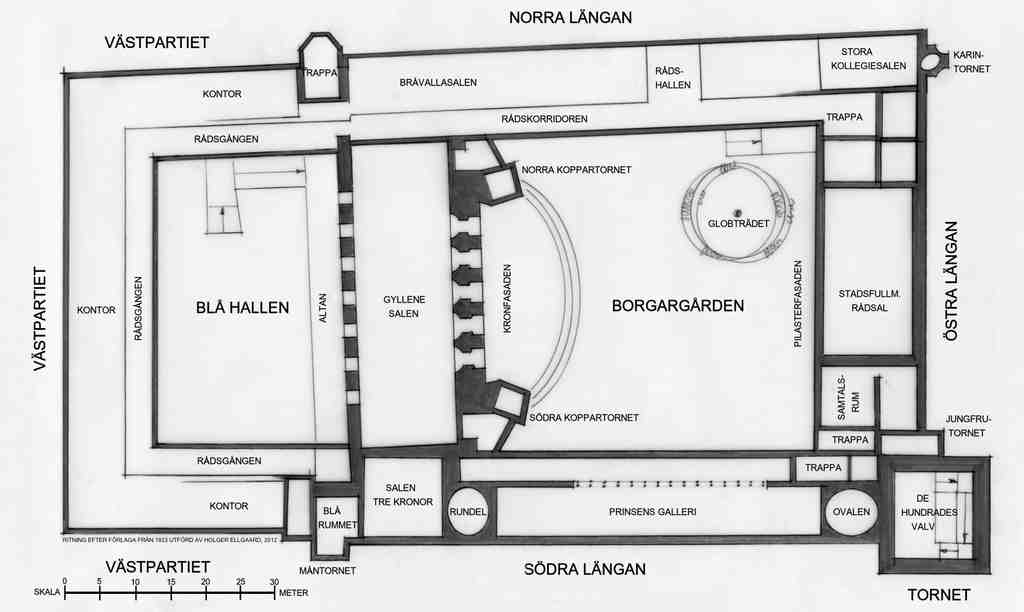
Before you stands a massive dark red brick complex organized around wide internal courtyards, anchored by a soaring square tower in the corner. This is Stockholm City Hall. It looks like it has been here for centuries, but it actually opened in nineteen twenty three.
The lead architect, Ragnar Östberg, had a rather romantic vision. He looked at the water lapping against the shore and saw Venice. He drew direct inspiration from the Doge's Palace and the famous bell tower of Saint Mark, blending Italian Renaissance elegance with Nordic grit. Earlier, we talked about the lost vision of Sergels Torg, where grand architectural dreams were swallowed by compromise. But here, Östberg's monumental vision survived intact. It is an awe-inspiring achievement of civic ambition, demanding fifteen years and roughly eight million bricks to complete. Over one million of those bricks were carefully shaped by hand.
Yet, building a masterpiece of this scale rarely comes without a heavy toll on the mortals who dare to shape it. Östberg was the obsessive conductor, but he relied heavily on a team of brilliant minds. One of them was a highly gifted young architect named Elis Benckert. Benckert was entrusted with the monumental task of designing the interiors and furnishings. But the relentless pressure and his own internal struggles proved too much. In a quiet, devastating tragedy, Benckert took his own life on New Year's Eve in nineteen twelve. The loss of this doomed creator halted interior work for years, a dark shadow cast over the city's gleaming new monument.
Eventually, the work resumed, and the result is staggering. Inside, you will find the famous Blue Hall. Funny enough, it is not blue at all. Östberg loved the raw texture of the hammered red brick so much that he abandoned the blue plaster entirely. This very hall is where the Nobel Prize banquet is held each year, hosting the world's most brilliant minds. Just above it is the Golden Hall, a dazzling space lined with over eighteen million pieces of gold leaf and colored glass mosaic.
If you want to step inside and see these spaces, the building is open to visitors every day from eight thirty in the morning until four thirty in the afternoon.
Look up at the top of that one hundred and six meter tower. It is crowned with three golden crowns, an ancient symbol of the Swedish realm. They angle outward, looking across the water toward our next destination. We are heading to the ancient burial grounds of Riddarholmen, where royals and creators alike find their final rest. The Riddarholm Church is about a ten minute walk away, so let us keep moving.




