
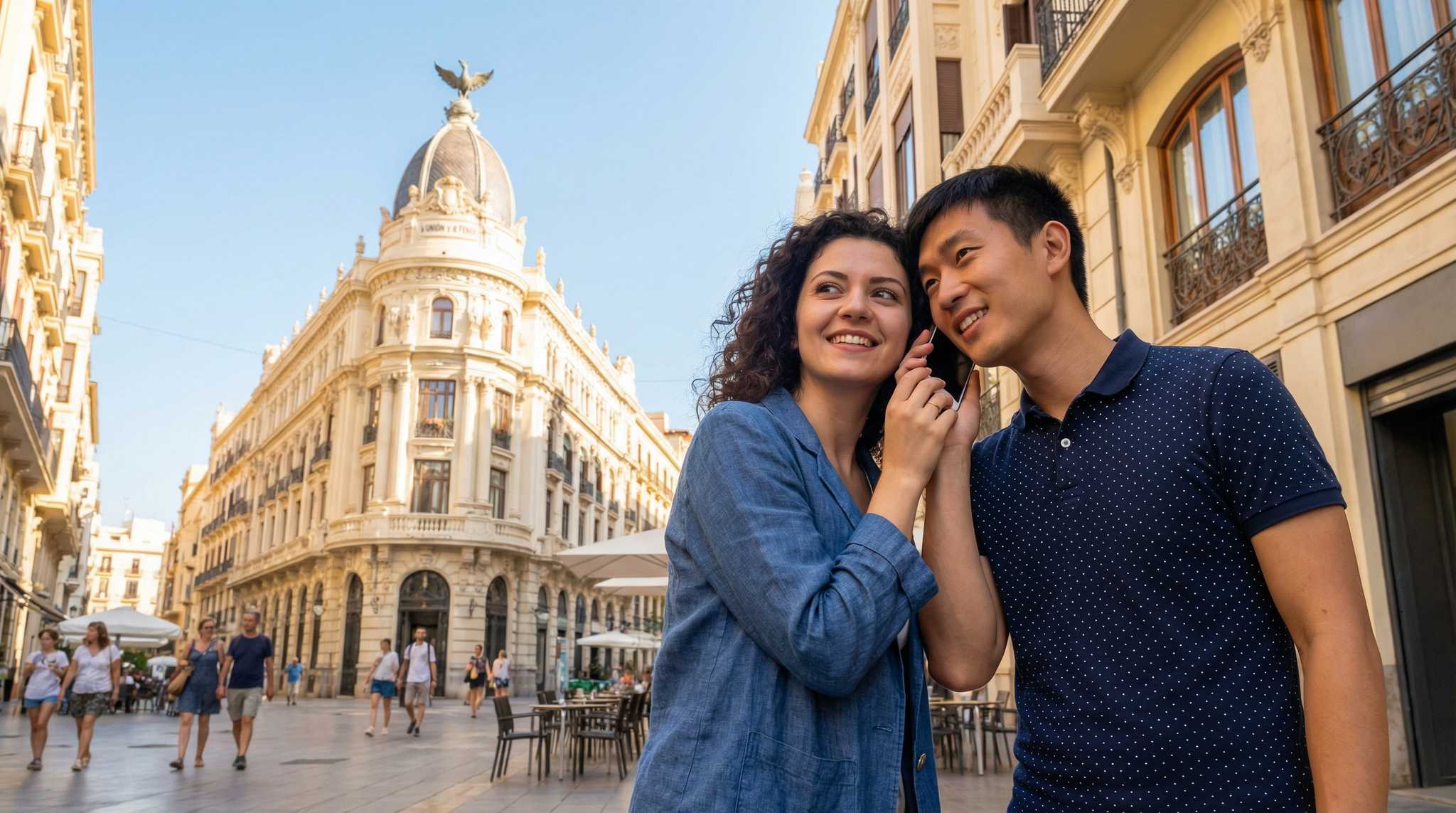
Valencia Audio-Tour: Legenden und Pracht in den Straßen von Sant Francesc
Ein Phönix schwebt über Valencias Straßen und trägt einen entschlossenen Reiter, während Marmorstatuen schweigend über prächtige Plätze wachen. Der Kern dieser Stadt birgt Schichten vergessener Rebellion, architektonischen Ehrgeizes und explosiver Feierlichkeiten direkt unter Ihren Füßen. Begeben Sie sich auf eine selbstgeführte Audio-Reise durch Sant Francesc und entdecken Sie Geschichten, die die meisten Reisenden übersehen. Gehen Sie dorthin, wo Versicherungsmogule es wagten, in Kriegszeiten zu bauen, Blumenhändler hartnäckig unter der Erde kämpften und das Rathaus gleichzeitig Schule und Palast wurde. Welche geheimen Streitigkeiten entfalteten sich unter dem „Schichtkuchen“-Platz, als Floristen rebellierten? Welches mächtige Artefakt verbirgt sich hinter den opulenten Mauern des Rathauses? Warum wurde ein mythischer Vogel in Valencias stürmischsten Tagen zu einem Symbol der Widerstandsfähigkeit? Bewegen Sie sich zwischen Legenden und Skandalen, während Sie lebendige Plätze, schattige Torbögen und von Helden gekrönte Dächer erkunden. Lassen Sie jeden Schritt Drama und Transformation an Orten enthüllen, die gewöhnlich erscheinen – bis Sie genauer hinhören. Bereit, zum Phönix aufzublicken und in den Puls von Valencias lebendiger Geschichte einzutauchen? Beginnen Sie Ihr Abenteuer jetzt.
Tourvorschau
Über diese Tour
- scheduleDauer 30–50 minsEigenes Tempo
- straighten2.2 km FußwegDem geführten Pfad folgen
- location_on
- wifi_offFunktioniert offlineEinmal herunterladen, überall nutzen
- all_inclusiveLebenslanger ZugriffJederzeit wiederholen, für immer
- location_onStartet bei Gebäude La Unión y el Fénix
Stopps auf dieser Tour
Take a look up at the impressive corner of Xàtiva street and Av. Marqués de Sotelo-keep your eyes peeled for those grand, carved facades and a rooftop crowned by a phoenix with a…Mehr lesenWeniger anzeigen
Take a look up at the impressive corner of Xàtiva street and Av. Marqués de Sotelo-keep your eyes peeled for those grand, carved facades and a rooftop crowned by a phoenix with a very bold rider! Welcome to the La Unión y el Fénix Building, where elegance, history, and just a dash of drama blend right into the heart of Valencia. Picture yourself back in 1929: the city buzzes with energy, cars rattle by, and Enrique Viedma Vidal, a talented local architect, has a vision. He imagines a neobaroque palace-seriously, he must have had an incredible imagination, or just one too many strong coffees! He designed this structure for the famous insurance company La Unión y el Fénix, and he really went for it: two grand facades, arched entryways, and shops and homes piled gracefully above the busy streets. But, as often happens, things weren’t so smooth. Construction started in 1931-right in the middle of the Spanish Civil War. Can you imagine the chaos? You’re laying bricks while the whole country shakes! But here’s my favorite part: look up at the very top. That proud little temple with columns is capped by a heroic phoenix, carrying a determined man. Hey, if I had a phoenix to ride to work, I’d never be late! This wasn’t just fancy decoration; it was the symbol of the insurance company, promising to rise above trouble and always start anew. So, as you stand here, the building is whispering tales of resilience, community, and maybe, just maybe, a touch of corporate flair with mythical birds. Now, ready to follow more stories around this amazing neighborhood? Let’s keep walking!
Eigene Seite öffnen →To spot the Town Hall of Valencia, look for a grand stone building with a central clock tower, statues standing guard near the front, and flags waving above its elegant columned…Mehr lesenWeniger anzeigen
To spot the Town Hall of Valencia, look for a grand stone building with a central clock tower, statues standing guard near the front, and flags waving above its elegant columned entrance, right in the heart of the city’s bustling main square. Welcome to the Town Hall of Valencia, or as the locals like to call it, La Casa Consistorial! You’re standing before one of the city’s most iconic and lively buildings-a real mashup between old-world charm and the bold ambitions of a new era. If buildings could talk, this one would probably ask, “Do I look better from the left or the right?” because, believe it or not, each side tells a different story. Close your eyes for a moment and imagine Valencia in the mid-1700s. Life here was buzzing, and Archbishop Andrés Mayoral had a grand idea: he wanted to build a school for girls, called the Casa de Enseñanza. Picture nuns gliding across the courtyard, children giggling in their classrooms on the lower floors, and tired students dreaming in their dormitories up above. If you listen closely, you might still hear the faint echoing through the stone. But the scene out here is a far cry from school uniforms and squeaky shoes! Fast forward to the roaring 20th century, and Valencia wanted a Town Hall to impress. They called in architect Carlos Carbonell Pañella in 1904, who must’ve thought, “We need something BIG, with clock towers, statues, bells, and enough marble to make the neighbors jealous!” And so, right in front of you, the two-faced personality of the Town Hall was born. One part school, all about order and learning, and one part grand palace, bursting with statues, arches, and-right in the middle-a clock tower that watches mischievously over the city’s daily hustle. Take a close look at the statues. It’s like a superhero team, but for virtues! You’ll spot marble figures symbolizing Justice, Prudence, Strength, and Temperance, carved by some of Valencia’s best sculptors, like Carmelo Vicent and Vicente Beltrán. Then there are the two marble ladies holding up the city’s coat of arms-don’t worry, they’re not real, but they are working hard to represent the Arts and Letters, just for you! And if you look way up at the tower, you can spot the clock and its bells, waiting to chime and remind everyone when it’s time to get back to business-or maybe just go for lunch. When you step inside (if you ever get the chance), you’ll find yourself treading on shiny marble floors, climbing monumental staircases, and maybe feeling a bit like a royal, even if you’re just looking for the bathrooms. The Town Hall’s interior is all grand paintings, enormous chandeliers, and marble everywhere, a place where every city celebration or important meeting buzzes with history. Even the parties here have a sense of style, with sculptures and reliefs of elegantly carved marble setting the scene for stories only these walls could tell. But here’s the twist: almost everything you see inside is a clever remix. The old school’s chapel became a sunlit, glass-roofed patio filled with busy offices. And the delicate rococo decorations? They’ve been tucked away behind new walls and floors, hidden like a secret waiting to be rediscovered. Imagine the mysterious as the city’s historical treasures are carefully preserved in the municipal archive and museum. Just think-inside these walls rests the famous Codex of the Fueros, the Consulate of the Sea Book, ancient banners, and even pieces of goldsmithery from centuries gone by. And as you stand here, facing this powerful mix of elegance and history, remember: this isn’t just a Town Hall. It's the stage for Valencia’s biggest moments-from festive parades to political drama and even the occasional lost tourist looking for the Tourist Information counter. So take a moment to appreciate this proud building-declared a national historic monument in 1962, it’s got enough stories to make your head spin and enough statues to start its own marble football team!
Eigene Seite öffnen →
8 weitere Stationen anzeigenWeniger Stationen anzeigenexpand_moreexpand_less
To spot the Valencian Museum of Illustration and Modernity (MuVIM), look out for a bold, modern concrete building with sharp angles, tall glass panels on top, and a striking…Mehr lesenWeniger anzeigen
To spot the Valencian Museum of Illustration and Modernity (MuVIM), look out for a bold, modern concrete building with sharp angles, tall glass panels on top, and a striking metallic pergola by the entrance-plus some colorful banners on the façade. Step closer and let your imagination wander: you’re about to enter one of Valencia’s most intriguing meeting points between past and future! This isn’t just another austere concrete box-MuVIM’s design has actually won architecture awards, and standing out front, you’ll feel its deliberate, clean lines inviting you into a world of ideas. Before the 21st century, this patch of ground hid more than you’d guess. Picture it centuries ago, occupied by the Hospital de los Inocentes-the very first psychiatric hospital in history! Only the central section remains (now a library), but if you stroll across the museum’s sprawling gardens, relics and bits of the ancient hospital are hidden beneath your feet, silently whispering their forgotten tales to the curious. But it’s what happened here in recent decades that really sends sparks flying. In the late 1990s, a bold idea took root: let’s build a museum dedicated to the very things that shape how we think and live-Enlightenment philosophy, revolutions, science, the rise of modern life, and all those moments when someone’s bright idea shook up society. That’s why it’s called the Museum of Illustration and Modernity. Inside, you’ll find permanent and temporary exhibitions-the heart of it being “The Adventure of Thought,” a walk through five centuries of history, where characters like medieval monks, prim Victorian housewives, and eccentric researchers come to life through sound, light, and even costumed guides. But wait, there’s more beneath the surface-a layer of drama! In 2010, the museum found itself in the eye of a political storm. The director resigned after an exhibit of controversial photos was censored by the city’s politicians. Journalists, artists, and hundreds of supporters rallied in defense, demanding freedom of expression. Imagine standing here amidst the crowd, voices echoing off these concrete walls-a vivid reminder that the museum isn’t just a place to look at cool things, but a space where big ideas collide and conversation gets loud. Want to dive deeper? Slip into MuVIM’s library and you’ll find a treasure trove of books dating from the Enlightenment, old maps, rare engravings, and even a legendary collection donated by the Lambert family-imagine the crinkle of ancient pages, the dusty scent of centuries-old ink, and the soft hush of scholars leafing through stories of logic, revolution, and the lives that shaped the modern world. There’s even a detailed scale model of Valencia as it looked in the 1700s, hand-painted and glowing with fiber optic lights-let yourself imagine the city as Father Tosca, the genius mathematician, saw it while mapping out every block, church, and alley. And speaking of things hidden in plain sight, don’t forget to look for the medieval tower integrated into the museum itself! It’s a survivor from the times when this area was just beyond the medieval city walls, built to defend against invaders-but never quite finished, as if it’s still waiting for its own story to end. Today, MuVIM is not just a museum, but a lively hub for conferences, film screenings, hands-on workshops, and the ever-shifting exhibitions where you might find anything from comic book art, to photography, to the story of the Borbón family’s inventions. It even hosts wild clay stop-motion exhibits-yes, you’re looking at one of the few places where Enlightenment thinkers and modern cartoonists could meet over a coffee (or maybe a heated debate about whether robots will soon write all our jokes). So go on-step through those glass doors. You’ll mingle with brilliant minds from centuries past, challenge the status quo, and discover Valencia’s own journey from medieval murkiness to bright, modern spark. And who knows? If you listen closely, you might just get an idea or two yourself... or at least be inspired to visit the next stop with a bit more curiosity! To delve deeper into the the building, collections or the controversies, simply drop your query in the chat section and I'll provide more information.
Eigene Seite öffnen →The MuVIM Library stands out as a modern, bright space with high white walls covered in colorful posters-just look for a building with large, glassy windows and an open, welcoming…Mehr lesenWeniger anzeigen
The MuVIM Library stands out as a modern, bright space with high white walls covered in colorful posters-just look for a building with large, glassy windows and an open, welcoming vibe on Calle Quevedo. Now, let’s take a breath and step into the world of ideas-because you’re standing in front of a landmark dedicated to none other than human curiosity: the MuVIM Library, or as it’s officially known, the Biblioteca y Centro de Documentación del MuVIM. Opened in October 2004, this isn’t your average book fortress. This library is like a time capsule mixed with a treasure chest, guarding the secrets of Enlightenment thinkers, daring revolutionaries, and visionaries on a quest for modernity. Imagine, if you will, the buzz of excitement back in 2004 when the doors first opened. The collection brought together not just one, but three major troves of rare and fascinating works. Suddenly, there was a new hub where you could run your fingers over pages printed centuries ago, from treatises of the French Revolution and stories about Napoleon, to passionate debates between 19th-century liberals and their slightly grumpier rivals, the reactionaries. There’s even a collection of breathtaking views and prints from the 16th right through the 19th centuries-if only those old engravings could talk! But wait, there’s more! How about a stash of books dedicated to the history, culture, and society of Valencia itself? The Diputación’s General Library contributed a vibrant mix, so if you wanted to know what Valencia was up to in the early 1900s, you’re in the right place. And let’s not forget cartography: here, you’ll find maps that chart the changing face of the entire region across four centuries. You could practically set sail on a paper ocean and land in the past. And what’s a library without a bit of personality? Enter the Alfons Roig Collection, the private library of the artistic, philosophical, and slightly eccentric Father Alfons Roig Izquierdo. His passion for art, especially catalogues and exhibition manuals, fills the shelves with both wit and wisdom. I like to imagine him peeking out from behind a stack of books, giving a gentle nudge: “Psst! Have you seen this catalogue of surrealist cats yet?” Plus, in 2005 came another twist: the IVEI collection, filled with works shaking up the political and cultural world of the 1980s and 90s. Picture scholars and dreamers debating into the night over well-thumbed magazines and rare journals. Not enough mystery? How about the Lambert Library, acquired in 2014? This came from a family of well-traveled architects and art historians who split their time between Paris and Jávea. Everything from art to architecture sits within-imagine opening a book knowing it might have once rested on a desk in 1920s Paris, or with a sea breeze drifting in off the coast of Jávea. But the MuVIM Library is much more than a resting place for books; it’s a beating heart for exhibitions, research, and design in Valencia. Whether you need wi-fi, a place to think, or inspiration for your next big idea, you’ll find it here. So take a peek inside-and if you get lost in the stacks, just remember, every great story begins with “Once upon a library…”
Eigene Seite öffnen →To spot the College of High Silk Art, look for the grand cream-colored building at number 7 with beautiful wrought iron balconies, colorful ceramic tiles beneath them, and an…Mehr lesenWeniger anzeigen
To spot the College of High Silk Art, look for the grand cream-colored building at number 7 with beautiful wrought iron balconies, colorful ceramic tiles beneath them, and an ornate stone entrance topped by a dramatic sculpted relief and a cardinal’s hat right above the doorway. Now, step closer and imagine yourself in old Valencia, in the heart of the bustling Velluters neighborhood-named for velvet, not because they liked soft furniture, but because it thrived on silk weaving! Picture the year 1494: artisans, noise, the swish of looms, and-yes-a lot of well-dressed people. Here stood the headquarters of the silk guild, a building that saw the humble thread of a silkworm transformed into some of the city’s richest treasures. The story begins even earlier, though. You see, in the days of the medieval Taifa of Balansiya, locals were already weaving silk. The real magic happened later when Italian masters journeyed here and sparked a velvet revolution-literally! By 1477, silk workers had their own official guild, the Gremio de Velluters, with royal rules approved by Ferdinand the Catholic. Their job? To make sure Valencia’s silk was the softest, brightest, and-most importantly-genuine, because if you tried to cheat, they could burn your cloth right here! This impressive building began as a gothic home, its very walls resting on even older Islamic foundations. By the eighteenth century, it blossomed into the baroque masterpiece you see today, with ornate stonework, balconies of iron, and colorful tiles from the 1700s. If you look up, don’t miss the proud relief of Saint Jerome-the silk workers’ patron-above the heavy entrance, his cardinal’s hat crowning the doorway. Legend has it the hat is there because people once believed Saint Jerome was the first cardinal, and every dignified silk guild needed a little extra flair! Inside, the rooms whisper stories of fortunes made and lost, of the silk industry’s heyday-when silk transformed Valencia’s economy. Here, decisions were made that shaped commerce, culture, and even fashion. The grand Sala de la Pometa has a floor decorated with apples and pomegranates (no relation to the fruit seller’s guild, by the way). The Sala de la Fama, or Hall of Fame, is covered with tiles featuring exotic animals-elephants from Asia, caimans from America, leopards from Africa, and horses from Europe. The message was clear: Valencia’s silk was world famous. But the threads weren’t always golden. In the 1800s, disaster struck. Industrial machines started to hum, hand-weaving jobs dwindled, and the silk worms themselves fell victim to a horrible disease called pebrina. Suddenly, you could almost hear the looms falling silent. Workers, desperate and angry, erupted in protest in what became the Motín dels Velluters, right outside these walls-Valencia’s first great working-class revolt. The silk industry stumbled, and the neighborhood slid into decline. The building was battered by time and nearly collapsed, especially when someone thought building an underground parking lot next door was a great idea. Spoiler alert: it wasn’t. But in the 21st century, a new fairy godmother (the Hortensia Herrero Foundation) waved a charitable wand, restoring the college and transforming it into the Museum of Silk you can visit today. Wander inside, and you’ll find more than historic halls: see a spiral staircase worn by centuries of hurrying feet, a chapel lined with glossy green and white tiles, and a spectacular baroque staircase with a lion clutching a cardinal’s hat (either Valencia’s bravest mascot or the fashion police, you decide). Don’t miss the old garden, now a peaceful patio shared with a café where you can sip something cool and imagine you’re the merchant king of silk. If you’re lucky, in the workshop at the back, you might catch the rhythmic rattle of a Jacquard loom weaving magic as it did centuries ago. And should you ever wonder where the secrets of this place are kept, know that its archive is the most important silk guild archive in Europe-hundreds of years of contracts, rules, and stories just waiting to be discovered. So take a good look around. Here, silk wasn’t just fashion-it was life, love, protest, power, disaster, and hope, woven into the very fabric of Valencia. And who knows? Maybe you’ll leave with a bit of that golden thread woven into your own story-just try not to spill coffee on it! Interested in knowing more about the building, file or the visits
Eigene Seite öffnen →To spot the Ateneo Mercantil de Valencia, just look straight ahead for a grand cream-colored building with tall, arched columns and several proud flags fluttering above the main…Mehr lesenWeniger anzeigen
To spot the Ateneo Mercantil de Valencia, just look straight ahead for a grand cream-colored building with tall, arched columns and several proud flags fluttering above the main entrance-trust me, its stately façade won't let you miss it! Alright, traveler, pause a moment and soak in the air outside this historic hub-we’re standing before one of Valencia’s beating cultural hearts. Picture the year 1879: the streets rattle with horse carriages and traders, the aroma of roasted almonds wafting from nearby stalls, and a group of determined gentlemen, led by Estanislao García Monfort and Eduardo Pérez Pujol, decide the city needs a new kind of gathering place. Not another tavern or a merchant’s guild, but a society for the everyday shop assistants-people who worked hard in the vibrant pulse of commerce yet thirsted for more learning and connection. And so, on March 23rd, the Ateneo Mercantil de Valencia was born - a place to nurture minds, spark creativity, and serve as the anchor for Valencia’s ever-curious spirit. Fast forward through decades, and you can almost hear the. The Ateneo quickly became more than a club for shopkeepers; it grew into Valencia’s civil soul, championing culture, education, and entertaining amusements of all kinds. From organizing trade schools to launching the city’s first stock exchange (wait, that’s more thrilling than it sounds, especially if you enjoy a dramatic hand-gesture-filled bidding war), the Ateneo kept pushing boundaries. But here’s a little suspense: Valencia in the 20th century saw its fair share of drama. The Ateneo threw its elegant weight behind landmark projects, like the mighty Regional Exposition of 1909-a massive event whose legacy includes that proud and playful Valencian Regional Anthem. Imagine crowds filling the square, bands playing, and banners fluttering with civic pride. Even during the Spanish Civil War, the Ateneo’s fate twisted and turned-renamed as the ‘Ateneo Popular’ and then, in the rubble of post-war years, shut down from 1939 to 1950. Yet, like a determined hero in a classic telenovela (maybe with a slightly messy mustache), it bounced back, declared of public utility and gold-medaled by the city itself. The story only grows richer. Let’s take a stroll-well, a mental one-into the library upstairs, where nearly 53,000 books are waiting, some as old as San Vicente Ferrer himself. The air smells of paper and possibility, and tucked among these tomes are priceless manuscripts, centuries-old newspapers, and more stories than any one person could hope to read in a lifetime. The Ateneo’s pinacotheca even shelters paintings once owned by the photographer Antonio García Peris-a man legendary enough to be Joaquín Sorolla’s father-in-law! Oh, and guess what? The legacy is modern and bright, too. For the first time in 2013, a woman-Carmen de Rosa Torner-took its helm, leading the institution with a lawyer’s cleverness and the heart of someone who believes in public service. She’s brought new life, digital pizzazz, and a global mindset to the rooms where gentlemen in top hats once debated the price of oranges. Today, the Ateneo Mercantil is bursting with events-art exhibitions, language classes, lectures, and more coffee-fueled meetings than your favorite café. Its doors are open to almost 4,000 members, and plenty of outside groups rent its stately rooms for festivals, conferences, and, I’m told, the occasional impromptu dance. So, as you stand here, feel the lively pulse of history under your feet! This isn’t just a beautiful building. It’s a time machine, a living testament to Valencia’s creativity, solidarity, and stubborn belief that every single citizen’s dream matters. Now, who’s up for joining a century-old club? Don’t worry-membership doesn’t require you to recite Latin or wear a powdered wig, but I’d love a photo if you tried!
Eigene Seite öffnen →To spot the Teatro Principal, look for a grand stone building with towering columns and arched windows set right at the corner - it stands out with its classical facade facing the…Mehr lesenWeniger anzeigen
To spot the Teatro Principal, look for a grand stone building with towering columns and arched windows set right at the corner - it stands out with its classical facade facing the lively Calle de las Barcas. Standing here, you’re about to hear stories that could fill a thousand seats. Imagine the street outside bustling with carriages and people in fancy hats-because, back in the 18th century, that was the scene when the city first dreamed of this very theatre. Designed by the Italian architect Filippo Fontana in 1774, the project took its sweet time getting off the ground and, like an actor with stage fright, it was years before construction really began! When the theatre finally opened its doors in 1832-only partially finished-it already promised magic inside its walls. Walk closer and try to picture stepping inside to behold that original rococo interior: shimmering gold, swirling shapes, as if a cake decorator had gone wild with plaster and paint. Picture the hush falling over the crowd just before the lights go down. Now, listen-can you hear the wild applause from March 1845, when the legendary composer and pianist Franz Liszt played here? He was such a sensation he even invited the audience to shout out requests, promising to improvise pieces on the spot. Talk about confidence! His concerts were the blockbuster events of the century, and the music nearly lifted the roof. Fast forward to the 20th century-Valencia’s most elegant theatre had another claim to fame. In 1918, the prestigious Ballets Russes breezed in from stages as grand as New York’s Metropolitan Opera House, and the city’s press could barely contain their excitement. Opera premieres, orchestras, even the pop star Nino Bravo made his debut here, serenading swooning fans in 1969. Did you know Rudolf Nureyev, the world-famous Russian dancer, also captivated crowds here in 1985? Imagine the hush, the gasp, as he leapt across the stage like a real-life superhero. Not all was smooth sailing, though. This theater has survived renovations, changing fashions, and lunchtime rumors about haunted dressing rooms (don’t worry, the only ghost here is the spirit of incredible performances!). In the 1990s, it was lovingly restored to make it comfier and more accessible, ensuring that music, dance, and drama continue to echo through its halls today. So, take a deep breath, and listen-can you almost hear the curtain rising? Welcome to the beating heart of Valencia’s stage magic!
Eigene Seite öffnen →To spot the Palace of the Marqués de Dos Aguas, look for an ornate, peach-and-cream colored mansion with extravagantly decorated stucco facades and corner towers, standing proudly…Mehr lesenWeniger anzeigen
To spot the Palace of the Marqués de Dos Aguas, look for an ornate, peach-and-cream colored mansion with extravagantly decorated stucco facades and corner towers, standing proudly at the corner of the square with swirling carvings framing the main entrance. Welcome, traveler! Prepare to have your breath stolen-don’t worry, only for a second-by this most theatrical of Valencian landmarks: the Palace of the Marqués de Dos Aguas. Before you stands a building so ornate and flamboyant, it makes most wedding cakes look downright underdressed. But don’t just admire it from afar. Step closer. Imagine the swirl of carriages in the square, the velvet rustle of noble cloaks, and the echo of whispered secrets filtering through those gilded walls. The story of this palace is, frankly, the kind of tale that would make even a telenovela jealous. Long ago, a knight named Don Francisco Perellós swept a rich heiress named Joanna Perellós off her feet. (Ah, love-and strategic marriages!) Their descendants took on both their names, forming the proud Rabassa de Perellós dynasty. You’d think marrying well would be enough, but this family was as ambitious as they come. They acquired the barony of Dos Aguas and, thanks to a royal favor in 1699, became marquises. Add a little wealth from savvy business deals and more alliances than you can shake a stick at, and voilà-you’ve got the crown jewel of Valencia's aristocracy. Originally, this site was perhaps a Roman necropolis-yes, you heard me right. Coffins, not comfort, likely dominated this address centuries ago! By the 15th century, the Rabassa de Perellós family built a Gothic palace here, with towers, crenellations, and even a courtyard. But ambition, as it tends to, demanded more-so in the dazzling 18th century, the marquises decided to turn up the glamour to an eleven. They called in the best: painter Hipólito Rovira, sculptor Ignacio Vergara, and decorator Luis Domingo. Together, they transformed this gloomy medieval pile into a Rococo spectacle, with facades swirling with allegorical creatures, cherubs, and enough mythological gods and goddesses to make Mount Olympus jealous. Let’s talk about that entrance. Does it seem a little... over the top? Well, that's the point. In 1745, Ignacio Vergara crafted the grand portal from alabaster-a creamy stone that practically glows at dusk. Notice the muscled, nearly-naked river gods pouring water: they’re the personifications of the Turia and Júcar rivers, a nod (or maybe a flex) to the title “Dos Aguas.” Crocodile heads, reclining lions, quivers of arrows, fruit, urns-if you can name it, it’s probably worked into this portal. Look up to spot the Virgin of the Rosary, surrounded by allegories of Agriculture and Justice, flanked by mermaids with wings, no less. Talk about security detail! If the marquises were at home, the Virgin would be on display. If not-she was hidden from view. A medieval out-of-office notice, you might say. Walk around to the side and you’ll find the carriage entrance, less showy but still sporting wooden doors studded with Greek masks and the initials “MD.” Imagine the crunch of hooves, the clatter of wheels, arrivals for a masked ball, a diplomatic dinner, or perhaps just another day in Spain’s most decorative family home. Look up at those facades-every level tells a story. You’ll spot Minerva, Ceres, Jupiter, Mercury, mermaids, lions, even a torch-wielding goddess named Aurora who’s in charge of lighting up the world every morning (and presumably, keeping everyone on schedule). There are balustraded balconies, pink and gray stucco pretending to be marble, and a riot of decorative busts, shields, eagles, masks, and cherubs. Some details are even an ode to silk and agriculture: after all, there’s no harm in showing off the source of the family fortune. Step inside-if you get the chance, since now it houses the National Museum of Ceramics and Decorative Arts-and the splendor only multiplies. Floors of colored tiles depicting epic tales, walls covered in damask, and grand marble staircases flanked by goddesses. Imagine the waltz of musicians, the din of laughter, and the swirl of silk at a 19th-century ball. Rooms have far-flung styles: a Far East tearoom with Mongol-inspired corners and Japanese vases; a riotous ballroom; a lobby watched over by a marble Flora; even a secret oratory where images of Mary preside over silent prayers. Oh, and here's a detail for your next pub quiz: they say the marble for that stucco was quarried from the very lands that gave the marquises their name, Dos Aguas. Now, if you hear any whisper of ghosts, well-when you’ve had Roman necropolises, centuries of noble drama, and masked balls, someone’s bound to linger. So take a moment and soak in the drama, the artistry, the sheer love of spectacle. Who knows? Maybe you’ll leave with a little rococo flair in your step. And with that, our tour comes to a close by the wildest, most splendid palace in all of Valencia. Thanks for exploring with me-you’ve officially walked in the footsteps of nobility, if not walked away with their fortune! Safe travels, adventurer.
Eigene Seite öffnen →

Häufig gestellte Fragen
Wie starte ich die Tour?
Laden Sie nach dem Kauf die AudaTours-App herunter und geben Sie Ihren Einlösecode ein. Die Tour ist sofort startbereit – tippen Sie einfach auf „Play“ und folgen Sie der GPS-geführten Route.
Benötige ich während der Tour Internet?
Nein! Laden Sie die Tour vor dem Start herunter und genießen Sie sie vollständig offline. Nur die Chat-Funktion benötigt Internet. Wir empfehlen den Download über WLAN, um mobiles Datenvolumen zu sparen.
Handelt es sich um eine geführte Gruppentour?
Nein – dies ist ein selbstgeführter Audioguide. Sie erkunden unabhängig in Ihrem eigenen Tempo, wobei die Audioerzählung über Ihr Telefon abgespielt wird. Kein Reiseleiter, keine Gruppe, kein Zeitplan.
Wie lange dauert die Tour?
Die meisten Touren dauern 60–90 Minuten, aber Sie kontrollieren das Tempo vollständig. Pausieren Sie, überspringen Sie Stopps oder machen Sie Pausen, wann immer Sie wollen.
Was, wenn ich die Tour heute nicht beenden kann?
Kein Problem! Touren haben lebenslangen Zugriff. Pausieren Sie und setzen Sie sie fort, wann immer Sie möchten – morgen, nächste Woche oder nächstes Jahr. Ihr Fortschritt wird gespeichert.
Welche Sprachen sind verfügbar?
Alle Touren sind in über 50 Sprachen verfügbar. Wählen Sie Ihre bevorzugte Sprache beim Einlösen Ihres Codes. Hinweis: Die Sprache kann nach der Tour-Generierung nicht mehr geändert werden.
Wo greife ich nach dem Kauf auf die Tour zu?
Laden Sie die kostenlose AudaTours-App aus dem App Store oder von Google Play herunter. Geben Sie Ihren Einlösecode (per E-Mail gesendet) ein, und die Tour erscheint in Ihrer Bibliothek, bereit zum Download und Start.
Wenn Ihnen die Tour nicht gefällt, erstatten wir Ihnen den Kaufpreis. Kontaktieren Sie uns unter [email protected]
Sicher bezahlen mit 


