AudaTours logoAudaTours

Treviso Audio Tour: Echos von Mauern, Wundern und Kriegsgeschichten

Audioguide15 Stopps

Hinter Trevisos ruhigen Fassaden verbergen sich Schichten der Geschichte – wo Kathedralsteine einst von geheimen Ritualen widerhallten und schattenhafte Geschäfte auf sonnenbeschienenen Plätzen stattfanden. Diese selbstgeführte Audiotour enthüllt Trevisos stille Geheimnisse und führt Sie durch die stille Intrige seiner Kathedrale, das geschäftige Herz der Piazza dei Signori und Denkmäler, die Geschichten flüstern, die nur wenige je hören. Entdecken Sie Geschichten und Ecken, die die meisten Besucher nie zu Gesicht bekommen. Was trieb eine wütende Menschenmenge dazu, an einem angespannten Nachmittag das Kriegerdenkmal zu stürmen? Welches verbotene Relikt verschwand einst spurlos hinter dem Altar des Doms von Treviso? Warum wurde ein einziger blauer Regenschirm zum Symbol des Aufstands mitten auf der Piazza dei Signori? Bewegen Sie sich durch verwinkelte Gassen und über widerhallende Plätze, während Jahrhunderte politischer Machtspiele, verschwundener Legenden und leiser Skandale um Sie herum lebendig werden. Spüren Sie, wie jeder Stein mit dem Drama der verborgenen Vergangenheit der Stadt pulsiert. Hören Sie Trevisos Geheimnisse – beginnen Sie Ihre Reise jetzt und sehen Sie, was alle anderen verpassen.

Tourvorschau

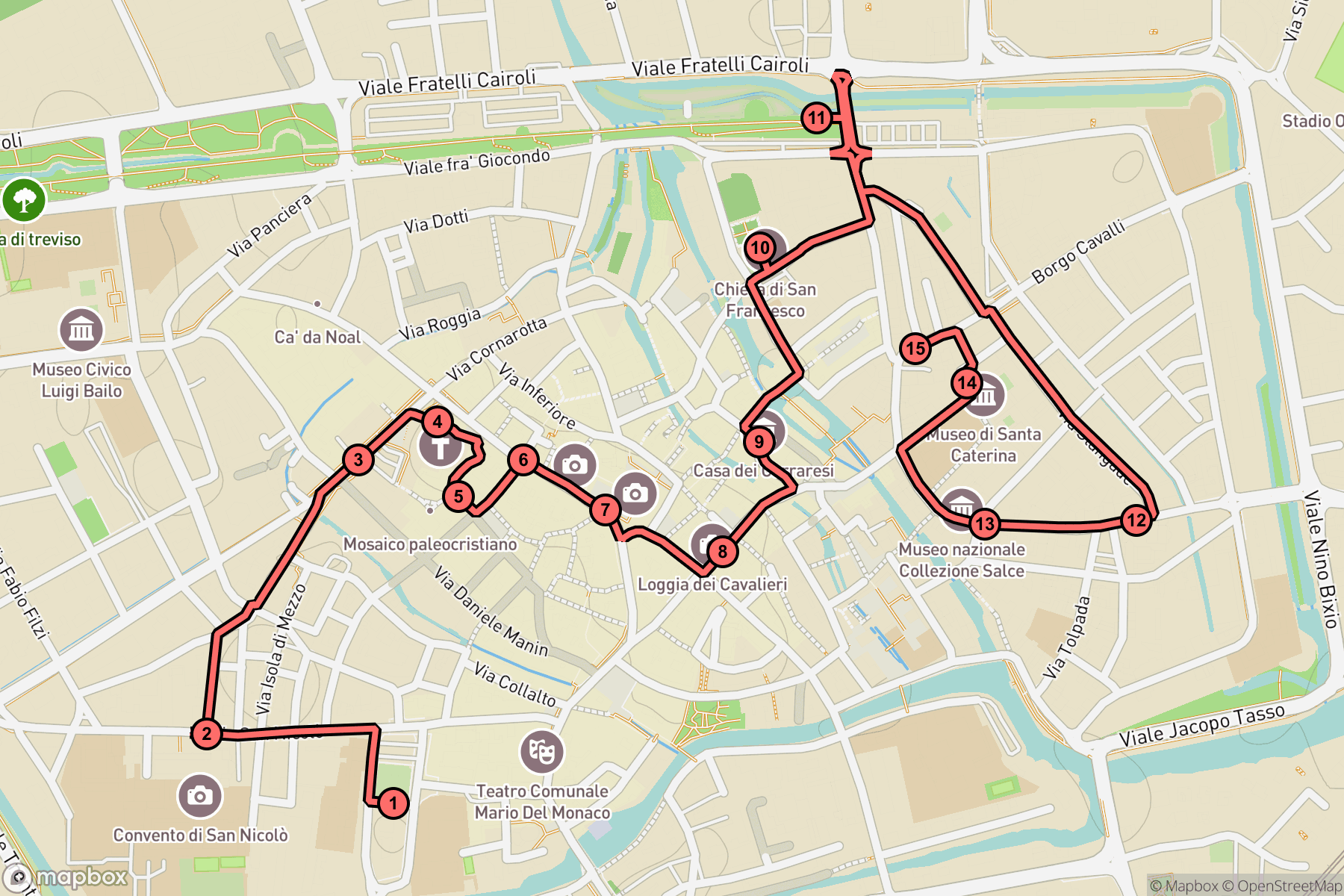
map

Über diese Tour

  • schedule
    Dauer 40–60 minsEigenes Tempo
  • straighten
    3.1 km FußwegDem geführten Pfad folgen
  • location_on
    StandortTreviso, Italien
  • wifi_off
    Funktioniert offlineEinmal herunterladen, überall nutzen
  • all_inclusive
    Lebenslanger ZugriffJederzeit wiederholen, für immer
  • location_on
    Startet bei Kriegerdenkmal

Stopps auf dieser Tour

  1. Look to the northeast corner of Piazza della Vittoria; you’ll spot a tall, commanding stone and bronze monument, its sculpted figures clustered together on rising steps, a…Mehr lesenWeniger anzeigen

    Look to the northeast corner of Piazza della Vittoria; you’ll spot a tall, commanding stone and bronze monument, its sculpted figures clustered together on rising steps, a dramatic presence among the open square and the rows of city buildings. Welcome to the War Memorial of Treviso, which the locals call “Gloria.” As you stand here, soak in the atmosphere-imagine it’s 1931, and this very plaza is buzzing with excitement. You’d hear the clatter of footsteps, the shuffle of uniforms, even the whisper of anticipation in the autumn air as King Vittorio Emanuele III himself arrived to unveil this monument. This square didn’t even fully exist before the monument: in fact, “Gloria” inspired Treviso to join together two smaller squares and create the sprawling Piazza della Vittoria you see now, right in the heart of the city’s daily life. But let’s rewind a bit. After the victory of November 4th, 1918, the people of Treviso were determined to honor their lost friends, family, and neighbors from a war that scarred the town and its surrounding countryside. Committees sprang up everywhere-practically every neighborhood, every street! People debated, sometimes heatedly, where to place the memorial. They considered the Palace of the Trecento, the Loggia dei Cavalieri, or even building a triumphal arch on Viale Vittorio Veneto, the avenue soldiers once marched down. You could almost hear arguments floating through the streets: “It must be grand!” “No, it must be solemn!” “Why not both?” After much back and forth-and plenty of Italian passion-it was decided: there’d be a national competition for the design. The year was 1926. Artists from all over Italy submitted their boldest ideas, with their names hidden behind secret mottos. Only the best would be worthy of Treviso’s grief, its pride, and the memory of its fallen. In the end, from the swirling, creative storm, one vision rose above the rest: Arturo Stagliano’s design, chosen for its emotion and originality, not to mention its eye-catching presence. The title “Gloria” promised to honor both sacrifice and victory, never forgetting the cost to the city and its people. It wasn’t all smooth sailing-picture the nervous committee, checking calendars as deadlines drifted by. It took years of back-and-forth, design tweaks, and careful negotiation before Stagliano finally achieved his vision. First, he considered making eighteen bronze figures, then sixteen; sometimes, the design shifted, as if the monument itself was pondering how best to express its story. Stagliano was stubborn-in a good way. He insisted the monument "should have no single face" and "no inscription," so it could speak directly to hearts, not just to eyes. When the day finally came, and the scaffolding was pulled away, Treviso gasped. There, on the new Piazza della Vittoria, the monument stood-a grand funeral procession in bronze and stone, telling the universal tale of loss and remembrance. At the center lies the fallen hero, sword and shield upon his chest, laurel leaves marking both sacrifice and glory; around him gather mourners-youthful comrades, grieving women-each figure wrapped in sadness, yet strangely united in a kind of solemn, dance-like movement. Stagliano wanted people to see not just celebration of victory, but the deep pain of those left behind, a message for all generations. Let’s not forget, this monument survived its own share of battles. On a dark day in April, 1944, bombs rained down on Treviso. The explosion toppled the side figures and sent shockwaves through the monument’s stone base. Yet, like the city itself, it wasn’t defeated. Soon after the war, careful hands raised it again, restoring its strength and dignity. Time, the weather, and even a few cheeky pigeons took their toll over the decades. But Treviso loves its monument; in 2016, “Gloria” was lovingly cleaned and restored, its bronzes polished, its message renewed for anyone who might forget the price of peace. The square filled with people again-this time, not for a king, but for the heartfelt memory of all taken by wars, and for the quiet hope of unity. So next time you see people crossing the square, pausing for a photo, or just sitting in quiet thought, remember: you’re standing in a place born from debate and determination, loss and triumph, art and emotion. “Gloria” stands watch, a silent storyteller, sharing the courage of Treviso’s past with every heart that passes by. And hey, if you happen to spot a pigeon sitting proudly atop the memorial-it’s probably just taking a moment to appreciate some fine sculpture... or maybe it’s just enjoying the view!

    Eigene Seite öffnen →
  2. To spot the Church of San Nicolò, just look for the towering, reddish-brick facade with a grand arched doorway and a rose window above it, rising tall and dramatic against the sky…Mehr lesenWeniger anzeigen

    To spot the Church of San Nicolò, just look for the towering, reddish-brick facade with a grand arched doorway and a rose window above it, rising tall and dramatic against the sky on your left. Welcome to the Church of San Nicolò, the gentle giant of Treviso! As you stand before this soaring wall of warm brick, let’s slip back in time to the year 1221. Picture a city buzzing with change, when a group of Dominican friars-all cloaks and determination-are invited by Treviso’s city leaders to build something extraordinary. With 500 lire jingling in their pockets (which would buy quite a lot of pizza today, by the way), they chose this very spot, wrapping their new church and convent inside the fresh protective ring of city walls. It’s said there was already a humble chapel to Saint Nicholas here, but the Dominicans dreamed big-so big, in fact, that this would become the city’s largest church, outshining even the Duomo! Imagine the sound of hammers and chisels echoing as the first bricks are laid. By 1282, the massive, cross-shaped church was already standing proud-so impressive that it was used as a model for other religious buildings across the region. Here, a young friar named Niccolò Bocassino began his spiritual journey. Little did the brothers know, this diligent friar would one day become Pope Benedict XI! After his time guiding the Dominicans and a stint as a cardinal, he journeyed through Treviso, leaving behind a dazzling donation of 25,000 gold florins so his brothers could expand this grand complex. The story goes that he had such a soft spot for this place, he may have even left another hefty 48,000 gold coins in his will-and secretly plotted, if you can believe it, to bring the Pope’s headquarters right here to Treviso! Imagine Treviso, the center of the Church… now there’s a plot twist. Walk around the outside and you’ll see the building’s unique style, a mix of Romanesque firmness and Gothic ambition. Its tall, thin pilasters give it a sense of upward movement, as if the whole building is itching to leap toward the clouds, brought back to earth only by its massive, solid walls. The pointed arch of the entrance and the rose window, with its intricate terracotta design, lead your eye straight up to the very top, often glowing in the afternoon sun. It’s almost like a brick rocket about to launch! The best full view is actually from around the northern side among the chapels, though the tight urban squeeze doesn’t always let you step back and fully admire its size. The outside is breathtaking, but wait until you imagine the inside: the nave stretches a whopping 88 meters long, with soaring ceilings and columns-ten robust ones of brick and two up front in stone-each matching the number of the Apostles. Sunlight pours inside, dancing across warm, golden bricks, and lighting up the great, airy space. The three naves and five chapels create a grid of light and shadow, and the side aisles reach so high you almost get dizzy just looking up. Painted on some of these columns you’ll find the handiwork of Tommaso da Modena: the wise faces of Saint Jerome, Saint Agnes, and Saint Romuald gaze out from the stone, their ancient, compassionate eyes watching centuries go by. Here’s a secret told in shadows-the church is angled just right so that, on winter solstice around noon, the sun pierces through the north windows, lighting up six saints’ medallions in a luminous line, as if the saints themselves are winking at you once a year. Look behind the altar, and you’ll see the grand Gothic apse, spiked with tall, narrow windows. Tucked here is the ornate tomb of Agostino Onigo, made by master sculptors and painters-some whisper the name Lorenzo Lotto, others debate, but all agree it’s a treasure. And don’t miss the painting of the Madonna with music-loving angels, finished in 1521, bringing a bit of Renaissance flair to the medieval walls. If you suddenly hear majestic organ music, don’t be surprised! The church houses a massive pipe organ from the 18th century by Gaetano Callido, with over a thousand pipes and keys waiting for nimble fingers, and a smaller, more recent organ, too. Even the old Dominican convent next door-now a seminary-is full of secrets, like frescos showing abbots with, get this, the earliest example ever of a pair of eyeglasses. So as you take in San Nicolò, imagine the echo of prayers, the toll of coins, the clash of ambition and devotion, and maybe-just maybe-the rustle of papal robes considering a new home in Treviso.

    Eigene Seite öffnen →
  3. As you stand in front of the Monigo Concentration Camp, take a moment to picture this place not as it is now, but as it was in the heat of World War II. The air would have been…Mehr lesenWeniger anzeigen

    As you stand in front of the Monigo Concentration Camp, take a moment to picture this place not as it is now, but as it was in the heat of World War II. The air would have been tense, filled with the heavy footsteps of guards and the anxious whispers of prisoners. The camp, housed in the newly built "Cadorin" barracks, opened its gates in July 1941-not for freedom, but for those caught in the tides of war: mostly Slovenian and Croatian civilians, swept up by the violence and politics of the era. Over its bleak existence, Monigo saw somewhere around ten thousand souls pass through-though no one can say the exact number. The military said the camp could fit about 2,400, maybe 2,700 people. But at its most crowded, there were up to 4,000 jammed together. If you’re thinking, “That sounds tight,” you’re right! Forget luxury accommodations-these were cold, stone barracks, divided into six giant dormitories with rows of squeaky bunk beds and barely enough blankets to go around. Imagine the routine: a new arrival at the gates would be hustled inside, doused with a cleansing shower-think less “spa day” and more “let’s just get the lice off.” Clothes were disinfected and handed back, because uniforms weren’t part of the deal here. As a welcome gift, you’d receive two blankets, a spoon, a mess tin, and some straw to sleep on-a starter kit for surviving camp life, Monigo-style. Bedding was thin, food thinner. According to the official plan, each prisoner would get 911 calories a day-barely enough energy to argue with your bunkmate, let alone survive. And, thanks to the “creative accounting” of certain guards who skimmed supplies to sell on the black market, many received less than that. Now, discipline here was as chilly as the unheated barracks. Inspections were frequent, rules tight, and yes-there were attempts to escape. Some artists, like the Slovenian Vladimir Lamut, tried to capture camp life with drawings showing prisoners shoveling or fixing things-more out of necessity than boredom, I assure you. Violence wasn’t systematic, but fear certainly lingered. Stories tell of Colonel Alfredo Anceschi, the stern commander, who once tied a woman to a post for a whole day as punishment. Not exactly the neighborhood’s friendliest welcome committee. Prisoners were technically divided into two groups-those the regime considered dangerous and those they claimed to be protecting. But, as is often the case when bureaucrats have too much to do, everyone ended up mixed together. This, in a crowded, stressful environment, only heightened the tension and the risk of conflict. And the food… The less we say about it, the better. Malnutrition was rampant-shortages of protein, fats, vitamins, and just about anything else you’d find in a hearty Italian meal. Many inmates depended on care packages from the outside, but if you didn’t have family or a network, your days were much, much harder. By the bitter winter months, the already weakened-especially women and children-were the first to succumb to hunger and disease. Just think: around 200 people died in Monigo, the records say-though the real number might be higher. Over fifty children under ten years old lost their lives here. One local doctor, Professor Menemio Bortolozzi, conducted autopsies and declared that these victims didn’t look normal: “They seemed like mummies, or bodies exhumed from graves.” That paints a somber picture, doesn’t it? But the story doesn’t end there. When the fascist regime toppled and the war slowed, Monigo briefly closed… only to open again in 1945, this time as a refugee camp under Allied control. The sounds changed: new languages echoed through the halls-Polish, French, Slavic. Almost 20,000 people passed through on their way to uncertain futures, including Italians freed from German camps. Eventually, the camp closed down, and the site returned to military use, its memories buried but not forgotten. Today, as you stand here, try to feel that mix of fear, endurance, and the unbreakable hope that so many carried within these very walls. History, after all, is never just stone and stories-it’s the echo of real lives, still whispering if you listen closely enough.

    Eigene Seite öffnen →
12 weitere Stationen anzeigenWeniger Stationen anzeigenexpand_moreexpand_less
  1. To find the Cathedral of Treviso, look straight ahead for a grand neoclassical building with a broad staircase and six tall white columns holding up a triangular pediment, and a…Mehr lesenWeniger anzeigen

    To find the Cathedral of Treviso, look straight ahead for a grand neoclassical building with a broad staircase and six tall white columns holding up a triangular pediment, and a green dome peeking behind. Welcome to the heart of Treviso! Right in front of you stands the majestic Cathedral of San Pietro Apostolo-locals just call it "Il Duomo." If you feel a little small next to those great big columns, you’re not alone; these impressive pillars and the wide staircase have outdone many a visitor’s camera lens. Before you step inside, take a second to imagine the spot over 1,500 years ago, when this area was a tangled crossroads of Roman temples, theaters, and maybe even ancient baths. The cathedral’s very foundations are steeped in Roman dust, and if these stones could talk, they’d invite you to a toga party. But while the roots stretch back to ancient times, the look you see today started taking shape in the 1700s, thanks to a bossy architect named Giordano Riccati. He wanted Romanesque arches mixed with all the dignity of the new Neoclassical style-and just look at those columns! Yet the path to glory was anything but smooth-there were arguments, design changes, and more delays than a Venetian gondola jam, so for years the building sat unfinished. It wasn’t until 1836 that the final neoclassical façade, with its six Ionian columns and grand stairway, finally greeted the piazza. And don’t miss the pair of lion statues at the base-carved from Verona red marble, they once supported the old porch and probably have some secrets of their own. If you wandered around the right side toward Calmaggiore, you’d find a mysterious Roman bas-relief carved right into the wall-look closely, it’s a dancing bacchante from the days of wine and divinity. Step inside, and you’ll find yourself in a cool cavern of three wide naves, lined with side chapels and capped with seven domes-five along the center and two at the ends. The air is thick with echoes of centuries of prayer, faint organ music, and legends swirling higher than the incense. Below your feet is the ancient crypt, held up by 68 columns, where the bishops of Treviso and even the city’s saintly patrons rest, their stories woven into the silence. Now, let me take you on a quick tour of the treasures within. The Chapel of the Madonna boasts a radiant wooden statue by a 19th-century master from Val Gardena. Beside Mary stand two marble guardians: San Liberale, Treviso’s own patron saint, and St. Anthony Abbot, careful not to bring along any desert animals. There’s an altar here for the saints of Treviso-ancient and modern, with a striking painting by Safet Zec called “The Bread of Charity.” If you see a golden statue of St. Pius X, that’s a local favorite who rose from altar boy to pope; he’s moved chapels over the years, kind of like musical chairs, but holier! The Chapel of the Annunciation is a Renaissance masterpiece, dreamed up by Broccardo Malchiostro, a name as fun to say as the artwork he commissioned. Here you’ll find paintings by the legendary Tiziano-yes, Titian himself-whose Madonna is illuminated by slanting sunlight, while the Pordenone’s frescoes here once rivaled the Sistine Chapel for drama and color. Imagine the cackle of artists at work, paint-splattered and rivalry fierce, each brushstroke a bold move in the chess game of Venetian art. Take a glance toward the magnificent organ-today, it boasts over 3,500 pipes that would awe anyone who remembers the days when they made do with just a flute and a tambourine. When those pipes thunder, trust me, you’d pity the devil who tried to nap nearby. And if you enjoy a little detective work, peek behind the main altar for sarcophagi containing the relics of saints, and across the way, monuments to famous bishops and even a baroque tomb for a pope. Above, frescoes parade scenes of glory, while groves of wooden choir stalls wait quietly for voices to return. It wouldn’t be a cathedral without music: Treviso’s Cappella Musicale dates back to medieval times-start with a humble choir, throw in a few fiendish disputes about which hymn to sing, and you’ve got centuries of soaring song. Even today, this place comes alive on special feast days with harmonies straight from the pages of Renaissance manuscripts held next door in the Chapter Library. Let’s not forget the battistero, a sturdy sidekick standing nearby. Its history is almost as tangled as the cathedral’s, built and rebuilt after earthquakes, wars, and a few too many architectural opinions. It may look unassuming, but it’s seen centuries of new TREVIGIANI taking their first holy splash. So as you stand before the Duomo, surrounded by stories, statues, and the ghosts of old architects who can’t stop rearranging columns in their dreams, take a deep breath-and let Treviso’s spiritual heart beat with voices from every century!

    Eigene Seite öffnen →
  2. First, picture Treviso in the 1100s: narrow medieval streets, the scent of parchment and beeswax candles in the air, and a steady parade of scholars passing through these very…Mehr lesenWeniger anzeigen

    First, picture Treviso in the 1100s: narrow medieval streets, the scent of parchment and beeswax candles in the air, and a steady parade of scholars passing through these very doors. The Chapter Library’s story begins way back around 1135-just to put that into perspective, that’s so long ago, the only thing more common than books was, well, a lack of books. Books were hand-copied, rare, and so valuable you had to be careful your monk friend didn’t “borrow” one and forget to return it. Hey, even in the Middle Ages, overdue fines could be steep! The first documented librarian was Giovanni, a local doctor who-clearly ahead of his time-made a proper list of what was in the library. He turned over 40 precious manuscripts to his successor. But it wasn’t all just dusty religious tomes: Alongside Bibles and works about church life, the library housed tales of long-haired Lombards, books on grammar and dialectics, and even the poetry of Virgil and Horace. Yes, nothing like a bit of Roman poetic drama to liven up a medieval scriptorium. Over the centuries, the collection expanded. Books arrived through generous donations, purchases, and, unfortunately, went missing through theft. Turns out, some 12th-century readers were just as “forgetful” as modern ones. You know what they say: good books are hard to hold onto, especially if someone else wants them more! Fast forward to the early 1500s-imagine the bustling Renaissance energy. In 1505, the library wins the jackpot: Pietro Loredan, a local canon (and lucky son of the city’s bigwig Podestà), pays for big upgrades. He even hires a star humanist, Giovanni Aurelio Augurelli, to reorganize the collection. Picture dusty stacks straightened, scholars debating over Latin texts, and maybe someone sneaking a peek at forbidden love poetry-academia hasn’t changed that much. The 1700s saw the library rebound again, thanks to one Rambaldo degli Azzoni Avogaro-if you think your last name is hard to spell, try fitting that on a library card! Rambaldo brought in more books, inspired townsfolk to make donations, and got the brilliant architect Giordano Riccati to give the collection and archives a facelift. Under the library’s later director, Giambattista Rossi, the collection reached its golden age: thousands of volumes, endless historical records, even a treasure trove of ancient coins, marble statues, and musical archives. But even here, drama wasn’t far away. In 1820, Rossi made a literal trade with the city-he gave the Municipality his personal library, about 30,000 volumes (talk about decluttering), and in return, merged archives and collections. It created a sort of super-library open to the public, known as the Biblioteca capitolare e comunale. Yet this golden age had its shadows. French soldiers, probably looking for a good romance novel (or just valuable books), looted irreplaceable treasures: rare incunabula and priceless early prints. And by 1847, the public collection moved out, leaving the Chapter Library accessible only to those with special permissions from the Chapter. So yes, you could say access is…exclusive. Don’t forget your secret password. As time ticked on, donations and legacies flowed in, building a collection that, by the 1930s, included not just books, but 470 handwritten manuscripts, rare musical scores, and enough papal bulls to make your head spin. The library even had its own art gallery filled with engravings and archaeological finds. It was a little like the ultimate attic-but one you actually *wanted* to visit. Now, let’s flash back to a darker night during the Second World War… April 7th, 1944: bombs fell over Treviso, and fire tore through the library and nearby homes. The flames devoured precious treasures-catalogs, books, centuries of records-a devastating loss. Yet thanks to the quick thinking of librarian Giovanni D’Alessi, who had secretly spirited some of the collection away to safer parish churches, a portion was saved. Sadly, the full tapestry of lost knowledge will never be known, because even the inventory lists went up in smoke. What remains has found new life. Bits of the past, carefully restored, have joined newer donations, and while much is still reserved for researchers, the spirit of curiosity hasn’t faded. Today, the library still occupies the Canoniche Nuove, perched high in the second floor and the iconic tower, donated by the noble Conte Giovanni himself in the 12th century. If you look up, you might glimpse the elegant loggia that once opened onto the little Vicolo Duomo, a touch of Romanesque beauty surviving centuries of chaos and flame. Silent now, perhaps, but still echoing with the hopes-and secrets-of all who came searching for knowledge here. So, perhaps you’ll leave this stop with the sense that you, too, are a character in the swirling story of Treviso-a city where even the libraries have lived a life worthy of a bestseller!

    Eigene Seite öffnen →
  3. Take a look straight ahead: you’ll see a beautifully long, narrow street lined on both sides with elegant porticoes and grand old buildings, their archways pulling your gaze right…Mehr lesenWeniger anzeigen

    Take a look straight ahead: you’ll see a beautifully long, narrow street lined on both sides with elegant porticoes and grand old buildings, their archways pulling your gaze right down the cobblestone avenue-yes, you’ve arrived at the Calmaggiore! Now, let’s dive into its story. Imagine yourself in ancient Treviso, centuries before sidewalk cafes and boutique shops. This road was no ordinary street; it was the main artery of Roman Tarvisium, called the cardo maximus. The Calmaggiore has run the same northwest-southeast line since Roman times-so as you stand here, you’re on the very path where Roman soldiers marched, merchants bustled with goods, and centuries of Trevisans hurried about their day. This wasn’t just any street: it was the grandest, proudly named from the Latin ‘callis maior’-the “major road”-sort of like the ancient world’s version of Main Street. As you look around, take in those porticoes. They aren’t just for pretty pictures-they were lifesavers when a surprise rain hit, or when you needed shelter from the searing summer sun. And if the walls could talk, boy, would they have stories! On both sides, you’ll find grand palaces adorned with beautiful frescoes, not just on facades but also hidden beneath those walkways. Every step you take here, you’re walking alongside the footsteps of noble families, busy shopkeepers, pilgrims, and even rebellious Venetian outlaws-probably all debating where to get the best gelato, if you ask me. But let’s spice up our stroll! At the very start of Calmaggiore, back in the day, there was a famous little marvel tucked inside the Palazzo Pretorio-the Fontana delle Tette. That’s right, the “Fountain of Breasts”-a quirky symbol of abundance, known to spout wine during local celebrations! Sadly, the original is kept safely under the loggia of Palazzo dei Trecento today, but you can still find a working replica, tucked away in a little courtyard leading off this very street. You’ll need a keen eye and a thirst for adventure to spot it-don’t worry, I won’t judge if you’re feeling a bit thirsty, too. Now, as you continue along Calmaggiore, try to picture the Middle Ages. This wasn’t just any road; this was the symbolic link between power and faith: connecting Treviso’s grand Cathedral, the center of spiritual life, with the Palazzo della Signoria, the seat of temporal authority. Royal processions, religious ceremonies, and grand parades would sweep through here, the air buzzing with excitement and-if we’re honest-a fair amount of political drama. Fancy some archaeology on the side? Pop into the cellar of the first shop to the right of the galleria, and you could gaze at ancient Roman roads resting just below your feet, silent witnesses to two thousand years of city life. On the southern side, the Church of San Giovanni, older than the ancient Romanesque cathedral, still stands with rectangular, single-nave dignity. Check the walls-spot the Roman stones rescued and reused long ago, or peer behind the church for a mysterious marble tomb from the early Christian era, once believed to hold the remains of a noble Lombard girl, her tiny dress still threaded with gold. Creepy? Maybe a little. Fascinating? Absolutely. So, as you stroll down this living time tunnel, remember: every echo, every stone, every archway whispers secrets of Treviso’s colorful, complicated, wine-fountain-filled past. Don’t forget to look up; you might just catch a glimpse of a bygone resident nodding a silent hello!

    Eigene Seite öffnen →
  4. Right ahead of you, you’ll spot a grand rectangular square paved with stone, surrounded by majestic red-brick palaces, elegant arched porticoes, and the striking tall civic clock…Mehr lesenWeniger anzeigen

    Right ahead of you, you’ll spot a grand rectangular square paved with stone, surrounded by majestic red-brick palaces, elegant arched porticoes, and the striking tall civic clock tower-just look for the heart of the action and the rows of inviting cafe chairs beneath the awnings. Now that you’re right in the heart of Piazza dei Signori, let’s take a little stroll through time together! Close your eyes for a moment and imagine the gentle clatter of footsteps bouncing off the stone all around you. This isn’t just any square-it’s Treviso’s very own living room, where the city’s spirit has gathered for nearly a thousand years. Back in the late twelfth century, this space was already coming alive, thanks to the construction of the first city halls. It’s even possible that, during Roman times, the city’s “quadruvium”-where the two main Roman roads, the cardo and the decumanus, crossed-was right here under your feet. Although, some believe it may have been the nearby Piazza Carducci; I guess the Romans loved a good debate, too! Now, here’s a treat for your imagination: over the centuries, this square has had as many names as secrets. Once “Piazza del Carubio,” then “Piazza delle Catene” for the chains where criminals were displayed (talk about public shaming in style), “Piazza della Berlina,” “Piazza Grande,” “Piazza del Popolo,” and eventually “Piazza dei Nobili.” It seems everyone wanted a piece of the party! By the 1500s, while politics were heating up inside the palaces, outside the locals were enjoying music in the evenings, wild Carnival celebrations, and, yes, the occasional bull hunt-don’t worry, the bulls are long gone now! As you look around, on your left you’ll see the formidable Palazzo del Podestà, which still serves the city’s administration today. It’s changed a lot over time-once the home of powerful Venetian officials, later a courthouse, even a museum. Sneak a peek above the arches for commemorative plaques and the mighty Lions of Saint Mark-leftovers from Venetian rule, almost daring you to spot them all. Above, soaring into the blue, is the civic tower, dating back to 1218. Inside it hangs the “marangona,” a massive bell that’s been marking out the rhythms of city life since 1328. Just for fun-imagine trying to sleep in on a Sunday back then! Front and center stands the iconic Palazzo dei Trecento with its sweeping loggia. This was the nerve center of old Treviso, where the Council of Three Hundred held their debates-and probably a few heated arguments over who had to bring the coffee. The building’s had a tough life: rebuilt after fire, revamped in the 1800s, bombed in 1944, and stubbornly restored again and again by the resilient locals. If you look closely, you might see the difference in the bricks and the way old meets new. The loggia at its base connects this piazza to Piazza Indipendenza-a shortcut locals have taken for centuries, dodging rain and gossip in equal measure. Turn a little, and there’s Palazzo Pretorio, its 17th-century façade almost winking at you from the west. Once home to Treviso’s judges, it hid away the famous Fontana delle Tette-a fountain that, legend says, flowed with wine during celebrations. Now, the fountain is safe in the loggia of the Palazzo dei Trecento, but the stories still flow freely here! And don’t miss the famous “corner of the four S’s” at Via Barberia’s entrance-where students have always gathered, “Always Without Money!” Some things never change. And if you feel a breeze under a shaded archway between palaces, that’s the Portico dei Soffioni, once noisy with the crack and pop of gunpowder “soffioni” set off to entertain crowds during wild Thursday Carnival bull chases (don’t try this at home!). Piazza dei Signori is, above all, a place where Treviso’s heart beats loudest: from medieval traders and noble councils to fashion parades and the all-important gelato festival. Soak it in-the stories are in the stone and the laughter of people all around you. And hey, if you can’t decide which café to pick, remember: the best seat in the house is wherever you make up your own story. If you're keen on discovering more about the description, the palaces or the popular toponymy, head down to the chat section and engage with me.

    Eigene Seite öffnen →
  5. To spot the Loggia dei Cavalieri, look ahead for a low, rectangular brick building topped with a deep red, overhanging tiled roof, and wide open arches on three sides-like a…Mehr lesenWeniger anzeigen

    To spot the Loggia dei Cavalieri, look ahead for a low, rectangular brick building topped with a deep red, overhanging tiled roof, and wide open arches on three sides-like a pavilion standing boldly at the street corner. Now, as you stand before the Loggia dei Cavalieri, pause for a second and let your imagination run wild. Picture knights in shining armor, nobles dressed in elaborate velvet robes, and the soft clinking of dice and laughter drifting out from beneath these very arches. This centuries-old loggia-built way back between the years 1276 and 1277-wasn’t just any old hangout. Oh no, it was the ultimate VIP lounge, reserved for Treviso’s elite: the knights and noblemen who ruled the city when Treviso was a proud, independent commune. Right where you’re standing now, two crucial Roman roads once intersected-think of it as the city’s ancient downtown crossroads, probably the old site of the Roman forum. If you listen closely, you might almost hear the echoes of grand meetings, debates, and a bit of medieval gossip too. The loggia was built in the age of the Podestà, those all-powerful leaders that kept the city in check. During Giacomo da Perugia's reign, this impressive shelter rose: its strong, compact northwest wall offers protection, while the other three sides open wide with five mighty arches apiece, resting on slim stone columns. Each arch invited laughter, games, and conspiracy into the open air. But wait-don’t rush off yet! This isn’t just a one-note building. Take in that trapezoid shape: not square, not rectangular, but slightly off-kilter, as if it’s nudging you to step inside and soak up its odd charm. See that lone, thick stone column smack-dab in a spot that almost-but not quite-matches the roof’s center? It’s a bit of a mystery, like someone set it down and said, “Good enough!” That Istrian stone pillar has been silently supporting centuries of stories, from dizzy celebrations to political plots. Now imagine the walls, centuries ago, gleaming with bright frescoes-colorful scenes that, over the years, faded and were painted over, layer upon layer. Sometimes, history likes to hide its treasures: only recently, during careful restorations, fragments of those ancient paintings were rediscovered, tucked up in the shadowy ceilings. You can still decipher parts of the oldest inscription in bold black letters, declaring loudly (in Latin, naturally): “This work is finished!” No modesty there; the builders were proud of their creation. Alas, the loggia’s tale isn’t all glory. By the late 1400s, the open arches were closed off and the space used for storage-turning a gathering place for the high-born into a simple warehouse. Before long, neighboring buildings started to get a bit… clingy, tacking on to the old loggia like barnacles. At several points, folks almost tore the whole place down: in the late 1800s, some even proposed demolishing it to make way for a square. Then, during World War II, bombing nearly finished the job-but Treviso’s people stood by their loggia, determined not to let her fall. Thanks to local art lovers like Antonio Carlini, the Loggia was saved, restored, and liberated! In 1910, those grand arches were cleared, and the loggia sprang back to life, open to the city once more. Fast forward to recent decades, and you’d have heard the cheerful buzz of book markets, flower stalls, and the so-called “Dwarf of the Loggia,” a beloved toy and antique seller whose table was stacked with every curiosity you could imagine. Today? The Loggia dei Cavalieri welcomes locals and visitors alike for everything from jazz concerts to art fairs and book markets. Wander underneath its vast roof, look up into the ancient rafters, and you might just glimpse the faded laughter of knights, poets, or mischievous booksellers-each one leaving a whisper on the Treviso breeze.

    Eigene Seite öffnen →
  6. Right in front of you is the Ca’ dei Carraresi, a striking medieval palace made of warm, weathered brick-just look for the graceful five-arched portico on the ground floor and the…Mehr lesenWeniger anzeigen

    Right in front of you is the Ca’ dei Carraresi, a striking medieval palace made of warm, weathered brick-just look for the graceful five-arched portico on the ground floor and the elegant row of arched windows above, all set right along the cobblestones of Via Palestro. Now, if you listen closely, the walls of Ca’ dei Carraresi might just want to tell you a story-one that’s every bit as twisty and watery as the little Cagnan river flowing beside it. Picture Treviso, centuries ago: it’s the 1200s. This building stands right here, maybe as a private home, maybe as the city’s coziest medieval inn. Frankly, nobody’s quite sure how it started, but we do know that very soon, travelers were shaking off the road dust and ducking under these arches to find a well-earned bite and drink at the “osteria alla Croce”-a place to rest, gossip, or plot your next adventure. Imagine the hustle and bustle of merchants, soldiers, and townsfolk mingling, mugs clinking, voices echoing under the stone portico. In 1354, a Venetian family snaps up the inn, and then, like hot bread, it’s sold off again to a Venetian named Paolo-not exactly Airbnb, but that’s medieval real estate for you. Over the years, the building keeps changing hands, but its importance only grows. The 1370s roll by and suddenly, its foundations-right at the edge of the river-need a makeover. Out go the old creaky wooden pillars, and in come strong stone columns, meant to withstand floods and, who knows, maybe a rowdy customer or two. They even build a grand terrace overlooking the water, the perfect spot for a medieval selfie, if you ask me. But here's where things get murky and just a little bit dramatic. Despite its name, the “Ca’ dei Carraresi” wasn’t actually home to the famous Carraresi family from Padua. Yes, the very same who left their mark all over this region, but-plot twist!-they lived nearby in another palace altogether. So where does the name come from? Well, it could be that for a time, the mighty Carraresi commandeered this place for their officials and soldiers (I suppose every family needs somewhere to keep their army, right?), and the family’s crest was splashed right on the facade. But, in 1388, local authorities decided those crests had to go-imagine someone running around with a trowel, frantically whitewashing the walls to hide those powerful symbols! Hidden, yes, but not forever: centuries later, restorers peeled away the plaster, and there, like long-lost treasure, the old Carraresi arms reappeared. Next door sits Casa Brittoni, decked with colorful frescoes still visible today. This house, too, became bound up in the Carraresi tale when it was bought in 1396 by Giovanni Berton, the innkeeper. From then on, their stories have marched side by side, sometimes as one combined complex. Step closer and look at the rough, red bricks arranged in careful symmetry along the facade. See those big arches at street level, perfectly mirrored by dainty ones on the upper floor? Every angle sings with classic Treviso style: strong, simple lines, and just a touch of elegance, as if the house itself is showing off. And underneath runs the water, cool and constant, a silent companion through centuries of parties, plotting, peace, and progress. Today, after a loving restoration in 1987, Ca’ dei Carraresi is a hive of ideas and art-a major spot for exhibits and events, where locals and visitors brush shoulders, share stories, and sometimes wonder if some medieval spirit might still be peeking out from those shadowy corners. So take your time, breathe in the cool river air, and imagine the endless parade of characters that have found a home under these ancient arches. I’d say if these walls could talk...well, you’d never get a word in!

    Eigene Seite öffnen →
  7. To spot the Church of Santa Maria Maggiore, look for a broad, sunlit brick façade with five little pointed stone spires rising on top, crowned by crosses, and three dramatic…Mehr lesenWeniger anzeigen

    To spot the Church of Santa Maria Maggiore, look for a broad, sunlit brick façade with five little pointed stone spires rising on top, crowned by crosses, and three dramatic arched doors beneath round and pointed stained-glass windows right in the heart of Treviso. Alright, deep breath, step a little closer…it’s time to meet one of Treviso’s most beloved and stubborn survivors! Here you are, in front of the Church of Santa Maria Maggiore-though the locals might affectionately call it “Madonna Grande” or, if you really want to sound like a native, “Madona Granda.” Now, at first glance, this brick beauty might look like a gentle slumbering giant, but don't be fooled-she’s seen more drama than a soap opera marathon. Picture the early days of Christianity here, when the land was awash with mystery and new beliefs. Legend has it that Saint Prosdocimus, the very first bishop of Padua and a disciple of Saint Peter himself, helped bring faith to this area. Where you’re standing might once have echoed with songs from a pagan temple devoted to Isis, the Egyptian goddess of magic-a bit of ancient spooky competition for our Madonna Grande! No wonder the church feels like it guards some old secrets, especially as you stand in its shadow. But let’s fast forward to something more fiery: it's the end of the first millennium, and waves of invaders sweep across northern Italy. In 899, the brutal Hungarians storm Treviso, and the original church-already a centuries-old sanctuary-crumbles under their fury. But the city doesn't let dreams die. By the 11th century, the church rises again, and then, in true Italian style, gets another fabulous makeover in the 1400s, courtesy of some hard-working priests with a flair for dramatic stonework and towering columns. That’s when the beautiful late Venetian-Gothic look-those arches, those mysterious windows-is born. So if it feels like this place has a foot in every century, well, it sort of does. And then… the Renaissance hits, and so does disaster. In 1508, the Pope and half of Europe gang up on Venice, kicking off a war that leaves Treviso squeezed between enemies like the last olive on an antipasto platter. The Venetian Republic calls in the famous architect Fra’ Giocondo to fortify the city’s riverbanks-bad news for the Madonna Grande, as she’s suddenly in the way of some brand-new, mighty walls. Demolition starts at the back, absinthe to the altar, but here’s where a miracle (and some seriously feisty townspeople) come in handy. As the walls inch dangerously close to a treasured fresco of the Madonna and Child, the people of Treviso erupt! That’s right: workers, grannies, all the faithful join together, demanding the church be saved. The wrecking balls stop mid-swing. The Madonna Grande survives-albeit a little shorter than planned. Now, if you’ve ever felt the urge to hug a building, this one deserves it! And here's a quirky side note: they built a military tower right next to your new brick friend for defense. When peace finally returned, the Venetians didn’t just tear it down-instead, they handed it over, turning battleworks into the church’s very own (and rather stately) bell tower. Over the centuries, it’s been tweaked and stretched, but never quite reached the soaring heights once imagined. World War II brought more storms, with bombings so fierce in 1945 that the heart of the church-the very central nave-was torn open to the sky. Once again, Treviso’s spirit proved unbreakable, and the Madonna Grande was carefully put back together, brick by brick, with as much love as the first time. Let’s not forget the interior! With three echoing naves and a famous Mascioni pipe organ singing out from the apse, it’s a rare treat for the ears. And above it all lingers the gentle legend of Santa Fosca, the resolute young martyr whose name the church now humbly bears, thanks to a parish merger in the 18th century. So as you look up at those elegant arches and the golden light glazing her bricks, remember: this church is so much more than a building. She’s a memory-keeper, a protest-winner, and a survivor-not to mention a fierce local favorite. And visiting her? Well, that’s a story you’ll never forget!

    Eigene Seite öffnen →
  8. To spot the National Museum Salce Collection, look for a modern, eye-catching logo featuring bold black geometric shapes that almost look like letters or numbers artistically…Mehr lesenWeniger anzeigen

    To spot the National Museum Salce Collection, look for a modern, eye-catching logo featuring bold black geometric shapes that almost look like letters or numbers artistically arranged-if you see this striking emblem on a building ahead, you’re in the right place! Now, imagine yourself standing at the crossroads of art, advertising, and a little bit of obsession-welcome to the National Museum Salce Collection! Behind these walls is a story that’s part treasure hunt, part love letter, and maybe just a dash of attic clutter. Let’s rewind about a century, to the bustling streets of Treviso at the end of the 19th century. Picture yourself alongside a young man-his name is Ferdinando Salce, but his friends call him Nando. Back then, posters weren’t just things stuck on lampposts; they were grand, colorful works of art, the Netflix trailers and Instagram ads of their day. It all started in 1895 when seventeen-year-old Nando, pocket money burning a hole in his trousers, forked over one lira for a striking poster: Incandescenza a gas Auer, created by Giovanni Maria Mataloni. This wasn’t just any poster-it was a game-changer, praised as the first Italian billboard worthy of standing beside the glamorous posters lighting up Paris, London, and New York. And from that spark, Nando’s passion grew wilder than a runaway printing press. Some kids collected marbles-Nando collected posters. By the time he was done, he’d stashed away somewhere around 25,000 of them, each lovingly stored in his attic in Borgo Mazzini, right in the historic heart of Treviso. Now, picture that attic: rolled-up posters in every corner, boxes of bold colors, sharp-edged fonts, mirrors of society’s dreams and schemes-and maybe the occasional worried glance from the maid dusting under the piles. Nando didn’t keep his treasures to himself. He swapped letters with artists and printers, formed alliances with other collectors, and scoured the city for posters destined for the trash heap. You could say he was Italy’s earliest recycler, only with much fancier paper. When Nando passed away in 1962, he left his colossal collection with the Italian State, hoping it would help spark creativity in students and artists far into the future. But for a while, his dream looked a bit dusty-the collection sat, waiting for a home of its own, shown off only in occasional exhibitions. It wasn’t until 2014 that the Ministry of Culture said, “Let’s do this right!” and created a national museum fit for such a collection-a place where every poster could have its moment in the spotlight, not just in Nando’s attic but here among you! Step inside today, and you’ll find yourself transported through time and style. The collection now numbers around 50,000 posters and placards. Some are bold and glamorous, like those created by Marcello Dudovich or Leonetto Cappiello, artists who made advertising as prestigious as fine art. It’s an all-star cast-think of Achille Luciano Mauzan, Gino Boccasile, Franz Lenhart, Federico Seneca, and international legends like Jules Chéret, Henri Matisse, and Alfons Mucha. And yes, there are also gems by futurists like Umberto Boccioni and the surreal Giorgio De Chirico! You’ll see more than just rectangles on a wall: there are tin signs, shaped cardboard standees, vibrant locandine, and playful peeks into how people once saw the world-and were sold on it. But it’s not just pretty pictures. This collection is also a behind-the-scenes tour of the magic of printing-from chromolithography to zincography to photomechanical wizards, you’ll get a sense of how new technologies changed the look and feel of what people saw on their streets and in shop windows. And don’t miss the museum’s venues: you might find yourself in the former church of Santa Margherita, a soaring hall, where centuries-old frescoes and cutting-edge multimedia displays mix, or in the San Gaetano complex with exhibitions that rotate like a carousel of artistic wonders. Every visit is different, just like Nando would’ve liked it-a museum that’s always changing, always surprising. Nando, with his sharp eye and quick wit, would no doubt get a kick out of knowing that kids today come here wide-eyed, gawping at the splashy colors just as he did over a hundred years ago. So take a good look, breathe in that sense of fun, innovation, and maybe just a hint of obsession. After all, not everyone can say their most prized collection is a national treasure-and not in the attic anymore! Want to explore the the salce collection, exhibition venues, warehouses, restoration laboratories or the temporary exhibitions in more depth? Join me in the chat section for a detailed discussion.

    Eigene Seite öffnen →
  9. Straight ahead you'll see the Santa Caterina Complex, easily spotted by its pale, peach-colored walls, tall arched windows, and the rustic brick church with a large round window…Mehr lesenWeniger anzeigen

    Straight ahead you'll see the Santa Caterina Complex, easily spotted by its pale, peach-colored walls, tall arched windows, and the rustic brick church with a large round window peeking out from behind-it’s a little like stumbling into a peaceful sunlit courtyard left over from the Middle Ages. Welcome to the Santa Caterina Complex, a site with more stories than an overstuffed library-so brace yourself, because this place has seen everything from royal ruins to miraculous rescues and even a few close calls with total destruction! Let’s imagine you’re stepping back through the ages: it’s the 1300s, and this spot still echoes with the footsteps of the Da Camino family, who once ruled Treviso until 1312. By 1346, their majestic palace was in ruins but ripe for a new adventure. The city council, in a surprisingly generous mood (or just trying to win points with someone upstairs), gifted the site to the Servite friars, who dreamed of building a church and monastery dedicated to Saint Catherine. Picture stone masons chipping away at foundations and monks shuffling by in their scratchy robes. The church itself went up in fits and starts: first, the grand apse and the long nave took shape between 1346 and 1348. Over the next decades, more and more was added, including private chapels from wealthy families hoping for some express service to heaven. Only one of these, the Chapel of the Innocents, still survives today-rising over the ghosts of an old Da Camino tower. Fast-forward to the late 1700s and, like a game of historical musical chairs, the convent was dissolved and sold off, ending up with Franciscan sisters from Belfiore. But before long, in 1806, Napoleon’s laws swept in and said, “You know what, forget religion-let’s use it for the army!”-turning these peaceful cloisters into military quarters that would echo with the tramp of boots instead of prayers. But this old marvel was not so easily defeated. After World War II, thanks to a passionate restorer named Mario Botter and a city devastated by bombs in 1944 and 1945, locals began peeling away centuries of whitewash. What they discovered beneath was breathtaking: ancient frescoes, hidden away like colorful secrets, suddenly brought back to life. In the 1970s, the site’s star was rising again. Following the big success of an Arturo Martini exhibit, the city pushed to make this whole complex one of Treviso’s main civic museums. And although the grand architectural dreams of Venice’s Carlo Scarpa never quite materialized, the persistence paid off; after decades of restoration battles, the main cloister was turned into a dramatic underground display hall for temporary exhibitions. Stepping in today, you’re not just entering a building-you’re entering a timeline. Downstairs, you can walk by treasures from prehistoric and Roman days, including bronze swords fished out of the Sile and Piave rivers, and intricate bronze figurines and caskets from the ancient Veneto tribes. Spend enough time in the cool underground halls and you might almost hear the echo of distant battles and ancient prayers drifting through the stone. Upstairs is a feast for the eyes: galleries of Venetian medieval and Renaissance art. It’s like every dusty corner here hides another masterpiece just waiting for someone to look up and go, “Wow, how did that survive?” Still, your journey isn’t complete without visiting the church itself, where Gothic arches soar and 700-year-old wood beams creak quietly overhead. In the heart of this church hang the famous Stories of St. Ursula by Tomaso da Modena-the result of a wild rescue mission led by abbot Luigi Bailo during a demolition in 1883. Imagine the chaos as workers tried to destroy the old church, and Bailo, perhaps waving his arms like a manic conductor, ordered them to slice entire frescoes off the wall with big metal saws. Thanks to this heroic act, twelve massive scenes showing the bold Princess Ursula-brave, doomed, dressed for a medieval dance-survived to tell their tales: her love, her murder by the Huns, saints and villains jostling with a splash of drama. Seriously, it’s like the world’s first comic strip, right on the wall! Just south, you’ll find the Innocents’ Chapel-small but vibrant with its own late-Gothic frescoes, swirls of bright colors tracing stories of the Virgin and Jesus’ childhood, and even heavenly symbols painted on the ceiling in an artistic game of “Spot the Evangelist.” Today, it’s all open to dreamers, history buffs, and curious wanderers like you. Think about all the centuries, all the changes, all the people whose laughter and worries once echoed in these halls. And if the stones under your feet seem to hum with secrets-well, that just means you’re standing somewhere truly unforgettable.

    Eigene Seite öffnen →
  10. Right in front of you, you’ll spot the Church of Sant’Agostino by its lively baroque style: look for the curved, dynamic façade with creamy columns and a big wooden doorway,…Mehr lesenWeniger anzeigen

    Right in front of you, you’ll spot the Church of Sant’Agostino by its lively baroque style: look for the curved, dynamic façade with creamy columns and a big wooden doorway, topped by a triangular pediment and a rounded window above that almost seems to wink at passersby. Now, as you stand here, imagine Treviso in the mid-1700s, brimming with anticipation-if you listen closely, you might almost hear the distant sound of monks shuffling their sandals. This wasn’t just any church; it was born as part of the nearby convent of the Clerics Regular of Somasca. Picture Father Francesco Vecellio, who, with a spark of inspiration, actually designed this very building nearly 270 years ago! I bet he never guessed people would still be marveling at his work centuries later-and maybe that his design would one day be admired via mobile phone. He finished it up just in time for Christmas, with the church consecrated on December 25th, 1758. Nothing like a wrapped-up construction job for the holidays, right? Back then, this church wasn’t only a holy place; it was the beating heart of the shoemakers’ guild in Treviso. Every day, local “Calegheri”-shoemakers-would gather under its elliptical dome, their hands coated with the scent of leather and dye, their minds lifted by the echo of prayers bouncing off the creamy white, baroque stucco. But history in Treviso is never just a straight shoe-lace: while Napoleon was busy suppressing church institutions all over Italy, Sant’Agostino managed to dodge the worst of it. The church was knocked down a rank, becoming a minor vicarage, and the Somaschi fathers shuffled over to the nearby Church of Santa Fosca. Yet this plucky church wouldn’t be erased! Take a look at its dramatic exterior-the Dorian columns, the dancing light on the white-ivory marble, and the entrance’s curved pediment. Above, an elegant, closed thermal window acts almost like an eye watching over Treviso, a bright accent that makes the whole place feel lighter and more inviting. Step inside mentally now, and you’d find a rare harmony between architecture, decoration, and even the stunning baroque furnishings. The altars burst with marbled color, and the ceilings swirl with white and ivory stucco, catching sunlight in all the right places. Among the treasures are three curious statues-Our Lady of the Belt, Saint Augustine, and Saint Monica-rescued from the now-closed Church of Santa Margherita, and paintings that tell their own stories. Picture Saint Anianus, the patron saint of shoemakers, patching up a shoe while watched by a host of heavenly figures-I guess even in heaven, someone’s got cold feet! But wait, there’s truly a musical secret here: perched high above is the only fully authentic Serassi organ in all of Treviso, crafted in 1858 in Bergamo. Restored lovingly, this instrument is a marvel-its airy sound has been enchanting the faithful (and maybe a few mischievous kids sneaking in to listen) for more than a century and a half. So as you glance up at the creamy stone, imagine the hum of music, the prayers of shoemakers, the endurance through Napoleonic storms, and even the odd burst of Christmas excitement. This church isn’t just a building; it’s a living diary of Treviso’s spirit-elegant, quietly resilient, and always ready to welcome those wandering by. Shall we wander onward?

    Eigene Seite öffnen →
  11. To spot the Church of San Francesco, look for a tall, rustic brick building with a wide triangular (or “gabled”) front, simple arched decorations along the top, and a square bell…Mehr lesenWeniger anzeigen

    To spot the Church of San Francesco, look for a tall, rustic brick building with a wide triangular (or “gabled”) front, simple arched decorations along the top, and a square bell tower soaring up to your right-all framed by slender cypress trees. Now that you’re standing in front of this quietly majestic church, imagine stepping back 800 years, all the way to when medieval Treviso was bustling with townsfolk and wandering monks. In the early 1200s, a handful of Franciscan friars, sent personally by Saint Francis of Assisi himself, arrived here, hoping to settle within the safety of the city walls. Picture these humble men, wandering the streets with their sandals flapping and robes swirling-perhaps not the trendiest of dressers, but their arrival would change this spot forever. The land they received was nothing fancy, just a patch north-east of the city, beyond the Cagnan river. Legend has it that the powerful Da Camino family gave them the land, maybe as a little spiritual insurance-just in case! Here, the friars put up a modest convent and a tiny chapel to the Virgin Mary. But their numbers grew so fast, it became clear they’d need something much grander. In 1231, helped by a generous donation of a thousand lire from the city (quite a sum back then, not just loose change behind a medieval sofa), construction of this church began. By 1270, the church and convent were complete, thanks in part to support from Gherardo da Camino-a local noble perhaps trying to patch up his karma after a less-than-holy incident involving the bishop of Feltre. Now look at this façade: it’s the perfect example of “less is more.” The church was made intentionally simple-none of the frilly details of the Dominican neighbors. Instead, you get this powerful, clean design in the transition style between Romanesque and early Gothic, with sturdy walls, decorations of little arches along the top, and a striking rose window. Above the main door, if you look carefully, there’s a lunette with a faded Byzantine-style fresco-ancient and mysterious, like a medieval graphic novel panel right above your head. Step inside-just imagine it-with one bold, wide nave beneath a ceiling that looks like the upturned hull of a wooden ship. To your right, there’s a line of smaller chapels formed by linking five side rooms together, each crowned by stone cross-vaults. This isn’t just beautiful architecture; it’s an atmosphere that whispers stories from the past. Art lovers, this church is like a surprise box. Near the entrance, you’d spot an enormous fresco of Saint Christopher, dating all the way back to the late 1200s, done in the Romanesque-Byzantine style-he’s genuinely larger than life here! In the main chapel’s vault, you’d see frescoes of the four evangelists, the stigmata of Saint Francis, and a Madonna with Child-works by a student of Tommaso da Modena, one of the greatest artists of his time. Speaking of Tommaso, just look left into the Giacomelli Chapel: here’s his masterpiece, the Madonna with Child and seven saints, painted in 1350-a perfect example of the elegant Gothic style from that period. Not all saints were original, though; apprentices helped fill out the heavenly crowd. Now for some tomb talk-no, don’t get spooked! This church hosts some intriguing guests. Here is the tomb of Pietro Alighieri, son of the legendary Dante, poet and judge, who died far from home in Treviso in 1364. His grave, originally moved from elsewhere, is topped with frescoes showing Saint Francis and musical angels-so even in eternity, Pietro got the VIP treatment. And nearby, you’ll find the grave of Francesca Petrarca, daughter of the great poet Petrarch, who died in childbirth in 1384. Her tombstone still carries a Latin inscription from her husband-a husband with enough poetic sense for a family of literary giants. Over the centuries, this peaceful church was almost lost to time. In 1797, French troops stormed in and kicked out the friars-no “peace and love” for them-and for a while, the building became a military warehouse, even a horse stable. The two grand cloisters once attached to the church? Simply demolished. It wasn’t until 1928, after serious restoration, that it reopened, returning, once again, to its Franciscan caretakers. Before you move on, glance outside: amongst the Cypress trees stands a bronze statue of Saint Francis himself, sculpted by Roberto Cremesini. And if you listen closely, you might even hear--from the 1960 Mascioni pipe organ, waiting to breathe life into centuries-old stone. If only these walls could talk, right? Though, given how many friars, poets, and nobles have passed through here, you’d need to pull up a chair and bring plenty of snacks.

    Eigene Seite öffnen →
  12. Right in front of you, you’ll spot the Walls of Treviso-a long, sturdy line of reddish-brick ramparts, stretching their way around the heart of the city, hugging the edge where…Mehr lesenWeniger anzeigen

    Right in front of you, you’ll spot the Walls of Treviso-a long, sturdy line of reddish-brick ramparts, stretching their way around the heart of the city, hugging the edge where the quaint town meets rows of trees and winding waterways. Picture this: You’re standing where centuries of Trevisans once huddled in the shadow of these mighty walls, glancing up as the sunset turned the scarlet bricks to gold. Long before this peaceful parkland and those quiet neighborhoods, Treviso’s story of defense began on an island edged by the rivers Botteniga and Sile. Back then, the Romans picked this spot for Tarvisium-safely hugged by natural water barriers and fortified with walls whose traces are still whispered about by local historians. Even today, if you were to dig near the old San Chiliano bridge, you might find the ghostlike remains of those ancient defenses, or perhaps stumble into a bit of mystery connected to the odd street name, via Cornarotta-some say it means “broken horn,” after it jutted awkwardly through the orderly Roman city grid. Fast forward several centuries-imagine Treviso’s skyline bristling with tall, battlemented medieval walls, brimming with archers and echoing with the creak of city gates. By the end of the 1100s, these walls stood as Treviso’s proud shield, pierced by eleven great gates named for saints and local legends-and life flowed in and out through places like Porta San Teonisto and Porta Santa Bona. These defenses were made of baked brick, not for show, but to survive the hard knocks of siege weapons. Imagine the or the battering of a medieval ram pounding against these ramparts. Yet over time, the protection they offered became a bit patchy; houses and villages crept up on both sides, creating cozy hideouts for possible attackers-oops! But the biggest transformation came in the 1500s, when Venice, rattled after a big defeat, said “Let’s get serious!” and called in the brilliant friar Giovanni Giocondo da Verona-an architect-monk with a talent for making cities unbreakable. With the city’s safety at stake, out went the old medieval walls, and in came a bigger, bolder ring of fortifications, starting July 9, 1509. Picture the work crews: walls built up with thick earth, faced with sleek red bricks-sturdy, cheap, and flexible, perfect for resisting the booms of new cannons. Instead of clunky old towers, Treviso now had angular, modern bastions sticking out, so defenders could aim in all directions. And style mattered: the walls soon sported smart lines of bright Istrian stone, and fancy stone lions of Saint Mark-Venetian pride gleaming above it all. They weren’t just building walls; they were changing nature itself! The engineers diverted the river Botteniga to circle the city with a deep moat. Clever locks and waterworks meant that, in times of trouble, defenders could flood the flat land outside the walls, making would-be attackers wish they’d studied swimming rather than swordplay. If you look today beneath Ponte de Pria, you can still spot that maze of sluices. Imagine the splash of water and the shouts of guards readying for a siege. Perhaps the tensest time was that summer of 1511. Treviso, sealed tight behind her fresh fortifications, faced the armies of the fearsome League of Cambrai. Cannons roared and ladders rattled as the enemies attacked from October 7 to 15-but the new walls did their job. Not even the League’s muscled army could break through, leaving defenders cheering and attackers limping home, empty-handed. After victory, city leaders weren’t shy about showing off. They transformed the old, boxy gates into monumental Roman-style arches-imagine marching through Porta Santi Quaranta or Porta San Tomaso under sculpted grandeur, rather than just ducking through a door! For three centuries, nobody was allowed to build outside the walls, preserving a wide, grassy expanse until the threat of invasion faded away. By the 1800s, these walls found a new calling: the space inside turned into leafy avenues, playgrounds echoing with children’s laughter, while the walls themselves became toll barriers, controlling every wagon and boat that wanted to enter Treviso. The city changed, but the walls never lost their watchful presence. As you stand here today, run your hand along the timeworn brick or search for the faint carvings of lions, and remember-these walls have seen it all: Roman plots, medieval sieges, Venetian pride, and now, the steady footsteps of curious explorers like you. And if you listen closely in the quiet, maybe, just maybe, you’ll hear the distant echo of a sentinel’s trumpet bobbing on the breeze. Welcome to the living heart of Treviso’s story! Exploring the realm of the roman walls, medieval walls or the sixteenth-century defensive system? Feel free to consult the chat section for additional information.

    Eigene Seite öffnen →

Häufig gestellte Fragen

Wie starte ich die Tour?

Laden Sie nach dem Kauf die AudaTours-App herunter und geben Sie Ihren Einlösecode ein. Die Tour ist sofort startbereit – tippen Sie einfach auf „Play“ und folgen Sie der GPS-geführten Route.

Benötige ich während der Tour Internet?

Nein! Laden Sie die Tour vor dem Start herunter und genießen Sie sie vollständig offline. Nur die Chat-Funktion benötigt Internet. Wir empfehlen den Download über WLAN, um mobiles Datenvolumen zu sparen.

Handelt es sich um eine geführte Gruppentour?

Nein – dies ist ein selbstgeführter Audioguide. Sie erkunden unabhängig in Ihrem eigenen Tempo, wobei die Audioerzählung über Ihr Telefon abgespielt wird. Kein Reiseleiter, keine Gruppe, kein Zeitplan.

Wie lange dauert die Tour?

Die meisten Touren dauern 60–90 Minuten, aber Sie kontrollieren das Tempo vollständig. Pausieren Sie, überspringen Sie Stopps oder machen Sie Pausen, wann immer Sie wollen.

Was, wenn ich die Tour heute nicht beenden kann?

Kein Problem! Touren haben lebenslangen Zugriff. Pausieren Sie und setzen Sie sie fort, wann immer Sie möchten – morgen, nächste Woche oder nächstes Jahr. Ihr Fortschritt wird gespeichert.

Welche Sprachen sind verfügbar?

Alle Touren sind in über 50 Sprachen verfügbar. Wählen Sie Ihre bevorzugte Sprache beim Einlösen Ihres Codes. Hinweis: Die Sprache kann nach der Tour-Generierung nicht mehr geändert werden.

Wo greife ich nach dem Kauf auf die Tour zu?

Laden Sie die kostenlose AudaTours-App aus dem App Store oder von Google Play herunter. Geben Sie Ihren Einlösecode (per E-Mail gesendet) ein, und die Tour erscheint in Ihrer Bibliothek, bereit zum Download und Start.

verified_user
Zufriedenheit garantiert

Wenn Ihnen die Tour nicht gefällt, erstatten wir Ihnen den Kaufpreis. Kontaktieren Sie uns unter [email protected]

Sicher bezahlen mit

Apple PayGoogle PayVisaMastercardPayPal

AudaTours: Audioguides

Unterhaltsame, budgetfreundliche, selbstgeführte Stadtrundgänge

App ausprobieren arrow_forward

Beliebt bei Reisenden weltweit

format_quote Diese Tour war eine großartige Möglichkeit, die Stadt zu sehen. Die Geschichten waren interessant, ohne zu konstruiert zu wirken, und ich liebte es, in meinem eigenen Tempo erkunden zu können.
Jess
Jess
starstarstarstarstar
Tbilisi-Tour arrow_forward
format_quote Das war eine solide Art, Brighton kennenzulernen, ohne sich wie ein Tourist zu fühlen. Die Erzählung hatte Tiefe und Kontext, übertrieb es aber nicht.
Christoph
Christoph
starstarstarstarstar
Brighton-Tour arrow_forward
format_quote Habe diese Tour mit einem Croissant in der einen Hand und null Erwartungen gestartet. Die App schwingt einfach mit einem mit, kein Druck, nur man selbst, Kopfhörer und ein paar coole Geschichten.
John
John
starstarstarstarstar
Marseille-Tour arrow_forward

Unbegrenzte Audioguides

Schalten Sie Zugriff auf JEDE Tour weltweit frei

0 Touren·0 Städte·0 Länder
all_inclusive Unlimited erkunden

