AudaTours logoAudaTours

Rom Audio-Tour: Eine Reise durch antike Wahrzeichen

Audioguide14 Stopps

Unter der römischen Sonne ragen Marmorbögen über geheimen Geschichten empor, die das Schicksal von Imperien prägten. Diese selbstgeführte Audio-Tour lädt Sie ein, Roms legendäre Pfade zu beschreiten und dabei verborgene Wahrheiten und dramatische Momente zu entdecken, die eiligen Reisenden oft entgehen. Warum führte eine einzige Schlacht zu einem so grandiosen Bogen, dessen Erbe bis in die olympische Geschichte reicht? Welche geheimen Rituale flackerten einst unter dem heiligen Feuer des Vesta-Tempels? Welche Familie verwandelte einen Triumphbogen in ihre mittelalterliche Festung und hinterließ gespenstische Spuren? Bewegen Sie sich vom donnernden Applaus kaiserlicher Paraden zu geflüsterten Gelübden, die jahrhundertelang in alten Steinen bewahrt wurden. Erleben Sie Skandale, Rebellionen und Mysterien neu, während jeder Schritt Sie tiefer in Roms schlagendes Herz zieht – vergangene Siege und stille Schatten, alles lebendig unter Ihren Füßen. Bereit, dort zu stehen, wo die Geschichte brennt, und zu entdecken, was die meisten nie sehen werden? Die Bögen und Flammen Roms warten – beginnen Sie Ihre Reise jetzt.

Tourvorschau

map

Über diese Tour

  • schedule
    Dauer 40–60 minsEigenes Tempo
  • straighten
    5.7 km FußwegDem geführten Pfad folgen
  • location_on
    StandortRom, Italien
  • wifi_off
    Funktioniert offlineEinmal herunterladen, überall nutzen
  • all_inclusive
    Lebenslanger ZugriffJederzeit wiederholen, für immer
  • location_on
    Startet bei Konstantinsbogen

Stopps auf dieser Tour
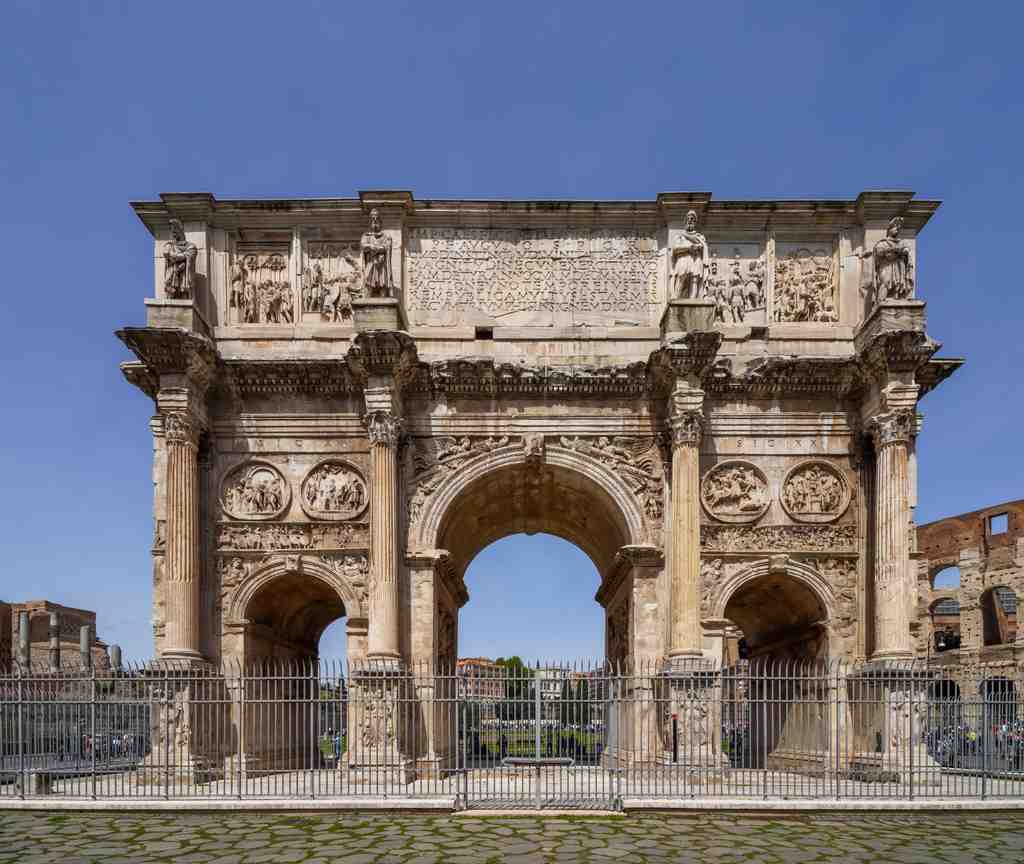
  1. You'll find this impressive monument between the Colosseum and the Palatine Hill, perfectly situated along the Via Triumphalis. This route was sort of the "Roman red carpet" for…Mehr lesenWeniger anzeigen

    You'll find this impressive monument between the Colosseum and the Palatine Hill, perfectly situated along the Via Triumphalis. This route was sort of the "Roman red carpet" for victorious leaders. With its intricate three-bay design, the arch flaunts a mix of materials, including brick-faced concrete wrapped in dazzling marble. The central passageway is a massive 11.5 meters (38 feet) high, flanked by two smaller bays. But wait, it gets juicier! The sculptures adorning the arch didn't exactly start their careers here. They were borrowed from earlier monuments dedicated to illustrious emperors like Trajan, Hadrian, and Marcus Aurelius. Constantine just did a bit of "Face Off" magic-replacing their portrait heads with his own. He really knew how to make a statement! Dedicated in AD 315, the archmarked both a decade of Constantine's reign and his victory over Maxentius. The Roman Senate used the occasion to throw epic games and reaffirm their spiritual and social vows. Imagine Olympics meets a royal vow renewal, ancient style! Fun fact: The arch even got in on the Olympic action! It was the finish line for the marathon event at the 1960 Summer Olympics. Talk about historic multitasking. Debates swirl around the arch’s true origins. Some scholars argue it might predate Constantine, possibly from Hadrian's time, and merely got a makeover. Others suggest Maxentius might have started it, adding even more drama to this ancient soap opera. Regardless of the theories, the Arch of Constantine stands as a timeless tribute to Roman grandeur-a place where past victories and present marvels collide. Now, on to our next stop-bring your sense of wonder and maybe a snack, because Rome’s history is as rich as its food! For a more comprehensive understanding of the sculptural style, iconography or the inscriptions, engage with me in the chat section below.

    Eigene Seite öffnen →
  2. You'll see detailed panels depicting the triumphal procession of 71 CE, showing off the spoils from the fall of Jerusalem. This is one of the few places you can see artifacts from…Mehr lesenWeniger anzeigen

    You'll see detailed panels depicting the triumphal procession of 71 CE, showing off the spoils from the fall of Jerusalem. This is one of the few places you can see artifacts from Herod's Temple, including the famous menorah, which inspired the State of Israel's emblem. Now, this isn’t just any old arch. It's the blueprint for many triumphal arches around the world, including the famous Arc de Triomphe in Paris. Talk about setting trends! Architecturally, it's got fluted and unfluted columns-thanks to some 19th-century restoration. Initially, Rabirius, a favorite architect of Domitian, might have had a hand in it. But who’s to say? Historians are still debating it! Funny enough, this very arch was transformed into a fortified tower in the Middle Ages by the Frangipani family, who added an extra story and left a few beam holes as evidence. They basically gave this ancient monument a medieval loft conversion! In modern times, Pope Paul IV made it the site of a yearly oath of submission, and it underwent significant restorations led by Raffaele Stern and then Valadier in the early 1800s. These efforts were so impressive, they became a model for restorations elsewhere. A quirky fact: Jews were once banned from walking under the arch-a ban lifted only in 1948 with the founding of Israel. The change was officially recognized during a Hanukkah event in 1997. Better late than never, right? The Arch of Titus measures around 15.4 meters in height, 13.5 meters in width, and 4.75 meters in depth. The inner archway is an impressive 8.3 meters tall and 5.36 meters wide, complete with victory personifications and relief sculptures of Titus' apotheosis. So, take your time to appreciate the art, the history, and the blend of ancient and medieval influences on this magnificent arch. And snap a picture or two-Titus would probably have liked that!

    Eigene Seite öffnen →
  3. Initially, there were just two Vestal Virgins, but over time, the number increased to six. Each served for a grand total of thirty years. Their duties included ensuring the sacred…Mehr lesenWeniger anzeigen

    Initially, there were just two Vestal Virgins, but over time, the number increased to six. Each served for a grand total of thirty years. Their duties included ensuring the sacred fire never went out, performing rituals, and even preparing food for certain festivals. These ladies were basically the ultimate multi-taskers of ancient Rome. Now, if the fire did go out accidentally, it wasn't just a matter of grabbing the nearest match. According to Plutarch, they had to use burning mirrors to relight it-kind of like the ancient Roman version of a solar panel! They'd use brass mirrors to concentrate sunlight and ignite the flame anew. Talk about a hot job! Allowing the sacred fire to die out was a massive no-no. It meant that the goddess Vesta might have withdrawn her protection from the city, and the guilty Vestal could face some pretty harsh penalties, like a good old-fashioned scourging. Ouch! The temple itself has seen better days. It burnt down completely at least four times and caught fire two other times-sounds like they could've used a better fire safety plan. The last rebuild was in AD 191, ordered by Julia Domna, the wife of Emperor Septimius Severus. Legend has it that the sacred fire dates all the way back to the 7th century BC, established by the legendary King Numa Pompilius. But alas, all good things come to an end. The eternal flame was extinguished in 391 CE by Emperor Theodosius I when he banned pagan worship. So, here you are standing at the site of a flame that symbolized the eternal spirit of Rome itself. A place where history was kindled and rekindled, much like our fascination with this ancient city. Feel the warmth? It's not just the sun; it's history radiating right where you stand!

    Eigene Seite öffnen →
11 weitere Stationen anzeigenWeniger Stationen anzeigenexpand_moreexpand_less
  1. Picture this: You're in ancient Rome, and you hear about a spring with water so special, it could heal the sick. You'd probably lace up your sandals and make a beeline for this…Mehr lesenWeniger anzeigen

    Picture this: You're in ancient Rome, and you hear about a spring with water so special, it could heal the sick. You'd probably lace up your sandals and make a beeline for this very pool! The shrine dedicated to Juturna was a hotspot, especially since the divine twins Castor and Pollux, according to legend, stopped here to water their horses after delivering the news of Roman victory at the Battle of Lake Regillus in 495 BC. So, it's got that celebrity endorsement thing going on. The Vestal Virgins, those priestesses of Vesta, were regular visitors, especially when their usual spring dried up. They needed pure, sacred water for their ceremonies, and Juturna’s spring was the go-to spot. Who knew water could be so versatile, right? Excavated first by Giacomo Boni and later Eva Margareta Steinby, this place has been thoroughly examined, but its charm remains. In ancient times, people believed the water had healing properties. Imagine the elderly, maybe with creaky joints from too much chariot racing, coming here with offerings, hoping for a touch of that magical cure. So, while you're standing here, think about all the hope and faith poured into these waters. If you're feeling a bit tired from all this touring, maybe a splash from the modern-day fountain nearby couldn't hurt. Or at least, it’s worth a try! Ready for the next stop? Let’s keep the adventure going!

    Eigene Seite öffnen →
  2. The Rostra, derived from the Latin word for a ship's ram, was originally adorned with six ship prows captured victoriously in 338 BC. It may seem ironic that such a symbol of…Mehr lesenWeniger anzeigen

    The Rostra, derived from the Latin word for a ship's ram, was originally adorned with six ship prows captured victoriously in 338 BC. It may seem ironic that such a symbol of naval triumph would sit far from the sea, but hey, Romans loved their grand gestures! This platform was the go-to spot for Rome's greatest orators, magistrates, and politicians. Imagine the Senate House in front, with excited crowds gathered in between, eagerly awaiting the latest triumphs, edicts, or-let's be honest-gossips! Julius Caesar himself strategized here, rearranging the Forum space to give the Rostra a more central location. He knew the power of a well-placed podium! Ever wonder why we call a speaker's platform a "rostrum" today? Yep, it all started right here. Every podium you see on TV news owes a little homage to this ancient structure. The Rostra also had a dark side. In more turbulent times, it became the Roman equivalent of a medieval pillory. Political heads would literally roll and end up on display here. Poor Cicero's head and hands ended their illustrious careers displayed on Caesar's Rostra after his execution. Not the kind of stardom he had in mind! Over time, the Rostra saw multiple restorations and expansions. Augustus, Rome's first emperor, gave it a new glory-it was dubbed the Rostra Augusti. Today, what you see are layers of history all melded together, like a Roman lasagna but with less cheese and more brick. So, if you ever feel like giving a speech and really making an impression, remember the Rostra: where Rome’s best and boldest once stood-and occasionally lost their heads!

    Eigene Seite öffnen →
  3. Standing at a whopping 30 meters tall (or about 98 feet if you prefer), this mighty column was completed in AD 113 to celebrate Emperor Trajan's victory in the Dacian Wars. It’s…Mehr lesenWeniger anzeigen

    Standing at a whopping 30 meters tall (or about 98 feet if you prefer), this mighty column was completed in AD 113 to celebrate Emperor Trajan's victory in the Dacian Wars. It’s like an Instagram story made of stone, narrating the emperor's triumphs with 2,662 figures and 155 scenes spiraling around the column. What’s really fascinating is that this 190-meter-long frieze wraps around the column 23 times. You’ll see Trajan himself making cameo appearances 58 times-move over, Stan Lee! The carvings don’t just show battles; they also depict soldiers building things and performing ceremonies. It’s like a mix of "Avengers" and "Extreme Makeover: Home Edition." Feeling adventurous? Inside the column is a spiral staircase with 185 steps. Climb to the top and imagine yourself as an ancient Roman sentinel, minus the armor and the very heavy sword. Originally, the top of the column featured a statue of Trajan, but it was replaced in the 16th century by a bronze figure of Saint Peter, which still stands today. So technically, it's still a victory column, just with a different MVP. Surrounded by what once was the Ulpian Library, this majestic column was not just a victory monument but a historical archive too. Imagine walking through the library's Greek and Latin chambers, the walls lined with scrolls including Trajan's very own commentary on the Dacian Wars-talk about first editions! Last but not least, the detailed reliefs on the column were meant to assure the Roman urbanites that their empire's military might was all about efficiency and order rather than chaos and destruction. Basically, Trajan wanted to show everyone that his troops were incredibly productive-like a well-disciplined construction crew with shields and swords. So, snap some photos, enjoy the view, and let your imagination travel back to an age when mighty emperors left their mark on the world with astonishing monuments like this one. And remember, if a victory column could tell stories this intricate in marble, just imagine what it would do with Wi-Fi and a smartphone! Fascinated by the frieze, setting or the purpose? Let's chat about it

    Eigene Seite öffnen →
  4. Built in the 1st century AD between the famous Palatine and Capitoline Hills, this temple once stood on the land where Augustus used to live before becoming the big man of Rome.…Mehr lesenWeniger anzeigen

    Built in the 1st century AD between the famous Palatine and Capitoline Hills, this temple once stood on the land where Augustus used to live before becoming the big man of Rome. Talk about an epic real estate upgrade! Imagine going from "just a house" to "temple of divine glory!" The temple had an impressive Ionic hexastyle design (that's fancy talk for six giant columns up front), but its exact dimensions and location still have historians scratching their heads. Maybe Augustus had a knack for keeping some mysteries alive? While Augustus had fans all over the empire, with provincial temples dedicated to him even before he became a celestial celebrity, the Roman folks in the city were a bit hesitant to immortalize him until after he passed away. After his death in AD 14, the Senate quickly vowed to build this monument, but it took decades to finish! Talk about Roman patience! The construction, debated to be spearheaded by Augustus' successor Tiberius or his widow Livia, was finally completed and dedicated by the emperor Caligula in 37 AD. And boy, did Caligula know how to throw a party! His dedication bash included a two-day horse race and the surprising combo of bears and wild beasts from Libya. Don’t worry, no lawsuit postponements were harmed in this process-Caligula made sure of it! Later on, the temple got a facelift from Claudius, who added a statue of Livia, Augustus' wife, with the Vestal Virgins scheduled to offer sacrifices in her honor. Fast forward to Domitian’s reign, the temple was rebuilt after a fire with a shrine to Minerva. It then became a shrine to four deified emperors, just to up the divine ante! By the late 150s, Antoninus Pius had restored the temple yet again, throwing some majestic Corinthian capitals into the mix. It was a veritable emperor’s club, with Augustus and Livia statues and symbols of Rome’s origin story all around the place. So here you are, standing where Romans celebrated, worshipped, and commemorated Augustus, blending history and myth into an unforgettable stone tapestry. Isn’t it amazing how time layers itself in the heart of Rome? Keep this enchantment in mind as you venture onwards! Ready for the next stop? Let's head toward the magnificent Trajan’s Column! Trust me, it's going to be colossal!

    Eigene Seite öffnen →
  5. Originally constructed as a cistern, it later became a holding cell for short periods before executions. Some unfortunate souls, like the co-conspirators of Catiline in 63 BC,…Mehr lesenWeniger anzeigen

    Originally constructed as a cistern, it later became a holding cell for short periods before executions. Some unfortunate souls, like the co-conspirators of Catiline in 63 BC, found themselves here. They faced their doom in the era of Cicero, who used the prison to hastily execute several conspirators without much of a trial. Talk about swift justice! The prison sits beneath the modern church of San Giuseppe dei Falegnami, giving it quite a makeover from its grim past. Once, prisoners were lowered into the lower dungeon, almost like they were taking an express elevator to despair. This lower level, the oubliette, was neither roomy nor comfy, and it wasn't intended for long stays. The term "Tullianum" might trace back to Roman kings Tullus Hostilius or Servius Tullius, or even from an old Latin term referring to a "jet of water" due to its origins as a cistern. And "Mamertine"? That's a medieval nod possibly linked to Mars, the Roman god of war. Notably, Sejanus, an infamous Roman prefect, met his gruesome end here, along with others who tangled with the Republic’s law. Conditions weren’t the best; imagine being held just before your ultimate demise. It wasn’t about long-term incarceration but short-lived detention before judgment day. Now, take a moment to reflect on the ironies of history as you stand here. The place once echoed with the groans of prisoners but now stands silent below the hustle and bustle of modern Rome. And remember, if anyone questions how much you know about Roman history now, you can simply say, "I learned it in prison!" Interested in knowing more about the name and origin, use or the christian significance

    Eigene Seite öffnen →
  6. Buckle up, because this Senate house dates back to the time of Romulus - yes, the guy who supposedly founded Rome. Initially, it was a temple where warring tribes laid down their…Mehr lesenWeniger anzeigen

    Buckle up, because this Senate house dates back to the time of Romulus - yes, the guy who supposedly founded Rome. Initially, it was a temple where warring tribes laid down their arms. Picture it: former enemies becoming frenemies, at least for a little while. Later, during the reign of Tullus Hostilius, the original structure was revamped after a fire - talk about a fiery debate! This place holds incredible history. Legend has it, there might have been an altar dedicated to Vulcan here, under the Lapis Niger, a series of large black marble slabs. Fast forward a bit, and in 80 BC, Lucius Cornelius Sulla thought the Curia could use a bit of sprucing up. But hold your toga, because in 52 BC, supporters of Publius Clodius Pulcher burned it down during his funeral! Talk about turning up the heat! The architecture of the Curia Hostilia evolved over time, yet it managed to keep its original charm. Common folks could walk right in and listen to the senators argue - like a live political podcast, but without the Wi-Fi. One standout feature was the "Tabula Valeria," a painting showing victories over the Carthaginians in 263 BC, making it the OG piece of Roman wall art. And for all its ups and downs, it sat prominently on rising ground, dominating the Forum Romanum, like the Rome of Thrones. Eventually, after its second blaze of glory in 52 BC, the Curia Hostilia made way for the Curia Cornelia and later the Curia Julia, which Julius Caesar started and Augustus completed. Talk about a legacy project! So, here you are, standing in front of what was once the epicenter of Roman political life. If walls could talk, these would probably be arguing still! Ready to move to the next stop? Buckle up those sandals, and let’s go!

    Eigene Seite öffnen →
  7. This rocky stage, perched 25 meters high on the south side of the Capitoline Hill, was Ancient Rome’s prime spot for ‘sudden exits.’ Murderers, traitors, and others who dabbled in…Mehr lesenWeniger anzeigen

    This rocky stage, perched 25 meters high on the south side of the Capitoline Hill, was Ancient Rome’s prime spot for ‘sudden exits.’ Murderers, traitors, and others who dabbled in dishonesty got a swift, scenic drop from this very cliff! It was the ultimate in one-way travel. Now, the tale behind its name is as dramatic as a Roman epic. It starts with the Vestal Virgin Tarpeia, daughter of Spurius Tarpeius. She betrayed Rome for some shiny baubles promised by the Sabine attackers. Plot twist: instead of bracelets, the Sabines gave her a pile of shields - right on top of her. Ouch. Her treachery was forever etched into this rock’s reputation. But this wasn't just a singular betrayal site-oh no! The rock continued to serve as an alternative, unofficial, and mighty shameful execution ground. And it wasn’t for just anyone caught with their hand in the cookie jar; only the worst of the worst got the special treatment from Tarpeian Rock. Victims included names like Spurius Cassius Vecellinus for high treason in 485 BC and, fast-forwarding to the 1st century, Simon bar Giora. Even Shakespeare made a mention in his play "Coriolanus," using the metaphor of a "steep Tarpeian death." Talk about making an impression! So, as you look down from the edge, imagine the stories this rock could tell... or scream, more likely! By the way, if heights make you queasy, make sure to step back a bit, alright? Otherwise, you might get too close to having your own ‘falling out’ with history.

    Eigene Seite öffnen →
  8. Built beside the Forum Boarium, Rome's ancient cattle market, this charming temple was once the hotspot for all bovine socializing. Imagine a Roman cowboy herding cattle right…Mehr lesenWeniger anzeigen

    Built beside the Forum Boarium, Rome's ancient cattle market, this charming temple was once the hotspot for all bovine socializing. Imagine a Roman cowboy herding cattle right through here! The temple was probably dedicated to Portunus, the god of keys, doors, and livestock. In other words, he’s the god you’d call if you lost your keys to your barn. But there’s a twist - for centuries, people thought it was the Temple of Manly Luck. Talk about some ancient rebranding! From the Medieval period until the early 20th century, this temple moonlighted as a Christian church dedicated to St. Mary of Egypt. It’s like that friend who changes careers but still keeps their charm. In 872, the clever Romans converted it into a church, and that’s how it dodged the ruins. Its architecture is in the Ionic order and boasts a tetrastyle portico (fancy word for four columns up front) and a high podium. The columns are like supermodels - some free-standing, striking a pose, and others half-stuck against the temple. They’re original in design, with Ionic capitals that look slightly different depending on the angle you’re peeking from. Constructed with tuff and travertine, and originally covered with a stucco facade, it has seen better days, but hey, haven’t we all? The preservation we admire today owes a lot to its brief stint as a church. Don’t forget, you’re standing where Portunus once kept a watchful eye over cattle barges coming from Ostia! The Temple of Hercules Victor is just nearby, so if you’re into ancient gods, you're in the right neighborhood. Enjoy the rest of your journey through time! Who knows, maybe you’ll find some manly luck or, at the very least, your keys!

    Eigene Seite öffnen →
  9. Nestled on a prime piece of flat land between the famous Capitoline, Palatine, and Aventine hills and right next to the river Tiber, it was the epicenter of trade. Talk about…Mehr lesenWeniger anzeigen

    Nestled on a prime piece of flat land between the famous Capitoline, Palatine, and Aventine hills and right next to the river Tiber, it was the epicenter of trade. Talk about prime real estate! The Forum Boarium was also where the Tiber’s first docks were situated, making it a bustling hub of activity. Now, gaze around and let your imagination run wild as we step back in time. Over there, you have the magnificent Temple of Hercules Victor. Hercules, by the way, had quite an adventure here according to legend. After dragging the cattle of Geryon all the way to Rome, he got robbed by the giant Cacus. But being Hercules, he made quick work of Cacus and got his cows back. Talk about beefing up your mythos! Next, we have the Temple of Portunus-initially mistaken for the Temple of Fortuna Virilis. Portunus was the god of keys, doors, and livestock-so it’s apt that his temple sat right here amidst all the cattle. It’s a beautiful structure with Ionic columns that have braved the test of time. Speaking of braving the test of time, did you know the Forum Boarium was also home to Rome's first gladiatorial combat? This storied tradition kicked off in 264 BC, as a rather adventurous funeral gift from the Junii Bruti brothers to their late father. Talk about one way to celebrate a life! Legend has it that this area also witnessed some rather less savory acts in its long history. Around 215 BC, after a series of ominous omens, four unlucky souls were buried alive here to appease the gods. Yikes! Please, no need for such dramatic sacrifices these days-well, maybe just the Wi-Fi password. Don’t forget to look across the street at the picturesque church of Santa Maria in Cosmedin, which houses the Bocca della Verità. If you haven’t yet, give it a whirl and check if it thinks you’re truthful. Before we move on, let’s soak in the scenery-both the temples were given a conservation makeover starting in the late 1990s. And though the Arch of Janus nearby is still in need of some TLC, the temples sure are looking good for their age. Alright, onward we go-next stop, the Temple of Portunus! Keep hoofing it, and I’ll see you there!

    Eigene Seite öffnen →
  10. Ah, I see you’ve arrived at the legendary Bocca della Verità, or Mouth of Truth! This ancient Roman marble mask has a knack for catching liars, or so the legend goes. If you dare,…Mehr lesenWeniger anzeigen

    Ah, I see you’ve arrived at the legendary Bocca della Verità, or Mouth of Truth! This ancient Roman marble mask has a knack for catching liars, or so the legend goes. If you dare, put your hand in its gaping mouth and see if you have been living an honest life. But no worries, I promise it’s just a harmless piece of marble… unless, of course, you’ve been hiding some secrets! Standing proudly against the left wall of the Santa Maria in Cosmedin church, this mysterious face likely represents Oceanus, the sea titan god. Weighing a hefty 1,300 kilograms, it's more massive than your average reality check! With eyes, nostrils, and mouth eerily open, it's no wonder it captures the imagination. Historians aren’t entirely sure what this disc was originally used for. It could’ve been a drain cover for the nearby Temple of Hercules Victor, catching the blood of sacrificed cattle. Talk about a macabre but efficient way to recycle! The mere sight of the Bocca della Verità has inspired artwork across Europe. Lucas Cranach the Elder and Albrecht Altdorfer even depicted it in their Renaissance creations. And Hollywood couldn’t resist its charm either: Audrey Hepburn and Gregory Peck famously tested its truth-telling powers in the classic film Roman Holiday. Like a celebrity with legions of fans, there are replicas worldwide-from California’s Alta Vista Gardens to Paris’s Luxembourg Garden, and even a quirky fortune teller machine at the Musée Mécanique in San Francisco. So, my friend, will you test your honesty? Place your hand in the mouth and let’s hope you'll leave with all your fingers intact! Just kidding. Or am I?

    Eigene Seite öffnen →
  11. So, let me take you back to Ancient Rome. The Lupercal is a legendary cave at the foot of the Palatine Hill, nestled somewhere between the temple of Magna Mater and the…Mehr lesenWeniger anzeigen

    So, let me take you back to Ancient Rome. The Lupercal is a legendary cave at the foot of the Palatine Hill, nestled somewhere between the temple of Magna Mater and the Sant'Anastasia al Palatino. According to Roman myth, this is where the she-wolf found Romulus and Remus, the twin brothers who are said to have founded Rome. The she-wolf suckled them until the shepherd Faustulus came to the rescue. Talk about some serious wolf-whispering, right? The Luperci, priests of Faunus, used this cave for ceremonies of the Lupercalia festival. Picture a bunch of priests in wolf-themed rites-hard to imagine, but they certainly loved their theatrics! Fast forward to modern times-in January 2007, archaeologist Irene Iacopi claimed to have found this legendary cave beneath Emperor Augustus's old digs, the Domus Livia. Pretty cool for an emperor who considered calling himself Romulus, right? They even uncovered colorful mosaics, pumice stones, seashells, and a majestic white eagle on the ceiling. Classic Roman over-the-top style! But hold your centurion horses-some top scholars, including Adriano La Regina and Fausto Zevi, thought Irene was barking up the wrong archaeological tree. They reckon the grotto is a nymphaeum or an underground dining room from Emperor Nero’s time, not the Lupercal. So, the scholarly tug-of-war continues, but whichever way you look at it, it's a fantastically intriguing slice of Rome's layered history! As they say, when in Rome... keep wondering where all the legends lie!

    Eigene Seite öffnen →

Häufig gestellte Fragen

Wie starte ich die Tour?

Laden Sie nach dem Kauf die AudaTours-App herunter und geben Sie Ihren Einlösecode ein. Die Tour ist sofort startbereit – tippen Sie einfach auf „Play“ und folgen Sie der GPS-geführten Route.

Benötige ich während der Tour Internet?

Nein! Laden Sie die Tour vor dem Start herunter und genießen Sie sie vollständig offline. Nur die Chat-Funktion benötigt Internet. Wir empfehlen den Download über WLAN, um mobiles Datenvolumen zu sparen.

Handelt es sich um eine geführte Gruppentour?

Nein – dies ist ein selbstgeführter Audioguide. Sie erkunden unabhängig in Ihrem eigenen Tempo, wobei die Audioerzählung über Ihr Telefon abgespielt wird. Kein Reiseleiter, keine Gruppe, kein Zeitplan.

Wie lange dauert die Tour?

Die meisten Touren dauern 60–90 Minuten, aber Sie kontrollieren das Tempo vollständig. Pausieren Sie, überspringen Sie Stopps oder machen Sie Pausen, wann immer Sie wollen.

Was, wenn ich die Tour heute nicht beenden kann?

Kein Problem! Touren haben lebenslangen Zugriff. Pausieren Sie und setzen Sie sie fort, wann immer Sie möchten – morgen, nächste Woche oder nächstes Jahr. Ihr Fortschritt wird gespeichert.

Welche Sprachen sind verfügbar?

Alle Touren sind in über 50 Sprachen verfügbar. Wählen Sie Ihre bevorzugte Sprache beim Einlösen Ihres Codes. Hinweis: Die Sprache kann nach der Tour-Generierung nicht mehr geändert werden.

Wo greife ich nach dem Kauf auf die Tour zu?

Laden Sie die kostenlose AudaTours-App aus dem App Store oder von Google Play herunter. Geben Sie Ihren Einlösecode (per E-Mail gesendet) ein, und die Tour erscheint in Ihrer Bibliothek, bereit zum Download und Start.

verified_user
Zufriedenheit garantiert

Wenn Ihnen die Tour nicht gefällt, erstatten wir Ihnen den Kaufpreis. Kontaktieren Sie uns unter [email protected]

Sicher bezahlen mit

Apple PayGoogle PayVisaMastercardPayPal

AudaTours: Audioguides

Unterhaltsame, budgetfreundliche, selbstgeführte Stadtrundgänge

App ausprobieren arrow_forward

Beliebt bei Reisenden weltweit

format_quote Diese Tour war eine großartige Möglichkeit, die Stadt zu sehen. Die Geschichten waren interessant, ohne zu konstruiert zu wirken, und ich liebte es, in meinem eigenen Tempo erkunden zu können.
Jess
Jess
starstarstarstarstar
Tbilisi-Tour arrow_forward
format_quote Das war eine solide Art, Brighton kennenzulernen, ohne sich wie ein Tourist zu fühlen. Die Erzählung hatte Tiefe und Kontext, übertrieb es aber nicht.
Christoph
Christoph
starstarstarstarstar
Brighton-Tour arrow_forward
format_quote Habe diese Tour mit einem Croissant in der einen Hand und null Erwartungen gestartet. Die App schwingt einfach mit einem mit, kein Druck, nur man selbst, Kopfhörer und ein paar coole Geschichten.
John
John
starstarstarstarstar
Marseille-Tour arrow_forward

Unbegrenzte Audioguides

Schalten Sie Zugriff auf JEDE Tour weltweit frei

0 Touren·0 Städte·0 Länder
all_inclusive Unlimited erkunden