
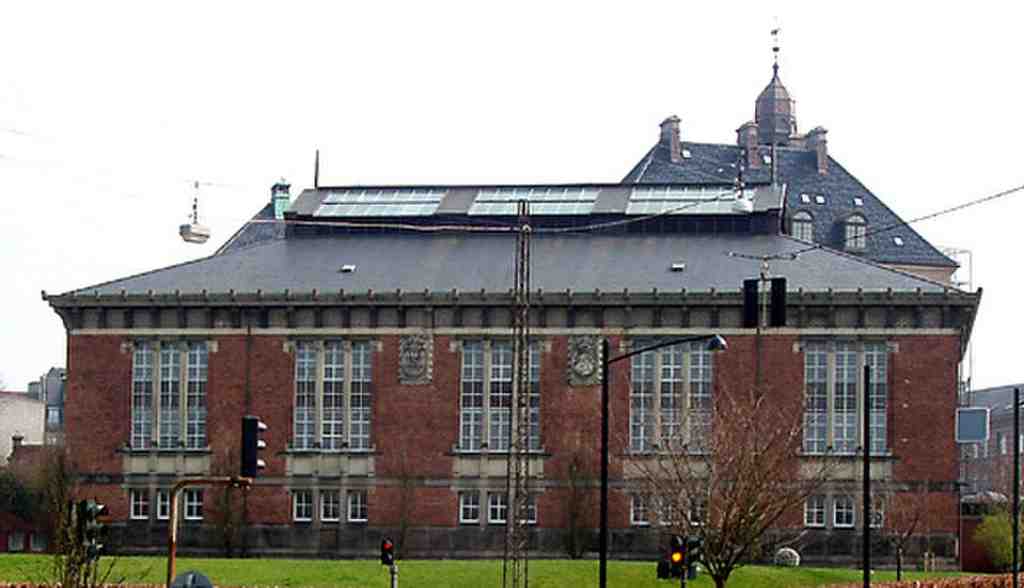
On your right is a compact red-brick building with a symmetrical front, tall arched windows, and finely worked stone details that give it a formal, almost jewel-box look.
This is Erhvervsarkivet, the Business Archives of Aarhus... though the building itself is older than the archive by quite a stretch. Architect Hack Kampmann designed it in eighteen ninety-eight for the State Library, and locals later nicknamed it Smykkeskrinet, meaning “the Jewel Box.” Not every archive gets to live in a place with that kind of nickname.
The archive opened in nineteen forty-eight as an independent institution, and it moved around before settling here in nineteen sixty-three. First it worked out of the basement under Aarhus City Hall, then the basement of the main university building, then the former Aarhus-Hammel Railway station on Carl Blochs Gade. Finally it arrived here, at Vester Allé twelve, in a building handsome enough to make paperwork feel important.
And paperwork really was the point. Private companies in Denmark did not have to hand over their records to the state, so archivists had to persuade them, one agreement at a time. That patient work built a collection of around seven thousand business archives, with material ranging from the sixteen hundreds back to the fifteen hundreds, though most came from the years between eighteen fifty and nineteen fifty. The archive also cared for Aarhus municipal records until the city founded its own municipal archive in twenty fourteen.
The move away from Aarhus caused real debate. In twenty fourteen, the national archive service announced that the storage magazines - the secure archive vaults - were no longer suitable, so the collections would move to Viborg. The public reading room, the study hall where researchers handled the material, closed on the eighteenth of December, twenty fifteen, with farewell speeches from a user and a reading-room guard. Since twenty twenty-one, Aarhus Court has used the building.
If you want to go inside, it is generally open Tuesday through Thursday from nine in the morning to four in the afternoon, and closed the rest of the week.
So this little jewel box held the paper trail of how Danish business actually worked. When you are ready, continue on toward Møllestien for a very different kind of Aarhus story.




