
This landmark appears as a pale stone outline in the paving, long and church-shaped, with a simple memorial marker recalling Saint Walburga on the old Burcht site.
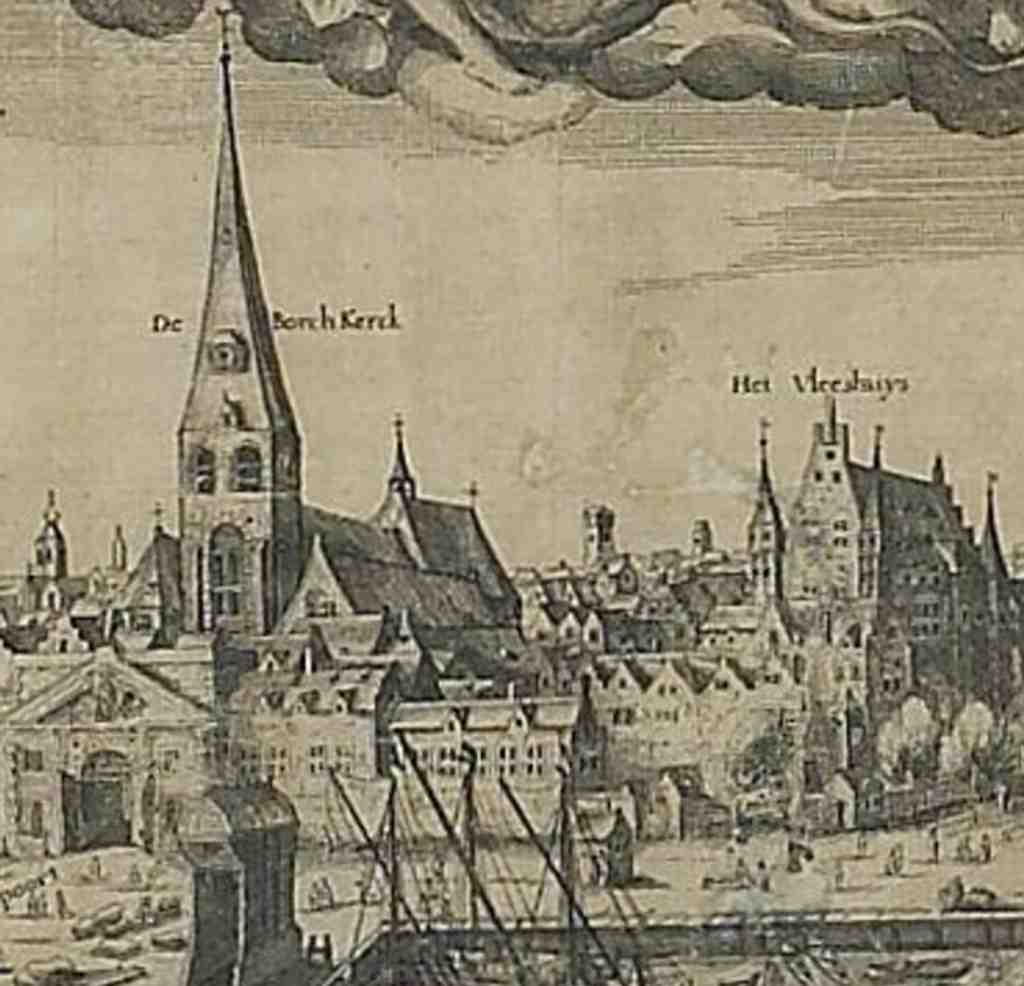
If this place feels a little ghostly, that is because Saint Walburga’s Church no longer stands. Yet for many centuries, this was one of Antwerp’s oldest sacred sites. Its story begins astonishingly early, in the year seven hundred and twenty-seven, when people raised a first chapel inside the ring-shaped fortification on the right bank of the Scheldt, a little north of today’s Steenplein. In eight hundred and thirty-six, Norse raiders destroyed it.
Then the place revived. In the middle of the tenth century, Emperor Otto the First, known as Otto the Great, ordered a fortress here beside the river. At its heart he placed a new church and dedicated it to Saint Walburga, an English-born abbess much loved in medieval Europe. That is when the church gained the name it kept.
The building did not stand still for long. Around twelve fifty, the Benedictine monks of Affligem rebuilt it for a third time. In fourteen seventy-eight, the church became a parish church, meaning it gained its own baptismal font and the right to bury the dead. Around fifteen hundred, the master builder Domien de Waghemakere enlarged it again, making it bigger and grander.
Then came the church’s most famous commission. In sixteen oh nine, the churchwardens asked Peter Paul Rubens for a great altarpiece. He answered with The Elevation of the Cross, a vast triptych, a painting made of three hinged panels, installed on the high altar in sixteen ten. When the church authorities replaced the wooden high altar in the seventeen thirties with a new one designed by Willem Ignatius Kerrickx, parts of Rubens’s work no longer fit and they removed smaller sections. In seventeen ninety-four, French occupiers carried the triptych off to Paris. Later, Antwerp recovered it, and today you can see it in the Cathedral of Our Lady.
The church itself fared far worse. In seventeen ninety-eight, during the French suppression of churches and monasteries, officials closed it and turned it into a storehouse. The choir, the eastern part around the altar, survived a little longer, with a covered passage beneath it leading toward Het Steen. But in eighteen sixteen, the Dutch government sold the church for demolition, and by eighteen seventeen it had gone. Even the last remains disappeared after a fire in the nearby De Gans warehouses.
So here, memory does the work that stone no longer can. When you are ready, continue on toward Het Steen, where the old fortress story still has walls to tell it.




