

伯利恒语音导览:大教堂、钢铁与艺术回响
钢铁曾在这里轰鸣,而今伯利恒的街道宁静蜿蜒。你脚下的石块,藏着比教堂尖塔回荡的布道更黑暗的秘密。 这个自助语音导览让你按照自己的节奏,揭开伯利恒的隐秘故事,深入大多数旅行者都会忽略的角落和走廊。就在历史发生的地方,解锁一层层丑闻、独创性和奇迹。 在圣诞大教堂,怎样的政治策略一夜之间改变了成千上万人的命运?为什么绝望的发明家曾徘徊于如今摆满文物的国家工业历史博物馆大厅?1917年一场致命暴风雪期间,市长办公室里一件奇异的文物又为何神秘消失? 穿过神圣的拱门和锈迹斑斑的齿轮,追溯野心与反叛的回响。让这座城市被遗忘的戏剧,引领你穿梭于鹅卵石街道,每一站都揭示伯利恒灵魂的另一面。 你的传奇与遗产之旅现在开始。进入钢铁与精神碰撞之地。
导览预览
关于此导览
- schedule持续时间 30–50 mins按照自己的节奏
- straighten4.2 公里步行路线跟随引导路径
- location_on
- wifi_off离线工作一次下载,随处使用
- all_inclusive终身访问随时重播,永久有效
- location_on从 圣诞大教堂 开始
此导览的景点
You’ll spot it by the big gray-stone church with a tall square tower on the left and a round “rose” window above bright red front doors-look up at the tower’s crenellated top,…阅读更多收起
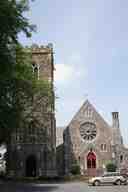
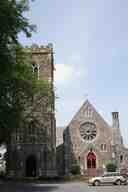
You’ll spot it by the big gray-stone church with a tall square tower on the left and a round “rose” window above bright red front doors-look up at the tower’s crenellated top, like a church wearing a little stone crown. Welcome to the Cathedral Church of the Nativity, an Episcopal landmark that’s been quietly anchoring Bethlehem for more than a century and a half. What you’re looking at now is the result of a community that started out… pretty improvisational. Back in the 1850s, Episcopalians in Bethlehem didn’t have a home base, so they worshiped wherever a door was open: a hall near Broad and New, local inns like the Sun Inn and the Eagle Hotel, even the Central Moravian Church. In the early 1860s, services were held in Tinsley Jeter’s house-because when you don’t have a church, apparently you just use the living room and hope everyone wipes their boots. A big turning point came on June 16, 1861, when the first Episcopal service led by a clergyperson in South Bethlehem took place in Robert Sayre’s parlor. Not a sanctuary… a parlor. And by 1862, they’d started a church school-52 students-inside the North Pennsylvania Railroad station. That is commitment, and also a bold choice if you like your lessons with a side of locomotive noise. In 1863, they got organized: a vestry formed at Sayre’s home, and the Reverend Eliphalet Nott Potter arrived as missionary, then rector. The first purpose-built church here began with a cornerstone in 1863, designed in English Gothic Revival style by architect Edward Tuckerman Potter. It opened for worship on Christmas Day 1864 and was consecrated in 1865. But Bethlehem was growing fast-industry, railroads, big ambitions-so in the 1880s the church expanded into the larger building you see now. The nave and that memorable apse were designed by E. M. Burns, and the older church became part of the new footprint. This place is basically a spiritual remodel with very good stonework. Then came the details that make cathedrals feel like cathedrals: a dramatic rood screen gifted in 1899, a memorial font and baptistery honoring members of the Sayre family, and that tower-built in memory of Sallie Packer Linderman Wilbur. In 1900, nine Meneely bells rang out for the first time on Easter Day… the kind of sound that tells a whole town, “Yep, we’re here.” Nativity also helped “plant” other congregations around town, including Trinity across the river and chapels that served changing neighborhoods and immigrant communities. And in 1988, it was recognized as part of the Fountain Hill Historic District on the National Register of Historic Places-proof that even federal paperwork can appreciate a good facade. Today it’s still a cathedral-now a co-cathedral in the Diocese of the Susquehanna after a 2026 reunion of dioceses-because church governance, like family reunions, can be complicated but meaningful. When you’re set, Fountain Hill Historic District is a 4-minute walk heading north.
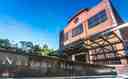
打开独立页面 →On your right, look for the white, castle-like building with a little tower and flags, sitting beside a hefty stone block marked “Masonic Temple.” Welcome to the Fountain Hill…阅读更多收起
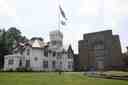
On your right, look for the white, castle-like building with a little tower and flags, sitting beside a hefty stone block marked “Masonic Temple.” Welcome to the Fountain Hill Historic District... a neighborhood with a fancy name and a slightly confusing footprint. It’s officially a national historic district in Bethlehem, but it mostly skips the separate borough of Fountain Hill down to the southwest. Geography is fun like that. What you’re really seeing is a concentrated show-off of 44 historic buildings plus one notable structure-big, dramatic mansions that once belonged to the people steering industry and railroads, along with more modest homes for managers and merchants. Names like the Linderman and Schwab Mansion from around 1870, the Robert Sayre House from about 1857, and the Elisha Packer Wilbur Mansion from around 1863 tell you exactly who had the better view... and the bigger parlor. The district also gathers public landmarks like this Masonic Temple, the Cathedral Church of the Nativity, and even the Hill to Hill Bridge-and it earned National Register status in 1988. When you’re set, head east for about 4 minutes to reach the Episcopal Diocese of Bethlehem.
打开独立页面 →On your right, look for the sturdy gray-stone church with a tall square tower and a big round rose window above bright red front doors. Now, even though you’re staring at stone…阅读更多收起
On your right, look for the sturdy gray-stone church with a tall square tower and a big round rose window above bright red front doors. Now, even though you’re staring at stone and stained glass, this stop is really about a map… and how it kept getting redrawn. The Episcopal offices here represent a diocese that’s spent a long time figuring out what, exactly, “here” means. If we rewind way back, Anglican worship in this part of Pennsylvania didn’t start in grand churches. It started in living rooms and small settlements-Perkiomen around 1700, with clergy riding out from Philadelphia to serve scattered communities. Picture muddy roads, long distances, and a minister who had to be part pastor, part travel blogger, part endurance athlete. By 1701, help arrived from across the Atlantic-the Society for the Propagation of the Gospel in London, which helped pay missionaries in the American colonies. That support mattered because rural Pennsylvania didn’t exactly have a surplus of full-time clergy sitting around waiting for a call. One of the more surprising twists: early on, Swedish and English congregations often shared space and cooperated. When Swedish support faded, some Swedish churches effectively “passed the baton” to Anglican leadership. A former Swedish church near Hopewell Furnace became St. Gabriel’s in 1753-and from there, new worshipping communities branched out, including one that met in homes in Reading before growing into a formal parish. Faith here spread the way towns did: slowly, socially, and with a lot of practical improvisation. After the Revolution, the Episcopal Church in Pennsylvania got organized fast. In 1785, leaders met at Christ Church in Philadelphia-clergy and laypeople together, which was a pretty bold, not-very-England move. And in 1787, William White became the first bishop of Pennsylvania. Then comes the bureaucratic soap opera. In 1871, a big chunk of Pennsylvania split off to form a new diocese. In 1904, it split again-Harrisburg got its own. By 1909, the remaining eastern section basically admitted, “Yeah, ‘Central Pennsylvania’ doesn’t fit anymore,” and renamed itself the Diocese of Bethlehem. And the story keeps going: in 2024, the Bethlehem and Central Pennsylvania dioceses voted to reunify, becoming the Diocese of the Susquehanna on January 1, 2026, with co-cathedrals in Bethlehem and Harrisburg. Church history: all soul… and a surprising amount of admin. When you’re set, Packer Memorial Chapel is a 15-minute walk heading north.
打开独立页面 →
再显示 7 个站点显示更少站点expand_moreexpand_less
On your left, look for the tall gray-stone chapel with a skinny spire and a cross on top, plus a big arched stained-glass window tucked into the roofline. This is Packer…阅读更多收起
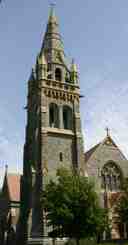
On your left, look for the tall gray-stone chapel with a skinny spire and a cross on top, plus a big arched stained-glass window tucked into the roofline. This is Packer Memorial Chapel, built in 1885 and designed by Philadelphia architect Addison Hutton-solid, serious stonework that basically says, “Yes, this is a university, and yes, we’re going to LOOK like it.” It was a gift from Mary Packer Cummings, made in memory of her father, Asa Packer. The cornerstone went in on Founders’ Day, October 8, 1885… and two years later, on Founders’ Day again-October 13, 1887-the chapel was officially consecrated. That timing feels intentional, like the campus was setting its watch by tradition. Lehigh used to be tied closely to the Episcopal Church, but today the chapel is non-denominational-Catholic Mass on Sundays, Muslim prayers on Fridays. Down below, the basement once hosted a coffeehouse called “The Catacombs,” because college kids never miss a chance for dramatic branding. It even made the National Register of Historic Places in 1979. When you’re set, Taylor Stadium (Lehigh) is an 8-minute walk heading east.
打开独立页面 →On your right, look for the big red-brick factory building with tall grid windows and a steel awning, fronted by a long dark sign that reads “National Museum of Industrial…阅读更多收起
On your right, look for the big red-brick factory building with tall grid windows and a steel awning, fronted by a long dark sign that reads “National Museum of Industrial History.” This place sits inside a former Bethlehem Steel building-an old workhorse of a structure that’s been remodeled more than once since its early days, but still wears its industrial bones proudly. Back when the mill was running, this neighborhood wasn’t about “curated experiences.” It was about shifts, heat, noise, and the kind of workday where your lunch tasted faintly like… industry. Bethlehem Steel shut down its mill operations here in 1995, but for a long stretch before that, the company was a giant: the nation’s biggest shipbuilder and the second-largest steel producer. At its peak, it employed about 31,000 people-basically a small city in hard hats. The museum you’re looking at opened in August 2016, and it’s a Smithsonian affiliate-actually the first affiliate museum of the Smithsonian Institution. That’s a pretty serious stamp of approval for a town built on turning raw stuff into useful stuff. The goal is simple and smart: connect America’s industrial past to the innovations we’re chasing now, by showing real machines, real tools, and the very human lives behind them. Getting here wasn’t exactly a smooth conveyor belt. The idea was floated back in the 1990s, but it got tangled in legal issues and delays. A state grand jury report in 2014 called out major mismanagement and wasted money… which is the kind of thing that makes everyone’s stomach drop. The case was kicked to the state Attorney General, who didn’t find criminal wrongdoing, said the project could still work, and gave it a blunt ultimatum: open within two years or dissolve. Nothing like a deadline to inspire efficiency. The team pulled it off-exhibits designed, built, and opened on time-and the museum raised nearly $17 million in its early years. Inside are four main exhibit areas plus a rotating gallery, with more than 200 artifacts. One of the artifacts is the building itself-once the steel plant’s Electric Repair Shop from 1913. The big crowd-pleaser is Machinery Hall: industrial heavyweights, including Smithsonian-loaned machines that once lived in the National Museum of American History. The headline act is a massive steam engine-115 tons of iron determination-that used to pump water for York, Pennsylvania starting in 1914. It’s the kind of machine that makes you feel like your phone charger is a little… underqualified. Then there’s the iron and steel gallery-Bethlehem Steel’s story told with plant models used to train workers and test factory changes, plus standout relics like the first piece of steel ever made here and an interactive map showing how far Bethlehem steel traveled across the country. And the museum doesn’t pretend only men built Bethlehem. The Silk Gallery gives working women and kids their due, with looms, line shafts, and a hands-on moment where you can heft a 20-pound bobbin tray-about what children carried for hours. That one lands. Finally, the Propane Gallery spotlights Allentown chemist Walter O. Snelling, who figured out how to distill propane-plus a hot-air-balloon basket simulation that’s surprisingly convincing, right down to the moving floorboards. When you’re set, South Bethlehem Downtown Historic District is a 6-minute walk heading west.
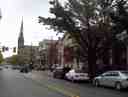
打开独立页面 →On your right, look for a classic Southside streetscape: a tall church steeple rising above rows of older brick and clapboard buildings, with storefront-style windows tucked under…阅读更多收起
On your right, look for a classic Southside streetscape: a tall church steeple rising above rows of older brick and clapboard buildings, with storefront-style windows tucked under a big leafy street tree. Welcome to the South Bethlehem Downtown Historic District... a whole neighborhood that made the National Register of Historic Places in 2005, basically because it’s one of those rare places where the past didn’t get bulldozed into a parking lot without at least putting up a fight. Spread across these blocks are 288 “contributing” buildings-meaning the historic character isn’t coming from one superstar structure, but from the chorus line. Most of what you’re seeing dates from around 1900 to 1935, when South Bethlehem was a working, building, humming extension of the factories and mills-especially Bethlehem Steel. So the district isn’t just pretty architecture; it’s a record of daily life: commercial buildings where people bought what they needed, municipal buildings where they dealt with the paperwork of being human, churches where they tried to stay hopeful, and homes where they tried to sleep through the noise. A few landmarks anchor the story. There’s the South Bethlehem Post Office from 1916-built when letters were how you did life admin. The Bethlehem Public Library followed in 1929, the kind of civic investment that says, “Yes, we work with our hands… and we’re still going to read.” You’ve also got industrial and Steel-related buildings threaded through the area, reminders that the paychecks-and the risks-often came from the mills. Then there’s the Protection Firehouse, built in 1875 as the Southside’s first fire station. It outgrew its job as the neighborhood expanded, and for a while it sat empty. In 1967 it was reborn as a youth center-until tragedy hit on August 5, 1970: a drive-by shooting and an attempted firebombing. The firebomb didn’t go off, but gunfire killed 14-year-old Rosemarie Parham and badly injured 16-year-old Carlos Garcia. The building carried that scar for years. In 1987 it got a new chapter when Touchstone Theater bought it and turned it into a 72-seat space-founded in 1981 by Lehigh alumni who wanted bilingual, multi-racial performances that could actually bring people together. As of 2026, Touchstone is still here, still doing the work. Immigration shaped this district, too. Around 1910, Slovenes from the Prekmurje region arrived seeking safety and jobs. Locals called them “Windish,” a label borrowed-incorrectly-from another group entirely. Many were Evangelical Lutherans, and they built St. John’s Windish Lutheran Church in 1910, then Windish Hall around 1915. After the steel mill closed in 1982, the community shrank. In 2023, after more than a century, the congregation merged and held a final service on April 23. The city even offered $3.75 million-about $4.5 million today-to buy and demolish the churches for parking. Nothing says “urban planning” like replacing history with painted lines. Lehigh matched the offer, promising not to turn them into student housing, and the church sold. And tucked among rowhouses was “the other” Grace House-once owned by Bethlehem Steel president Eugene Grace, a 3,000-square-foot mansion that stood out like a boss’s office in a break room. It became apartments, a doctor’s office, maybe even a funeral home, and for over a decade, a pizzeria called Anna Mia. Plans to redevelop it ran into historic-district limits, and later COVID delays-so it’s a story still in progress. Ready for Monsoon gallery? Just walk east for 5 minutes, heading toward Taylor Street.
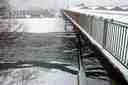
打开独立页面 →On your left, look for the long steel bridge with greenish railings stretching over the Lehigh River-especially easy to spot today with the river ice and snow-dusted walkway in…阅读更多收起
On your left, look for the long steel bridge with greenish railings stretching over the Lehigh River-especially easy to spot today with the river ice and snow-dusted walkway in view. This is the Philip J. Fahy Memorial Bridge-though around Bethlehem, you’ll hear it called “the Fahy,” or just “the New Street Bridge,” like it’s an old friend who never moved away. Stand here a second and listen... you’ve got the hush of the river below, the faint rattle of traffic overhead, and a crossing that has been reinvented more than once since the late 1800s. Back in 1915, a private company ran a bridge here like a tiny business. You paid to cross-one cent if you were walking, two cents on a motorcycle, and five to fifteen cents for a car depending on how big and fancy it was. That’s roughly about $0.30, $0.60, and $1.50 to $4.50 in today’s money... which is still cheaper than most parking meters. The current bridge went up in 1970, but its name is rooted in a grim night: August 29, 1969. Officer Phillip Fahy and Officer Merle Getz tried to stop a driver. The chase ended off Williams Street Extension, and the driver, Beverly Wells, stepped out and fired a shotgun, mortally wounding Fahy. Getz returned fire. Wells was convicted of murder and died in prison in 2004. Time kept moving. In 2011 the sidewalk got closed after inspectors found serious deterioration, and in 2016 the bridge was rehabilitated-patched up, reinforced, kept in service. And then, because Bethlehem also knows how to be Bethlehem... in 2024, Lehigh students hauled football goalposts over four miles and tossed them into the river right here. History, heartbreak, repairs, and a little college chaos-pretty much the full local recipe.
打开独立页面 →
常见问题
如何开始导览?
购买后,下载 AudaTours 应用并输入您的兑换码。导览将准备好立即开始--只需点击播放并按照 GPS 引导的路线行驶即可。
导览期间我需要互联网吗?
不需要!开始前下载导览并完全离线享受。只有聊天功能需要互联网。我们建议在 WiFi 下下载以节省移动数据。
这是导游带领的团体游吗?
不是--这是自助语音导览。您按照自己的节奏独立探索,通过手机播放音频解说。没有导游,没有团体,没有时间表。
导览需要多长时间?
大多数导览需要 60-90 分钟才能完成,但您完全控制节奏。随时暂停、跳过站点或休息。
如果我今天无法完成导览怎么办?
没问题!导览具有终身访问权限。随时暂停和恢复--明天、下周或明年。您的进度已保存。
有哪些语言可用?
所有导览均提供 50 多种语言版本。在兑换代码时选择您的首选语言。注意:导览生成后无法更改语言。
购买后我在哪里访问导览?
从 App Store 或 Google Play 下载免费的 AudaTours 应用。输入您的兑换码(通过电子邮件发送),导览将出现在您的资料库中,准备下载并开始。
如果您不喜欢该导览,我们将退款。请联系我们 [email protected]
安全结账使用 


