
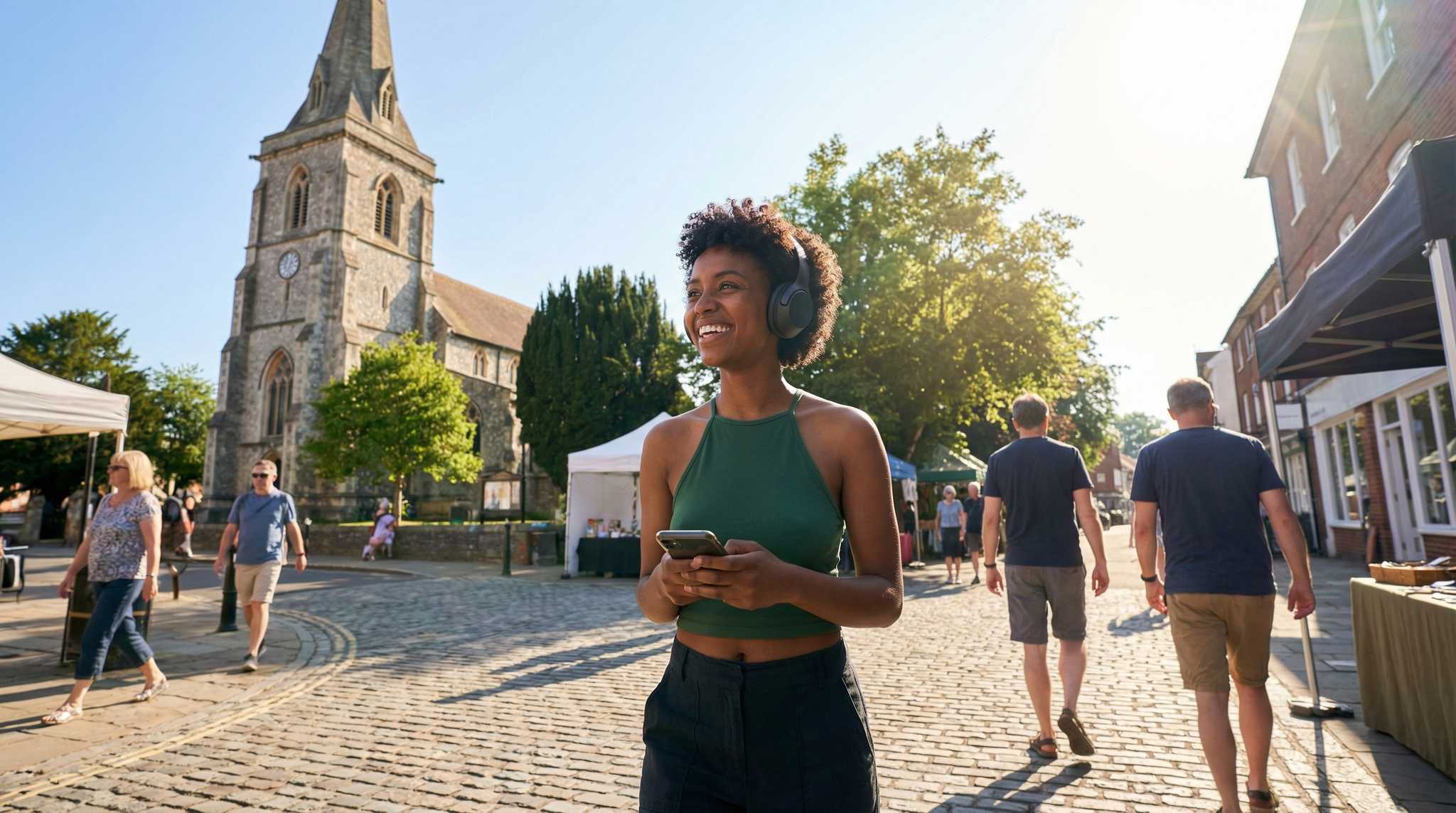
戈达尔明语音导览:法恩科姆核心区的故事、尖顶与体育
在戈达尔明鹅卵石铺就的街道上,千年秘密隐藏在显眼之处,等待着好奇的旅行者去探寻表面之下的故事。这个自助语音导览将揭示小镇的脉搏:圣彼得与圣保罗教堂的中世纪阴谋,古老石块上回荡的反叛故事,圣埃德蒙教堂在守望山丘上低语的祈祷,以及戈达尔明博物馆里一系列令人惊讶的奇珍异宝。 在英格兰最激烈的冲突中,戈达尔明为何被卷入宗教骚乱?是怎样的幕后之手塑造了如今闪耀着无声传奇的神秘彩色玻璃?一台巨大的织袜机又是如何引发了一场19世纪的丑闻? 漫步于阴影中的尖塔、花园般的圣地和隐秘的小巷之间,你将解开深植于小镇灵魂中的戏剧、竞争和被遗忘的瞬间。每一步都展现一个新视角,每一次驻足都开启一个不为人知的故事。 准备好揭开戈达尔明的真实脉搏了吗?让你的旅程从踏上古老石块的第一步开始吧。
导览预览
关于此导览
- schedule持续时间 30–50 mins按照自己的节奏
- straighten4.3 公里步行路线跟随引导路径
- location_on
- wifi_off离线工作一次下载,随处使用
- all_inclusive终身访问随时重播,永久有效
- location_on从 戈达尔明圣彼得与圣保罗教堂 开始
此导览的景点
To spot the Church of St Peter & St Paul, just look for the striking tall, lead-covered spire rising high above a sturdy old stone building, with weathered gravestones surrounding…阅读更多收起
To spot the Church of St Peter & St Paul, just look for the striking tall, lead-covered spire rising high above a sturdy old stone building, with weathered gravestones surrounding its grassy grounds right beside Church Street. Welcome to the heart of old Godalming-a place so packed with history, you might trip over a medieval secret if you’re not careful! Here stands the Church of St Peter & St Paul, the oldest building in town, and believe it or not, people have been gathering here for more than a thousand years-long before smartphones, selfies, or even forks. Glance up at that central tower and the spire gleaming against the sky: the spire alone has been watching over Godalming since the thirteenth century, its oak beams and silvery lead sheeting tested by every storm the English weather could throw at it. If you listen closely, you might imagine the deep, marking the hours as it has for centuries. The ground beneath your feet is Lammas land, once common ground for townsfolk-maybe a cow or two snoozed precisely where you’re standing. But it wasn’t always this peaceful. In the mid-ninth century, Anglo-Saxon Christians were already worshipping here; some of their carved stones, more than 1,100 years old, are still tucked away in the walls. Their church was built small but strong, with thick walls and a lofty chancel-if only walls could talk, they’d whisper stories about ancient prayers echoing between rock and shadow. Move forward to 1086 and the Domesday Book-a sort of medieval census-lists Godalming’s church as a prized possession, run by a man named Ranulf Flambard. His name sounds a bit like a villain from a fantasy novel, but he was real enough, helping keep William the Conqueror’s England ticking. Over time, thanks to clever investments and a helpful patch of “glebe land” generating funds, the church grew grand and proud. The church you see before you today rose up in the 1100s, transforming from a simple chapel into a mighty Norman structure, shaped and reshaped as centuries drifted by. The Reformation and the Civil War brought their share of drama-no English parish was left untouched! During the reign of Charles I, Godalming developed a reputation for its piety, a regular Calvinist stronghold. You might chuckle at this, but it got so famous that Londoners had an old saying: “He that shall say well, do well, and think well in mind, Shall as soon come to heaven, as they that dwell at Godalming.” That’s a high spiritual bar, and it shows how seriously this town took its churchgoing. Picture preachers like Thomas Edwards trudging the 30 miles from London in every kind of weather, stopping along the Portsmouth road to gather crowds-a bit like the world’s slowest but most dedicated stand-up act. Take a glance at those thick walls and the patchwork of stones: here is Bargate stone from the nearby ridge, and if you squint, a few ancient Anglo-Saxon blocks might wink at you from the structure’s base. The church was always expanding: in the thirteenth and fourteenth centuries chapels and aisles sprouted like branches, stained glass glimmered, and the nave stretched to hold ever more bustling townsfolk. In 1879, they even lifted an ancient arch to let in more light. Modern touches kept arriving: a 1911 porch, new vestries in 1925, and wall paintings carefully revealed again in the twenty-first century. Inside awaits even more marvels. Sixty-eight roof bosses peer down from the rafters, their heraldic crests a veritable “who’s who” of English history. Don’t forget to look for the arms of Thomas Howard, who thumped the Scots at the Battle of Flodden! Beneath those bosses echo tales of the families remembered here-monuments to Judeth Elyott, clad in fine clothes, kneeling eternally before a stone lectern at her tomb, skulls and hourglasses reminding visitors to make the most of every moment. There are reminders of Thomas and Joan Purvoche, John Barker, and the Westbrooks, their names etched in silence across the centuries. On Sundays, especially if you stroll by at 10 am, you’re likely to hear the peal of bells again, their harmonious sound calling people together, just as they have since long before “ring tones” meant anything digital. The largest bell weighs more than a small car-the last time it was recast in 2017, it took one of Britain’s oldest bell foundries to manage the task. Just imagine the gleam of hot metal and the crackling excitement as that monumental bell was hoisted up-the sound ringing pure and bright. Step a little closer to the ancient stone and you’ll feel it, too: the gentle persistence of centuries, all those lives, hopes, and stories layered beneath your feet. This is Godalming’s oldest heartbeat, and today, you’re a part of its never-ending tale. For a more comprehensive understanding of the services, chapels and paintings or the bells, engage with me in the chat section below.
打开独立页面 →To spot the Godalming Museum, just look for a smart white building with classic sash windows and a dark sign that proudly says "Godalming Museum & Garden" right above the…阅读更多收起
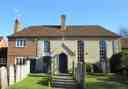
To spot the Godalming Museum, just look for a smart white building with classic sash windows and a dark sign that proudly says "Godalming Museum & Garden" right above the entrance-it's nestled between the timbered building on the left and a brick building on the right. So here we are, right outside the magical little treasure chest that is the Godalming Museum. Imagine stepping back in time, where every corner you turn promises a delightful surprise from the town’s rich past. Inside, it’s not just old bits and bobs-think glittering ceramics, intricate embroidery, and lush paintings that almost let you smell the fresh rain on Surrey fields. You’d find yourself shoulder to shoulder with talent, like the famous watercolourist Helen Allingham and the garden visionary Gertrude Jekyll-her floral sketches might even give your own garden some ideas! There’s a special kind of hush in front of the paintings by Myles Birket Foster, as if his gentle countryside scenes are whispering secrets of old Godalming. A favorite story? There’s a giant stocking frame here-yes, a contraption that helped knit stockings-donated by a company from Nottinghamshire when they called Godalming home in the 1800s. Imagine the noise as yarn turned into cozy socks for the townsfolk, or maybe a bit of sneaky gossip while the machines clacked away. Godalming Museum is like a friendly time machine-you never know whether you’ll end up chatting with an architect, admiring a watercolour, or pondering just how many socks one machine could make before tea.
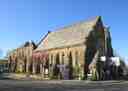
打开独立页面 →Directly ahead of you is a tall, sturdy church built from coarse, sandy-brown stone, with a square tower and long, narrow windows - just look up the hillside and spot the grand…阅读更多收起
Directly ahead of you is a tall, sturdy church built from coarse, sandy-brown stone, with a square tower and long, narrow windows - just look up the hillside and spot the grand entrance reached by a short flight of stone steps. Take a moment to imagine yourself here over a century ago, the air carrying not the sound of passing traffic, but the quiet hopes of a community longing for a place of its own. St Edmund’s Church, named after an ancient English king and martyr, stands as a beacon of faith on this dramatic hillside, its tower watching over Godalming. But believe it or not, the town once had hardly any Catholic presence - since the 1500s, Catholics were almost invisible here, outnumbered by Protestants, and the bold few attended secret masses hidden quietly behind private doors. You can almost hear the hush of feet up the stone stairs as villagers slipped inside, seeking spiritual comfort at a time when being Catholic was tougher than finding matching socks in the dark! The parish’s story roars to life in the late 19th century, when Captain W.H. Rushbrooke from Suffolk decided this town needed a Catholic church. At first, there was only a tin tabernacle standing nearby, opened in 1899 - a modest building that looked more like a fancy shed than the awe-inspiring church before you! Services back then rang out with the voices of a faithful few, sometimes joined by French priests escaping revolution, working hard to keep the flame of Catholic worship alive. But the parish soon grew too big for its tin walls. Along came the energetic Fr. St George Kieran Hyland, the town’s first resident priest, freshly appointed at only 29 and full of determination. Hyland eyed this very hillside, higher than the church down by the river, and declared, “Let’s build big!” The new church took shape in 1906 under local builders and the prolific architect Frederick Walters, who must have had a secret fondness for ambitious hillsides (or perhaps just a really good pair of climbing shoes). St Edmund’s rose up with Gothic arches, buttresses, and a roof reaching 40 feet above the nave, the soaring tower and spire catching every ray of sunlight. Imagine the bustle of construction - stone blocks thudding down, the echo of hammers, the chatter of hopeful townsfolk eyeing their new home. The church cost £4,700, a small fortune then, and fundraising was a town-wide adventure, with lectures, parties, and eager donations, many of them anonymous. When the doors finally opened, St Edmund’s was plain but proud, its interior gradually adorned in later years with dazzling stained glass windows, a carved Lady Chapel at the tower’s base, and some rather rare, almost sculpted Stations of the Cross that draw admirers even today. Its windows tell stories: from the west, you’ll spot Jesus flanked by St George (patron saint of England) and St Demetrius, shining in colored light; others, added between the 1920s and 1950s, show everything from the Virgin Mary to the Annunciation. The church even has a font and organ donated by mystery friends of the parish - perhaps ghostly benefactors who liked to keep things interesting? Over time, St Edmund’s became the heart of a sprawling parish. Mass might be said here, at a chapel in a barn in nearby Elstead, in Milford Hospital, or for a thriving Polish community that found a spiritual home within these walls after the Second World War, their hymns echoing alongside English prayers. And during the Hungarian Revolution of 1956, when refugees arrived in Godalming, St Edmund’s welcomed Catholic newcomers from across Europe with open arms. Fr Hyland, the tireless priest who did everything from building altars to helping at local hospitals, was laid to rest under the sanctuary after serving well beyond retirement. His successors kept the parish lively - opening new churches, building community halls, and even, for a while, planning a “super church” for the whole district (sadly, this dream never got beyond the drawing board… but not for lack of enthusiasm). Today, if you stand quietly and listen, you can almost hear the mingled voices of the past - English, Polish, Hungarian - rising through the nave, blending with the modern bustle outside. St Edmund’s may have begun as an underdog on a hill, but now, it’s the proud guardian of generations of stories, standing just a little higher than its ancient neighbour down by the river - as if giving a good-natured wave across the rooftops of Godalming. And don’t worry, the steps up are the only challenge now - no climbing shoes required! Eager to learn more about the early catholicism in godalming, the present church or the architecture? Simply drop your inquiries in the chat section and I'll provide the details you need.
打开独立页面 →
再显示 7 个站点显示更少站点expand_moreexpand_less
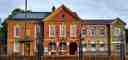
Straight ahead of you, you’ll spot the Borough Hall by its grand red brick facade with golden stone trim, tall sash windows, and a pointed gable with a round window at the top.…阅读更多收起
Straight ahead of you, you’ll spot the Borough Hall by its grand red brick facade with golden stone trim, tall sash windows, and a pointed gable with a round window at the top. Just look for the set of three big arches and the “Borough Hall” sign. Picture yourself here more than a century ago-Bridge Street is busy with people chattering, market stalls overflowing, and the imposing Borough Hall right here, shimmering in the morning light. This building isn't just a pretty face: its story goes way back to the days of Queen Elizabeth I, when the town first got a royal charter in 1575. But don’t let the royal connection fool you-Godalming’s first municipal building was a bit cozier and probably much smellier, as it even held French prisoners after a long-ago battle. Imagine being those people, stuck in the middle of the High Street, listening to the constant clopping of horses and the noisy market traders. As Godalming grew, so did its ambitions. The Pepperpot was built in 1814 with its own assembly room, but even that soon got too small for all the big ideas and debates brewing in the town. When the civic leaders got tired of squeezing into tight quarters, they built this striking Borough Hall in 1861 using brown rubble masonry. You can almost imagine the excitement-and maybe a few grumbles-when Henry Peak’s dramatic, asymmetrical frontage took its place here. But they weren’t finished yet! In 1907, the town’s leaders decided the hall should stretch even farther. With a flurry of dust and the clatter of tools, they extended the building in red brick, topped it with stone, and crowned the central section with a grand pediment and an oculus-a fancy round window to impress all passersby. If you look up, you’ll spot the borough coat of arms proudly displayed, as if the building itself is standing at attention. The Borough Hall was always the center of Godalming’s drama-literally and politically. Imagine the echo of councillors’ shoes and heated voices, with plans being hatched well into the twentieth century, until eventually the real political wrangling moved out in the 1970s. But you won’t find dust gathering on history here: even after the official council moved to The Burys, the Borough Hall buzzed with local goings-on and even art, including a grand portrait of Admiral Sir John Balchen, a local lad who grew up to wrangle the Royal Navy. Talk about home-grown talent! Now, as you stand on Bridge Street, you’re joining the long parade of townsfolk who have stood before this proud hall, hearing secrets and stories echoing in its walls.
打开独立页面 →To spot the Godalming Congregational Church, just look for a large, golden-brown building with dramatic pointed-arch windows and a steep roof-the main entrance faces the corner…阅读更多收起
To spot the Godalming Congregational Church, just look for a large, golden-brown building with dramatic pointed-arch windows and a steep roof-the main entrance faces the corner across from the Town Bridge, with a beautiful set of arched porches and a tower rising off to the right. Now, as you’re standing here, close your eyes for a moment and picture this spot as it was over 150 years ago. The year is 1868. The River Wey trickles nearby, and the streets are alive with the sound of boots on cobblestone and the distant ring of church bells. This impressive suite of buildings, crafted from sturdy yellow Bargate stone, was brand new back then, glowing with hope and purpose. If you’d walked by, you might have seen townsfolk in their Sunday best, drawing their eyes up to the landmark spire atop the turret-yes, the building had a spire in those days! Godalming was no stranger to religious nonconformists. Back in the mid-1600s, even when it was risky, locals gathered in secret-sometimes in the woods, sometimes by candlelight in whispering homes. By the 18th century, these bold worshippers formalized into thriving congregations, eventually building the original Ebenezer Chapel on Hart’s Lane. As the years rolled by, the community grew so large, their old chapel was bursting at the seams. Imagine the excitement-and maybe a touch of anxiety-as Reverend Thomas Davies announced a new fundraising campaign for a grand chapel in a more prominent location, right here next to Town Bridge. The first stone was laid with great ceremony in May 1868, and after just five months, worshippers poured inside for the opening service. This church could seat 450 people-although, as in every large family, I bet someone always complained about their seat! Later, with more land in hand, they added a two-story schoolroom in the back, filled with the clatter of lively children, wooden benches, and maybe a teacher or two clutching a stick for good measure. These walls saw plenty of adventure: Congregational members set out to villages like Elstead and Milford, building new chapels, helping neighbors, and sometimes weathering setbacks-like a Monopoly player forced to sell Old Kent Road. Village chapels sometimes closed, were reborn, or even moved miles away (as at Eashing, with its chapel now at the Rural Life Living Museum in Tilford). Through thick and thin, the Godalming church kept up the fight for faith. But time takes its toll. Ever resourceful, the congregation melted down their iron railings for the Second World War effort, did you know? And the elegant spire that once soared above you? By the late 1960s, it had become too wobbly to trust-so, off it came. If you hear the wind whistling, it’s almost as if the church is whispering tales of its lost tower. By 1977, the world outside had changed, and so had church life inside. After over a century of worship, the last service was held on Christmas Day-a poignant time to say farewell. The congregation joined with their Methodist neighbors across the street, beginning a fresh chapter just as the old building swapped hymnals for hammers and became an auction house, then a bustling restaurant. Lately, the aroma of coffee and fresh furniture polish have replaced Sunday morning incense as the Cotswold Company made it a showroom. Yet through all these changes, the church’s dignified Gothic Revival architecture endures: those tall lancet windows with their lace-like tracery, the quirky quatrefoil shapes above the doors, and the granite tower-slightly stubbier now, after losing its spire, but still noble. Inside, echoes of the past linger: can you almost hear hymns mixing with laughter, or perhaps the clink of cutlery from its restaurant days? In 1991, the building was officially recognized as Grade II listed-“nationally important and of special interest.” Isn’t it amazing to think that even furniture shoppers today are unwittingly surrounded by centuries of faith, struggle, and community spirit every time they step through its porch? So stand tall outside these golden stone walls-remember you’re not just looking at a church, but at a living chapter of Godalming’s story, telling tales of bravery, teamwork, disappointment, and renewal. And if you listen close, maybe you’ll catch a faint whisper of a Victorian hymn drifting through the air.
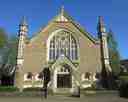
打开独立页面 →Straight ahead, you’ll see a sturdy, grey-brick church with tall pointed towers on each corner and an impressive arched window packed with intricate stonework - look between the…阅读更多收起
Straight ahead, you’ll see a sturdy, grey-brick church with tall pointed towers on each corner and an impressive arched window packed with intricate stonework - look between the fire station and the River Wey, and you can’t miss it! Now, let’s step back to 1903, when this church first opened its doors right here in Godalming. Imagine the sound of footsteps echoing on new stone floors, as hopeful voices fill the air - Methodist hymns, URC prayers, each ringing out, waiting for a time when they’d share the same space. That time arrived in 1977, when the Godalming United Church was born, uniting two local congregations who decided, “Why sit apart? Let’s join forces and double the cake at the coffee mornings!” Ever since, the ministers have taken turns wearing the ‘top hat’ - Methodist one year, URC the next, like a friendly game of musical pulpits. But here’s something special: this church is a registered place where couples - of any kind - can tie the knot, making it a home for love in all its forms. And when the community was needed most, back in January 2022, these walls didn’t just echo with song, but with comfort; it became a safe haven for neighbours escaping a fire, offering warmth and hope on a cold, uncertain night. So as you stand here, you’re not just seeing a building - you’re in front of a beating heart in Godalming, a place where people come together, rain or shine, song or sorrow. And who knows, if you listen closely, maybe you’ll hear the choir warming up - or at least the kettle boiling for tea!
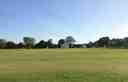
打开独立页面 →You’re looking at a wide-open sweep of bright green grass, scattered with people in white sports kit - just glance ahead and you can’t miss the stretch of players and the neat…阅读更多收起
You’re looking at a wide-open sweep of bright green grass, scattered with people in white sports kit - just glance ahead and you can’t miss the stretch of players and the neat cricket sight screens with trees and rooftops beyond. Welcome to Broadwater Park, the very heartbeat of Farncombe! Right where you’re standing, imagine a summer day in 1827: gentlemen in wool trousers and high collars are playing cricket, and a small crowd gathers, their laughter carried by the breeze. This very field set the stage for local legends when East faced West Sussex for the first time - and not just once! In 1854, Surrey met Nottinghamshire right here for a match filled with excitement, no doubt leaving players and spectators alike on the edge of their seats. Over centuries, the grass has soaked up hundreds of games, shouts, and at least a few biscuit crumbs dropped mid-picnic. When cricket takes a bow for winter, the pitch transforms for football, and if you listen closely, you might just hear echoes of cheers from Farncombe Cricket Club, Farncombe Wanderers, and the football teams. Early on Saturdays, crowds gather for the parkrun - five kilometres of energy, as runners puff along the paths, racing against time or just their own snooze button. Don’t miss the lake at the far end: on misty mornings, you’ll find silent anglers from Godalming Angling Society, lines poised, eyes dreaming of the day’s big catch. Broadwater Park isn’t just a field - it’s a stage for drama, competition, and well-earned sandwiches, every day of the year!
打开独立页面 →To spot the Meadrow Unitarian Chapel, look for a quaint, single-storey building with a tiled roof, a central gabled porch with a cross on top, and tall arched windows, set just…阅读更多收起
To spot the Meadrow Unitarian Chapel, look for a quaint, single-storey building with a tiled roof, a central gabled porch with a cross on top, and tall arched windows, set just behind a row of old gravestones and a neatly cut path leading to its blue double doors. Welcome, intrepid explorer, to the Meadrow Unitarian Chapel-where stories hide in the brickwork and the air tingles with over two centuries of secrets. As you stand before its red-brown bricks (the left side sporting its original face, the rest now cloaked in cream stucco), imagine you’re stepping across not just a graveyard, but a threshold into 18th-century Farncombe, when this was a bustling town not of markets, but small factories and rumbling mills. Back then, Godalming had a rebellious heart-a whopping one in three townsfolk refused to worship with the Church of England. Instead, they sneaked into secret gatherings in flickering candlelight, crammed into cottages or barns, where hushed voices debated faith and freedom. Out of this atmosphere grew a determined group of Baptists, often meeting at the house of William Evershed, a landowner, and a Baptist forerunner with connections stretching to Billingshurst. Picture this: it’s June of 1783, and the group decides-over tankards of ale, perhaps-that it’s time for a proper chapel. An agreement is struck: build a new meeting house at Meadrow. Six long years later, the doors finally swing open in 1789. The chapel wasn’t fancy, but it was perfectly suited to their needs, boasting a baptistery set deep in the floor for those bracing, full-immersion ceremonies. If you pressed your ear to that old brick today, maybe you’d still hear the. It’s not just Baptists who shaped this place. Throughout the 1800s, debates about the Holy Trinity grew louder. Eventually, this congregation and many like it shifted their beliefs towards Unitarianism, welcoming those who saw God-well, a little less by-the-book. The chapel became a haven for new ideas, unafraid to question, always looking for a better, kinder path. Life didn’t stand still outside these walls either. By 1821, a snug red-brick cottage was built right onto the chapel-like a faithful sidekick. By 1870, there was a Sunday school bursting with little Victorian boots, and education for poor children soon followed with a bold, free "British School" near Bridge Road. You could almost imagine the chaos: desks clattering, chalk dust swirling, and the laughter of children who, just maybe, didn’t want to be there as much as their teachers hoped. Inside, things have changed little: the pews have been pushed to the walls, creating an open, light-filled space beneath a neat gallery. There’s even a "good row of hat pegs" for bonnets and bowlers-clearly, these folks had their priorities in order! Out front, the ancient gravestones and burial vaults provide a roll call of the past. There lie the Elphs, the Pilsleys (Thomas was first to be buried here, in 1810), the Knights, and especially the Ellises-a family whose name you’ll spot a dozen times among the weathered stones. Tradition has it that a certain John Ellis was a generous builder, so when you imagine the first bricks being laid, you might picture him all business, sleeves rolled up… and perhaps grumbling about the price of lime! By the 1970s, the congregation briefly swapped buildings, worshipping in the old Sunday school for a spell before returning to their beloved chapel. In 1976, a new era began: weddings were held under these sturdy tiles, and laughter replaced the solemn hush. Even the architecture has its charms: notice the way the roof stretches across cottage and chapel without missing a beat, the arched porch inviting you in beneath its cross, a chimney parked confidently above, and the three elegant windows that let sunlight flood the space. And while the last burial took place here in 1869, the chapel grounds are still alive with memory-walk quietly, and you may sense the presence of those who came before. So here ends our journey: in front of a building that’s not just bricks and mortar, but a treasure chest of Farncombe’s dreams, debates, and deep affection for freedom and faith. Thank you for joining me, and if you listen closely-who knows? You might just hear echoes of the past on the wind.
打开独立页面 →
常见问题
如何开始导览?
购买后,下载 AudaTours 应用并输入您的兑换码。导览将准备好立即开始--只需点击播放并按照 GPS 引导的路线行驶即可。
导览期间我需要互联网吗?
不需要!开始前下载导览并完全离线享受。只有聊天功能需要互联网。我们建议在 WiFi 下下载以节省移动数据。
这是导游带领的团体游吗?
不是--这是自助语音导览。您按照自己的节奏独立探索,通过手机播放音频解说。没有导游,没有团体,没有时间表。
导览需要多长时间?
大多数导览需要 60-90 分钟才能完成,但您完全控制节奏。随时暂停、跳过站点或休息。
如果我今天无法完成导览怎么办?
没问题!导览具有终身访问权限。随时暂停和恢复--明天、下周或明年。您的进度已保存。
有哪些语言可用?
所有导览均提供 50 多种语言版本。在兑换代码时选择您的首选语言。注意:导览生成后无法更改语言。
购买后我在哪里访问导览?
从 App Store 或 Google Play 下载免费的 AudaTours 应用。输入您的兑换码(通过电子邮件发送),导览将出现在您的资料库中,准备下载并开始。
如果您不喜欢该导览,我们将退款。请联系我们 [email protected]
安全结账使用 


