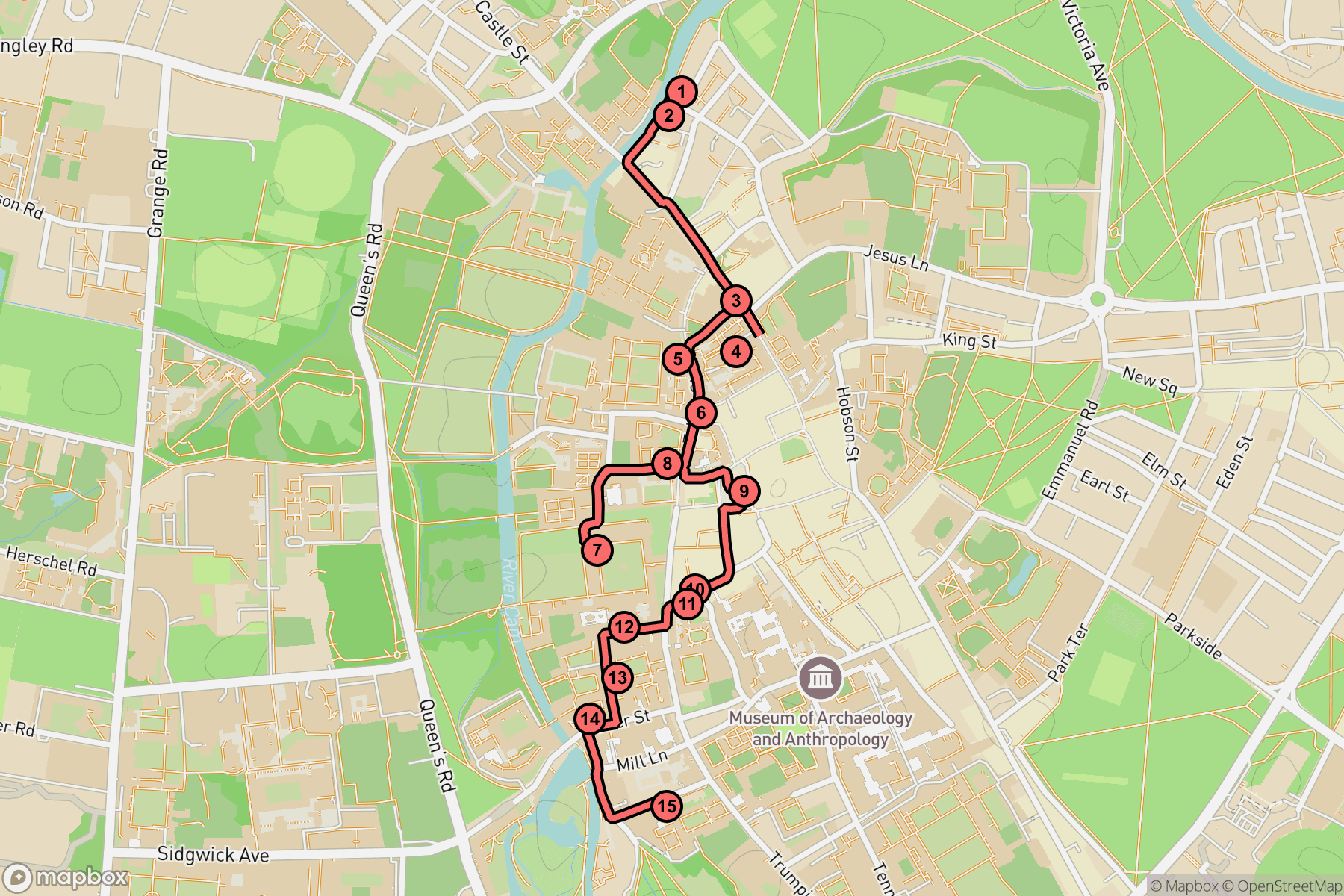
Cambridge Audio Tour: Bedders, Bargees and Booksellers
语音指南15 景点
Cambridge is famous as a university town. This walk is about the other Cambridge — the carriers who delivered the post, the watermen who poled coal up from King's Lynn, the binders who stitched the books, the women who lit the staircases at dawn, the brewers who tied the inns, the masons who cut the stone, the printers who set the type, and the market traders who fed the lot. From the working wharves of Quayside, through the bookbinders' alleys and gown-makers' shopfronts of Trinity Street and King's Parade, into the chapel that was Corpus's parish before Corpus had a chapel, past the only galleried coaching-inn yard left in town, across the open market that has traded continuously for a thousand years, past the gates where Thomas Hobson the carrier kept forty horses, to the world's oldest publishing house and finally to the Mill Pond where the Bishop's and King's Mills ground Cambridge's grain — a couple of miles, a couple of hours, and most of a working town hiding inside a famous one.
Magdalene BridgeThe 1823 cast-iron bridge over the Cam, sitting where the Roman crossing and the medieval Great Bridge of Cambridge stood for nearly two thousand years. Quayside, the unloading point for the river-borne coal, grain, stone and timber that fed the town, lies on the east bank just below.
location_on
2
lock
PickerelReputedly Cambridge's oldest continuing pub — first licensed 1608, with a 16th-century timber-framed core behind a Regency brick front. The yard behind the pub still has the carriageway and the site of the harness-room. Magdalene College owned the building for most of the 20th century; today it's a Greene King tied house.
location_on
3
lock
The Round ChurchThe Church of the Holy Sepulchre, c.1130, one of only four medieval round churches in England. The 1841-43 restoration by Anthony Salvin gave it the conical roof you see today. The working-life angle here is the Great Bridge story 50 metres up the road — the working road into Cambridge — and the named Victorian craftsmen (Willement, Wailes, Gurney) who restored the church.
location_on
4
lock
All Saints PassageThe narrow cobbled alley running east from Trinity Street to St John's College. Home to the Bowtell bookbinding household in the 1850s. The Bodley-built All Saints Church (1864) on Jesus Lane replaced the medieval All Saints-in-the-Jewry that stood on the passage and was demolished in 1865. The passage itself is now the All Saints Garden Saturday craft market.
location_on
5
lock
Trinity College Great GateThe ceremonial gate of Trinity College, c.1490-1535, built originally as the gate of King's Hall. The lower stages are by the master mason William Swayn (1490-1505); John Wastell (the great freemason of King's College Chapel) consulted in the 1490s. The Henry VIII statue, holding a chair leg, sits above. The porter's lodge, the gardeners on the lawn and the bedders on the staircases inside are the working population of every Cambridge college.
location_on
6
lock
Heffers BookshopCambridge's defining 20th-century bookshop. William Heffer's first shop opened at 104 Fitzroy Street in July 1876; the firm moved to Petty Cury in 1896 and to its current Trinity Street site in 1970, in a building designed by Austin-Smith: Lord as part of Trinity's Wolfson Building. Sold to Blackwell's in 1999 after four working generations of the Heffer family.