
剑桥语音导览:永恒的发明与钟声传奇
在剑桥的心脏地带,传说蜿蜒穿过石砌回廊和木结构拱门。每一个标志性地标背后都隐藏着一个秘密——有些是学者们低声耳语的,有些则藏在木桥的寂静弧线中,或被描绘在闪烁的玻璃窗格上。这个自助语音导览邀请您按照自己的节奏漫步,解锁大多数游客从未听过的故事。 为什么敌对的国王们为了国王学院礼拜堂发动了长达数十年的战争,使这座城市陷入困境?数学桥中编织着哪些奇特的秘密——它真的没有用一根螺栓就建造而成吗?在叛乱时期,谁在神圣的空间里刻下了禁忌的标记? 漫步经过湍急的河流和高耸的拱顶,丑闻、科学的辉煌和幽灵传说在每一个转弯处向您涌来。每一站都将把您更深地带入数百年的神秘与奇迹之中,永远改变您看待剑桥的方式。 迈步向前——发现表面之下的真相,让剑桥揭示其隐藏的内心。
导览预览
关于此导览
- schedule持续时间 30–50 mins按照自己的节奏
- straighten0.8 公里步行路线跟随引导路径
- location_on
- wifi_off离线工作一次下载,随处使用
- all_inclusive终身访问随时重播,永久有效
- location_on从 数学桥 开始
此导览的景点
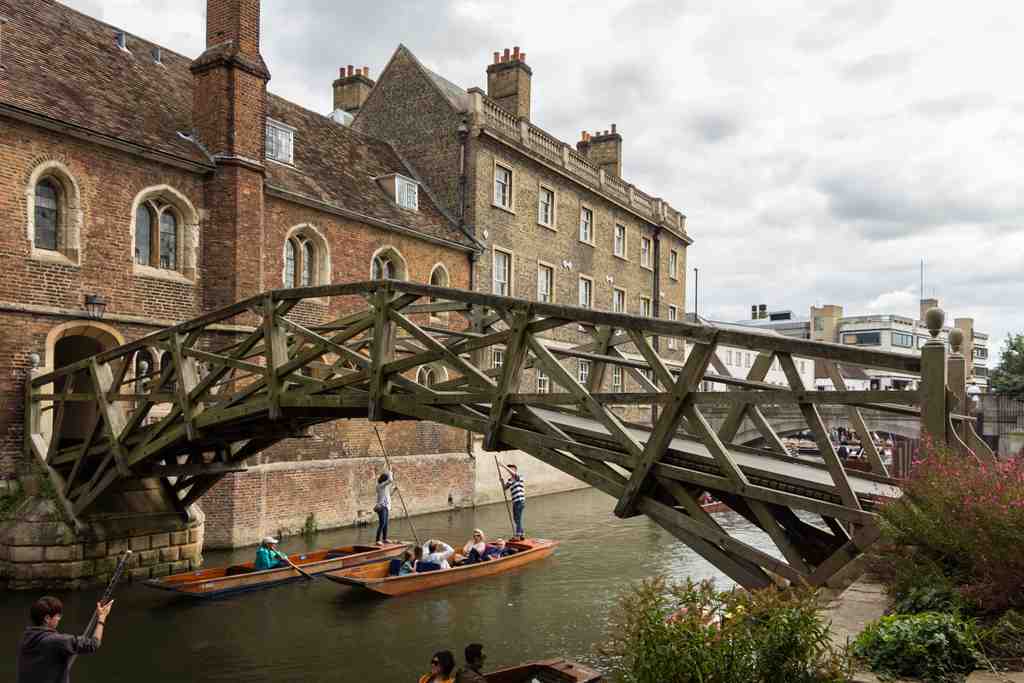
On your left, stretching over the River Cam between the old brick buildings, you’ll spot a striking wooden bridge, its straight timbers zig-zagging together into a gentle…阅读更多收起
On your left, stretching over the River Cam between the old brick buildings, you’ll spot a striking wooden bridge, its straight timbers zig-zagging together into a gentle arch. Welcome to the Mathematical Bridge, one of Cambridge’s most mysterious and iconic sights! Picture yourself standing here in 1749-horses clip-clopping in the distance, the air full of the scent of fresh timber and river water, and the quiet buzz of students chattering as craftsmen work with saws and hammers. Built by James Essex from a cutting-edge design by William Etheridge, this bridge was no ordinary feat. To everyone’s surprise, the bridge looks curved, but not a single curved piece was used! Every one of those wooden beams is perfectly straight. It’s like a magician’s trick, and the secret is hidden in its clever geometric arrangement-tangents and spokes locked tightly together, creating an elegant arch strong enough to carry eager students racing across between classes. As you stand here, you might hear the gentle splash of a punt pole dipping in the Cam below. But listen closely-the bridge has its own stories to whisper! One of the wildest myths is that the great Isaac Newton himself built the bridge, using nothing but sheer genius-no nuts, no bolts, and definitely no glue. The tale goes that students once tried to take it apart, convinced it was all magic, but of course, when they tried to put it back together again, it promptly collapsed into a pile of awkward timber! The truth is a bit less dramatic, but just as clever. Bolts were hidden away in the joints with iron spikes, so from the inside they were nearly invisible. That’s more a sign of engineering flair than wizardry. Imagine the tension as those students realized-maybe, just maybe, their professors did know a thing or two after all! And no, Newton couldn’t have been responsible-he’d already left this world a good two decades before the bridge appeared. But the myth sticks around, perhaps because everyone wants a slice of Cambridge magic. Today, this bridge still connects two sides of Queens' College and stands as a reminder that sometimes the simplest-seeming things are the most ingeniously designed. So next time someone asks you if the Mathematical Bridge is held together by mysterious forces, you can smile and say, “Only if you count bolts as magical!”
打开独立页面 →On your left, stretching over the River Cam between the old brick buildings, you’ll spot a striking wooden bridge, its straight timbers zig-zagging together into a gentle…阅读更多收起
On your left, stretching over the River Cam between the old brick buildings, you’ll spot a striking wooden bridge, its straight timbers zig-zagging together into a gentle arch. Welcome to the Mathematical Bridge, one of Cambridge’s most mysterious and iconic sights! Picture yourself standing here in 1749-horses clip-clopping in the distance, the air full of the scent of fresh timber and river water, and the quiet buzz of students chattering as craftsmen work with saws and hammers. Built by James Essex from a cutting-edge design by William Etheridge, this bridge was no ordinary feat. To everyone’s surprise, the bridge looks curved, but not a single curved piece was used! Every one of those wooden beams is perfectly straight. It’s like a magician’s trick, and the secret is hidden in its clever geometric arrangement-tangents and spokes locked tightly together, creating an elegant arch strong enough to carry eager students racing across between classes. As you stand here, you might hear the gentle splash of a punt pole dipping in the Cam below. But listen closely-the bridge has its own stories to whisper! One of the wildest myths is that the great Isaac Newton himself built the bridge, using nothing but sheer genius-no nuts, no bolts, and definitely no glue. The tale goes that students once tried to take it apart, convinced it was all magic, but of course, when they tried to put it back together again, it promptly collapsed into a pile of awkward timber! The truth is a bit less dramatic, but just as clever. Bolts were hidden away in the joints with iron spikes, so from the inside they were nearly invisible. That’s more a sign of engineering flair than wizardry. Imagine the tension as those students realized-maybe, just maybe, their professors did know a thing or two after all! And no, Newton couldn’t have been responsible-he’d already left this world a good two decades before the bridge appeared. But the myth sticks around, perhaps because everyone wants a slice of Cambridge magic. Today, this bridge still connects two sides of Queens' College and stands as a reminder that sometimes the simplest-seeming things are the most ingeniously designed. So next time someone asks you if the Mathematical Bridge is held together by mysterious forces, you can smile and say, “Only if you count bolts as magical!”
打开独立页面 →To spot King’s College Chapel, look to your left for an enormous stone building with towers topped by intricate pinnacles and a huge, arched window filled with delicate…阅读更多收起
To spot King’s College Chapel, look to your left for an enormous stone building with towers topped by intricate pinnacles and a huge, arched window filled with delicate glasswork. Now that you’re standing before King’s College Chapel, take a moment and let your mind travel back through the centuries-it’s hard not to feel something special here. Imagine it: the year is 1446, and instead of undergraduates hurrying to lectures, the green lawns are bustling with builders in woolen tunics, the air humming with the sharp tap of chisels and the grumble of carts hauling stone. The first stone for this chapel was laid by King Henry VI himself, who was dreaming big-he wanted a chapel that would outshine anything else in Cambridge, something that would make people stop, look up, and say “Wow, that’s a chapel fit for a king!” But as anyone who’s ever tackled a home renovation knows, things didn’t go entirely to plan. Not just bad weather or someone forgetting to order bricks-no, this was much bigger. The whole country was thrown into the madness of the Wars of the Roses! Construction would stall for years at a time, and the half-finished chapel stood here like a stony skeleton, year after year, through three different kings’ reigns. It took almost seventy years to finally finish the building, with bits started under Henry VI, more work done when Richard III stopped fighting long enough to lend a hand, and some heroic teamwork by Henry VII, who left behind money in his will just to make sure those masons got paid. If you ever need inspiration for perseverance, look no further than these walls. But oh, what patience produced! Just step inside-or at least peer through those massive windows-because above your head soars the world’s largest fan vault. It’s like looking up into a stone forest, each rib fanning out in perfect symmetry. The original architect, Reginald Ely, probably wouldn’t have believed it-he’d envisioned a simpler vault, but those daring masons under John Wastell went wild and created a ceiling that still amazes people 500 years later. And speaking of amazed, look at those windows! There are twelve along each side and massive showstoppers at each end, filled with stained glass crafted by legendary Flemish glaziers between 1515 and 1531-a rainbow of saints, kings, and Bible scenes lighting up the floor whenever the sun shines. But this chapel has seen more than peace and prayers. During the English Civil War, many churches were smashed up by Puritan soldiers who thought stained glass and statues were a bit too fancy. King’s Chapel was luckier-some say Oliver Cromwell himself, a former student here, ordered its protection. If you look close to the altar, you can still find graffiti scratched into the stone by bored Parliamentarian troops using the chapel as their training ground. And when World War II rolled around, those precious medieval windows were gently taken out and hidden away for safekeeping. And then there’s the painting: towering above the altar is a gigantic work by Rubens, The Adoration of the Magi, added in 1968. Moving it here turned into a proper Cambridge drama-at first, it looked like someone had stuck a postage stamp under a cathedral window! After much huffing and puffing, an architect came up with the idea to add plain shutters to give it the right shape, and now it fits in, as if it belonged all along. Listen closely-all that history is still alive, not just in stone and glass, but in sound. Today, the choir of King’s College still sings under those vaults, their voices soaring up and echoing through the arches, filling the chapel with music during special services and concerts. And every Christmas Eve, the world tunes in to hear a solo voice sing "Once in Royal David’s City" as part of the Nine Lessons and Carols-a tradition broadcast by the BBC to millions. So as you stand here, look up and imagine all those kings, architects, masons, and choirmasters gazing with pride-or possibly a little exhaustion-at what they created. Whether you come for the beauty, the music, or just to snap a great photo, King’s College Chapel stands as a symbol of Cambridge: enduring, uplifting, and full of stories. Now, who’s up for starting a building project that’ll outlast a few civil wars? No takers? Interested in a deeper dive into the construction, great windows or the rood screen? Join me in the chat section for an insightful conversation.
打开独立页面 →
常见问题
如何开始导览?
购买后,下载 AudaTours 应用并输入您的兑换码。导览将准备好立即开始--只需点击播放并按照 GPS 引导的路线行驶即可。
导览期间我需要互联网吗?
不需要!开始前下载导览并完全离线享受。只有聊天功能需要互联网。我们建议在 WiFi 下下载以节省移动数据。
这是导游带领的团体游吗?
不是--这是自助语音导览。您按照自己的节奏独立探索,通过手机播放音频解说。没有导游,没有团体,没有时间表。
导览需要多长时间?
大多数导览需要 60-90 分钟才能完成,但您完全控制节奏。随时暂停、跳过站点或休息。
如果我今天无法完成导览怎么办?
没问题!导览具有终身访问权限。随时暂停和恢复--明天、下周或明年。您的进度已保存。
有哪些语言可用?
所有导览均提供 50 多种语言版本。在兑换代码时选择您的首选语言。注意:导览生成后无法更改语言。
购买后我在哪里访问导览?
从 App Store 或 Google Play 下载免费的 AudaTours 应用。输入您的兑换码(通过电子邮件发送),导览将出现在您的资料库中,准备下载并开始。
如果您不喜欢该导览,我们将退款。请联系我们 [email protected]
安全结账使用 


