
新德里语音导览:新德里之旅
在新德里,近三百万大军守卫在无声的石墙和低语的政策背后,每一条走廊都隐藏着一个转折点。通过这次自助语音导览,探索这座城市隐藏的力量和创造脉搏,从印度国防部阴暗的大厅漂流到镀金的画廊和战争纪念馆坚不可摧的寂静之中。 谁在历史试图抹去的午夜对峙中冒着一切风险?斋浦尔宫蝴蝶状的怀抱中隐藏着哪些秘密?为什么永恒的火焰在城市注视的目光下改变了位置? 当你从帝国阴谋的回声走向刻有牺牲的墙壁时,追溯几个世纪以来的反叛、革新、艺术丑闻和记忆。每一站都在德里跳动的心脏处,开启了关于奋斗、愿景和国家认同的新视角。 现在就开始聆听——看看阅兵场之外能揭示多少秘密。
导览预览
关于此导览
- schedule持续时间 30–50 mins按照自己的节奏
- straighten6.2 公里步行路线跟随引导路径
- location_on
- wifi_off离线工作一次下载,随处使用
- all_inclusive终身访问随时重播,永久有效
- location_on从 印度国防部 开始
此导览的景点
The Ministry of Defence (MoD), or Rakshā Mantrālaya, is an essential institution responsible for coordinating and supervising all government agencies and functions related to…阅读更多收起
The Ministry of Defence (MoD), or Rakshā Mantrālaya, is an essential institution responsible for coordinating and supervising all government agencies and functions related to national security and the Indian Armed Forces. The armed forces, including the Indian Army, Indian Air Force, Indian Navy, and Indian Coast Guard, operate under the Ministry's guidance to ensure the territorial integrity of India. The MoD plays a vital role in providing policy frameworks and allocating resources to enable the armed forces to fulfill their responsibility in defending the country. Its importance is evident by the fact that, according to Statista, it is the largest employer globally, boasting a staggering 2.92 million employees. The Ministry of Defence oversees the organization and execution of the Republic Day celebrations and parade, held every year in January. It hosts a significant chief guest for this event. Furthermore, it possesses the largest budget among all federal departments in India, standing third in military expenditure worldwide. The history of the Ministry traces back to the establishment of a Military Department in Kolkata in 1776 by the English East India Company. Originally a branch of the Public Department, it documented and managed Army-related orders. With the Charter Act of 1833, the Secretariat of the East India Company government was restructured, giving rise to four departments, each headed by a secretary. The Indian Army transitioned from separate presidencies (Bengal, Bombay, and Madras) to a unified force in 1895. The supreme authority over the Indian Army rested with the Governor General-in-Council, subject to the control of the Crown. The Military Department was eventually abolished in 1906 and replaced by the Army Department, responsible for administrative and operational matters. Over time, the MoD has undergone significant changes. Following the 1962 war, the Department of Defence Production was established to focus on research, development, and production of defense equipment. The Department of Defence Supplies was also created in 1965 to plan and execute schemes for import substitution in defense. These two departments were later merged to form the Department of Defence Production and Supplies. In 1980, the Department of Defence Research and Development was formed, and the Department of Defence Production and Supplies was renamed the Department of Defence Production in January 2004. Additionally, a Scientific Adviser to the Defence Minister was appointed to provide expert advice on the scientific aspects of military equipment and research and design. The Department of Ex-Servicemen Welfare was established in 2004 to cater to the needs of former military personnel. As you can see, the Ministry of Defence has evolved from a logistical support provider at its inception in 1947 to an institution involved in various aspects of defense, including research, production, and welfare. Its critical role in ensuring national security cannot be underestimated.
打开独立页面 →The National Gallery of Modern Art (NGMA) is a prestigious art gallery under the Ministry of Culture, Government of India. It was established on 29th March 1954 by the Government…阅读更多收起
The National Gallery of Modern Art (NGMA) is a prestigious art gallery under the Ministry of Culture, Government of India. It was established on 29th March 1954 by the Government of India, with branches in Mumbai and Bangalore. The main museum, located at Jaipur House in New Delhi, houses over 1700 works by more than 2000 artists. The collection includes renowned artists like Thomas Daniell, Raja Ravi Verma, Abanindranath Tagore, Rabindranath Tagore, Gaganendranath Tagore, Nandalal Bose, Jamini Roy, and Amrita Sher-Gil, as well as works by foreign artists. Some of the oldest artworks preserved in this museum date back to 1857. With an impressive exhibition space of 12,000 square meters, the Delhi branch of NGMA is one of the largest modern art museums in the world. The idea for a National Art Gallery was initially proposed by the AIFACS (Delhi-based artists’ organization) in 1938. The gallery showcases diverse art forms and has played a significant role in promoting Indian art on an international level. The Jaipur House, where the museum is located, was a former residential palace of the Maharaja of Jaipur. Built in 1936 in the shape of a butterfly, the building features a central dome and was designed by Sir Arthur Blomfield. It is situated at the end of Rajpath, near the iconic India Gate. The Central Hexagon around the India Gate, which was designed by Sir Edwin Lutyens, housed the residences of prominent princely states. Hence, the location of the NGMA holds historical and architectural significance. Inaugurated by Vice President Dr. S. Radhakrishnan in the presence of Prime Minister Jawaharlal Nehru, the NGMA continues to preserve and promote modern art in India. Alongside its extensive collection, the gallery offers art restoration services, an art reference library, and a documentation center. Its commitment to art education and knowledge further enhances its stature as a prominent cultural institution in India.
打开独立页面 →


再显示 5 个站点显示更少站点expand_moreexpand_less
The Amar Jawan Jyoti, also known as the Immortal Soldier Flame, is an Indian memorial that was built following the Indo-Pakistani War of 1971. It was inaugurated on January 26,…阅读更多收起
The Amar Jawan Jyoti, also known as the Immortal Soldier Flame, is an Indian memorial that was built following the Indo-Pakistani War of 1971. It was inaugurated on January 26, 1972, and served as the national war memorial until February 2019 when the new National War Memorial was inaugurated. The Amar Jawan Jyoti, located at India Gate, consists of a base measuring 15 square feet with a height of 4 feet 3 inches. On top of the base, there is a black marble pedestal in the shape of a cenotaph, standing at a height of 3 feet 2 inches. The words "Amar Jawan" (meaning Immortal Soldier) are inscribed in gold on all four sides of the cenotaph. At the top, there is a reversed rifle, symbolizing a fallen soldier, and a war helmet. The construction of the Amar Jawan Jyoti was completed hastily, as per the wishes of Prime Minister Indira Gandhi. It was her desire to have a memorial ready in time for Republic Day on January 26, 1972. The monument was constructed in a short timeframe to honor those who had fought in the war just the previous month. In 2019, a new flame was installed at the National War Memorial to honor all known martyrs of the Indian Armed Forces. The flame at the Amar Jawan Jyoti was merged with the new one at the National War Memorial. This sparked a debate surrounding the old and new monuments, including their semantics, history, politicization, and symbolism. India Gate, designed by Edwin Lutyens, was unveiled in 1931 and originally allowed traffic and parades to pass through it. However, vehicular movement under the arch was restricted in the 1950s. The Amar Jawan Jyoti was added under India Gate after the Indo-Pakistani War of 1971, which led to the liberation of East Pakistan. It is worth noting that for many years after Independence, there was no clear-cut policy regarding war memorials in India. As a result, memorials were often constructed across the country without proper coordination or thoughtful architecture. Currently, there are at least 150 war memorials in India. In 2017, the construction of the National War Memorial began, and it was finally inaugurated in 2019. Following the inauguration, the fate of the old Amar Jawan Jyoti became a topic of debate, raising questions about whether the flame was merged or extinguished, whether the old memorial was temporary, and the significance of its location under India Gate and its colonial history. Overall, the Amar Jawan Jyoti stands as a testament to the sacrifice and bravery of the Indian Armed Forces. It serves as a solemn reminder of the sacrifices made by soldiers in defense of their country.
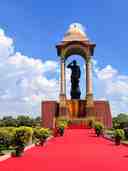
打开独立页面 →The Statue of Subhas Chandra Bose, also known as the Netaji's Statue, is a remarkable landmark made of black granite. It stands as a tribute to Netaji Subhas Chandra Bose, a…阅读更多收起
The Statue of Subhas Chandra Bose, also known as the Netaji's Statue, is a remarkable landmark made of black granite. It stands as a tribute to Netaji Subhas Chandra Bose, a valiant freedom fighter and the Commander-in-Chief of the Indian National Army. The statue reaches a total height of 28 feet (8.5 m), with a width of 8 feet (2.4 m). Situated under a canopy behind India Gate in Delhi, the statue was skillfully sculpted by renowned artist Arun Yogiraj, hailing from Mysuru. Yogiraj has also created the impressive Statue of Adi Shankaracharya in Kedarnath. At its dedication ceremony in 2022, esteemed individuals including Prime Minister Narendra Modi, his cabinet members, MP Hardeep Singh Puri, G. Kishan Reddy, and Arjun Ram Meghwal graced the event. Subhas Chandra Bose was an Indian nationalist who not only served as the second leader of the Indian National Army but also headed the Provisional Government of Free India. Initially, Bose had joined the National Congress and was elected twice as its president. Later, he went on to form the All India Forward Bloc. However, in 1941, Bose was placed under house arrest by the British government, with constant surveillance on his residence by the CID. Despite this, he managed to escape to Germany via Afghanistan and the Soviet Union, finally arriving in Singapore from Germany. In 1943, Bose revived the concept of forming an army for India's independence. During a meeting held in Singapore, Rasbihari Bose handed over control of the Indian Independence League to Subhas Chandra Bose. With his effective leadership, Bose was successful in reorganizing the army and garnering widespread support among the Indian diaspora in Southeast Asia. Notably, the installation of a statue of King-Emperor George V on the canopy of India Gate in 1936 was met with opposition from Indians. Though the statue remained in its original position for two decades after India's independence in 1947, objections arose, particularly after the tenth anniversary of independence and the centenary of the 1857 Indian Rebellion. On the night of August 12-13, 1958, George V's royal insignia and the Tudor crown atop the canopy were removed. Following mounting pressure from socialist members of Parliament, Deputy Home Minister Lalit Narayan Mishra announced in May 1964 that all British statues would be taken down from the national capital by 1966. Two days prior to Independence Day in 1965, members of the Samili Samajtantrik Party forcefully gained access to the site, vandalizing the statue by defacing its royal crown, nose, one ear, and attaching a picture of Subhas Chandra Bose to the monument. Eventually, in late 1968, the statue was relocated from its position under the canopy. In 2021, Indian Prime Minister Narendra Modi announced the construction of the Statue of Subhas Chandra Bose. The statue was intended to be placed on the canopy of India Gate as part of the 'Azadi Ka Amrit Mahotsav,' commemorating 75 years of independence and celebrating Bose's 125th birth anniversary. On January 23, 2022, a hologram statue of Subhas Chandra Bose was installed during the 'Parakram Diwas' ceremony with Prime Minister Narendra Modi unveiling it. The statue was officially dedicated on September 8, 2022, by Prime Minister Narendra Modi, marking a significant moment in the nation's history. In the inauguration ceremony, the Prime Minister emphasized, "Today, when George V's statue is replaced by Netaji's statue, it marks the first instance of the abandonment of the slavery mentality." Located at the center of the C-hexagon, the statue is surrounded by other notable attractions such as India Gate, Param Vir Memorial, National War Memorial, and Children's Park. It stands within a canopy and is situated in a water body adorned with fountains. The imposing black granite statue measures 28 feet (8.5 m) in height, 10 feet (3.0 m) in length, and 8 feet (2.4 m) in width, weighing approximately 65 tons (65,000 kg).
打开独立页面 →The India Gate, formerly known as All India War Memorial, is a significant war memorial located near the eastern edge of New Delhi's ceremonial axis, previously known as Rajpath.…阅读更多收起
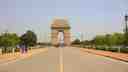
The India Gate, formerly known as All India War Memorial, is a significant war memorial located near the eastern edge of New Delhi's ceremonial axis, previously known as Rajpath. It stands as a tribute to the 84,000 soldiers of the Indian Army who lost their lives between 1914 and 1921 during the First World War. Designed by the renowned architect Sir Edwin Lutyens, the India Gate embodies the architectural style of ancient Roman triumphal arches, reminiscent of landmarks such as the Arch of Constantine in Rome and the Arc de Triomphe in Paris. This grand structure, often likened to the Gateway of India in Mumbai, bears the names of 13,300 servicemen, including soldiers and officers from the United Kingdom. Beneath the archway, a significant structure called Amar Jawan Jyoti, meaning Flame of the Immortal Soldier, has been erected. It consists of a black marble plinth adorned with a reversed rifle, crowned by a war helmet and encircled by four eternal flames. Since its completion in 1972, Amar Jawan Jyoti has served as India's tomb of the unknown soldier, commemorating those who lost their lives during the Bangladesh Liberation War in 1971. As one of the largest war memorials in India, the India Gate holds great significance. Every year on Republic Day, the Prime Minister visits the gate to pay homage to the Amar Jawan Jyoti before the commencement of the Republic Day parade. Apart from its solemn purpose, the India Gate also serves as a gathering place for civil society protests. It has witnessed numerous demonstrations, including those in response to the Nirbhaya rape case in 2012, the Unnao rape case in 2017, and the 2011 anti-corruption movement. The foundation stone for the gate, then known as the All India War Memorial, was laid on February 10, 1921, by the Duke of Connaught in the presence of officers and men of the Imperial Indian Army, the Imperial Service Troops, the commander in chief, and the viceroy. At the inauguration ceremony a decade later, Lord Irwin stated that the memorial would serve to remind future generations of the sacrifice and service of the brave soldiers whose names adorn its walls. Although the gate was previously open to traffic, it is now closed to cars. Illuminated every evening from 19:00 to 21:30, it has become one of Delhi's most iconic tourist attractions. The Republic Day Parade, starting from Rashtrapati Bhavan, passes by the India Gate, enhancing its significance in the country's ceremonial events. In recognition of its architectural resemblance to the Arch of Remembrance in Leicester, England, another war memorial designed by Sir Edwin Lutyens, the India Gate was officially twinned with the English monument in 2017.
打开独立页面 →The museum was planned by the Gwyer Committee, a committee set up by the Government of India in 1946. Sir Maurice Gwyer, the former Chief Justice of India and Vice Chancellor of…阅读更多收起
The museum was planned by the Gwyer Committee, a committee set up by the Government of India in 1946. Sir Maurice Gwyer, the former Chief Justice of India and Vice Chancellor of Delhi University, headed the committee. Sir Mortimer Wheeler, then heading the Archaeological Survey of India, was also a member and is credited with advocating for the museum's development. The National Museum houses over 200,000 works of art, primarily Indian but also some of foreign origin, covering a span of more than 5,000 years. Additionally, it is home to the National Museum Institute of History of Art, Conservation and Museology, which offers master's and doctoral level courses. The museum's origins can be traced back to an exhibition of Indian art and artifacts organized by the Royal Academy of Arts in London. After the exhibition, with the support of Jawaharlal Nehru, it was decided to showcase these collections in India, leading to the establishment of the National Museum. Initially, the exhibits were displayed in the state rooms of the Rashtrapati Bhavan, also known as Government House, until the construction of the current location on Janpath was completed in 1960. However, upon Nehru's request, the statue of Buddha and the Rampurva Bull remained at the Rashtrapati Bhavan. The National Museum drew inspiration from the Indian Museum in Kolkata, with some of its first curators being former employees of the Indian Museum. Nonetheless, the National Museum aimed to surpass its predecessor and provide a comprehensive view of India's cultural heritage. The museum not only displays objects of historical and artistic significance but also encourages visitors to view them in a broader historical context. It seeks to facilitate a deeper understanding and appreciation of India's rich heritage. Grace Morley, the founding director of the San Francisco Museum of Art, played a pivotal role as the first director of the National Museum in New Delhi. During her tenure, which lasted six years, she emphasized the importance of making art accessible to all, believing that museums have a vital role to play in cultural democracy. As we continue our tour, I encourage you to explore the diverse and captivating exhibits within this magnificent museum.
打开独立页面 →Rajpath holds immense importance as one of the most prominent roads in India. Every year on the 26th of January, it becomes the focal point for the Republic Day parade. This…阅读更多收起
Rajpath holds immense importance as one of the most prominent roads in India. Every year on the 26th of January, it becomes the focal point for the Republic Day parade. This national event showcases India's rich cultural heritage, military prowess, and technological advancements. Crossing Rajpath is Janpath, meaning "People's Way." Rajpath extends in an east-west direction, with roads from Connaught Place, Delhi's financial center, merging into it from the north. As you ascend Raisina Hill, you will be flanked by the North and South Blocks of the Secretariat Building. These iconic structures house key government offices, such as the offices of the Finance, Home, External Affairs, and Defense ministries. Continuing along Rajpath, you will reach the gates of the magnificent Rashtrapati Bhavan, the official residence of the President of India. The imposing Rashtrapati Bhavan once served as the viceroy's residence during the British Raj. At Vijay Chowk, Rajpath intersects with Sansad Marg, offering a glimpse of the majestic Parliament House of India. This impressive structure on your right marks the heart of Indian democracy, where important legislative decisions are made. Rajpath also plays a solemn role in the funeral processions of prominent politicians who have served the nation. Its significance dates back to the early 20th century when the British Imperial Government decided to shift the capital of the British Indian Empire from Calcutta to Delhi. The renowned architect Sir Edwin Lutyens was entrusted with the construction of a new city, New Delhi, centered around a grand boulevard known as the "ceremonial axis" or Rajpath. The panoramic view of Delhi from Raisina Hill, unobstructed by the National Stadium, was an essential aspect of Lutyens' vision. Most of the esteemed buildings surrounding Rajpath, including the Secretariat Buildings, were designed by Lutyens and Sir Herbert Baker. The rich architectural heritage of these structures further exemplifies the road's significance in the governance of India. Originally named Kingsway, in honor of Emperor George V's visit and the proclamation of the capital's relocation during the Durbar of 1911, Rajpath eventually received its Hindi name, Rajpath, after India gained independence. This change represented a translation rather than a substantial renaming, as 'Rajpath' in Hindi is akin to 'King's Way' in meaning. In recent times, under the Central Vista Redevelopment Project, Rajpath has undergone redevelopment and has been renamed Kartavya Path, which translates to 'Path of Duty'. As you conclude your tour of Rajpath, take a moment to appreciate the significance of the Rashtrapati Bhavan, the North and South Blocks, Vijay Chowk, India Gate, the National War Memorial, and the rich history that unfolds along this monumental boulevard.
打开独立页面 →

常见问题
如何开始导览?
购买后,下载 AudaTours 应用并输入您的兑换码。导览将准备好立即开始--只需点击播放并按照 GPS 引导的路线行驶即可。
导览期间我需要互联网吗?
不需要!开始前下载导览并完全离线享受。只有聊天功能需要互联网。我们建议在 WiFi 下下载以节省移动数据。
这是导游带领的团体游吗?
不是--这是自助语音导览。您按照自己的节奏独立探索,通过手机播放音频解说。没有导游,没有团体,没有时间表。
导览需要多长时间?
大多数导览需要 60-90 分钟才能完成,但您完全控制节奏。随时暂停、跳过站点或休息。
如果我今天无法完成导览怎么办?
没问题!导览具有终身访问权限。随时暂停和恢复--明天、下周或明年。您的进度已保存。
有哪些语言可用?
所有导览均提供 50 多种语言版本。在兑换代码时选择您的首选语言。注意:导览生成后无法更改语言。
购买后我在哪里访问导览?
从 App Store 或 Google Play 下载免费的 AudaTours 应用。输入您的兑换码(通过电子邮件发送),导览将出现在您的资料库中,准备下载并开始。
如果您不喜欢该导览,我们将退款。请联系我们 [email protected]
安全结账使用 


