AudaTours logoAudaTours

圣何塞语音导览:艺术、权力与文化的永恒回响

语音指南14 景点

在圣何塞,无声的壁画曾激起城市最激烈的辩论,石头上的弹孔仍在低语着过去的革命。 这个自助语音导览将带您深入隐藏的篇章,揭示哥斯达黎加艺术、权力与身份背后的故事和秘密。揭开大多数游客擦肩而过的层面。 为什么一声枪响打破了最高选举法庭平静的走廊?当代艺术与设计博物馆最抽象的装置中隐藏着什么秘密代码?谁曾不止一次地试图窃取国家博物馆最引人注目的文物? 漫步在谣言四起的林荫大道上,穿梭于阳光普照的广场和阴影笼罩的大厅之间,那里曾酝酿着争议,也曾迸发出璀璨的光芒。让每一步都点燃新的好奇心,让圣何塞最辉煌的时刻从鹅卵石和画廊墙壁上跃然而出。 准备好发现这座城市的墙壁和博物馆渴望揭示的一切了吗?按下播放键,解锁圣何塞的脉搏。

导览预览

map

关于此导览

  • schedule
    持续时间 80–100 mins按照自己的节奏
  • straighten
    2.8 公里步行路线跟随引导路径
  • location_on
  • wifi_off
    离线工作一次下载,随处使用
  • all_inclusive
    终身访问随时重播,永久有效
  • location_on
    从 玉博物馆 开始

此导览的景点

lock_open 3 个免费预览 · 11 个付费解锁

  1. Take a good look at this building. It looks like a giant block of stone that has been cracked open, doesn't it? That is exactly what local architect dee-ay-go-van-der-laht…阅读更多收起

    Take a good look at this building. It looks like a giant block of stone that has been cracked open, doesn't it? That is exactly what local architect dee-ay-go-van-der-laht intended. It mimics a raw piece of jade split down the middle to let the light in. For decades, the treasures inside were tucked away on the eleventh floor of an insurance company headquarters, accessible to very few. It wasn't until 2014 that this collection moved from that high-security corporate vault to this striking public landmark, finally bringing these cultural riches out into the light. But... why did an insurance company own a museum's worth of jade? Well, in the 1970s, looting was rampant here. fee-del-tree-stahn-kah-stro, the president of the National Insurance Institute, or een-ess, decided to intervene. He treated history like a patient in need of rescue. He directed the een-ess to aggressively purchase jade from private collectors to stop it from being sold abroad. This corporate intervention saved thousands of pieces from the black market. Inside, you will find the world's largest collection of American jade. The craftsmanship is unbelievable. Jade is an incredibly tough stone. Yet, pre-Columbian artisans carved it using only wood, leather strings, and sand. A single pendant could take hundreds of hours of rubbing and grinding to complete. You will also see the mysterious dee-kees spheres-perfectly round stone balls made by indigenous sculptors using simple stone hammers. It is a testament to human ingenuity. Ready for more history? Look up toward the yellow fortress-like building on the hill. That is our next destination. Let's walk about three minutes to the National Museum of Costa Rica.

    打开独立页面 →
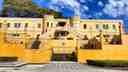
  2. Look to your right at the imposing ochre-yellow fortress, featuring crenellated castle-like turrets and a massive central staircase guarded by iron gates. This architecture…阅读更多收起

    Look to your right at the imposing ochre-yellow fortress, featuring crenellated castle-like turrets and a massive central staircase guarded by iron gates. This architecture screams "power," doesn't it? That is because before this was a sanctuary for gold and jade, it was a machine for war. You are standing in front of the National Museum of Costa Rica, but locals still know it by its old name... the bay-yah-vee-stah Fortress. The story of this hill is a complete rollercoaster of irony. In the late 19th century, this wasn't a military site at all. It was the home of a man named mow-ro-fer-nan-dez-ah-koon-yah, a brilliant reformer of Costa Rican education. It was a place of books, culture, and high-minded conversation. But as politics in the region grew darker, the light on this hill was extinguished. The transformation from home to fortress happened under the tee-no-ko dictatorship in 1917. The tee-no-ko brothers needed an iron fist to control san-ho-zay, so they seized this strategic high ground. They turned a place of learning into a bastion of intimidation, building these high walls to make sure the population knew exactly who was in charge. Now, I want you to look closely at the walls of those corner towers. If you have sharp eyes, you might notice the texture isn't perfectly smooth. There are pockmarks in the masonry. Those aren't weathering issues; they are scars. Those are actual bullet holes left over from the Civil War of 1948. This building was the epicenter of the conflict. It was besieged, shot at, and surrounded by smoke and fury. It stands as a physical witness to the violence that once tore this country apart. But history has a sense of humor... or perhaps, a sense of justice. After the Civil War ended in 1948, the victorious leader, ho-zay-fee-gay-res-fay-rair, stood right here in a ceremony that changed the world. He didn't just decommission the fort. He took a sledgehammer and--smashed the stones of the battlements. It was a piece of political theater that echoed across the globe. He formally abolished the army, handing the keys of this fortress to the Minister of Education. He essentially declared that this building would no longer house rifles, but rather the country’s heritage. Inside, the contrast is haunting. Down in the old dungeons, you can still see graffiti scratched into the walls by prisoners from the 1940s-names, dates, and desperate prayers etched into the plaster. It is heavy, dark, and real. But then, you walk upstairs, and you are surrounded by dazzling pre-Columbian gold and massive stone spheres from the dee-kees delta. You move from a place of confinement to a celebration of indigenous shamans who saw gold not as money, but as captured energy from the sun. It wasn't an easy transition, though. In 1949, a minister actually tried to stage one last coup-the "kar-do-nah-so"-seizing this very building. But he failed. That failure sealed the deal. The fortress was dead; the museum was alive. Just like the Jade Museum we visited a few minutes ago, this place protects the past. But here, the building itself is the most powerful artifact of all. It proves that a site designed for exclusion and violence can be redeemed. We are now going to follow that same trajectory. We are leaving the place where power was decided by bullets, and walking to the place where power is decided by ballots. Let's head toward the Supreme Electoral Tribunal.

    打开独立页面 →
  3. If you look to your left, you are facing a building that houses what Costa Ricans call the Fourth Power of the Republic. In most democracies, you have three branches...…阅读更多收起

    If you look to your left, you are facing a building that houses what Costa Ricans call the Fourth Power of the Republic. In most democracies, you have three branches... legislative, executive, and judicial. But here, the sanctity of the vote is so heavily guarded that they elevated the Supreme Electoral Tribunal, or tay-es-ay, to the same level of independence as the Supreme Court or the President. This unique status was born directly from the smoke and ashes of the 1948 Civil War, the conflict connected to the bullet-riddled fortress we just left. Picture the scene on March 1, 1948. At a high school nearby called the ko-lay-hee-oh-soo-pay-ryor-day-say-nyo-ree-tahs, a fire broke out. This wasn't just a structural fire. That school was holding the physical ballots from a contested presidential election. As the flames consumed the paper ballots, the evidence of the people's will turned to ash. That destruction was the final spark that ignited the Civil War. So, when the new Constitution was written in 1949, the founders said, Never again. They created this Tribunal and gave it a superpower that is almost unique in the world. During an election period, the President of the Republic effectively loses control of the National Police force. Control of the police is handed over... directly to the magistrates inside this building. It is a complete bleen-dah-hay, or armor, around the democratic process. This institution transforms the potential violence of politics into a sanctuary of order. In 2006, the presidential election was decided by less than one percent. In many countries, that margin would start a riot. Here? The country waited in silence for two weeks while the Tribunal counted every single vote manually. No tanks in the streets. Just people waiting for the math. It is also a place of firsts. In 1950, a woman named ber-nar-dah-vahs-kez-men-dez, from a town called lah-tee-grah, woke up at 3:00 AM. She wanted to be absolutely sure she was first in line. And she was. She became the first woman in Costa Rican history to cast a vote. If you look closely at the complex, you might see the plah-sah-day-lah-lee-ber-tahd-ay-lek-to-rahl. There is a sculpture there called eh-pee-to-may-del-vway-lo, or Epitome of Flight, symbolizing the freedom of suffrage. And the logistics are incredible. To ensure every vote counts, they use special security sacks called too-lahs equipped with radio-frequency tracking chips. Whether the ballot box travels by helicopter, boat, or on the back of a horse through the rainforest, this building tracks it in real-time. Even the leadership here sets a high bar. A recent president of the Tribunal, loo-ees-ahn-to-nyo-so-brah-do, resigned simply because his sister-in-law decided to run for Congress. The law didn't require him to quit, only to step aside for that specific election, but he resigned completely to avoid even a shadow of doubt regarding the Tribunal's neutrality. That is the weight of the history held within these walls. From a fire that destroyed ballots to a system that tracks them by satellite. Now, keeping that spirit of transformation in mind, let's head toward the industrial heart of the old city. We are going to walk just one minute to our next stop, the Museum of Contemporary Art and Design.

    打开独立页面 →
再显示 11 个站点显示更少站点expand_moreexpand_less
  1. Look to your left. That massive structure isn't just a building; it is a fossil of industry that has been cracked open to reveal something entirely new inside. This is the Museum…阅读更多收起

    Look to your left. That massive structure isn't just a building; it is a fossil of industry that has been cracked open to reveal something entirely new inside. This is the Museum of Contemporary Art and Design, or the em-ah-day-say. But long before it housed avant-garde video installations or abstract sculptures, this place was pumping out something very different. Imagine the air here is thick and heavy. Not with the scent of old paper or paint, but with the cloying, sweet smell of fermenting sugar and the sharp sting of ethanol. For nearly one hundred and fifty years, this was the fah-bree-kah-nah-syoh-nahl-day-lee-ko-res-the National Liquor Factory. Back in 1850, President hwan-rah-fay-el-mo-rah decided the state needed to take control of the alcohol business. The official story? The government wanted to protect the "lah-brah-dor-mes-tee-so"-the mixed-race workers-from the dangers of toxic, homemade moonshine. But let's be real. It was also about money and control. By monopolizing the production of gwah-ro, the sugarcane spirit of the people, the state secured a massive revenue stream to fund public works. So, where you are standing now was once a fortress of distillation. Behind those walls, men toiled in extreme heat, surrounded by hissing boilers and deafening machinery, breathing in alcoholic vapors for twelve hours a day. It was a place of hard labor, strictly controlled by the government to manage the "vices" of the population. But in the early 1990s, everything changed. The factory machinery was moved out, and a question remained: what do you do with a nineteenth-century industrial complex that looks like a fortress? Enter a woman named veer-hee-nyah-pay-rez-rah-tohn. She was a titanic figure in the art world, and as the museum’s first director, she had a radical vision. She didn't want to whitewash the history of this place. She, along with a team of architects called groo-po-kah-lee-kahn-to, decided to let the scars of the factory remain visible. They peeled back the layers to reveal the stone walls and the heavy timber beams. The result is absolutely stunning. Inside, there is a space called the "Rum Cellar." It has stone walls almost a meter thick! It used to hold massive oak barrels for aging fine liquor. Now, it is a "non-white cube"-a gallery so imposing that artists have to create massive, site-specific works just to compete with the architecture. Then there is "The Tank." This is literally an old metal cylinder that used to store bunker fuel for the boilers. It’s dark, claustrophobic, and the acoustics are wild-everything echoes metallically. It creates a challenge that forces artists to get incredibly creative with sound and light. And perhaps the most haunting space is the pee-lah-day-lah-may-lah-sah-the Molasses Pit. It’s a huge underground reservoir that once held nearly a million liters of molasses. Today, it’s a space for performance art. In 2019, an artist named mar-ko-ah-goo-day-lo flooded it with darkness to mourn lives lost in political protests. That is the magic of this place. It transformed from a site that manufactured intoxication and social control into a sanctuary for critical thought. Where the state once dictated what people drank, artists now question how people think. It’s a complete inversion of power. Let’s keep moving. We are going to head toward a park that, believe it or not, used to be a muddy swamp. Turn and continue walking straight ahead; our next stop is mo-rah-sahn Park.

    打开独立页面 →
  2. Look to your right at mo-rah-sahn Park. It is a sweep of green, anchored by that elegant domed structure in the center. But if you were standing here two hundred years ago, you…阅读更多收起

    Look to your right at mo-rah-sahn Park. It is a sweep of green, anchored by that elegant domed structure in the center. But if you were standing here two hundred years ago, you would not be looking at a park. You would be staring at a swamp. This area was originally called plah-sah-lah-lah-goo-nah. It was a stagnant, artificial lake where locals dug up clay to make adobe bricks for their homes. It was useful, but it was a mess. Locals called it a "swahm-po," a boggy depression that collected rainwater and sewage, becoming a breeding ground for disease. This did not sit well with the new masters of the city. Enter the Liberal Oligarchy. These were the coffee barons, the wealthy elite who turned Costa Rica’s golden bean into dynastic power and political control. They looked at san-ho-zay and didn't want a muddy colonial village; they wanted a "civilized" capital that mirrored the grand boulevards of Europe. To them, a muddy hole in the ground was an embarrassment. So, starting in 1877, the government drained the lagoon to sanitize the city and, essentially, to hide the mud. But the elites didn't just terraform the land; they tried to engineer the public memory. In 1887, the government decided to name this new plaza after General frahn-sees-ko-mo-rah-sahn. This was... controversial. mo-rah-sahn was a Honduran caudillo-a military strongman-who had tried to force a Central American Union and was actually executed by firing squad right nearby in Central Park back in 1842. Imagine naming a park after a foreign general your own country executed! The public was baffled. They wanted to honor local heroes. But the government offered no explanation. They issued a decree, ignored the newspaper editorials screaming in protest, and forced the name through. It was a classic move by the oligarchy: impose their will, ignore the locals, and move on. Now, look closely at that domed structure. That is the tem-plo-day-lah-moo-see-kah, or Temple of Music. It looks like it belongs in France because it does. It is a near-exact replica of the Temple of Love and Music at the Palace of Versailles. You cannot get more Euro-centric than that. The story of its construction is wild. In late 1920, the city realized the Christmas festivals were three weeks away. They had demolished the old wooden kiosk but hadn't built a replacement. Panic set in. They hired architect ho-zay-frahn-sees-ko-sah-lah-sar, who pulled off a miracle. He organized crews to work eighteen-hour shifts, pouring reinforced concrete in a frenzy. Against all odds, they finished it by Christmas Eve. Over time, this park became a cluttered altar to political power. You have statues of Simon Bolivar, the Argentine Domingo Faustino Sarmiento, and former president hoo-lyo-ah-ko-stah. They even had a Japanese garden here once, complete with a red bridge and pagoda, but it was bulldozed in the nineties to make room for... another statue of a politician. This park was the elite’s attempt to pave over the swampy, chaotic reality of the tropics with concrete and imported marble. They wanted a stage for their European fantasies. Today, however, the script has flipped. It is a playground for everyone, filled with festivals and music, far more democratic than its founders ever intended. Let’s leave the park behind and head toward our next stop, the loo-ees-oh-yay Building, where we will see where this merchant class actually did business.

    打开独立页面 →
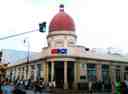
  3. Look to your left for the beige corner building defined by its tall, classic columns and that striking reddish-bronze dome sitting right on top of the curve. This elegantly…阅读更多收起

    Look to your left for the beige corner building defined by its tall, classic columns and that striking reddish-bronze dome sitting right on top of the curve. This elegantly curved corner serves as a perfect mask for a turbulent past. Before this neoclassical structure rose up, the ground here belonged to the colonial residence of a man named ahn-to-nyo-peen-to-swah-res, known locally as tah-tah-peen-to. He wasn't just a merchant; he was a powerful military general. Right here, in his home, he orchestrated the coup of 1842 against frahn-sees-ko-mo-rah-sahn, the leader who dreamed of a united Central America. It was tah-tah-peen-to who gave the final order to execute mo-rah-sahn. So, these foundations rest on the site where a grand political dream was violently dismantled. But cities change, and sites of military power often give way to the bustle of trade. The building you see now was designed by the Salvadoran architect dah-nyel-do-meen-guez-pah-rah-gah. He wanted to bring a sense of big-city monumentality to san-ho-zay. He utilized brick and reinforced concrete, which was cutting-edge technology at the time. This signaled a major shift, moving the city away from the traditional cane-and-mud construction known locally as bah-ah-ray-kay. For decades, this place was known as the loo-ees-oh-yay Store, and oh, it was the absolute definition of cosmopolitan ambition! It represented a san-ho-zay that was hungry to connect with the wider world. This was where the local bourgeoisie came to feel sophisticated. Imagine walking through those doors. You could buy a heavy-duty iron safe from the famous Mosler brand, and then, in the very same trip, pick up fine European wines and chocolates. They even sold those novel American chewing gums, Chiclets Beechies. It was a wonderland of imported luxury, mixing heavy hardware with the sweet taste of life abroad. Now, look up at that dome again. It looks solid, right? Well, it is actually a replacement. The original was made of heavy reinforced concrete. But years ago, a massive truck crashed into the corner column down here at street level. The impact was so severe that the structural integrity failed, and that massive concrete dome eventually had to be demolished because it was collapsing! The one you see shining today is made of bronze, which is much lighter and far less likely to crush the portico. In the 1980s, this building housed a private bank called bee-ay-sah, which collapsed during a major financial crisis. It was a chaotic time for the economy. But thankfully, the state-owned Bank of Costa Rica stepped in, bought the property in 1988, and saved this architectural gem from falling into ruin. It is a true survivor, transforming from a site of military conspiracies into a nostalgic temple of global trade. Ready for a change in scale? We are going to look for what was once considered the skyscraper of 1940s san-ho-zay, the air-do-syah Building, just a few steps away.

    打开独立页面 →
  4. Look for the tall, reddish-coral corner building featuring white vertical pilasters and a distinct, rounded tower rising above the roofline. Isn’t that color just incredible?…阅读更多收起

    Look for the tall, reddish-coral corner building featuring white vertical pilasters and a distinct, rounded tower rising above the roofline. Isn’t that color just incredible? You are standing before the air-do-syah Building, a true vertical experiment in a city that used to hug the ground. This corner is where an architect named loo-ees-yach decided to reach for the clouds. Now, loo-ees-yach was a Catalan architect who left a massive fingerprint on this city, but usually... he played it safe with height. Most of his designs were grounded, sensible, two-story affairs. But here? In 1945? He decided to break his own rules. This was his personal skyscraper. It is the only building Llach ever designed that dared to go above two floors, rising to four stories of concrete and brick. Just look at that facade. It is a conversation between two very different worlds. You have the strict, orderly columns of the Neoclassical style-those vertical white pillars that look like they belong on a Greek temple. But then, look closer at the details. See the windows? The spirals, or ay-lee-koy-dez, flanking them? The tail-end of the stair railings inside? That is pure Art Deco... playful, geometric, and modern. But a building is just a shell without the people who dream it up. While Llach was pouring concrete here in San Jose, the owner, kar-men-air-do-syah-ro-hahs, wasn't even in the country. She was living a life of absolute cosmopolitan glamour. First as a student in London, then living in the exclusive Lomas de Chapultepec neighborhood in Mexico City, working as a cultural diplomat. There is a fascinating, hidden layer to her story too. In the 1950s, an obituary revealed she was the daughter of ho-zay-chahng-ween-teeng, a respected member of the Chinese-Costa Rican community. It shows just how deep the multicultural roots of this city run, even behind these European-style facades. Because Carmen was so worldly, she allowed something revolutionary to happen on that fourth floor. In the 1940s, commerce in San Jose happened on the street. You didn't go up for coffee. But here, they opened a "kah-fay-teen," a small coffee shop right at the top. Imagine walking up that spiral staircase, leaving the dust and noise of the street behind, and sipping coffee in the tower, looking out over the rooftops. It was an elevated sanctuary... a place to be above the fray. And believe me, there was plenty of "fray" down below. Just three years after this opened, in 1948, the country was torn apart by Civil War. Right next door, in house number 217, the newly formed Supreme Electoral Tribunal set up its offices. This very corner became the nerve center for rebuilding Costa Rican democracy. History, however, is a rollercoaster. By 2012, this jewel had fallen on hard times. It had become what locals call "too-goo-ree-sah-do"-essentially turned into a tenement slum. A private investment group bought it, pouring in ninety million colones to restore it. They had dreams of luxury boutiques and a gourmet rooftop restaurant to bring back the glamour of Carmen’s old kah-fay-teen. They even evicted the struggling tenants to make way for this high-end vision. But cities are stubborn things. While the facade you see is pristine and restored, the upper floors have struggled to find that new life, often sitting empty. It remains a beautiful, waiting stage, caught between its history as a sanctuary for the elite and the chaotic, democratic reality of the street below. Let’s keep moving. We are going to walk just a few steps to the massive beige building right next door. It is the Costa Rica Post and Telegraph Building... and believe it or not, it is another masterpiece by our friend loo-ees-yach.

    打开独立页面 →
  5. Look to your right at this monumental cream-colored palace, easily identified by its soaring central archway, the decorative Corinthian columns pressed against the walls, and the…阅读更多收起

    Look to your right at this monumental cream-colored palace, easily identified by its soaring central archway, the decorative Corinthian columns pressed against the walls, and the bronze statue standing watch in the plaza. This is the Costa Rica Post and Telegraph Building, and it is an absolute fortress of history. While we just walked past commercial buildings like the air-do-syah, this structure was built to send a very different message. It was designed to project unwavering state power and stability. But here is the irony... its grand opening was built on a betrayal. Construction began in 1914 under President ahl-fray-do-gon-sah-les-flo-res. He envisioned this as a symbol of a modern, democratic state. But he never got to walk through these doors as leader. Just months before the ribbon-cutting in October 1917, he was overthrown in a military coup by his own Minister of War, fay-day-ree-ko-tee-no-ko. So, when the doors finally opened, it wasn't a celebration of democracy. It was a photo opportunity for a dictator who used this majestic backdrop to pretend his illegitimate regime was stable. The architect behind this masterpiece was loo-ees-yach, a Catalan genius who shaped the face of Costa Rica. His range was incredible. At the exact same time Llach was designing this secular center of government communications, he was also designing the Basilica of Our Lady of the Angels in Cartago, the country’s spiritual heart. Think about that versatility. The same mind defined where Costa Ricans went to pray, and where they went to speak to the world. And speaking to the world was exactly what this building was for. Look closely at the facade. You might spot representations of Mercury, the god of communication. In the early twentieth century, this wasn't just a post office; it was the high-tech nervous system of the nation. The telegraph lines running out of this building were the Victorian equivalent of fiber-optic cables. Before the internet, before the telephone was common, the "click-clack" of the telegraph key inside these walls was the only thing connecting san-ho-zay to the rest of the planet in real-time. It was so vital that in October 2023, the building was awarded the "Blue Shield" by UNESCO. This is a rare honor that marks it as a protected cultural heritage site, strictly off-limits during armed conflict or disaster. It has transformed from a tool of a dictatorship into a guarded sanctuary of memory. But some say the memories here are a little too active. The building is now home to the Philatelic Museum, dedicated to the art of stamp collecting. However, the night watchmen and cleaning staff tell stories about the "fahn-tahs-mahs-klah-see-fee-kah-do-res," or the phantom sorters. Legend has it that in the dead of night, on the upper floors where the manual correspondence was once processed, you can still hear the rhythmic thumping of rubber stamps hitting tables and the shuffling of paper. It seems the old postal workers are still on their eternal shift, ensuring that not a single letter goes undelivered. It is a beautiful thought, isn't it? That a place born from a coup has become a permanent guardian of communication, protecting our letters, our history, and perhaps even its own ghosts. Now, we are going to leave this solid, standing monument and head toward a memory of something that vanished. We are walking just three minutes to the site of the National Palace. Let’s get moving.

    打开独立页面 →
  6. Take a look at the image on your screen to visualize what once dominated this corner. You are looking at a grand, rectangular two-story structure featuring a central triangular…阅读更多收起

    Take a look at the image on your screen to visualize what once dominated this corner. You are looking at a grand, rectangular two-story structure featuring a central triangular pediment and a long row of arched windows that give it a rhythmic, stately appearance. Now, look up at the modern building standing in front of you. It is hard to believe, but for one hundred and two years, the magnificent National Palace from that sketch stood right here. This site is a ghost of Costa Rican history. The story begins with President hwan-rah-fay-el-mo-rah-po-rahs, the visionary leader who transformed this nation from a collection of villages into a sovereign republic. In the early 1850s, riding the wave of a booming coffee economy, Mora Porras wanted a building that shouted "legitimacy." He hired the German engineer and architect frahnts-koort-suh to make it happen. Kurtze didn’t just stack bricks. He used what was then cutting-edge technology: a combination of stone masonry and cast iron. We are talking about galvanized nails, corrugated sheets, and forged balconies imported all the way from England, with crystal glass brought in from Belgium. The style was Neoclassical. That is a fancy way of saying they copied the look of ancient Greece and Rome-columns, symmetry, and grandeur-to make their young, fragile government look as eternal and stable as the Roman Empire. But this palace wasn’t just for show. It was the stage for the country's survival. In February 1856, President Mora gathered Congress right here to warn them about William Walker. Walker was a "filibuster," which in this context means an American mercenary who was trying to conquer Central America and turn it into a slave-holding empire. When Walker sent men to this palace to negotiate, Mora didn’t even let them in the door. He called them delinquents and kicked them out of the country. That defiance happened right where you are standing. However, the walls of the Palace also witnessed the ultimate betrayal. Despite saving the country, Mora Porras made enemies among the powerful coffee elite. In 1859, a coup d’état was launched against him. He was arrested at his home and dragged as a prisoner to this very Palace-the same building he had inaugurated just four years earlier. The tragedy gets darker. Mora was exiled, tried to return, and was eventually executed by firing squad in 1860. The history books tell us that the soldiers ordered to shoot him had tears running down their faces because they loved him so much. His enemies even left his body on the beach, hoping sharks would dispose of it, until a French consul stepped in to give him a proper burial. The Palace survived that political storm and even a massive earthquake in 1924 that forced Congress to move out temporarily. But it could not survive the march of what some called "progress." In 1958, President ho-zay-fee-gay-res-fay-rair ordered the demolition of the National Palace to make room for the Central Bank of Costa Rica, which sits here now. There was no crumbling ruin or safety hazard cited; it was simply wiped away. Historians call this the "lost memory" of the capital. It was an act that many at the time considered barbarism, erasing the tangible symbol of the state’s consolidation. We can no longer walk through its halls, but standing here, we can honor the ambition and the turbulence that forged this nation. Now, let’s leave this site of lost heritage and head to an institution dedicated to preserving culture in a different way. Our next destination, the Costa Rican Academy of Language, is just a four-minute walk away.

    打开独立页面 →
  7. Look to your left at the stately two-story building painted in slate-grey and white, featuring a row of tall arched windows on the ground floor and a classic black streetlamp…阅读更多收起

    Look to your left at the stately two-story building painted in slate-grey and white, featuring a row of tall arched windows on the ground floor and a classic black streetlamp standing guard on the sidewalk. This is the Costa Rican Academy of Language. It sounds incredibly formal, doesn't it? You might picture a dusty room full of elderly men in stiff suits debating where to put a comma. And for a long time, that is exactly what it was. But if you look closer, this building is actually the site of a fascinating tug-of-war between elite prestige and the gritty reality of the streets. For eighty-six years, this Academy was actually homeless. It’s true. The guardians of the language were nomads, borrowing desks in libraries and embassies, or meeting in tiny, uncomfortable offices until the government finally granted them this heritage building to end their pilgrimage. But the lack of a roof wasn't their only issue; it was who they left out in the cold. Consider the story of mah-ree-ah-ee-sah-bel-kar-vah-hahl. You might know her by her pen name, kar-men-lee-rah. She wrote kwen-tos-day-mee-tee-ah-pahn-chee-tah, the collection of folktales that is practically the bedrock of Costa Rican literature. Every child here knows her stories. Yet, she was never invited to join this club. Why? Because the Academy of that era couldn't look past the fact that she was a woman, born out of wedlock, and an outspoken communist. She died in exile, excluded by the very institution meant to honor the country's best writers. But institutions evolve. Over time, the people inside these walls stopped trying to be gatekeepers for a European ideal and started fighting for the dignity of how Costa Ricans actually speak. One of the great champions was a man named kar-los-gah-hee-nee. He argued that the Academy shouldn't just imitate models from Spain but should embrace the "tico" way of speaking-the folklore and the language of the street. This shift led to some incredible diplomatic battles. There was the "Gallego Incident." The Royal Spanish Academy in Madrid-the mothership of the Spanish language-had a definition in their dictionary for the word gah-yay-go, or Galician. It said that in Costa Rica, the word was a synonym for "stupid" or "slow-witted." Can you imagine? The Academy here was furious. They launched a full investigation, proved that nobody used the word that way anymore, and demanded Madrid delete the offensive definition. And they won. Then there was the battle over the verb sah-pay-ahr. The dictionary defined it as criminal slang used by the underworld. A brilliant academic named ahl-ber-to-kah-nyahs, known as "don-bay-to," stepped in. He argued that here, sah-pay-ahr isn't criminal; it’s what a little brother does when he tattles on his sister for stealing a cookie. It’s a family word, not a gangster word. By fighting these battles, they turned this space from a tower of judgment into a defender of the local voice. Leaving these linguistic warriors behind, we are going to head toward the heart of the city's social life. Walk straight ahead about one minute toward the large, pale building on the corner, the Gran Hotel Costa Rica.

    打开独立页面 →
  8. On your left stands a massive five-story structure of grey concrete and iron, distinguished by its neoclassical cornices and a modern glass-enclosed top floor that contrasts with…阅读更多收起

    On your left stands a massive five-story structure of grey concrete and iron, distinguished by its neoclassical cornices and a modern glass-enclosed top floor that contrasts with the historic arches below. This is the Gran Hotel Costa Rica. When it opened its doors in 1930, this wasn't just a place to sleep... it was the center of the universe for san-ho-zay. Before this, the country didn't have a hotel that met the high standards of international luxury. So, the government teamed up with a wealthy doctor named loo-ees-pow-lee-no-hee-may-nez-or-tees to build a palace that would attract foreign tourists and prove that Costa Rica was a modern nation. For decades, if you were a celebrity, a diplomat, or royalty, this is where you stayed. We are talking about guests like John Wayne, the soccer legend Pelé, and various U.S. Presidents. But my absolute favorite story is about John F. Kennedy. When JFK visited in March 1963, his trip was a massive diplomatic event, but it came with a very specific logistical headache. Because of his severe back pain from World War II injuries, the President had to swim every single day for physical therapy. The problem? This grand hotel didn't have a pool. The solution was incredibly complicated. The hotel owners offered up their private summer home in the suburb of es-kah-soo, which did have a pool. Every single day, the Secret Service had to organize a discrete but complex motorcade just to shuttle the most powerful man in the world from his suite here to a backyard pool so he could do his exercises away from the public eye. Then there is the story of the Mexican comedian kan-teen-flahs. In 1985, he tried to visit san-ho-zay incognito. He arrived on a Norwegian ship wearing a sailor's beret and thick glasses, hoping to blend in. He actually managed to walk down the busy avenue right outside without being mobbed. He slipped into the hotel lobby to make a phone call, thinking he was safe. But a sharp-eyed cashier looked up and asked, "Are you mah-ryo-mo-ray-no?" kan-teen-flahs realized the jig was up. He smiled and replied, "Yes, kan-teen-flahs, for more detail." He later admitted that while he wanted privacy, he secretly loved that the people here knew him so well. It hasn't all been glitz and glamour, though. This corner is a stage for power, and sometimes that gets dangerous. During a failed coup in 1949 known as the kar-do-nah-so, the hotel was caught in the crossfire. A militia leader positioned his troops nearby to shoot at a rebel tank. The guests became involuntary spectators to a gunfight right outside their balconies. If you look up at that top floor, you might notice the glass looks very modern. That is the source of a huge recent controversy. That fifth floor used to have arches that matched the rest of the building. When a hotel chain renovated it recently, they replaced the historic style with modern glass. Critics called it a "historical fake" and the dispute got so heated that prosecutors raided the cultural heritage offices to investigate! It just goes to show that in this city, even the architecture fights a battle between preserving the past and pushing for the new. Now, let's leave the high society behind and turn toward the spiritual center of the city. We are heading to the Archdiocese of san-ho-zay.

    打开独立页面 →
  9. Look to your right at the massive Neoclassical structure dominated by tall, light-colored columns and a grand triangular pediment. This is the Metropolitan Cathedral, the heart of…阅读更多收起

    Look to your right at the massive Neoclassical structure dominated by tall, light-colored columns and a grand triangular pediment. This is the Metropolitan Cathedral, the heart of the Archdiocese of san-ho-zay. This isn't just a house of prayer. It is a battlefield where the war for Costa Rica's soul was fought. We have seen how buildings in this city shift from sites of power to places of the people, and this Cathedral is the ultimate example of that tug-of-war. The story here begins with a serious clash. Back in the 1850s, the relationship between the Church and the government was... explosive. The very first bishop, ahn-sel-mo-yo-ren-tay-ee-lah-fwen-tay, found himself in a showdown with President hwan-rah-fay-el-mo-rah-po-rahs. Now, Mora Porras is a national hero for fighting off foreign invaders, but he also demanded the church pay taxes to fund hospitals. Bishop Llorente refused. The President didn’t hesitate. He gave the Bishop twenty-four hours to leave the country. Imagine that... the head of the church, expelled by the head of state, spending a year in exile in Nicaragua. It happened again a few decades later. Bishop ber-nar-do-ow-goo-sto-teel, a German priest who famously trekked through deep jungles to reach indigenous tribes, opposed new laws that made education secular. The government accused him of political interference and banished him to Europe. For years, this building stood as a symbol of resistance against the state's liberal reforms. But then, the script flipped. In the 1940s, Archbishop veek-tor-mah-nwel-sah-nah-bryah-mar-tee-nez did something historically wild. He formed an alliance with the Communist party. Sanabria publicly declared that Catholics could join the communist vahn-gwar-dyah-po-poo-lar party "without sin," as long as they supported social guarantees. This created a strange, powerful trio-the Catholic Church, the Government, and the Communists-working together. That unlikely coalition laid the foundation for the social security system Costa Rica uses today. The history here is not all heroic, though. In the late 1970s, Archbishop ro-dree-guez-kee-ros faced severe financial instability, leading the Vatican to effectively force him out of office. More recently, the Archdiocese has faced a painful reckoning. In 2022, a landmark court ruling ordered the church to pay damages to victims of sexual abuse by priests, rejecting the defense that the institution wasn't liable. It was a moment that transformed this space from one of unquestionable authority to one of legal accountability. If you were to step inside, you would see a "flying pulpit"-a wooden structure suspended from a column with no visible support from below. And in the crypt, you would find rival enemies buried in the same ground. Liberal dictators sleep next to the bishops they once exiled. Just outside, take a look around. You might spot a statue of Anne Frank, standing just meters away from a monument to Pope John Paul II. A Jewish girl and a Catholic Pope, sharing the same sanctuary. It is a perfect symbol of how this space has evolved from a fortress of exclusion into a complex, shared public square. Now, let’s leave the spiritual center and head toward the cultural heart of the city. We are walking toward the crown jewel of liberal design, the National Theater.

    打开独立页面 →
  10. Look to your left at the National Theater, a formidable Neoclassical palace defined by its pastel stonework, the elegant columned portico, and the three allegorical statues-Dance,…阅读更多收起

    Look to your left at the National Theater, a formidable Neoclassical palace defined by its pastel stonework, the elegant columned portico, and the three allegorical statues-Dance, Fame, and Music-silhouetted against the sky on the roof. This isn't just a theater; it is a declaration of identity carved in stone and marble. When construction began in eighteen ninety-one, san-ho-zay was a small town of barely twenty thousand people. Yet, the ruling class-the wealthy coffee barons often called the Liberal Oligarchy-decided they needed an opera house that could rival the grandest stages of Paris or Milan. They wanted to prove that Costa Rica was civilized, wealthy, and decidedly European. But there is a twist in how this bill was paid. Initially, the government decreed a tax on coffee exports to fund the project. It seemed fair; the coffee growers wanted the theater, so they would pay for it. But that arrangement didn't last. Just fifteen months later, the government realized the money was running out. So, they quietly switched the tax. Instead of taxing the rich exporters, they placed a tax on general imports. That meant every regular person buying fabric, tools, or medicine helped pay for this palace. In the end, the wealthy coffee elite contributed less than five percent of the cost. The general public paid for over ninety-five percent. Despite that inequality, the result is undeniably spectacular. They spared no expense. They brought in gold, French glass, and precious woods from the province of ah-lah-hway-lah. The engineering was a mix of European expertise and local ingenuity. There is a wonderful story about the famous ceiling mural inside, painted by ah-lay-ar-do-vee-yah. It is called the Allegory of Coffee and Bananas. Villa painted it in Italy without ever stepping foot in Costa Rica. He painted coffee growing on a beach-which is impossible, as coffee needs high altitude-and he painted the bananas hanging upside down! But the locals loved it so much it eventually ended up printed on the five-colón bill. Now, I want you to imagine the floor inside. Beneath the auditorium seating lies a mechanical marvel designed by the Italian engineer chay-sah-ray-sahl-dee-nee. It is a screw-jack system, a rarity in the world of theater. To work it, twelve men have to go into the basement and push heavy levers for thirty minutes. This mechanism lifts the entire floor of the seating area until it is perfectly level with the stage. Why go to all that trouble? So the Liberal Oligarchy could transform the theater into a massive, flat ballroom for their exclusive parties. For decades, this building enforced a strict social hierarchy. While the elite walked through this grand portico you are looking at, the working class had to use a separate side entrance to reach the upper gallery, known as the "gah-yee-nay-ro," or chicken coop. They were physically and symbolically separated. But buildings evolve. In nineteen sixty-three, this site hosted a summit for the Presidents of Central America, attended by John F. Kennedy. The city practically shut down as thousands gathered to see him. And today, the theater is guarded not just by security, but by legend. Staff members talk about a "ghost actress," a spirit who sits in a specific seat in the gallery, watching over the stage to ensure the arts survive. We have seen how the elite built their monuments. Now, we are going to walk just three minutes to the Maroy Building. We need to see a place that reveals what happened when the grip of that oligarchy began to slip, and political unrest turned into actual fire. Follow me.

    打开独立页面 →
  11. Look for the beige corner building topped with a gray concrete dome, featuring intricate balconies and three stone lions resting above the main doorway. We have reached our…阅读更多收起

    Look for the beige corner building topped with a gray concrete dome, featuring intricate balconies and three stone lions resting above the main doorway. We have reached our final stop, and what a beauty it is. This is the Maroy Building. The name itself is a little romance hidden in plain sight... it is an acronym combining "Ma" for Maria and "Roy" for her husband, see-goord-roy-hol-stahd. They built this place in 1923. Back then, it was the height of sophistication. Picture this... the family living in luxury apartments on the upper floors, while downstairs, Roy ran a high-tech business importing modern adding machines and typewriters. For a brief time in the twenties, it even housed a Methodist School, teaching Protestant students right here in the heart of a Catholic city. But if you look at this peaceful corner today, you would never guess that the ground beneath it was baptized in fire. You see, the Maroy Building was actually built on a graveyard of machinery and ash. Before 1923, this was the headquarters of a newspaper called lah-een-for-mah-syohn. And the people of san-ho-zay... absolutely despised it. At the time, Costa Rica was under the thumb of the tee-no-ko dictatorship. The newspaper was the regime's mouthpiece, spewing what locals called "journalism of hate." On June 13, 1919, the city reached its breaking point. A massive, angry crowd gathered nearby until one anonymous voice shouted... To lah-een-for-mah-syohn! The mob surged toward this corner. The newspaper owners panic and make a terrible choice... they start shooting at the crowd from the windows! That turned a protest into a full-blown riot. The people stormed the building, threw the printing presses into the street, and lit a match. The fire was so intense it consumed four neighboring houses and forced the army to intervene. That fire cleared the way for the building you see now. It is a bit ironic, though. Despite a restoration in the year 2000 costing nearly two hundred thousand dollars, the Maroy has fallen back into silence and disrepair recently. But look closely at those three stone lions guarding the entrance. For decades, locals used them as a landmark, saying "meet me at the lions." They stand watch over a corner where the city burned down a symbol of tyranny... proving that sometimes, destruction is just the painful first step toward building a democracy.

    打开独立页面 →

常见问题

如何开始导览?

购买后,下载 AudaTours 应用并输入您的兑换码。导览将准备好立即开始--只需点击播放并按照 GPS 引导的路线行驶即可。

导览期间我需要互联网吗?

不需要!开始前下载导览并完全离线享受。只有聊天功能需要互联网。我们建议在 WiFi 下下载以节省移动数据。

这是导游带领的团体游吗?

不是--这是自助语音导览。您按照自己的节奏独立探索,通过手机播放音频解说。没有导游,没有团体,没有时间表。

导览需要多长时间?

大多数导览需要 60-90 分钟才能完成,但您完全控制节奏。随时暂停、跳过站点或休息。

如果我今天无法完成导览怎么办?

没问题!导览具有终身访问权限。随时暂停和恢复--明天、下周或明年。您的进度已保存。

有哪些语言可用?

所有导览均提供 50 多种语言版本。在兑换代码时选择您的首选语言。注意:导览生成后无法更改语言。

购买后我在哪里访问导览?

从 App Store 或 Google Play 下载免费的 AudaTours 应用。输入您的兑换码(通过电子邮件发送),导览将出现在您的资料库中,准备下载并开始。

verified_user
满意保证

如果您不喜欢该导览,我们将退款。请联系我们 [email protected]

安全结账使用

Apple PayGoogle PayVisaMastercardPayPal
深受全球旅行者喜爱

数千次旅途已出发。
好评如潮。

App Store 与 Google Play 综合评分 4.8。这是我们反复回味的几条好评。

starstarstarstarstar
这是了解布莱顿的一种可靠方式,感觉不像游客。解说有深度和背景,但并未过度。
starstarstarstarstar
一手拿着羊角面包,零期望地开始了这次导览。这款应用真的很适合你,没有压力,只有你、你的耳机和一些很酷的故事。
download 下载应用

戴上耳机。
走出去。

免费下载。每座城市都有导览。60 秒即可开始——无需账号,无需绑卡。

Download on the App StoreGet it on Google Play
starstarstarstarstar_half
4.8
AudaTours app icon
headphones
约 4 分钟 到第一条导览开始
public
1,000+ 全球城市
all_inclusive
AudaTours
Unlimited

每个导览。每座城市。 一份订阅。

3335 导览2280 城市140 国家50+ 种语言