
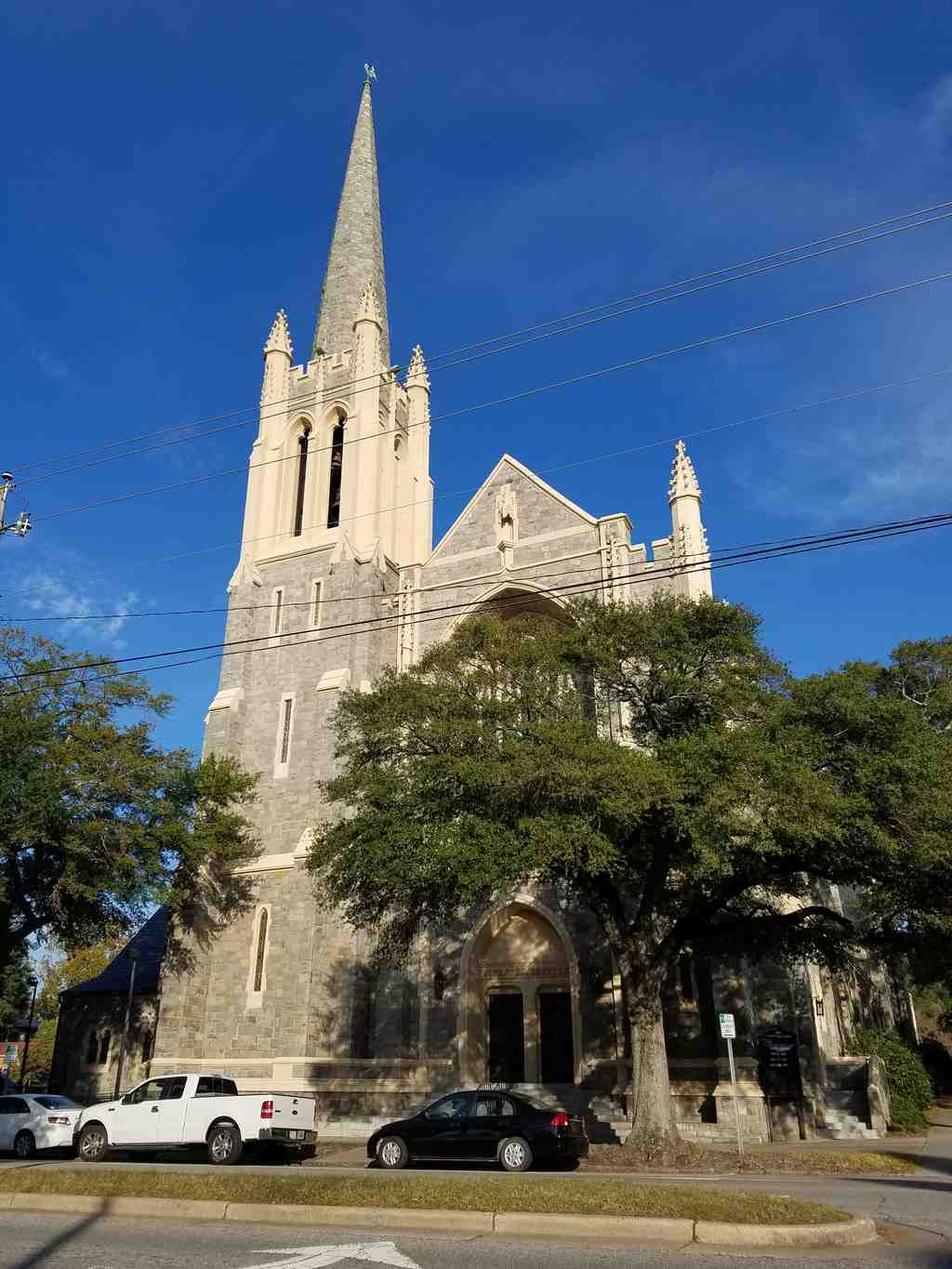
Just ahead on your left is a pale stone facade with rows of sharply pointed windows and a magnificent, soaring spire. This is First Presbyterian Church, and standing before this fortress of quiet grace, you would never guess the sheer amount of fire, fury, and defiance woven into its foundation.
Wilmington’s Presbyterians started gathering way back in 1760 under Reverend James Tate, an Irish immigrant who actually opened a classical school just to pay his bills while he preached to the locals. But for decades, this early congregation had a terrible string of luck with fire. Their first two churches, built over on Front Street, burned straight to the ground. So, for their third attempt in 1861, they secured this very piece of land.
Locals called this property the Thunder and Lightning Lot. It earned that terrifying nickname because an old stable that previously sat here was constantly getting blasted by lightning strikes. Yet, despite the ominous reputation, the congregation confidently hired Samuel Sloan, the same architect who designed the First Baptist Church. He delivered a breathtaking structure in his signature Gothic Revival style.
Sloan's grand church stood strong through the Civil War, but danger was always lurking in the walls. On New Year's Eve in 1925, disaster struck again. Ironically, it was not a lightning strike from the stormy heavens, but hidden faulty wiring that sparked a catastrophic fire. The blaze burned so incredibly hot that neighbors stood out in the street, watching in absolute terror as the towering steeple glowed white-hot, entirely convinced it would come crashing down onto their roofs at any moment.
The beautiful Samuel Sloan church was completely destroyed, but the ashes set the stage for an incredible display of community resilience. When it came time to rebuild the structure you are looking at right now, there was actually a bitter debate. Many members fiercely demanded an exact replica of the beloved 1861 building. However, the minister, Doctor Gilmour, aggressively championed a totally new design inspired by grand European cathedrals. Gilmour ultimately won the battle, hiring architect Hobart Upjohn to create this stunning masterpiece, though for decades, older members still complained that the old church sat more gracefully on the lot.
As they finished this new sanctuary in 1928, a miraculous piece of their past finally came home. Back in 1865, when Union troops occupied Wilmington, a Union officer had brazenly stolen the church's large pulpit Bible. For over sixty years, the holy book remained up North. But in a striking act of reconciliation, the officer's descendants returned that very Bible just in time for the new church's dedication. Today, it rests safely inside, a quiet survivor of both war and devastating flames.
This congregation has continually navigated the space between fierce literal storms and elegant architectural grace. Even a young Woodrow Wilson regularly walked through their doors, years before he became the twenty-eighth President of the United States, attending services while his father served as the commanding pastor.
We have seen how much dramatic history hides behind Wilmington's beautifully polished brick and stone, from our earlier walk through the Historic District right up to these heavy wooden doors. Next, we are heading to a true masterclass in architectural endurance. Take a six minute walk over to the Basilica Shrine of Saint Mary, and I will meet you there.




