
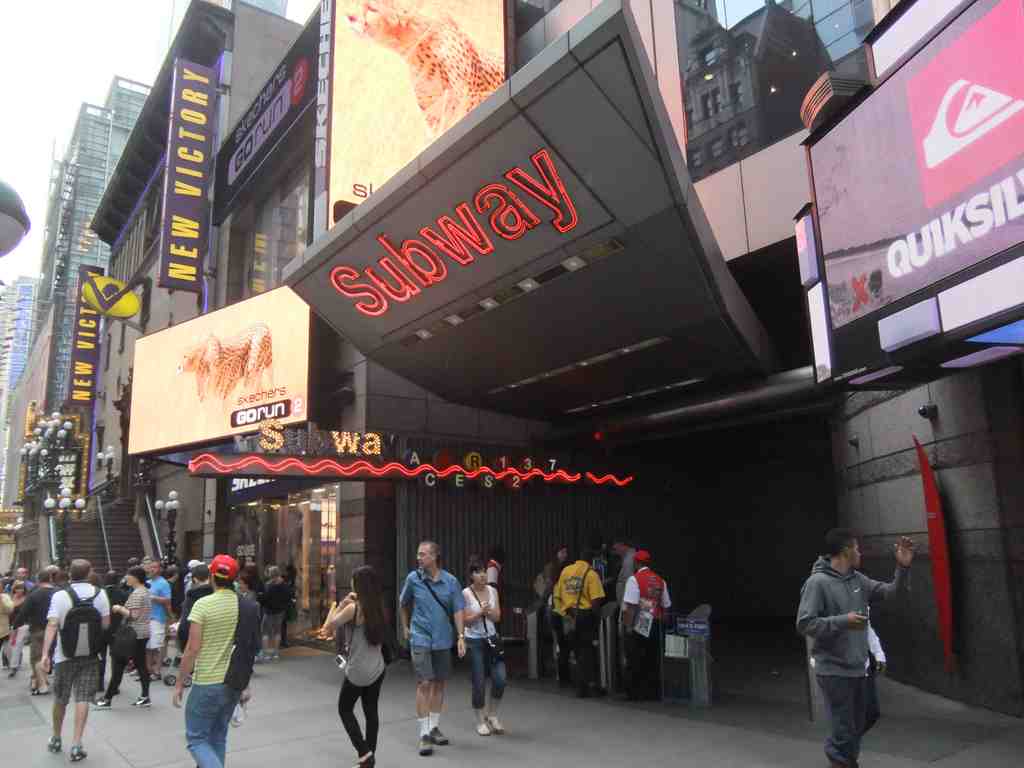
If you're looking for the Times Square-42nd Street station, just glance up for the giant, glowing “Subway” sign in flashy red letters, right beneath a futuristic canopy and surrounded by massive digital billboards-you really can’t miss it.
Alright, you’re here in the beating heart of New York City’s underground: the Times Square-42nd Street station. Stand still for a second-close your eyes and try to imagine the chaos and excitement from over a century ago. In 1904, as autumn chilled the air and horses still clip-clopped through the streets above, workers were still scrambling to finish the ceilings and walls just one day before opening! Talk about cutting it close. Crowds once gathered here, not just for the promise of a smooth ride uptown, but to see a modern marvel that would change the city forever. Trains bursting into tunnels, lights twinkling like the skyline above-even back then, Times Square was never quiet.
Times Square itself was called Longacre Square before all this subway business, but thanks to a little help from The New York Times-yes, the newspaper-the city renamed it. The subway station at Broadway and 42nd Street quickly took the new name, transforming the crossroads into the world-famous Times Square.
Imagine trains rattling beneath your feet as history unfolded: in 1904, this very station opened as part of the city’s first subway line, and it was already swamped-third busiest in the city and the leader among local stops, welcoming 30,000 people a day. As the city boomed and spread, new lines branched out like roots under the city’s concrete skin: the Broadway-Seventh Avenue Line platforms in 1917, the Broadway Line platforms in 1918, and the Flushing Line, which let out a little sigh of relief in 1928 as crowds got some much-needed elbow room.
The platforms extended, stairways twisted, new gleaming entrances appeared and disappeared over the decades. At one point in 1910, city officials decided to lengthen the platforms to cram in more people-who doesn’t love getting cozy on a rush hour train, right? By 1917, the whole original line was being transformed into part of the new “H system”-the subway’s clever way to serve more neighborhoods, more folks, and more dreams.
This place had its share of drama, too-besides the daily ballet of tourists and commuters bumping shoulders, there was once a train wreck in 1928 that became the city’s second deadliest, a stark reminder that with great speed sometimes comes a bit too much excitement. Oh, and did you know? In 1940, a midnight ceremony right here marked the city’s takeover of the subway from private operators. The BMT’s president handed over subway property to the mayor-basically like passing the world’s most valuable baton at a track meet.
Over time, Times Square-42nd Street station became the ultimate connector: IRT, BMT, IND-those alphabet soups on your subway map-came together here, allowing passengers to slip from line to line, layer upon layer, just like the city itself. The block-long tunnel to the Port Authority Bus Terminal opened right before Christmas in 1932, so you could even roll your suitcase inside and catch your next ride without hitting the cold.
By the mid-20th century, the station matched the sparkle of the square upstairs. There were three-dimensional ads, tests with fancy new lights, and constant updates to entrances and stairways. The trains themselves stretched out, adding more cars, squeezing a little more magic and a lot more humanity into each rush hour.
Of course, things got gritty in the second half of the last century-crime, grime, and crumbling tiles-but just as Times Square reinvented itself above ground, so did the station beneath it. Enormous renovations began in the 1990s and carried on into the 21st century, with widened corridors, new elevators, neon entrances, wild mosaics-even bathroom facilities patrolled by staff to keep things, let’s say, more pleasant than historical!
By the time you’re hearing my voice, the Times Square-42nd Street station is not only the busiest in the entire system, feeding over 65 million people a year, it’s also a monument to adaptation, ambition, and a startling amount of underground teamwork. If you pause and let your senses run wild for a moment, you’ll feel the echoes of the city’s past-hustling, whispering, rumbling beneath Times Square, forever in motion. And hey, you never know-the next person you bump into here might have just as wild a story as Times Square itself.
If you're keen on discovering more about the station layout, irt 42nd street shuttle platform or the bmt broadway line platforms, head down to the chat section and engage with me.




