Tulsa Audio Tour: Art Deco Beats in the Downtown Canyon
Beneath Tulsa’s Art Deco skyline, downtown keeps secrets in plain sight. A quiet library wall can echo with political battles, a theater lobby can hide old scandals, and a jazz shrine can carry the heat of rebellion. This self guided audio tour leads through the Tulsa City County Library, the Tulsa Performing Arts Center, the Oklahoma Jazz Hall of Fame, and nearby stops. Hear the stories that slip past plaques and postcards and spot the details most visitors never notice. What was nearly lost in a last minute fight that could have reshaped the city overnight? Which backstage corner at the Performing Arts Center keeps a mystery that refuses to go away? Why does one specific exhibit note at the Jazz Hall of Fame read like a coded confession? Move block by block through drama and discovery. Follow echoes, shadows, and bright brass notes. See downtown Tulsa with sharper eyes. Start now and let the skyline open.
Tour preview
About this tour
- scheduleDuration 70–90 minsGo at your own pace
- straighten2.7 km walking routeFollow the guided path
- location_onLocationTulsa, United States
- wifi_offWorks offlineDownload once, use anywhere
- all_inclusiveLifetime accessReplay anytime, forever
- location_onStarts at Mincks-Adams Hotel
Stops on this tour
lock_open 3 free previews · 8 unlock with purchase
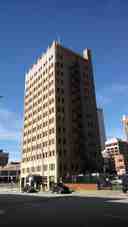
Look up for a tall, beige 13-story building with a fancy cream-colored, patterned front face and a dark metal fire-escape zigzagging down the side. You’re standing by what…Read moreShow less
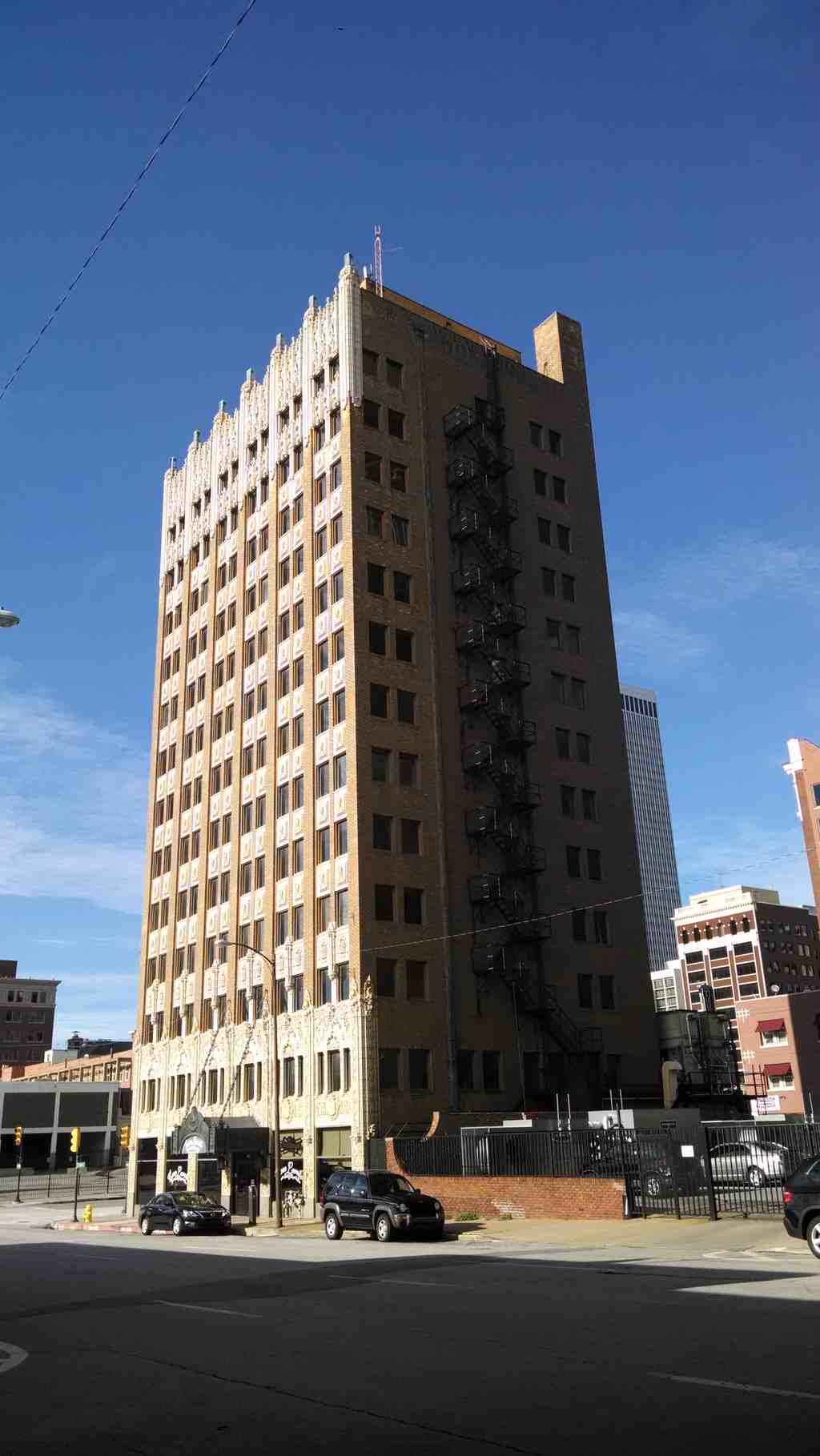
Look up for a tall, beige 13-story building with a fancy cream-colored, patterned front face and a dark metal fire-escape zigzagging down the side. You’re standing by what started life as the Mincks Hotel, built in 1927 to 1928-right when Tulsa was feeling boldly confident and oil money was doing what oil money does: showing off. A businessman named I. S. “Ike” Mincks put it up at 403 Cheyenne, just a block west of the Oil Capital Historic District, aiming squarely at traveling businessmen who wanted comfort, status, and probably a decent place to talk shop. Timing mattered. The hotel opened in time for the first International Petroleum Exposition, when the city was basically rolling out the red carpet for the oil world. The building itself was a statement: 13 stories plus a basement and a penthouse, about 195 feet tall. It cost $802,800 back then-roughly about $15 million in today’s money-serious cash for serious ambition. Now, let your eyes trace those bright, detailed panels on the front. That’s glazed terra cotta-made by the Northwestern Terra Cotta Company-wrapped over reinforced concrete. Architect Alfred C. Fabry mixed Gothic, Italian Renaissance, and Baroque vibes into one confident design, like Tulsa saying, “Yes, we read books, too.” But the story has a twist: Mincks went bankrupt in 1935. The building sold off, reopened as the Adams Hotel, and later-early 1980s-shifted again into the Adams Office Tower. It was recognized for its architecture and added to the National Register of Historic Places in 1977. Even the Tulsa Press Club posted up here for a while, then found the place a little too… complicated when they came back. When you’re set, Tulsa City-County Library is a 4-minute walk heading southeast.
Open dedicated page →On your right, look for the low, red-brick building with teal-framed windows and a big white sign that reads “Tulsa City-County Library,” sitting above a neat bed of bright…Read moreShow less
On your right, look for the low, red-brick building with teal-framed windows and a big white sign that reads “Tulsa City-County Library,” sitting above a neat bed of bright flowers. This is Tulsa City-County Library-Tulsans usually just say “the library,” the way you might say “the lake” if you live near one. And while the building in front of you feels calm and practical, the story behind the system is a classic Tulsa mix: civic ambition, oil-boom growth, and a steady belief that free information is a public utility, like water or roads… just quieter. Public library service here started in the early 1900s, and the first setup was as no-frills as it gets: books in the basement of the Tulsa County courthouse. From there, Tulsa did what a lot of fast-growing American cities did-aimed for a Carnegie grant. In 1904, that grant was $12,500, which is roughly around half a million dollars today. Over the next decade it grew-up to $42,500 in 1913 and $55,000 by 1915, or about $1.4 million in today’s money. That original Carnegie library served downtown for decades, until it was demolished in 1965-because mid-century America had a real talent for knocking down beloved buildings and calling it progress. The modern Tulsa City-County Library system-the one that ties the county together-took shape in the early 1960s. In 1961, voters were asked to approve $3.8 million for a new Central Library and three branches, plus a 1.9 mill annual levy to keep the whole thing running. That $3.8 million was serious money at the time-think roughly $39 million in today’s dollars-so this wasn’t just “let’s buy some more books.” It was Tulsa County deciding, out loud and on a ballot, that a shared library system mattered. The new countywide setup officially kicked in July 1, 1962, when the levy went live, and the system began folding in existing local libraries-places founded by community clubs, city efforts, and even WPA-era projects. In other words: people built libraries however they could, and then the county finally tied the knot. Today, the scale is big: 24 branches across Tulsa County, serving people who live, work, go to school, own land, or even pay property taxes here. The collection tops 1.7 million items-books, audiobooks, magazines, movies, music, e-books, the whole buffet. And it’s not just shelves: every branch has public computers and Wi‑Fi, and the system runs a bookmobile that moves materials among branches on request-basically a behind-the-scenes delivery network for your next great read. There’s also homebound delivery, literacy support for adults, meeting rooms, and reference help by phone, email, chat, text, and social media. If you have a question at 10 p.m. and type it into a message, the library won’t judge you. It’s trained not to. Some branches carry specialized resource centers-African American, American Indian, Hispanic, genealogy-because a library isn’t just about finding information; it’s about deciding what a community is worth preserving. And the system gets noticed: Library Journal named Tulsa a “5 Star Library” in 2009 and again in 2022, and the Central Library earned a major “New Landmark Library” designation in 2019. Not bad for an institution that mostly deals in paper cuts and overdue reminders. When you’re ready, our next stop is the Pythian Building-just walk northeast for about 4 minutes.
Open dedicated page →On your right, look for the cream-colored, Art Deco building with a blocky corner, rows of dark windows, and a zigzagged crown along the roofline. This is the Pythian Building,…Read moreShow less
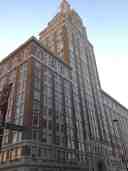
On your right, look for the cream-colored, Art Deco building with a blocky corner, rows of dark windows, and a zigzagged crown along the roofline. This is the Pythian Building, and it’s basically a snapshot of Tulsa’s optimism-and its sudden, very rude interruption. Construction kicked off in 1929, backed by two local oilmen, J. M. Gillette and H. C. Tyrrell. The original dream was ambitious: a three-story office base with a ten-story hotel stacked on top, like someone said, “Let’s build confidence, but make it taller.” Then the Great Depression showed up, and the plans collapsed faster than a bad stock tip. The project froze at the third floor. In 1931, the half-finished building found a new owner: the Knights of Pythias, a fraternal organization that was big on ceremony, community, and-apparently-finishing what other people started. They pushed it forward as office space and gave it the name you know today. Take a second to notice how much personality got baked into the exterior. The front is divided by slim vertical strips that run all the way up, and they’re decorated with back-to-back diamond shapes-those Art Deco zigzags that look like they’re trying to conduct electricity. Blue terra cotta pops in the details, and up at the roofline you’ll catch richer colors-blue, burnt sienna, and green-like the building decided to dress up for a night out. Down at street level, the openings have a Tudor-arch shape, but filled with steel-and-glass patterns that feel more machine-age than medieval. It earned a spot on the National Register of Historic Places in 1982, and it also helps define the Oil Capital Historic District-because in Tulsa, even the buildings keep receipts. In more recent years, it bounced around investment portfolios; at one point it was listed for sealed bids with a minimum of $1.4 million in 2012-about $1.9 million today-and it was mostly leased, which is the real Downtown love language. Ready for First Place Tower? Just walk southeast for 5 minutes.
Open dedicated page →
Show 8 more stopsShow fewer stopsexpand_moreexpand_less
On your left, look up for a tall, pale tower with tight rows of square windows, rising clean and straight against the sky like a giant office-file cabinet that got promoted. This…Read moreShow less
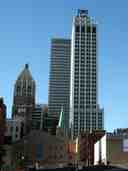
On your left, look up for a tall, pale tower with tight rows of square windows, rising clean and straight against the sky like a giant office-file cabinet that got promoted. This is First Place Tower, sitting at 15 East Fifth and facing Boston Avenue, even though it shares an address with the neighboring First National Bank Building. The building’s got layers, literally: the shorter midrise portion came first in 1949, twenty stories of postwar confidence, and then Tulsa went bigger. In 1973, the main tower was finished and shot up to forty-one floors, topping out around 516 feet. For downtown, that’s serious height-third tallest in Tulsa, and fourth in the whole state-basically the kind of building that makes your neck do overtime. Ownership has shifted, too. From 2006 to 2017, it belonged to Maurice Kanbar, a California entrepreneur with a sizable downtown portfolio, before it moved to his operating partner, Stuart Price. Ready for Mid-Continent Tower? Just head northwest for 0 minutes.
Open dedicated page →Look for the tall, bright-white tower with a dark copper cap at the top, rising above the downtown rooftops like a clean-cut wedding cake with a slightly moody hat. You’re…Read moreShow less
Look for the tall, bright-white tower with a dark copper cap at the top, rising above the downtown rooftops like a clean-cut wedding cake with a slightly moody hat. You’re standing by the Mid-Continent Tower, 36 stories of Tulsa confidence at 401 South Boston Avenue-about 513 feet high, which makes it one of the city’s big-league skyline players. The first thing you notice is that crisp white skin: terra cotta that catches the sun and practically dares clouds to drift by. Then there’s that copper roof, the detail that turns it from “tall building” into “oh, that one.” Here’s the twist: this tower is a sort of architectural time-travel trick. The original building went up in 1918 as the Cosden Building, commissioned by oilman Joshua Cosden and designed by Kansas City architect Henry F. Hoit. And it wasn’t built on just any patch of land-this spot once held Tulsa’s first schoolhouse, started as a mission in 1885 on Creek Nation land. So yeah, the ground under your feet has seen a few chapters. Decades later, after a restoration in 1980, Tulsa quite literally added to its own history: in 1984, a new 20-story section was cantilevered over the older 16-story base. It looks like the top is sitting on the original building, but the real muscle is an added support on the east side. The designers matched the older Gothic-inspired style so well that most people never realize it’s a two-part story built 66 years apart. When you’re set, 320 South Boston Building is a 1-minute walk heading north, and it will be on your left.
Open dedicated page →On your left, look for the big brick-and-cream high-rise that fills the whole block, with a stepped-back tower and a little crown-like cupola at the very top. This is the 320…Read moreShow less
On your left, look for the big brick-and-cream high-rise that fills the whole block, with a stepped-back tower and a little crown-like cupola at the very top. This is the 320 South Boston Building, and it’s been quietly showing off since the days when Tulsa was deciding what kind of city it wanted to be. The first version went up in 1917 as the Exchange National Bank’s headquarters-ten stories, solid and confident, right on the corner of Third and Boston. Then came the upgrade in 1929: the building shot up to 22 stories and about 400 feet, briefly claiming the title of tallest building in Oklahoma. It only held that bragging right until 1931, but it stayed Tulsa’s tallest for decades, which is plenty of time to develop a little swagger. Architecturally, it’s Beaux Arts-think “formal suit,” but in brick with terra cotta trim. Notice the heavier terra cotta on the lower floors, and how the central tower steps back near the top before finishing with that temple-like cap and cupola. For years, that cupola wasn’t just decoration-it acted like a low-tech weather app. Green lights meant fair skies; red warned you trouble was coming, including flashing red for storms. Tulsa: practical, but make it dramatic. The name changed as the bank did-Exchange National became National Bank of Tulsa, then Bank of Oklahoma, before BOK moved out in 1977 and the building settled into general office life. One darker footnote: in 1949, a television transmitter went up top, and a dropped wrench killed a woman on the street below-a sharp reminder that “progress” can have a human cost. When you’re set, Tulsa Performing Arts Center is a 2-minute walk heading northwest.
Open dedicated page →On your left, look for the big, boxy, cream-and-tan building with a tall, mostly windowless face and a low black awning over glass doors labeled “Chapman Music Hall.” This is the…Read moreShow less
On your left, look for the big, boxy, cream-and-tan building with a tall, mostly windowless face and a low black awning over glass doors labeled “Chapman Music Hall.” This is the Tulsa Performing Arts Center-locals usually just call it the PAC-and from the outside it can feel a little like a present wrapped in very serious paper. But that’s kind of the point: the magic is on the inside. This complex holds four main theaters, plus studio and event spaces, an art gallery, and a reception hall big enough to handle opening-night crowds dressed like they’re casually pretending not to be excited. The main event is Chapman Music Hall, a 2,365-seat house that’s hosted everything from big touring Broadway shows to major concert headliners. Over the years, names like Michael Bublé, Kelly Clarkson, Steve Martin, and Anthony Bourdain have all taken the stage here-proof that this building can pivot from symphonies to stand-up to stories about noodles without breaking a sweat. And when the PAC opened on March 19, 1977, the opening night talent was Ella Fitzgerald with the Tulsa Philharmonic. That’s not “soft launch” energy. That’s “we’re here, and we brought Ella” energy. The PAC exists because Tulsa decided, in the early 1970s, that the old setup wasn’t cutting it anymore. The earlier hometown venue was the Tulsa Municipal Theatre-today’s Tulsa Theater-and leaders formed an advisory committee to figure out whether to restore older theaters or build something new. Meanwhile, businessman John H. Williams had been buying up a big nine-block stretch downtown for development. Plans shifted, land got reshuffled, and a key piece-between 2nd and 3rd on Cincinnati, where a vacant Hotel Tulsa sat-ended up being offered to the city for a performing arts center. Then came the great Tulsa bargain of 1973: Williams and philanthropist Leta Chapman told residents, essentially, “You vote to pay half, we’ll raise the other half.” The bond campaign slogan was “Everyone’s Place,” which is honestly a pretty good line if you’re trying to get a whole city to agree on something. In August 1973 the vote passed with 69%, and the project was funded at about $14 million at the time-roughly around $100 million in today’s money, give or take, depending on which inflation calculator is having a mood. The architect was Minoru Yamasaki-the same designer behind the former World Trade Center towers-so you’re looking at a building with some serious pedigree. To keep construction moving fast during a period of nasty inflation, a private corporation briefly managed the build and then handed the finished property back to the city. In the end, the total cost landed closer to $19 million then (around $135 million today). Big undertaking, big payoff. Inside, the PAC isn’t just stages and seats-it’s also a museum of sorts. A city ordinance required that one percent of public building construction costs go toward art, so a committee assembled a collection that blends local, national, and international works, including significant Native American representation. The permanent collection totals 76 works, with artists like Barbara Hepworth and Louise Nevelson in the mix. So yes-this place is multitasking. Beyond Chapman, there’s the 437-seat John H. Williams Theatre for more intimate performances, plus two flexible studio-style theaters: the Liddy Doenges Theatre and the Charles E. Norman Theatre. Acoustics were handled by Bolt, Beranek and Newman-the same firm trusted with places like Lincoln Center-so when a note hangs in the air, that’s not luck. That’s engineering. When you’re ready, BOK Tower is a 4-minute walk heading northeast.
Open dedicated page →Look to your right for a tall, bright white tower with narrow vertical stripes and a red “BOK” sign near the top, rising like a sheer wall between the older buildings on either…Read moreShow less
Look to your right for a tall, bright white tower with narrow vertical stripes and a red “BOK” sign near the top, rising like a sheer wall between the older buildings on either side. This is BOK Tower-Bank of Oklahoma’s name on it today, but it opened in 1976 as One Williams Center, and for decades it was the tallest thing in the whole state at 667 feet. Fifty-two stories of “yes, we’re serious,” planted right in downtown Tulsa. Here’s the twist: the architect was Minoru Yamasaki, the same guy who designed New York City’s World Trade Center. And this building isn’t just inspired by that look-it’s basically a close cousin. The story goes that John Williams, the CEO of Williams Companies, liked the Twin Towers design so much he hired Yamasaki to bring that vibe home… at about half-scale. Early plans called for two 30-story towers, but Williams wanted more drama. So he literally stacked one model on top of the other to make his point. It worked: one taller tower instead-clean, symmetrical, and unapologetically vertical. Executives even joked the architects just “cut the WTC plans in half.” Corporate humor is a special, thrilling genre. Inside, the lobby leans into the same mood too-marble walls and hanging panels that echoed the Twin Towers’ interiors. The building packed about 1.1 million square feet of office space, and it hit around 80 percent occupancy within four months-Tulsa didn’t waste time moving in. Then, in 2005, a water main break flooded the basement and wrecked electrical equipment-because even skyscrapers can be taken down by plumbing. The next year brought a sixteen-million-dollar repair and renovation (about twenty-five million today): pedestrian bridges, granite at the base, new windows and fitness areas, plus the heavy work of fixing that flood damage. When you’re set, Tulsa parks and recreation is a 2-minute walk heading northeast.
Open dedicated page →On your right, that’s Tulsa Parks and Recreation-the folks whose job description is basically: “make Tulsa feel like Tulsa when you step outside.” It’s easy to think of a parks…Read moreShow less
On your right, that’s Tulsa Parks and Recreation-the folks whose job description is basically: “make Tulsa feel like Tulsa when you step outside.” It’s easy to think of a parks department as lawnmowers and picnic tables, but here it’s more like managing a small green kingdom spread across the city. Tulsa oversees 135 parks covering about 8,278 acres. That’s a lot of ground to keep friendly, safe, and inviting-especially in Oklahoma, where the weather can go from “perfect jog” to “I did not sign up for this wind” in a hurry. And it’s not just open grass. The city’s park system includes nature centers, community centers with gyms and meeting rooms, skate parks, dog parks, swimming pools, and roughly 66 miles of walking trails. If you’re the kind of person who likes your recreation organized into options, you’ve also got 186 sports fields, 93 playgrounds, 111 tennis courts, water play areas, splash pads, picnic shelters, and even golf and disc golf courses. It’s like Tulsa looked at a weekend and said, “Yes. All of it.” What’s fascinating is how wildly these parks vary in scale. On the “big” end, you’ve got Mohawk Park-over 3,000 acres-one of the largest city parks in the country. It’s the kind of place where you could wander long enough to forget you’re still inside city limits. On the other end, the smallest is Creek Nation Council Oak Park, under two acres. That’s not a park you get lost in-it’s a park you discover, take a breath, and realize a lot of history can fit into a small piece of land. Tulsa’s park story also has some early, almost homespun beginnings. Owen Park, for example, started when the city bought 20 acres in 1909 and opened it in 1910. Soon after, they dammed a ravine and made a swimming hole-very “let’s just make it work,” early-1900s style. In winter it froze over and turned into a skating spot. That kind of simple, scrappy fun carried through the 1920s. Today, there’s no swimming or skating there-now the water is more for birds and geese, which is a quieter vibe but still a good one. And here’s a detail I love: Tulsa’s first park superintendent, John Meisenbacher, lived in a house right in the park, and park board meetings were held above his garage. Government: slightly less glamorous, significantly more practical. There are also parks shaped by the complicated realities of land and ownership. Woodward Park and Gardens began with Tulsa buying 45 acres in 1909 for 100 dollars an acre-about 4,000 dollars per acre in today’s money. Then came a long legal fight because the land was tied to a Creek headright belonging to a minor, and construction didn’t really begin until 1933. Today it’s one of Tulsa’s showpieces, famous for its gardens and officially historic, but it got there the hard way. And just when you think all city parks stay inside the county lines, Tulsa has one that doesn’t. Lake Eucha Park sits outside Tulsa County. It started as a state park in 1952, and when Oklahoma moved to close some state parks in 2011 for budget reasons, Tulsa stepped in and took over. Not just out of kindness-Lake Eucha helps protect water quality feeding into the larger water supply system. Even parks, it turns out, can be part of the city’s survival plan. When you’re set, Oklahoma Jazz Hall of Fame is a 3-minute walk heading northwest.
Open dedicated page →On your left, look for the tan stone Art Deco building with two chunky corner towers, tall arched windows, and big carved letters across the front reading “TULSA UNION…Read moreShow less
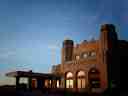
On your left, look for the tan stone Art Deco building with two chunky corner towers, tall arched windows, and big carved letters across the front reading “TULSA UNION DEPOT.” This place started life as a transportation workhorse, not a music shrine. The old Tulsa Union Depot was built for the steady rhythm of arrivals and departures-people hustling under that long canopy, porters rolling trunks, the whole city moving past the arched windows. Today it goes by a more fitting nickname: the Jazz Depot, home to the Oklahoma Jazz Hall of Fame. The Hall of Fame is a nonprofit with a simple mission and big ears: honor Oklahoma’s jazz, blues, and gospel musicians. Inside, it’s part performance venue, part museum-photos, stories, and artifacts that connect names on plaques to real lives and real gigs. You’ll see tributes to players like Chet Baker, Charlie Christian, Don Cherry, Earl Bostic, Barney Kessel, and Jimmy Rushing-artists who helped prove that Oklahoma didn’t just borrow American music; it helped write it. Every year there’s an induction ceremony-these days held in November-and more than a hundred musicians and groups have been recognized so far. The very first inductee was Zelia N. Breaux, a music educator who shaped generations of talent. And in 1999, they added the Jay McShann Lifetime Achievement Award, tipping the hat to people who spent a whole lifetime enriching the sound-names like Dave Brubeck, Lou Donaldson, Ramsey Lewis, Nat King Cole, George Duke, and Lalo Schifrin. Not every chapter is smooth. In 2004, a county initiative set aside four million dollars-about six and a half million in today’s money-to buy and renovate this depot, and it officially reopened in 2007. Then came hard times: by late 2020, a lawsuit over unpaid costs, bankruptcy in 2021, and finally a new nonprofit buyer with plans, funding, and renovations to keep the music alive. Ready for Oneok Field? Just walk southwest for about 13 minutes.
Open dedicated page →Look to your right for the big steel-and-brick entrance arch that reads “ONEOK FIELD,” topped with a tall black frame and a glowing blue “T.” You’re standing outside ONEOK…Read moreShow less
Look to your right for the big steel-and-brick entrance arch that reads “ONEOK FIELD,” topped with a tall black frame and a glowing blue “T.” You’re standing outside ONEOK Field-Tulsa’s modern front porch for baseball, tucked right up against downtown in the historic Greenwood district. If you can hear the faint clink of a bat in your imagination, you’re already getting the idea. Back in the late ’90s, the Tulsa Drillers started hunting for a new home, because their old park out at the fairgrounds wasn’t exactly “connected to the city”-unless you count being connected by a long drive and a parking lot the size of a small nation. At one point, there was even a serious flirtation with moving the team out to Jenks. But Tulsa leaders-Mayor Kathy Taylor among them-pushed hard for a downtown ballpark, and on June 26, 2008, the Drillers made it official. Then came the drama: a major donor, SemGroup, collapsed financially, and the whole plan wobbled for a moment. Still, the shovels hit the dirt on December 19, 2008. A few weeks later, ONEOK stepped in with $5 million for 20 years of naming rights-about $7 million in today’s money-helping keep the project on track. Designed by Populous and built by Manhattan Construction, the park cost $39.2 million (roughly $56 million today), with a total project budget around $60 million. The field sits about 13 feet below street level, there are 23 suites, and on April 8, 2010, the first game drew 8,665 fans-yes, over capacity. Tim McGraw threw the first pitch. The Drillers lost 7-0, which is baseball’s way of teaching humility early. And it’s not just baseball: since 2015, FC Tulsa has played here too-proof this place can swap cleats for spikes without breaking a sweat.
Open dedicated page →
Frequently asked questions
How do I start the tour?
After purchase, download the AudaTours app and enter your redemption code. The tour will be ready to start immediately - just tap play and follow the GPS-guided route.
Do I need internet during the tour?
No! Download the tour before you start and enjoy it fully offline. Only the chat feature requires internet. We recommend downloading on WiFi to save mobile data.
Is this a guided group tour?
No - this is a self-guided audio tour. You explore independently at your own pace, with audio narration playing through your phone. No tour guide, no group, no schedule.
How long does the tour take?
Most tours take 60–90 minutes to complete, but you control the pace entirely. Pause, skip stops, or take breaks whenever you want.
What if I can't finish the tour today?
No problem! Tours have lifetime access. Pause and resume whenever you like - tomorrow, next week, or next year. Your progress is saved.
What languages are available?
All tours are available in 50+ languages. Select your preferred language when redeeming your code. Note: language cannot be changed after tour generation.
Where do I access the tour after purchase?
Download the free AudaTours app from the App Store or Google Play. Enter your redemption code (sent via email) and the tour will appear in your library, ready to download and start.
If you don't enjoy the tour, we'll refund your purchase. Contact us at [email protected]
Checkout securely with