
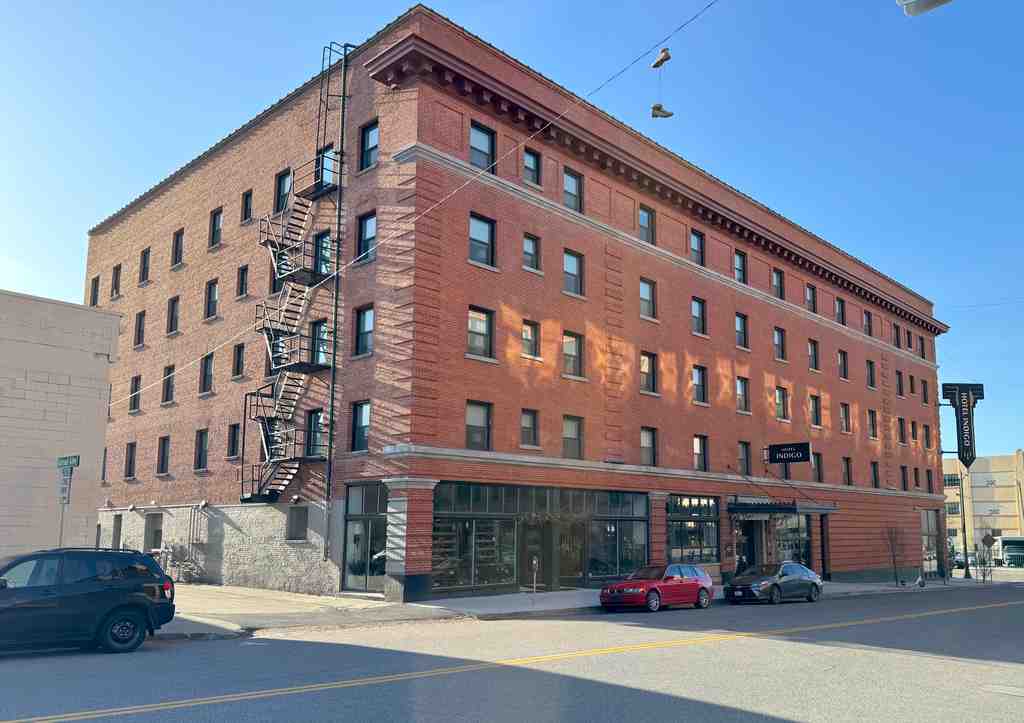
Look to your left and straight ahead for a big, brick-red building with five stories, a bold black sign that reads “Hotel Indigo,” and a zig-zagging metal fire escape clinging to its side-you can’t miss it on the corner!
Alright, you’re standing in front of what might look like just another handsome old hotel, but don’t be fooled-this place is a true survivor, a champion at “changing outfits,” and a living scrapbook of Spokane’s ever-changing downtown spirit! Meet the Otis Hotel, or as its current fans know it, the Hotel Indigo Spokane Downtown. Imagine Spokane in 1911: train whistles, the clang and dust of construction, wagons rattling down First Avenue. A young, ambitious Dr. Joseph Gandy-yes, doctor and city mover-and-shaker-commissioned this very building, fresh out of his role as president of the Spokane City Council. He wanted a place for the crowds of migrant workers fueling Spokane’s big building boom, and chose the talented architect duo Arthur Cowley and Archibald Rigg. Rigg, by the way, was a bit like the Beyoncé of Northwestern architecture-everyone wanted to work with him.
They created a sturdy, stylish Commercial Style structure clad in red brick, rising five stories on a concrete foundation, tall and serious as a schoolteacher. The Willard Hotel, as it was first called, quickly filled up with hard-working travelers. Back then, First Avenue was the neon spine of Spokane, lined with hotels just like this one, each a pit stop for people building the American West by day (and possibly snoring loudly by night-thin walls, you know).
Now, the Otis Hotel had more personality changes than a sitcom character. After Dr. Gandy, hotelier Victor Dessert took the reins in 1921, and with a sweep of his hand, dubbed it the Atlantic Hotel-his way of balancing out another nearby hotel named the Pacific. A bit dramatic, but hey, who’s judging? The 1930s rolled in with the Great Depression, tough times across America, and suddenly cheap rooms like these were gold. Locals and newcomers alike crowded in, resting their heads for as little as a dollar a night.
As the decades hustled by, the building cycled through names faster than a spy on the run: from the Milner to the Earle, and finally Otis Hotel-this name stuck like paint. The river of guests changed too. By mid-century, wave goodbye to the young laborers; now the Otis was home to older, low-income residents, and people who needed an affordable roof overhead for more than just a few nights.
But the city was changing, sometimes not for the better. By the late 1900s, the Otis Hotel stood in what some newspapers, quite gloomily, called the “most dangerous” part of downtown-a spot where you might find more empty bottles than tourists. Despite that, the Otis never lost its good bones. Its brick walls stood firm, windows neatly lined, still marked with the decorative stripes of that original gray concrete. You can feel it now-stand close and touch the brick! You’re touching more than a century of downtown comings and goings.
By the 1990s, the Otis became a symbol of pride and struggle: over 400 people lived here, sometimes paying just $140 a month for the same rooms that once hosted swanky trainmen and businessmen. Then, as the 21st century dawned, the old hotel shuttered up and went silent; for over a decade, it stood empty, just a sleeping giant overlooking First Avenue.
Enter Curtis Rystadt, a dreamer with deep pockets and courage, who bought the place in 2017. After a gorgeous $15 million glow-up-think new everything, but with all that old charm saved for you to see-it roared back to life in 2020 as the Hotel Indigo Spokane. Yes, the sign is new, but the brick, the history, and the mischievous whispers of a hundred years are all still here.
So go ahead-peek up at the fire escape, feel the breeze wrap around the corner, and listen closely. You might just hear echoes of Spokane’s pioneers, rowdy workers, and every curious traveler who ever passed through. Welcome to the Otis Hotel: a Spokane time machine, still open for business!


