
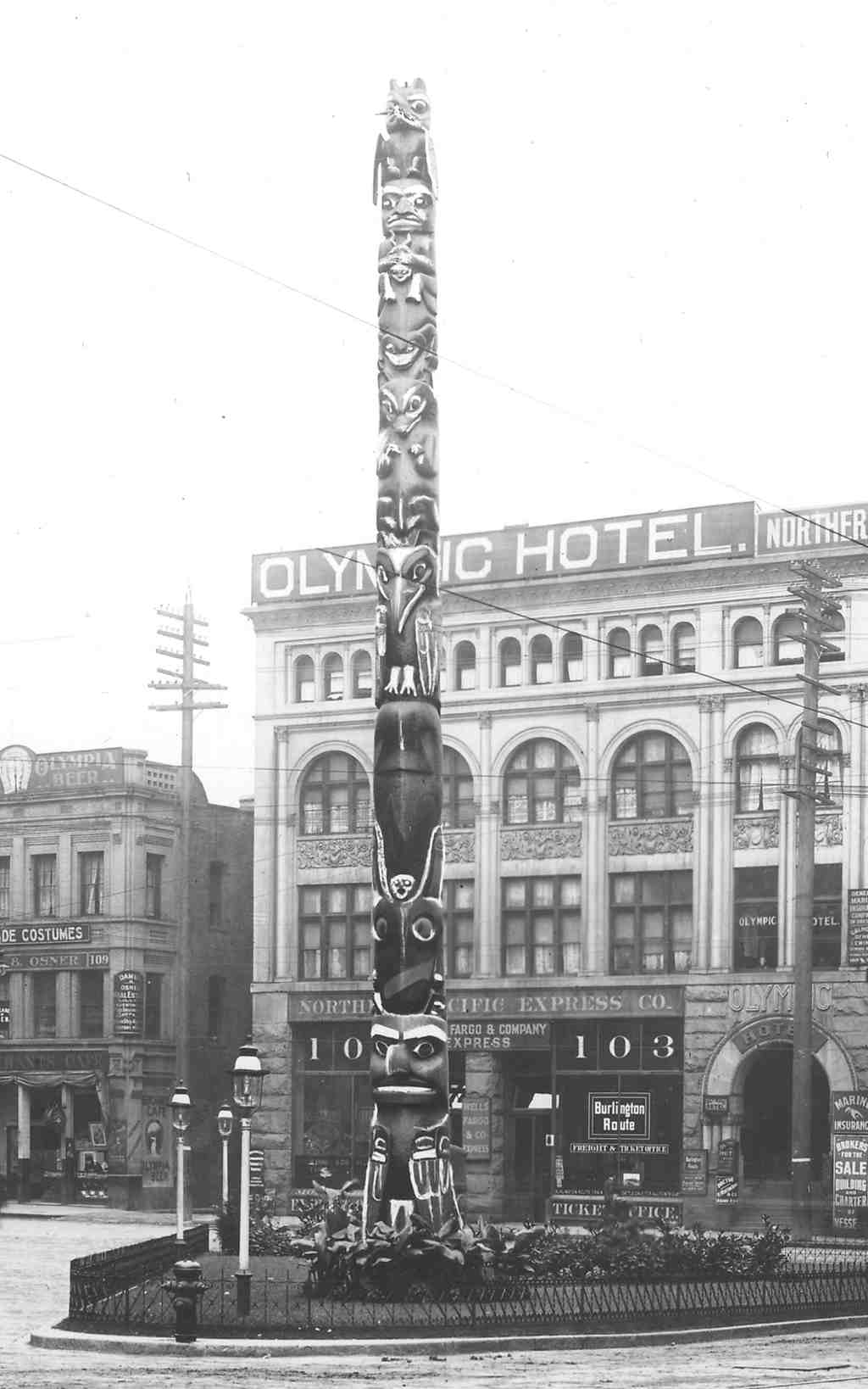
Look to your right-you’ll spot a tall, carved wooden pole with bold faces and animal figures stacked one above the next, rising high above the small patch of greenery in the square.
Standing here in front of the Pioneer Square totem pole, you’re looking back through more than two centuries of stories, adventures, and even a little mischief. Imagine yourself on the edge of a misty Alaskan village in 1790. The sharp scent of hemlock fills the air, and you hear the steady rhythm of carving tools against wood. In the Tlingit village of Tongass Island, the Kinninook family is gathered, hoping to honor the memory of a beloved leader-Chief-of-All-Women, a woman of such wisdom and heart that her story must be told to generations yet to come.
They hire a master carver and share with him their most important stories to shape into the wood: legends of Ravens, frogs, whales, and family, all woven with magic and mystery. When the pole is finally standing tall, a magnificent potlatch fills the village with celebration, drums, and laughter. Not many totem poles were dedicated to women, but this one was for her.
Flash forward a hundred years or so, and we switch scenes! Instead of a quiet Alaskan village, you’re on the bustling decks of the steamship City of Seattle, full of would-be adventurers, business leaders, and reporters from Seattle itself during the Klondike Gold Rush days. But instead of finding gold, this group became obsessed with finding a souvenir to show off Seattle’s new status as the “Gateway to Alaska.” And what better souvenir than a totem pole, they thought. With the village folk away for their fishing season, a handful of Seattle’s guests spot the majestic pole, chop it down, and saw it in two to cart it off-but, of course, they accidentally smash the beak of one of the figures! They float the pole home and pay the third mate a whopping $2.50 for his tree-chopping efforts.
The totem pole makes its way to Seattle, where it’s patched up, given a coat or two of non-traditional paint, and gets gifted to the city in October 1899. At its public unveiling in Pioneer Square, the crowd goes wild! Some folks cheer for this dramatic new “gateway” centerpiece, while others grumble, calling it a “blot” and “ridiculous.” Rival newspapers even exchange jabs over the event-one paper draws a cartoon poking fun, with a sign on the pole advertising their competition as grave-robbers! Clearly, civic pride can be a double-edged sword.
But the story doesn’t end there. When the Tlingit villagers and the Kinninook family return home from fishing, discovering their beloved pole missing, anger and shock ripple through the community. They call for justice, file lawsuits, demand compensation, and even get federal grand juries involved! Eventually, a legal settlement is hammered out and a few thousand dollars exchange hands-but not before Seattle’s business leaders get more than one nervous night’s sleep.
Without regard for its complex origin, the pole quickly becomes part of Seattle’s identity: featured on postcards, advertisements, and even as the mascot for the city’s hockey team, the Seattle Totems. Ironically, the Coast Salish-peoples native to the Seattle region-never traditionally carved totem poles at all! Seattle’s love of this borrowed symbol grew anyway.
Then, like any figure that stands out in a crowd, the totem pole faced misfortune. In 1938, arson scorched its carvings, and experts declared it too damaged to save. The city sent the burned remains back to Alaska for Tlingit carvers to do what they’d always done best-repair the spirit through art. Charles Brown and his team, including members of the Kinninook family, worked for months, and in 1940, their new red cedar replica returned home to Seattle. It now stands proudly where the spirit of Chief-of-All-Women still tells her stories to all who pass by.
So if you gaze up, you’ll see more than just wood or paint. Carved into this pole are three epic Tlingit stories: Raven, the trickster, stealing the sun, stars, and moon by transforming himself and outsmarting a powerful chief; the woman who married a frog, whose children became human and spread far from their watery home; and Mink and Raven’s wild escape from inside a hungry whale. Each figure is stacked from top to bottom, colors returned to their Tlingit roots-black, red, and blue-green-a story in every twist of wood.
So, as you stand here, let yourself be transported back: to the laughter of a potlatch, the chaos of a gold rush steamer, the embers of loss, and, finally, the healing return. Even a stolen story can bring new meaning in a city always on the move.




