
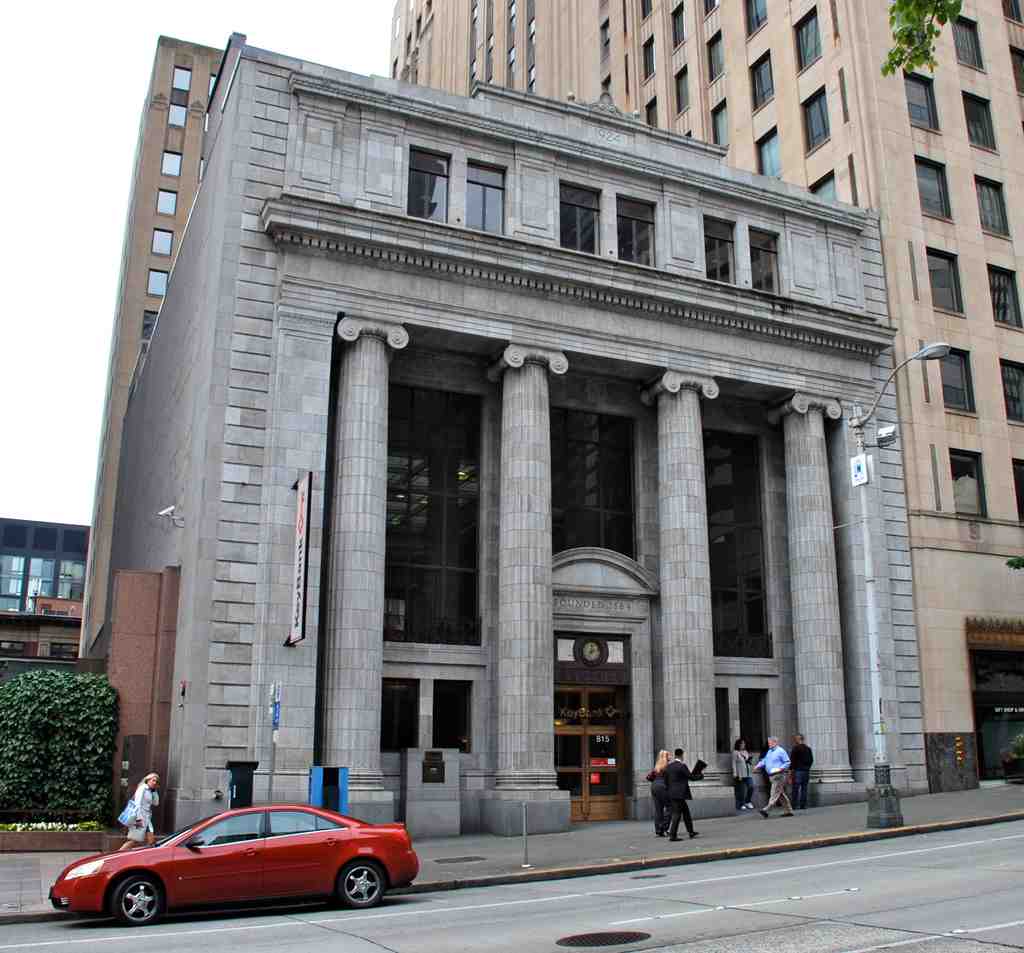
To spot the Bank of California Building, just look for a stately, rectangular two-story structure faced in gray stone-like terra cotta, with four massive Roman-style columns rising up above the sidewalk and big windows shining behind them, right in the middle of the block.
Alright, get ready to step back in time as you stand before the grand old Bank of California Building! Imagine the year is 1924: the cars are boxy, the jazz is lively, and Seattle is buzzing with ambition. Now, here comes the Bank of California, rolling into town with big dreams and an even bigger need for elbow room. They’d outgrown their tiny office down the street and snapped up this very lot for the princely sum of $160,000-a fortune back then-after the old Epler Block came down. Brick by brick, they cleared the way for something marvelous.
As workers cleared away the dust, architect John Graham & Company cooked up a true show-stopper: a strict Italian Renaissance design, built to impress even the toughest banker. No nonsense, no frills-just four enormous ionic columns out front, holding up a stately attic above, and an entrance elegant enough to make customers wonder if they were there for a mortgage or an audience with the gods. The terra cotta façade was glazed to shimmer like stone, and the whole face of the building sparkled with newness. If you climbed the front steps in August 1924 for opening day, you’d see sunlight pouring through enormous windows, catching on bronze torch lights, marble counters, and an octagonal rotunda ceiling soaring forty feet overhead. Rumor has it even the clocks were classy, with dials made from imported Escolette marble.
Inside, the main banking room stretched an impressive 60 by 70 feet. Up above, it was “semi-Pompeian” in its colors, with an octagon design so striking that even the grumpiest customer might have smiled while depositing their paycheck. Walnut woodwork gleamed, bronze fixtures glinted, and those massive bronze-bedecked columns made each teller window feel like a palace reception. All that marble underfoot? Straight from France, thank you very much! Behind the scenes, a web of offices wound through balconies and up to the fourth floor where bank employees had their own club room-a spot for unwinding after counting all that money.
But the building wasn’t just about looking good. Oh no! There was talk of installing customer parking in the basement-a wild innovation for the era. Was it ever built? That mystery lingers, like a secret shared among tellers and managers long gone. Out back, the bank expanded with new offices in the adjoining Exchange Building, plus a handy parking garage to the south, proving that in the roaring twenties, Seattle was ready for the fast lane.
Business boomed for decades. Our grand bank held strong through good times and bad, standing as a symbol of Seattle’s growth. Then, in the 1970s, these walls saw a twist that would make even a movie director grin: the big bosses built a flashy new skyscraper a few blocks away, but when the dust settled, the old building stayed open as a branch, and soon enough, the brand-new tower became-to everyone’s shock-a pharmacy! Talk about a plot twist! The original bank building, however, kept doing what it did best: holding onto people’s savings and secrets.
In 1983, a new name took over: Puget Sound Mutual Savings Bank. This comforting chunk of history soon became a part of Key Bank, and today it still welcomes customers with the same sturdy columns and marble floors. Through mergers, acquisitions, and decades of change, the building never lost its polished 1920s charm. And in 1987, Seattle made it official, granting landmark status to ensure that future generations could marvel at its timeless elegance.
Take a moment-listen for distant echoes of clinking coins, the murmur of old conversations, and maybe, just maybe, catch a whiff of freshly polished walnut and a glimmer of old-fashioned ambition. Who would have thought a bank could tell such a story? And if you ever look up at the entablature, remember: it once boldly spelled out the bank’s name for anyone walking by. These days, the marble and bronze stand silently, but their tales are as vibrant as the city that surrounds them.




