
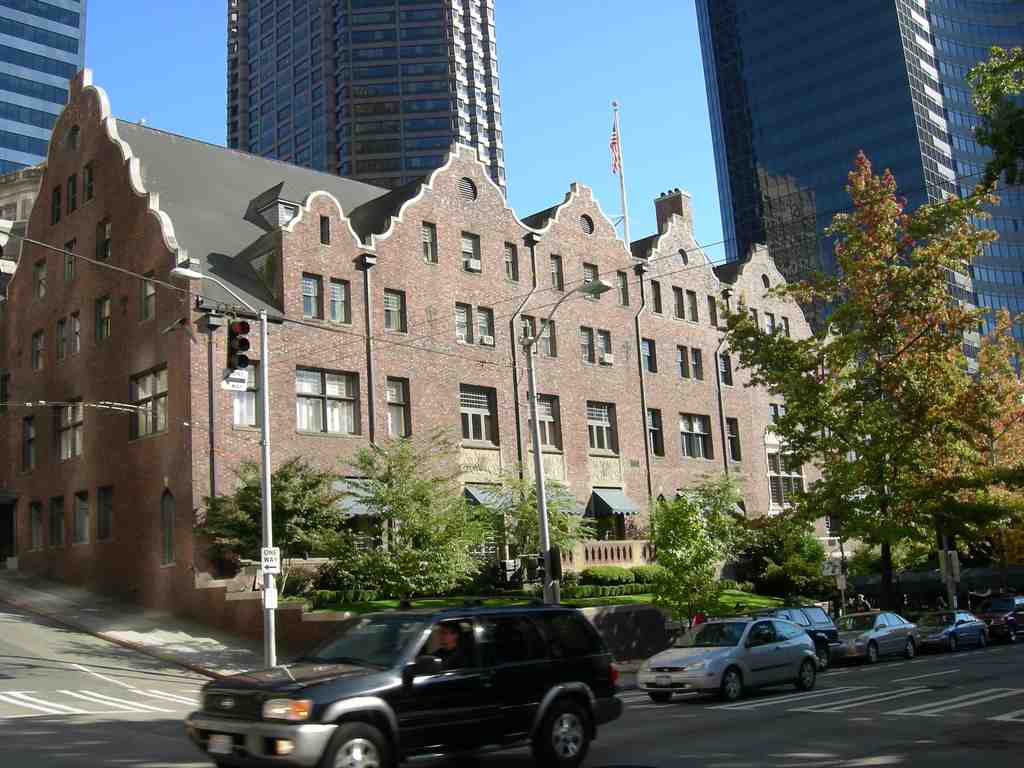
To spot the Rainier Club, look straight ahead for a striking red-brick building with distinctive Dutch-style gables, set against the backdrop of glass skyscrapers on the corner of Fourth Avenue and Columbia Street.
Imagine it’s the late 1800s, the air is thick with the smell of wood smoke and excitement as Seattle dreams of growing into something great, even before Washington became a state! Right here, in what was then nearly wild territory, six powerful men huddled together, probably trying to look important, but maybe mostly just trying to keep warm. They wanted a place to meet-a symbol of their ambition-and so, the Rainier Club was born in 1888, in the flickering candlelit hush of early Seattle. Fast forward a couple decades, and a new building stood here, gleaming with possibility. That’s the very same brick fortress in front of you now, finished in 1904, with its playful gables and the imposing presence of a castle built for rain-soaked gentlemen with big dreams.
If you listen closely, you might almost hear the shuffle of boots and the muted chuckles from when the club first opened as…a men’s boarding house and a restaurant. Why? Well, the law didn’t even recognize private clubs in 1888! Picture the city’s leaders sneaking through the rain to draft nefarious-er, totally legal-plans for Seattle’s future. They’d eventually reincorporate as a genuine club in 1899, but by then, legends were already growing inside these walls.
Before the Rainier Club took root here, it bounced around town like a wandering spirit: first in the lavish mansion of James McNaught, which is now the site of the Central Library, then a grimy stint in the Bailey Building, a spell at the Seattle Theatre, and at last, finding its forever home where you’re standing now. The club’s castle-like façade, designed by Kirtland Cutter, invites you to imagine top hats bobbing, umbrellas dribbling, and horse carriages clattering out front. In 1929, a new wing with shiny Art Deco ornaments and a sweeping Georgian-style entry made sure the Rainier Club was always the fanciest spot on the block-even during bleak times.
Rainier Club’s roots tangle deep into the city’s most dramatic moments. After the Great Seattle Fire of 1889 burned half the city to cinders, part of this club became emergency City Hall, as leaders huddled and made desperate plans surrounded by singed suits and hope, the sort of hope only found in rebuilding from ashes and-maybe-a good whiskey. Speaking of whiskey: when Prohibition rolled in like a cold, gray fog in 1916, the club swore, “No employee shall ever serve or possess alcohol.” But, and this is important, it never said anything about the members! I suppose you could say the Rainier Club ran almost as much on secrets as on cigars.
During tough times like the Great Depression, membership fees dropped faster than a soggy sandwich, plummeting from $500 to $100 just to keep the doors open. But spirits (and glasses) rose again after Prohibition ended-quirky new liquor laws let only private clubs serve drinks, funneling fun right into places like the Rainier Club.
And if you think this was just a place for old men with big mustaches, think again. The club helped organize the monumentally grand Alaska-Yukon-Pacific Exposition of 1909, the fair that transformed Seattle’s University of Washington campus forever and put the young city firmly on the national map. Later in the 1960s, secret meetings here helped launch the Century 21 Exposition, better known as the 1962 World’s Fair. If you squint, you might almost see guests like John Muir stepping out to explore Alaska, or President Bill Clinton’s diplomatic motorcade rumbling up for top-level APEC meetings with Japan and China in 1993.
Inside, past those stately doors, incredible art hangs on the walls, including dozens of original prints by Edward S. Curtis-club member, photographer, and sidekick to President Theodore Roosevelt. Distinguished visitors ranged from Buffalo Bill to Babe Ruth, and the club eventually broke its own barriers: Saburo Nishimuro became the first Japanese American member in 1966, Luther Carr the first African American member in 1978, and that same year, the club finally invited women, starting with trailblazing judge Betty Binns Fletcher. Now 1,300 strong, the Rainier Club continues to be a gathering place for folks who shape, shake, and sometimes overturn Seattle’s story.
Take a long look at this gabled landmark-you’re sharing the sidewalk with more than a century of secrets, celebrations, and the echoes of some very, very lively conversations.
Want to explore the buildings, activities or the prohibition and great depression eras in more depth? Join me in the chat section for a detailed discussion.




