
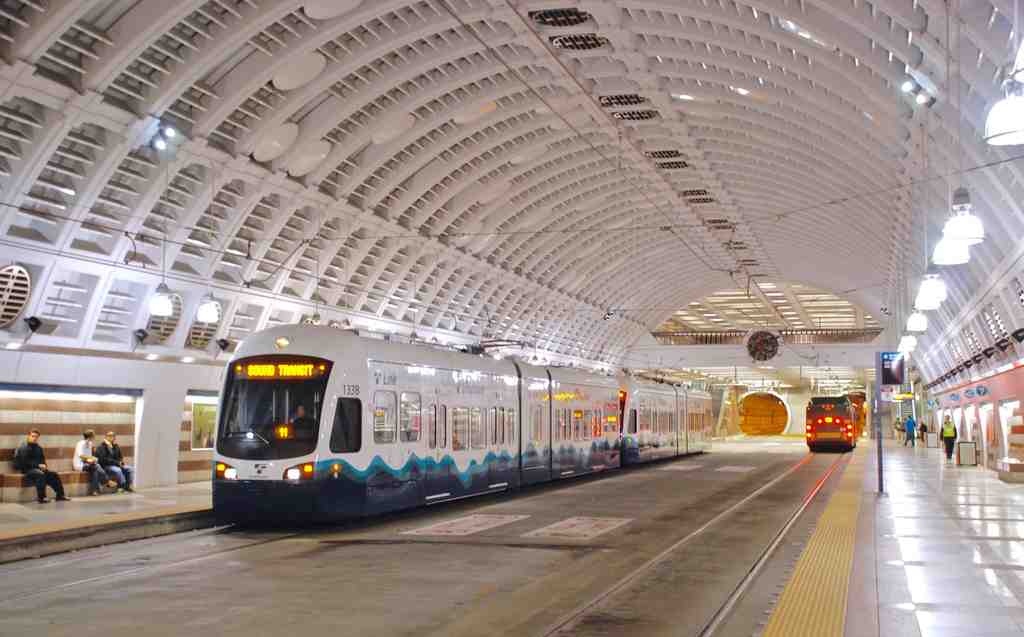
Look for a wide entrance leading down beneath 3rd Avenue-Pioneer Square station stretches out below with its distinctive arched white ceiling and long platforms, bright lights, and the steady coming and going of light rail trains and buses.
Welcome to Pioneer Square station-the hidden heart of Seattle’s transit history and, some say, a living museum beneath your feet! Imagine yourself standing here, in front of a gateway that leads deep under 3rd Avenue, right where the city itself was born back in the 1850s. If you listen closely, you might just hear the faint echo of old cable cars and the bustling energy of commuters past and present.
Picture this: over a century ago, engineers dreamed of a subway under 3rd Avenue, and there were more than a few wild ideas. Plans for an underground railway kept popping up-in 1911, then again in the roaring ‘20s, but Seattle wasn’t quite ready. Fast-forward to the swinging 60s and 70s, when city leaders cooked up a new rapid transit scheme with tunnels under your very feet. Close, but no subway sandwich just yet-after multiple votes, the dreams fizzled out.
But Seattle’s spirit isn’t known for quitting! In the 1980s, Metro Transit decided it was time for buses-and, eventually, trains-to zoom beneath downtown. The Pioneer Square station was planned to echo the neighborhood’s old brick and stone charm but with a futuristic twist. Construction wasn’t all smooth sailing; imagine giant tunnel boring machines munching through the earth and-yikes-knocking out the power to City Hall in 1987! The city went dark for a day. At one moment, workers even uncovered a massive 11-foot cable car flywheel-a hidden relic from the Yesler Way line, now on display in the south mezzanine.
By 1990, the station was a wonder: it boasted dizzying escalators, the longest and steepest west of the Mississippi, and a striking arched white ceiling, meant to reflect the historic grandeur of Pioneer Square above. But trouble still bubbled up-literally. Water leaks made their mark and left rust stains as a reminder that, down here, you’re closer than ever to Seattle’s watery roots.
And don’t miss the art! Hanging from the high vault, you'll spot the mysterious “artifact clocks” built from tools and treasures found during construction. One clock is built from modern bits: granite, steel beams, even old electrical wires. The other is a time capsule of Seattle, with pieces as old as the city-cobblestones, cast-iron pipes, even some of the bricks that built early Seattle. The numbers are made from hand tools and tape measures, a nod to builders past and present.
From 1990 until 2009, buses ruled these tunnels, gliding along tracks designed for future trains. But Seattle got ambitious; after years of planning and a $3.9 billion vote in favor of light rail in 1996, the big transformation began. The tunnel closed for a massive renovation, fitting it for shiny new light rail cars. Walls came down, fresh rails went in, and on July 18, 2009, the very first Link light rail train rolled into Pioneer Square.
Imagine, through all this, that the area above grew into a busy urban mix-historic buildings, city offices, and glass towers. At rush hour, the station fills with travelers heading for ferries at Colman Dock, office towers like Smith Tower, and the famous Klondike Gold Rush National Historical Park. Modern commuters sprint along the platforms, glancing up at the clocks, perhaps trying to guess whether it’s old Seattle or new Seattle telling the time.
Even now, the story isn’t over-construction and upgrades are a constant part of the buzz down here. In 2020, a temporary center platform popped up overnight to help trains and passengers shift around while the city built out new extensions. And changes keep coming as more lines, more stories, and, maybe, a new burst of inspiration shapes what happens beneath the streets of Pioneer Square.
So, next time you descend under 3rd Avenue and feel the pulse of Seattle all around, remember: you’re standing in a place where the city’s dreams and determination, frustrations and discoveries, have all been woven together-one train, one bus, and one wild idea at a time!




