
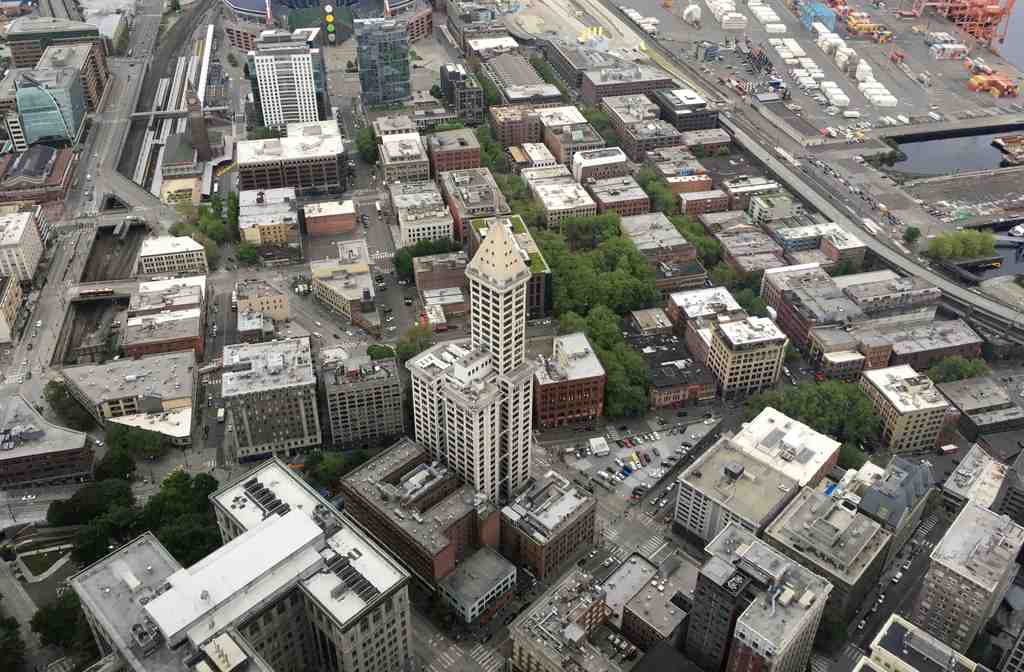
If you’re looking ahead, you’ll spot Pioneer Square by its patchwork of red-brick buildings clustered around leafy trees and wide streets near Yesler Way, with the iconic triangular plaza and the tall Smith Tower nearby-a little oasis of history nestled in the heart of the city.
Welcome to Pioneer Square, the spot where Seattle itself began-right here where those proud brick buildings give you a big group hug from the 1800s. It’s hard to imagine now, but back in 1852, this whole area was just raw forest and muddy shoreline, a whole lot less internet and a whole lot more axes and adventure. The city’s first settlers stomped ashore right here after six tough months across the water at Alki Point, drawn in by Henry Yesler’s whopping big lumber mill. If you listen closely, you might hear those early saws gnawing through old-growth trees -that’s the soundtrack of Seattle’s birth.
Back then, everything was built out of wood-homes, shops, dreams-but that proved a rather flammable choice. In 1889, the Great Seattle Fire ripped through these blocks, turning nearly every wooden building into smoke and ash. Picture it: neighbors rushing buckets, horses bolting, frightened chickens-complete chaos. When the smoke cleared, everyone rolled up their sleeves and rebuilt in brick and stone, often sturdy and round-arched in a style called Richardsonian Romanesque. It’s why Pioneer Square looks like it’s dressed for a costume ball set in 1890. And, fun fact, much of what you walk on today is landfill, with former bluffs and islands smoothed out beneath your feet-Seattle really didn’t do things halfway.
The neighborhood got its name from the small triangular plaza at First Avenue and Yesler Way-the famous “Pioneer Place.” You’re standing at the heart of what was known as the Pioneer Square-Skid Road Historic District. Yesler Way has always been the main drag-Mill Street in those days-splitting the city along founder’s claims and later dividing the respectable from the not-so-respectable. South of here was “Skid Row,” a carnival of cheap hotels, brothels, “crib houses,” gambling, and the sort of nightlife where the piano professors played late into the night. Let’s just say police only came here in teams. If you were a gambler, a piano man, or on the run from your landlord, this was the place to be!
But don’t count it all as vice-there’s a streak of civility, too. Seattle’s first Catholic Church stood here, and not far away, Lou Graham opened the city’s most famous parlor house, where fortunes were made faster than you could lose them. In fact, you might even recognize some names: Donald Trump’s grandfather, for example, owned a restaurant here in the 1890s, serving dreams and maybe a few bad checks right on Washington Street.
When fire destroyed the square, Seattle bounced back fast. By the end of 1889, masonry buildings shot up everywhere, sometimes with two doors-one at the old street level, one at the new, higher one. Under your feet, those old storefronts still wait in the dark, and you can visit them on the famous Seattle Underground Tour. As cable cars once clanged past, people dreamed big and built even bigger, getting ready for surges of gold-stampeders on their way north during the Klondike Gold Rush.
Iconic art and sculpture became part of this story too. In 1899, a group of locals “borrowed” a Tlingit totem pole, planting it right here-a little awkward, but a piece of history remains with every retelling. An elegant iron-and-glass pergola and a bust of Chief Seattle joined the square, adding layers of memory and meaning.
Through booms and busts, this place never lost its pulse. It nearly vanished under a wave of “urban renewal” and would’ve been replaced by parking garages if not for a stubborn crew of preservationists. Thankfully, Pioneer Square is now a protected historic district. Nowadays, the area is buzzing with artists, cafés, bookshops, tech startups, and galleries. Local art groups make the district even livelier-keep your eyes peeled for framed art on the walls, transforming Pioneer Square into a year-round open-air gallery.
Every June, if you’re lucky, you’ll catch the Fire Festival and the solemn ringing of bells at the Fallen Firefighters Memorial, a reminder that this neighborhood is built on both courage and chaos. So as you stand here, surrounded by a swirl of stories, let your mind wander through time. You’re walking on layers of Seattle’s hope, hustle, heartbreak, and more than a few good parties. Don’t be shy-say “hi” to history while you’re here!




