
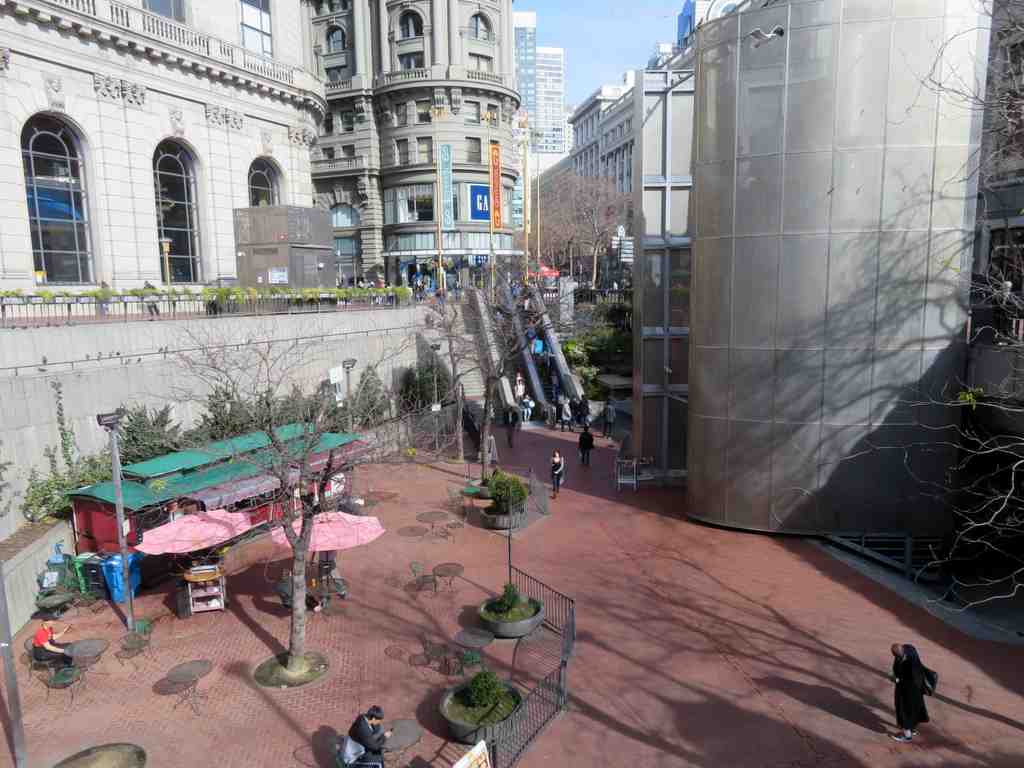
You’re looking for a sunken brick plaza below street level, just across from the big, classic buildings and next to a shiny, cylindrical elevator shaft-look down for a red-bricked triangle with tables and escalators heading underground.
All right, you’ve made it to Hallidie Plaza! Take a moment-breathe in that sweet mix of coffee from the carts and a whisper of BART tunnel dust. All around you, there’s a hum of city life…but maybe not the wild crowd you’d expect from the entrance to Powell Street Station, one of San Francisco’s busiest subway stops. In fact, Hallidie Plaza has a funny secret: for decades, it's been the city’s most bustling backdrop nobody seems to notice. It's kind of like an urban magic trick-walk by on Market, and you might not even realize there's a whole world happening 20 feet below your shoes!
Picture it: the early 1970s. San Francisco is buzzing with hope for the future, shiny new dreams built on dust and daring. The Bay Area Rapid Transit system-BART-has just punched its way through the city, turning Market Street into a construction zone with visions of sleek, modern plazas rising from the chaos. Hallidie Plaza was born from this era, designed by the superteam of Lawrence Halprin, John Carl Warnecke, and Mario Ciampi-three architects with hopes as big as the city itself. Their idea? Create a sunken square, shielded from the roar of Market Street, where people could gather, rest, and start their journeys on BART.
But San Francisco loves a plot twist! The architects embraced the dramatic: instead of a gentle slope, the plaza plunged deep, wrapped in granite walls and brick paving arranged like a herringbone weave. Escalators whisked people from the street down to the red brick floor, while a walkway zipped right below bustling Cyril Magnin Street. It was meant to be an amphitheater for city life-benches, planters, even a slick visitor center for lost tourists. But the reality? The lower you went, the lonelier it got. More oven than oasis on a hot day, with hardly any shade and a peculiar chill in its shadowy corners, the plaza somehow missed the mark.
The people who did show up weren’t always shopping for new shoes. San Francisco’s urban planners and city officials have been playing a tug-of-war here ever since. There’s been a parade of attempts to draw a livelier crowd-planting more trees, adding benches, policing out the mischief, and, in the late '90s, even an elevator. And not just any elevator: a giant perforated cylinder that earned its very own nickname, “San Francisco’s Poop Chute.” (Hey, if a name like that doesn’t stick in your head, I don’t know what will!) Disability activists had sued, demanding access for everyone, sparking the city to commission a new public sculpture with the Arts Commission.
Now, this plaza sits at a crossroads of power and quirky San Francisco history. Up top, you have department stores, the cable car turntable spinning its way around tourists, and legendary buildings like the Flood Building, while down here are echoes of city politics and more than a few hard-fought battles about just who belongs in a public space. More than once, the city tried to shoo away the unhoused by passing laws and policing harder, but as Chronicle critic John King dryly wrote, those efforts just moved the problem around. If you make a space too unwelcome, everyone loses-a lesson the city is still learning.
But for all its quirks and cold edges, Hallidie Plaza has some unexpected flashes of fun and civic pride, too. There’s the sign pointing to San Francisco’s nineteen sister cities around the world, offering a kind of dreamer’s compass for tourists and locals. Across the years, plans have flickered to add more sculpture, flags, seats, or even a giant underground water cistern-the plaza’s hidden practical superpower, storing floodwater pumped out from Powell Station and maybe even keeping the city a bit drier on rainy days.
If you squint, you almost see Hallidie Plaza as a stage-half café, half commuter crossroads, all wrapped up in a city’s hope that even sunken spaces can come alive with possibility. So as you stand here now, listen to the blended soundtrack of city sounds: streetcars dinging, BART trains rumbling, footsteps echoing off brick, and maybe…just maybe…the distant laughter of architects still imagining how to make this steep triangle a grand entrance for everyone. Just goes to show: in San Francisco, even a “void to avoid” is never boring!




