
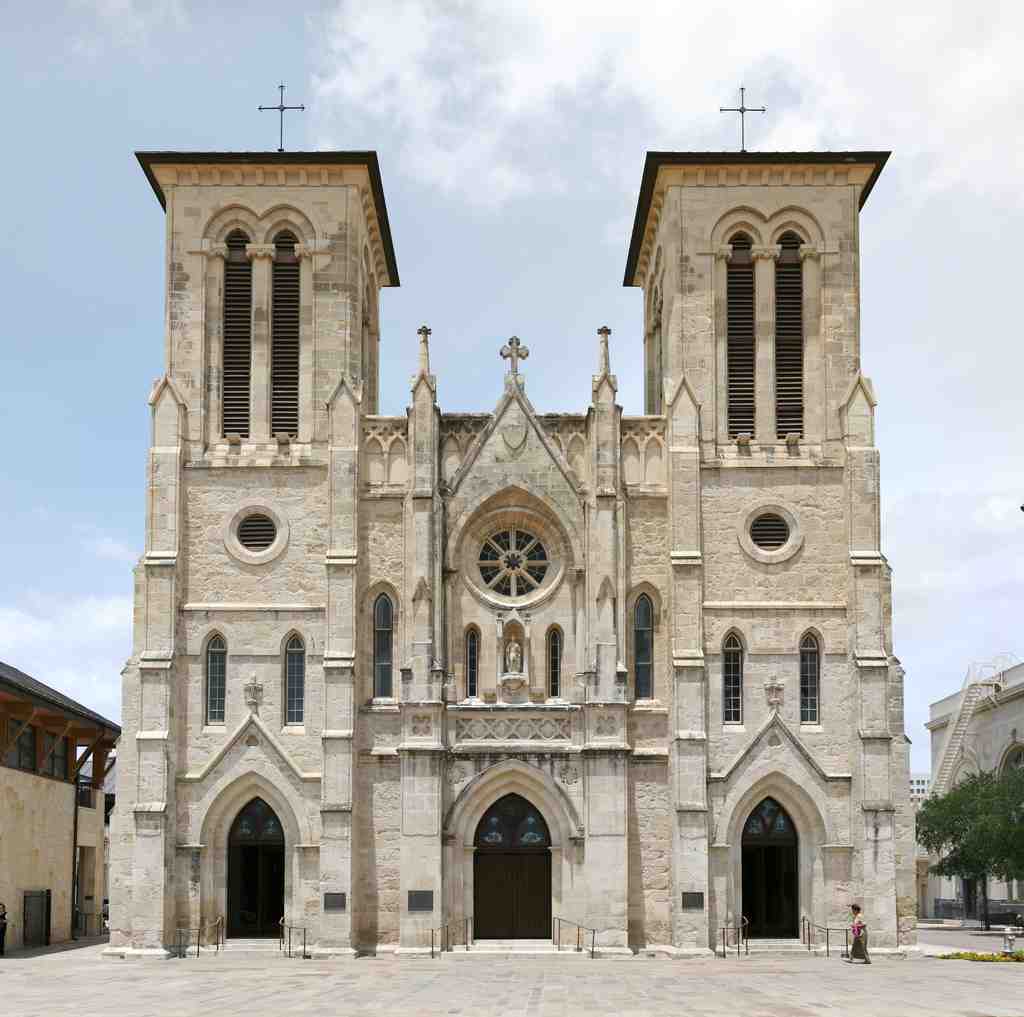
Well now, plant your boots right here in front of San Fernando Cathedral and take in that grand face of stone. Folks call it San Fernando Cathedral, but it’s also the Cathedral of Our Lady of Candelaria and Guadalupe, or in Spanish, Nuestra Señora de la Candelaria y Guadalupe. However you name it, you’re lookin’ at the mother church of the Archdiocese of San Antonio, the official seat where the archbishop leads. And that dome up top? It’s long been treated like San Antonio’s cultural and geographic “center point,” like a landmark you can measure the city’s story from. <break time="1.0s" />
This place is old by Texas standards, and downright ancient by American ones. Back in the 1700s, this was Spanish Empire territory, and the local Catholics answered to the Archdiocese of Mexico. In 1731, the Spanish Crown sent 55 settlers from the Canary Islands to help anchor San Antonio. The military commander, Juan Antonio Pérez de Almazán, was told to pick a spot for their church. The cornerstone was laid May 11, 1738, and they named it for Ferdinand III of Castile, a king from the 1200s. <break time="1.0s" />
Now, the first builders were soldiers and families and those new settlers, and bless their hearts, they tried-but “inexperienced” is a polite word for what happened. The work was poor enough that in 1748 the viceroy kicked in 12,000 pesos-think roughly a couple million dollars in today’s money-to bring in a master stone mason and stone cutter from Mexico. They tore out the bad start, expanded the footprint, and finally got the church dedicated in 1755. And there’s a tradition that King Charles III donated the baptismal font-the big basin used for baptisms-later in the 1700s. <break time="1.0s" />
History didn’t tiptoe around this sanctuary, neither. A flood in 1819 damaged it. A fire in 1828 damaged it again. Then in 1831, after repairs, James Bowie married Ursula de Veramendi right here-yep, that Bowie. During the Texas Revolution, the Battle of Béxar saw Mexican artillery positioned at the church. And when the Battle of the Alamo began in 1836, General Santa Anna raised a “no quarter” flag from the tower-meaning no prisoners would be spared. The siege ended with the Alamo’s defenders killed, Bowie included. <break time="1.0s" />
Afterward, the church itself sagged under hard years-its roof even caved in by 1840, and birds moved in like they’d bought the place. But San Antonio grew, and so did the need to rebuild. In 1868, architect Francois P. Giraud oversaw a major redo: the nave-the long central hall where folks sit-was rebuilt in a Gothic Revival style, with three entrances, buttresses, and twin bell towers. Only the original sanctuary was saved, and the renewed church was consecrated in 1873. <break time="1.0s" />
In 1874, Pope Pius IX made it a cathedral, and by 1920 stained glass windows colored the light inside. Renovations kept coming, including a major one in the 1970s, and in 1987 Pope John Paul II visited-there’s a marker for that moment. A huge renovation began in 2003, and later changes in 2011 set a new fixed altar and placed relics inside it-tiny sacred keepsakes-two tied to St. Anthony of Padua and one to Blessed Concepción Cabrera de Armida. <break time="1.0s" />
And if you ever catch “San Antonio: The Saga,” that 24-minute video art projection started in 2014, cast right across this very façade like history painted with light. <break time="1.0s" />
This cathedral isn’t just a monument; it’s a living heartbeat, with thousands attending weekend Mass and hundreds of baptisms, weddings, and funerals each year. Take a moment to soak it in. When you’re ready, we can mosey along to the next stop. <break time="1.0s" />




