
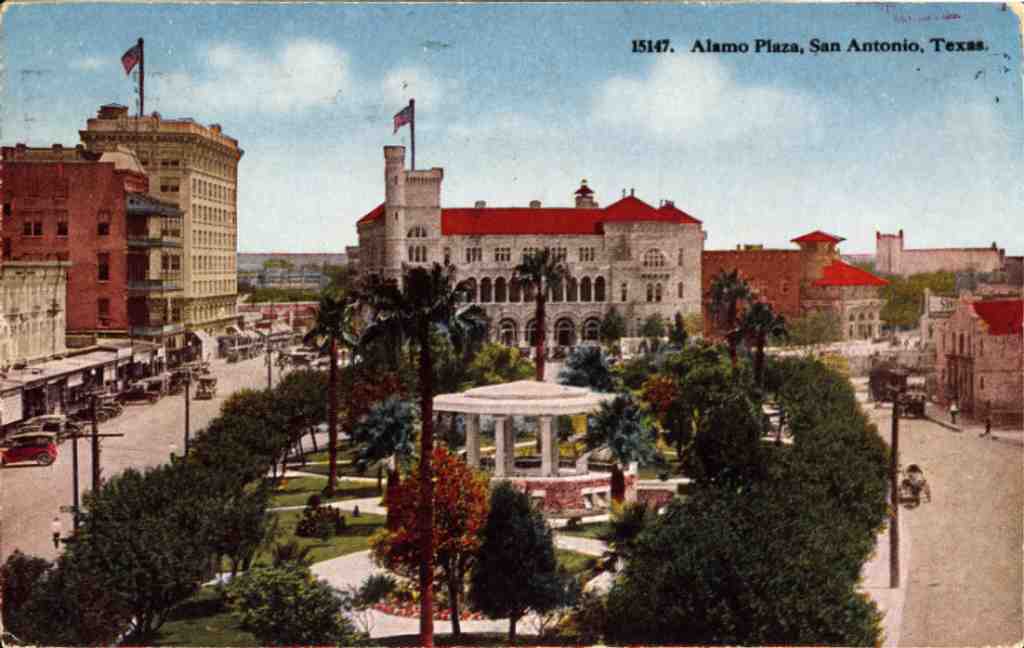
Alright now, partner, if you’re standin’ with the breeze of San Antonio dustin’ your boots and lookin’ straight ahead at a lively green park dotted with tall palm trees, a stately white bandstand right in the center, and grand old stone buildings holdin’ court all round, you’ve found yourself smack dab in Alamo Plaza Historic District. You’ll spot it easy: that wide-open square, dotted with walkways and shade, lays out like a welcome mat at the foot of the city’s most legendary stories.
Now, get comfortable, ‘cause this ground you’re standin’ on is the heart and soul of San Antonio, and boy, it’s seen more drama and heroics than a county fair back in the day. Long before all these iron balconies and corniced rooftops sprang up, this patch of earth was a meeting place not just for locals, but for folks from two very different worlds. Imagine a time, way back in the early 1700s, when Spanish friars made their way here with the rumble of wagons and the shuffle of tired boots, their eyes set on buildin’ not just a church, but a safe haven. It was the local Native Americans themselves, weary of raids from unfriendly tribes, who asked those Franciscan missionaries for shelter. The friars, with a mind to spread the Good Word and a heart for helpin’ souls, said, “Come on in.” So shelter was given, a little faith was traded, and families grew under the watchful gaze of the old missions. Some even took on brand-new Spanish names to go with their fresh start!
By late nineteenth century, the plaza started shapin’ up into something grand, thanks to a fella named Anton Wulff. He was a city alderman with an eye for pretty things and the patience of a mule teachin’ tricks. Wulff oversaw the layout and landscaping right here, and just to say thanks, the local business folks gifted him a gold-topped walking stick, as shiny as a new silver dollar, and had it engraved so everyone’d remember who put in the elbow grease.
Look around you and you’ll see a patchwork of buildings, each one with its own story to holler. Take the Menger Hotel, for instance-she's a true old Texas dame. Started as a humble limestone building in 1857, she kept growin’ taller and fancier, right up to a three-story beauty with stained glass lightin’ up the lobby, and balconies stretchin’ like arms, ready for a moonlit whisper. Then there’s the Crockett Hotel, peeking over the plaza, built where heroes once stood-yep, the Crockett name here still gets hearts thumpin’ with memories of the Alamo.
Now, this plaza ain’t just about hotels and bandstands. Over near the north end, a white marble shaft stands tall-hard to miss if you’re squintin’ up at the Texas sun. That there’s the Cenotaph, the “Spirit of Sacrifice,” built in 1940 to remember the brave souls of the Alamo. Look close and you’ll see the faces of Crockett, Bowie, Travis, and Bonham, chiseled in stone with the same determination they had all those years ago. On the north side stands a sculpted Lady representin’ Texas herself-sturdy and proud, just like the folks who call this place home.
This plaza has seen the high-heeled bootsteps of city folk trappin’ into Joske’s Department Store, and once echoed with the boom of grand opera in a bygone theater, only to be rebuilt and repurposed as the city grew. There’s the Old Post Office not far off, standin’ with its limestone bones since 1937, and the Medical Arts Building, with its pointy Chateauesque tower peerin’ at the skyline like a cattleman watchin’ the range.
San Antonio never stops changin’, but the plaza here holds it all together. From the palm-fringed bandstand that's swapped out since the 1890s to each ornate shopfront down Alamo, this is ground where cultures met, legends rose, and Sunday afternoons still hum with the spirit of folks who made San Antonio what she is. You ain’t just standin’ in a park-you’re standin’ at the crossroads of stories, where memory and hope seem to shake hands beneath the Texas sky.




