
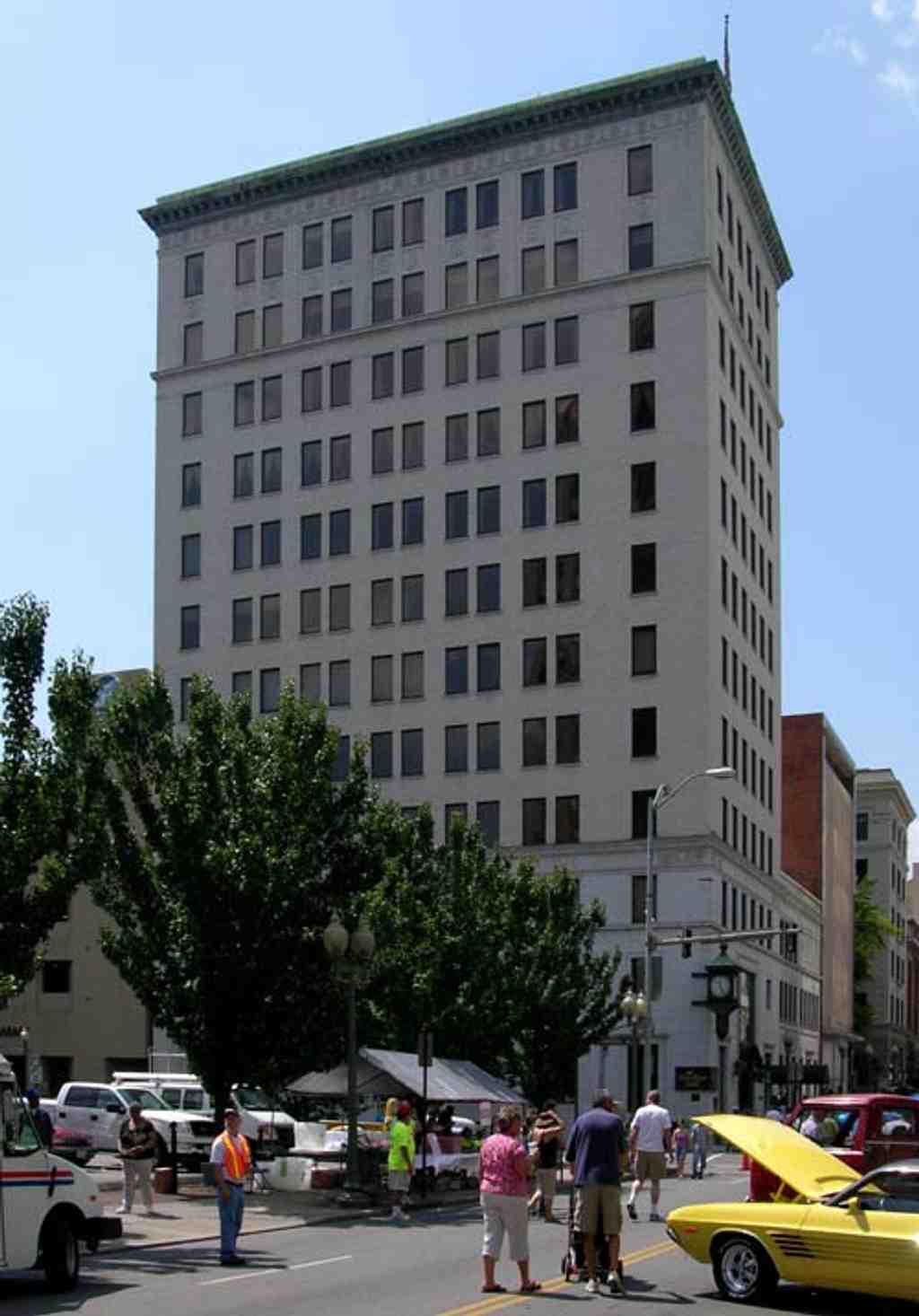
Look to your right for a tall, pale gray, twelve-story tower with a crisp, classical “crown” along the roofline and rows of dark, square windows stacked like graph paper against the sky.
Alright, you’re standing beside what Roanoke once treated like the height of modern ambition… literally. This is the Colonial National Bank building, finished in 1926 to 1927, when downtown was still trying on its big-city shoes. It’s granite and gray enamel brick, and it’s dressed in a Neoclassical outfit-because if you’re going to hold people’s money, you might as well look like you learned trustworthiness from ancient Rome.
Here’s the fun part: the whole building is designed like a classical column. Not a carved marble one, obviously-more like “skyscraper cosplay.” The first three floors form the base, solid and weighty in granite. Above that, the next seven floors are the plain “shaft,” mostly unadorned brick-just business, no jewelry. Then the top two floors are the “capital,” with more ornament, like the building remembered at the last second that it’s supposed to be fancy.
This corner was banking territory long before this tower went up. The bank started in 1910, and by 1912 it had moved into the Terry Building right here-an Italianate seven-story “skyscraper” for its day. Roanoke’s first. But styles change, and by 1927 the Terry Building was starting to feel… dated. So the bank did what ambitious institutions tend to do: it knocked the old landmark down and built a taller one in its place. Local architects Frye and Stone-names that pop up all over Roanoke-gave the city this twelve-story statement piece. For nearly fifty years, it was the tallest building in town, which is a long reign in skyline years.
Inside, the bottom two floors handled the banking-tellers, ledgers, the whole ritual. The ten floors above were laid out in identical office suites, sixteen per floor. And in a perfect little time capsule detail: each floor had men’s and women’s restrooms… with five fixtures for men and only one for women. Nothing says “modern progress” like designing the future with your eyes shut.
In 1929, Colonial National merged with American National, and one of the building’s signature features dates from that era: a copper-and-stained-glass clock jutting from the corner, with chimes tucked inside and the bank’s name glowing in colored glass. It’s the kind of detail meant to stop you mid-stride and think, “Okay, these folks wanted to be remembered.”
The building kept evolving-an annex went up next door in 1949 and 1959, and the lobby levels got a remodel in 1960. Then, in 1992, Roanoke tried something bold up on the roof: peregrine falcons, released to help rebuild the state’s population and maybe chase off downtown pigeons. The city bought five chicks at $1,600 each-about $3,600 today-funded by downtown businesses, plus a sixth rescued bird from the U.S. Fish and Wildlife Service. Turns out pigeons don’t scare easy… and the falcons didn’t quite solve the problem.
Today, it’s still working for a living: banking down low, and high-end homes up top, after renovations and conversions over the years. A money-and-people machine… just with better views now.
When you’re ready, Mill Mountain Theatre is next-just walk east for about 1 minute.


