
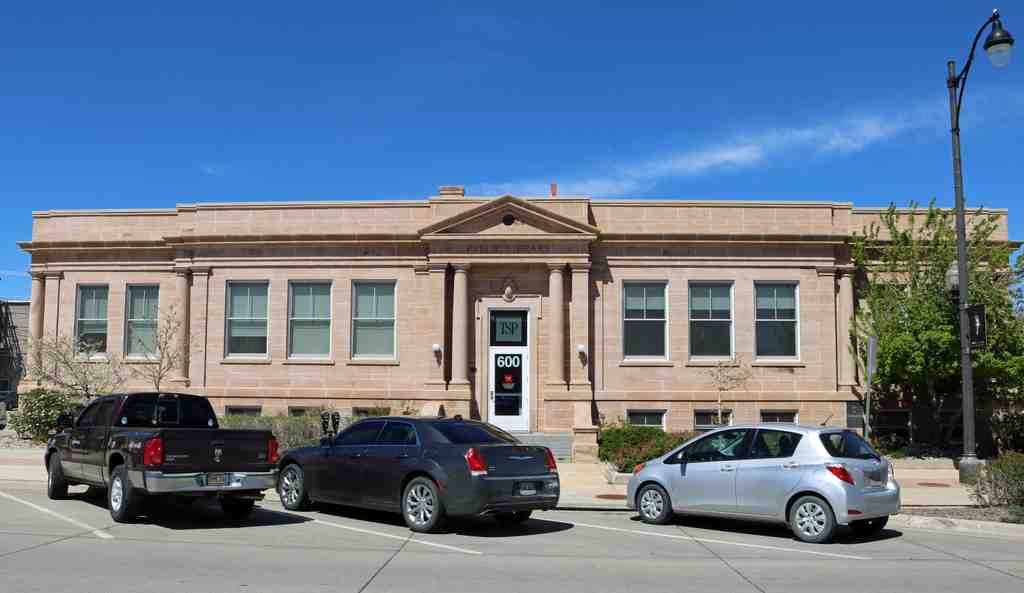
On your left, look for the low, wide, pale-yellow stone building with a classic temple-style entrance-two columns holding up a little triangular pediment, and “PUBLIC LIBRARY” carved up near the roofline.
This is the Rapid City Carnegie Library, and it’s got that solid, no-nonsense look because it was built to be a civic promise in stone. One story up top, a raised basement down below-see those shorter windows near the sidewalk? That’s the basement peeking out, like the building is standing on tiptoe. The whole place is dressed in yellow limestone, with a flat roof and a bold trim line running around the top like a tidy hatband.
But the real story is how badly Rapid City wanted a library before this ever showed up. Back in 1881, the town’s first public building was called Library Hall. At first it did fine… then people’s attention wandered, as attention does, and it started getting used more as a meeting space and a theater. Eventually, the books got shipped off to the School of Mines. Which is one way to handle overdue returns-just move the whole collection.
Still, the idea wouldn’t die. In 1904, locals scraped together a “free library” and shoved a reading room into a corner of the Flormann Building. Then it bounced around-Todden Worth Building in 1909, Elks Building in 1912-like the city’s books were stuck in a long-term housing crisis.
The turning point was Andrew Carnegie’s library program. Because Rapid City kept its free library going for two years, the city qualified for a grant. On March 11, 1914, Carnegie’s program offered $12,500-around $400,000 in today’s money-to build a real home for readers. Of course, the town promptly argued about where to put it, and the dispute went all the way to the South Dakota Supreme Court. In the end, Library Hall was demolished, and this building rose in its place, finished in 1915 and opened March 2, 1916-with speeches, and a high school orchestra to make it official.
By 1921, there were 4,120 books here. In 1938, during the Works Progress Administration era, the building grew new wings-made to match so well you’d barely notice they’re slightly set back. By 1966, the collection topped 66,000 volumes, with more than 253,000 loans in a single year. That’s a lot of pages turning in a one-story building.
Rapid City eventually outgrew it, and a new public library opened in 1971. This old place even did a short stint as police headquarters-because if you’re going to keep order, why not do it surrounded by the ghost of quiet reading? It landed on the National Register of Historic Places in 1981, which is the building equivalent of getting a well-earned gold star.
When you’re set, Church of the Immaculate Conception is about an 8-minute walk heading east.


