
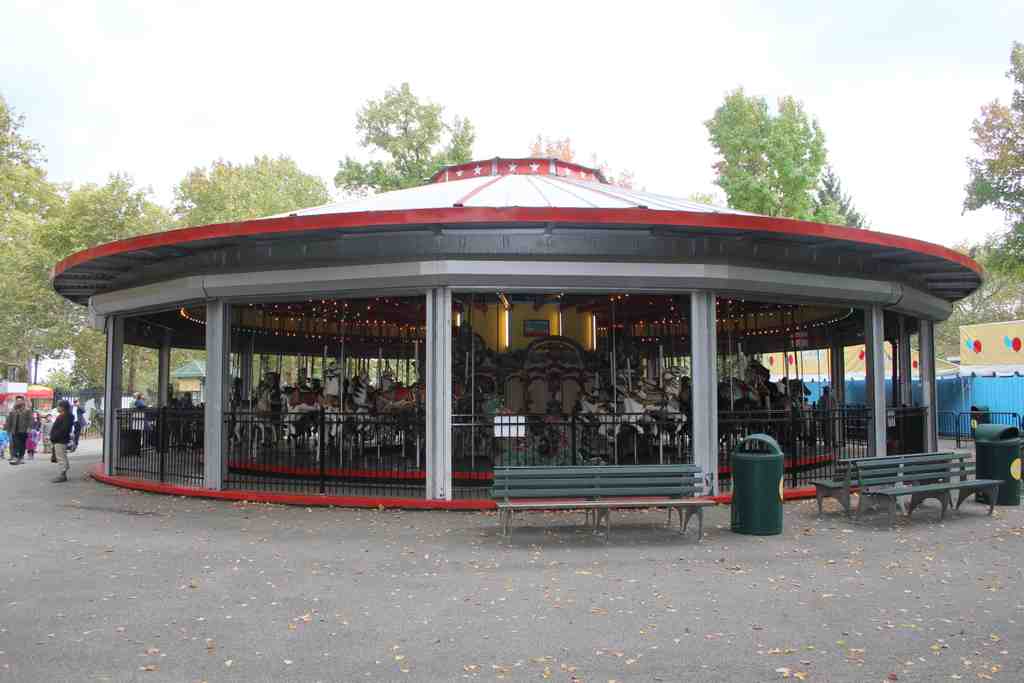
Just steps away from the zoo, look to your right and you will spot a circular, open-air pavilion sheltering a classic wooden carousel, instantly recognizable by its brilliantly painted rim and rows of leaping, jewel-encrusted horses. What you are looking at is not just an amusement ride. It is a spectacular survivor from a completely different era.
This machine's story begins over a century ago, during the Coney Island Golden Age. Back in the early nineteen hundreds, amusement parks were booming along the Brooklyn shore, and a Prussian immigrant named Marcus Illions was revolutionizing the craft of woodcarving. Illions literally fled the military by traveling in the belly of a transatlantic ship, spending the voyage sketching the live circus animals kept down below in the dark. He became the undisputed master of the Coney Island style, a carving technique famous for wildly dramatic, fantasy-driven beasts. Illions kept his own stables to study how an Arabian horse strained its muscles while running. He carved explosive energy into the wood, adorning his fiery steeds with real horsehair tails.
The spinning wonder in front of you is actually a miraculous Frankenstein creation. When a group of investors decided they needed an attraction for the nineteen sixty-four World Fair right here in the park, they scoured a Brooklyn warehouse. They discovered the pieces of the legendary Feltman Carousel, which had been dismantled and dumped unceremoniously on its back to make room for a modern tower. The mechanics were totally shot. In a frantic pivot, the crew bought a second ride, the Stubbman Carousel, which had a perfect mechanical frame.
They combined the two, loading the Stubbman frame with sixty-four jumping horses, a lion, and two lavish chariots from Illions' workshop. They intentionally ditched many of the plain, stationary figures to maximize the thrilling, galloping effect.
They pulled it off just in time for the summer crowds. For fifteen cents... which is about a dollar and fifty cents today... fairgoers could take a spin on what quickly earned the nickname the Galloping Ghost. It was a resurrected phantom blasting traditional tunes from a massive German military band organ. They even built a miniature boardwalk around it. Sadly, after a major corporate sponsorship fell through, a patent attorney had to finance the operation entirely out of his own pocket, and the ride barely made a dime.
The World Fair eventually packed up its grand visions of the future and went home. The carousel, however, was permanently moved to this spot. Yet, as the decades passed, it struggled. By two thousand eight, it sat entirely shuttered and abandoned. But the local neighborhoods refused to let it rot. Queens residents and local block associations aggressively lobbied the city for years. It was an incredible community triumph when, in two thousand twelve, new operators finally took over. They sanded the historic floors, restored the brilliant paint, and surrounded the antique ponies with modern family attractions.
Throughout our walk today, we have seen massive concrete pavilions and towering steel globes. Those were monumental, highly orchestrated attempts to dictate a perfect tomorrow. But the true heartbeat of this park is organic. It is the simple, enduring joy of local families gathering to ride a wooden horse. The future did not turn out quite like the planners imagined. Instead, it became something far more vibrant and beautifully human. As this carousel spins, it perfectly captures the everyday magic of Queens. Thank you for exploring with me today. Keep wandering, and keep wondering.




