
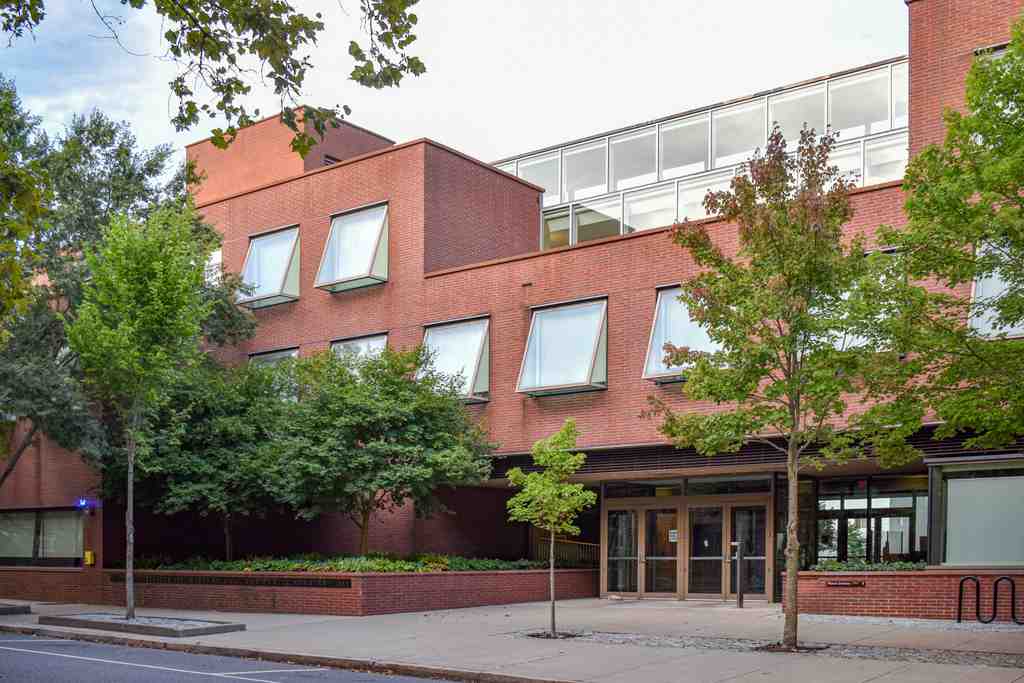
Ahead of you, you’ll spot a sleek, modern structure with panels of glass and a striking design, nestled beside a plaza-just look for that sophisticated contemporary building accented by wide windows, at the southern edge of Brown’s campus.
Standing here, you’re at the pulse point where the big, wild world meets academic ambition-the Watson Institute for International and Public Affairs! While most universities have regular old lecture halls, Brown serves up modern architecture designed by the world-renowned Rafael Viñoly and Toshiko Mori. Picture the first Watson building: sharp angles, bold glass, and sunlight bouncing in and out like ideas in a great debate. In fact, Watson is more than a single building-it's a collection of three, ringing this plaza in a neat triangle of what I like to call “serious brainpower real estate.” Just a heads-up: only at Brown would you find a place where an entire building feels like it’s prepping for a United Nations summit.
Let’s rewind to a time before this was a centerpiece of global thinking. The roots trace back to 1981, when Brown University wanted to prick up its international ears and tune into the major world problems of the day, especially the looming threat of a nuclear standoff between the United States and the Soviet Union. Their solution? Found the Center for Foreign Policy Development, thanks to a little help (and, okay, a lot of support) from Thomas J. Watson Jr.-a Brown alumnus, former IBM chairman, and U.S. Ambassador to the Soviet Union. His motto was, “If you want things done, assemble the world’s best minds, put them in a room, and see what happens,” which, in Watson’s case, was clearly not just a metaphor.
Fast forward to the '90s, as Brown’s global ambitions grew. The university merged its international centers, forming the Institute for International Studies, then in 1991, named it for the ever-generous Thomas Watson, following his whopping $25 million gift. No pressure, right?
But the story doesn’t end there-as global politics got messier, Watson got bolder. In 2014, the Institute merged with the Taubman Center for American Politics and Policy, driven by the hunch that today, domestic and foreign policy are like peanut butter and jelly: inseparable, a bit sticky, but perfect together. That merger brought a new era of thinkers under one very imaginative architectural roof, and another $50 million gift (seriously, there’s a trend here) helped Watson grow into even more space, including a newly built, glass-walled showcase-Stephen Robert '62 Hall.
Watson’s work isn’t just theoretical. Their “Costs of War Project” makes headlines across the world. Ever wondered how much money, how many lives, how much liberty is lost during modern conflicts? Watson’s team of researchers-economists, political scientists, anthropologists, and even some physicians-have been tallying it all up since 2011, producing what many believe is the most complete accounting of post-9/11 military operations. Talk about receipts!
Watson isn’t just a playground for professors either. Undergraduates take on big questions in international and public affairs, with options to dig into development, security, governance, or, if they’re really ambitious, all three at once. The graduate programs are equally fascinating-think fast-paced, intensive master’s degrees in public policy or the unique, NSF-funded Ph.D. in Development. And for the overachievers out there, Brown offers a fifth-year M.P.A so you can keep the brain-juice flowing.
And the faculty? It reads like a global “Who’s Who,” with former diplomats, ex-presidents (and not just student government!), and glass-walled ideas bouncing between Nobel-worthy economists and legendary journalists. Here, you might bump into a former President of Brazil, the ex-Chancellor of Austria, or someone who served as Ambassador to the U.N. No biggie-just everyday Watson things.
By 2025, Brown made things official: Watson became a full-fledged school, standing shoulder to shoulder with Brown’s other giants, like the School of Engineering and the Warren Alpert Medical School. Its goal? To blend research, teaching, and public engagement so students can tackle today’s wild world head-on. Think of it as Brown’s launchpad for future world-changers-direct from a stunning plaza, just off Thayer Street, to every corner of the globe. And hey, if you feel smarter just standing here, don’t worry… it’s catching!
For further insights on the location, academic programs or the area studies, feel free to navigate to the chat section below and inquire.


