
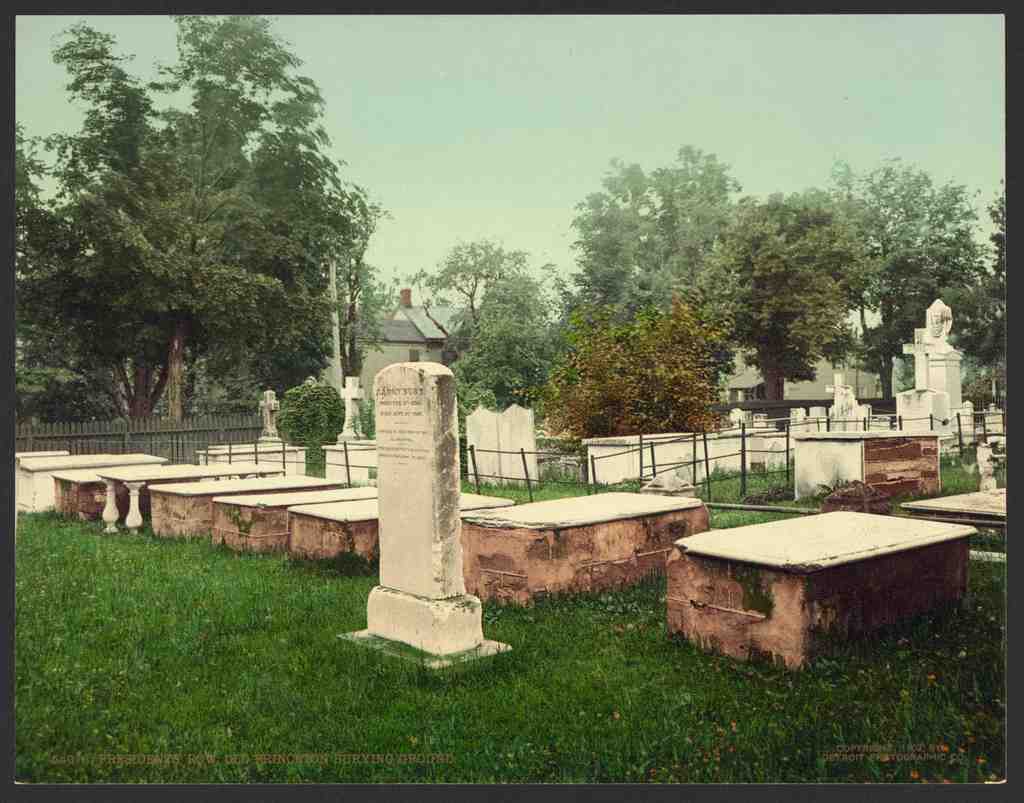
Directly ahead, you’ll spot Princeton Cemetery by its old wrought-iron gates and the tall, stately trees peeking over the stone wall-just look for the peaceful rows of headstones nestled comfortably behind these historic barriers.
Welcome to Princeton Cemetery, known as the “Westminster Abbey of the United States”-though I promise, nobody here will give you a British accent. Owned by Nassau Presbyterian Church, this quiet plot of land has witnessed more stories, secrets, and famous last words than just about anywhere else in town. As you stand here, you might hear the subtle sound of leaves brushing against weathered stone, setting the mood for a walk with Princeton’s departed legends.
Step through these gates and you’re walking with the ghosts of presidents, poets, professors, and plenty of plot twists. Beneath the grass lies Grover Cleveland, the only U.S. president to serve two non-consecutive terms. Imagine his spirit pacing, still trying to explain electoral math to Rutherford B. Hayes and Franklin Pierce. Right nearby is his wife, Frances Folsom Cleveland Preston, and their daughter Ruth-yes, she’s the supposed namesake for the Baby Ruth candy bar. Now, whether that’s actually true or just a sweet legend depends on who’s telling the story, but it makes for great cemetery trivia.
And just in case Hamilton wasn’t dramatic enough, Aaron Burr is buried here too. He was vice president, adventurer, duelist-and yes, the infamous man who shot Alexander Hamilton and walked away, mostly unscathed, except for a treason trial later on. Talk about having skeletons in your closet! Burr’s father is here as well-Aaron Burr Sr., a president of Princeton University, and beside them, you’ll find Jonathan Edwards, yet another Princeton University president (and the “Sinners in the Hands of an Angry God” preacher). Some families collect baseball cards, but the Burr-Edwards clan liked university presidencies.
You’ll also find some real brainpower underground. Picture this: the grave of John von Neumann, who helped invent the computer. Or Kurt Gödel, the mind behind incompleteness theorems-he and Von Neumann might just be endlessly debating logic, even now. And don’t miss John Tukey and Frank Anscombe, statisticians who turned numbers into fascinating puzzles and patterns. If you stand quietly, maybe you’ll pick up some math by osmosis…or at least get a tingle of curiosity.
Beyond presidents and professors, look for Sylvia Beach, whose Paris bookshop launched the first edition of James Joyce’s *Ulysses.* Or George Gallup, whose name lives on in polling every election season. There’s even Harold Bender the linguist, Michael Graves the architect, and William G. Thompson-a mayor of Detroit, because why not?
From Civil War generals like George Dashiell Bayard and David Hunter, to signers of the Declaration of Independence like John Witherspoon, each stone is a doorway into another story, another century. And as you imagine the mix of quiet conversations and silent secrets, you might hear the distant crunch of gravel underfoot as another visitor pays respects.
This peaceful resting place is more than a collection of tombstones-it’s Princeton’s greatest tale, told chapter by chapter beneath your feet. If you listen closely, you just might hear the echo of history itself. Now, ready for the next mystery?


