
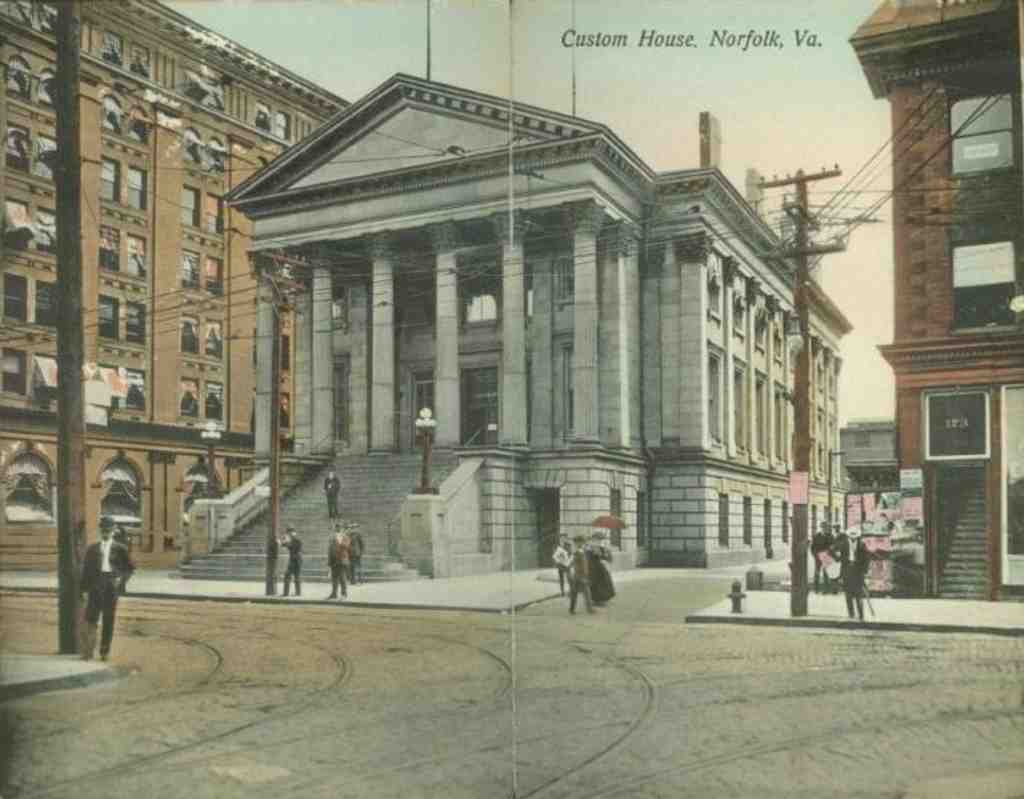
Look for a grand gray granite building with sweeping steps and six tall, fluted columns in front of you-like a stone Roman temple plunked right in the middle of downtown; you can’t miss it!
Alright, traveler! Imagine you’re stepping back into the bustling heart of 19th-century Norfolk. The smell of salt from the harbor, the clip-clop of horses, the trill of steamboat whistles in the distance, and all eyes are on this imposing structure before you: the Owen B. Pickett United States Custom House. Talk about making a first impression! Picture this very corner at Main and Granby Streets-back in 1852, the U.S. government forked over the princely sum of $13,500 just for the land, which honestly, nowadays might only get you a parking spot.
The Custom House looks just like a Roman temple-sturdy and proud. Six massive granite columns rise up to a triangular pediment, casting deep shadows across those famous sweeping stairs. As you approach, every footstep on the stone might make you feel like you’re entering some ancient bank vault of secrets (or at least, a place where people took their postal duties very seriously).
Why such grandeur? Well, in the days before Amazon Prime, customs offices were a city’s lifeblood. They made sure every barrel, bolt, and bale entering port paid its dues, and Norfolk, thanks to its bustling waterfront, was one of the nation’s earliest customs districts. Before this mighty house, the Customs Service folks were shuffling paperwork in rented spaces scattered all over town. When this place was finished in 1858-after five long years of hammers, saws, and budget overruns (the original price tag doubled faster than you can say “import tax”)-historians called it one of Norfolk’s “most showy and imposing” new landmarks.
But the story here isn’t all bristling columns and majestic facades. Peek through those elongated windows and you’ll find secrets: inside, a corridor ten feet wide, marble tiles cool to the touch, vaulted ceilings echoing voices, and, if you’d been here long ago, maybe the clatter of Union boots. For one brief spell between April 1861 and May 1862, the Confederacy claimed these very halls. What did they whisper about in those offices, fires flickering in marble hearths? The only ones who know for sure are the shadows.
There’s humor here too if you look-those side entry doors? Originally made separate for men and women to post their letters. Apparently the post office lobby was the place for extreme civility (or perhaps just extreme gossip).
As the city grew, so did the Custom House. Improvements came along in the early 1900s: new sash windows, a rear addition in 1935, and a grand restoration in the late 1990s, costing a cool three million dollars-more than Ammi B. Young, the original architect, could’ve ever imagined! Even the cast-iron columns inside have been decorated with a special Virginia touch: capitals at the tops are carved with a tobacco leaf motif, a little wink to the region’s key crop.
Over the years, the building has sheltered not just customs officers but postmasters, architects, builders, and local legends. It was renamed in 2001 to honor Congressman Owen B. Pickett, who fought to preserve these precious bricks and stones. And in 1970, it officially became part of the National Register of Historic Places, cementing its legacy.
Now, with the Modern Age nipping at its heels, the future of the Custom House hangs in the balance. “Non-core property,” they say-ready for a new chapter, even as its columns stand vigilant over hundreds of years of Norfolk history. Take a moment here to imagine: clanging carriage wheels, booming ships’ horns, and merchants hurrying up those steps, all echoing in the air.
Pretty legendary for a building that started out as a paperwork storehouse, right? If only the walls could talk-you’d have enough stories, mysteries, and wild characters for a whole season on streaming TV. Maybe next, you’ll find your own secret here in the shadow of those grand granite columns.




