
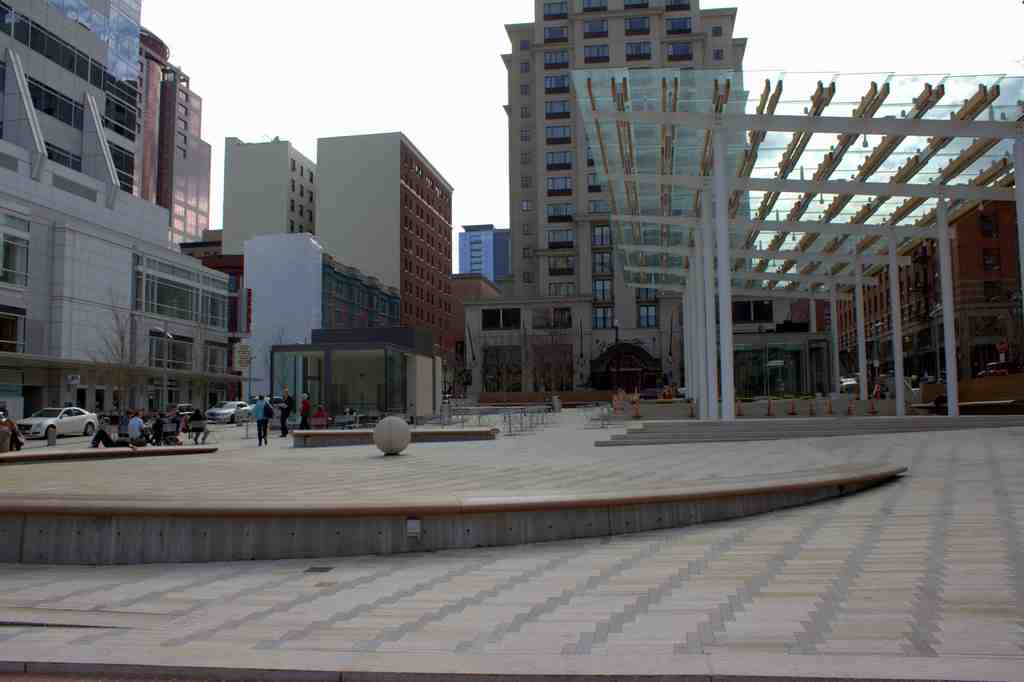
To spot Director Park, just look ahead for a large, open granite plaza with striking white pillars supporting a modern glass canopy and a sunken stone surface-it stands out in the middle of Downtown, surrounded by tall city buildings.
Alright, you’re standing in front of Director Park-a place that proves Portland can turn even a plain old parking lot into an urban adventure! Imagine: before this elegant granite square and gleaming glass canopy existed, this was just a typical city block, used for parking cars and, for a while, serving tasty crêpes out of a food cart called the Snow White House. Today, it’s a bold statement in the very heart of Portland, and you’re about to find out just how much drama and ambition went into creating it.
It all starts with a grand plan-decades ago, dreamers hoped to stitch downtown Portland together with a beautiful green corridor running from the North Park Blocks to the South Park Blocks. As it happens with all great city projects, that dream hit a few speed bumps, or, shall we say, a few parking lots and stubborn developers. In the 1970s, as if the city itself was plotting for an urban oasis, site battles began. Visionaries like developer Tom Moyer eyed this block, refusing to let it become just another 12-story parking tower (which, as one critic famously jabbed, would be "like putting lipstick on a dead corpse"-ouch, parking garage lovers!). Even Neil Goldschmidt and Bill Naito, local legends, rallied to keep this patch alive for something better.
Fast-forward a couple of decades and you have heated city meetings, rival developers squabbling, and public votes about what exactly should rise above this spot. Should it be a commercial block? Should it become a full park? The answer, after years of negotiation and a hefty bit of fundraising, was: “Yes, and yes!” By the early 2000s, the idea of a reconnecting corridor had fizzled out, mostly due to political shakeups and-let’s just say-developers getting tired of swimming upstream.
Enter Tom Moyer, a man determined to put his mark above and below ground (literally). He proposed a park that sat atop a massive 700-space parking garage, linking up with the Fox Tower and the new Park Avenue West Tower. Moyer gave up the surface for evolving Portlanders to play, sip coffee, or nap on a sunny day, while underneath, folks could park their cars in grand, hidden fashion. Naturally, being a businessman, he made sure 30% of the park would be available for commercial activity-because even oases need to serve a good sandwich.
Now, naming the park is where things get extra Portland-quirky. First, Moyer wanted to call it Marilyn Moyer Park, in memory of his late wife. But when it came time to raise the last big slice of funding, Jordan Schnitzer stepped in with a $1.97 million donation, asking to name the park after his grandparents, Simon and Helen Director-a love story that started back in 1916, when Simon and Helen met in Portland after journeys all the way from Russia and Poland. Cue the romantic music! And so, Simon and Helen Director Park was born, with the whole community contributing nearly $9.5 million. That’s a lot of lattes and Lincoln coins.
Designer Laurie Olin, who helped reinvent New York’s Bryant Park, collaborated with ZGF Architects to give Portland a space that is curbless on two sides-making it easy for strollers, events, parades, and the occasional hopscotcher. There’s a bubbly fountain, engaging art, places to sit, and a café. Speaking of which, if you get a waft of coffee or pastry, that’s no accident-first it was Violetta, and now Elephants Delicatessen keeps the snacks and sandwiches coming.
Of course, no slice of Portland ever escapes a little hiccup. The grand glass canopy, capped with wood beams, was found to have a lumber problem, so the city swapped out the wood for sturdier steel (part of the hazards of making a park in rainy Portland-wood can only handle so much soggy weather).
Today, you’re standing in one of the finalists for the Urban Land Institute’s open space awards. As you look around, picture the transformation: from plain parking lot to a buzzing, modern square where the city’s stories, new and old, cross paths every day. You can almost hear old Portlanders sighing-“finally, something special for everyone.” And if you listen closely, you might even hear the echo of that old Snow White crêperie, dreaming about the days when its customers ordered dessert right where you’re now soaking up city life.




