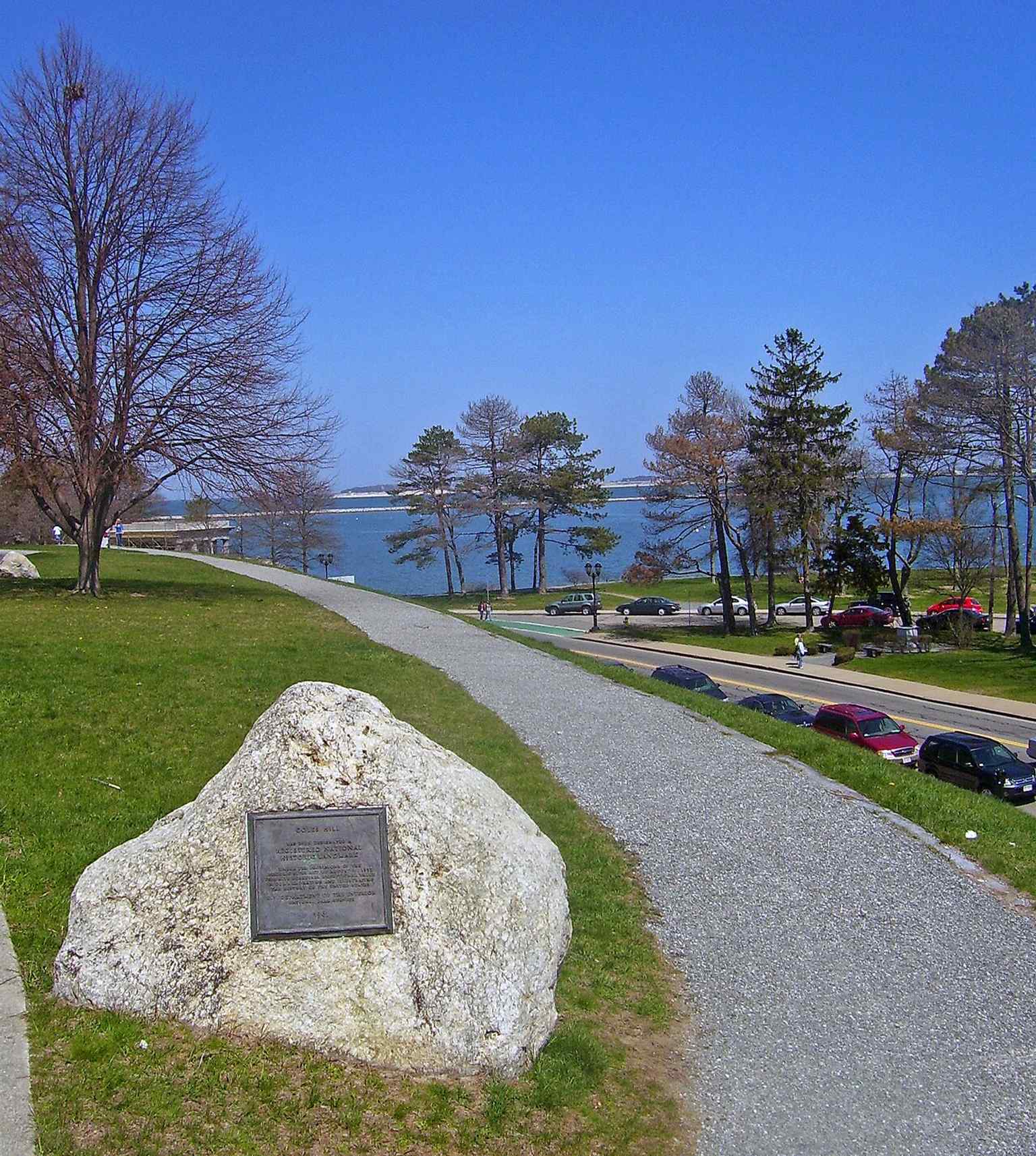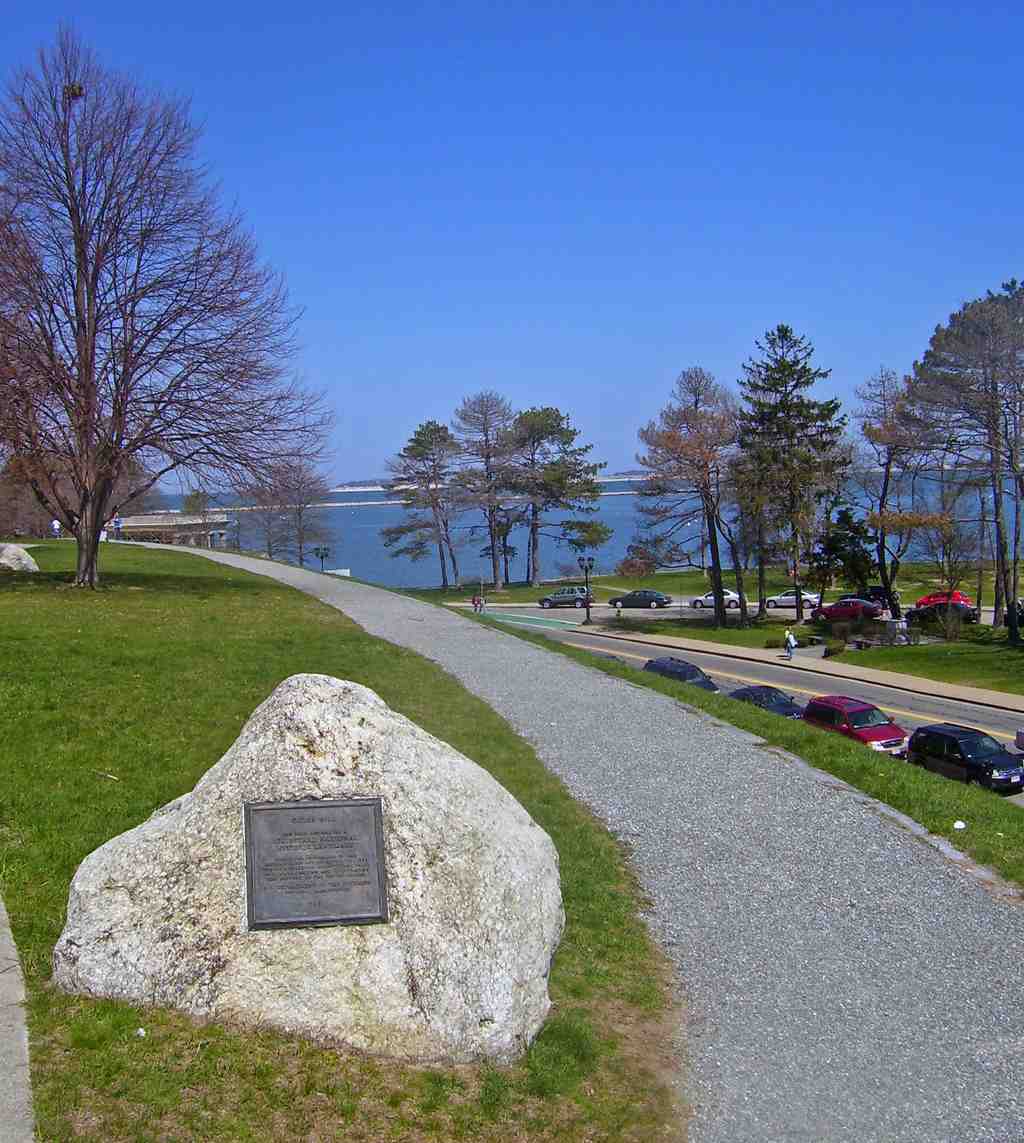
You are looking at a steeply rising grassy landscape anchored by a large, rugged granite boulder bearing a dark rectangular plaque, marking the entrance to a winding path. This is Cole's Hill. Underneath this manicured lawn lies the heavy history of the Pilgrims' first, devastating winter in New England.
In the winter of sixteen twenty to sixteen twenty-one, fifty-two of the original one hundred and two Mayflower settlers died. Up to fifty of them were buried quietly right here, on this slope facing the sea. Over time, however, the hill completely lost its identity as a graveyard. The land was deeded to Samuel Fuller, the colony's physician, and later to a man named James Cole, who ran a tavern here in the sixteen forties. Because of its commanding view of the harbor, the town repeatedly used the hill to build defensive forts, throwing up earthworks in seventeen forty-two, again during the Revolutionary War, and once more in eighteen fourteen.
But the forgotten dead refused to stay buried.
In seventeen thirty-five, a severe storm sent a torrent of water pouring down nearby Middle Street, carving a ravine into the hill and washing many human remains straight into the harbor. Later, in eighteen fifty-five, workers laying a public conduit - a large pipe for the town's water supply - unearthed a grave containing two skeletons. One had a particularly prominent forehead, leading people to romantically assume they had found John Carver, the first governor, and his wife. In eighteen seventy-nine, spectators watching another excavation actually pocketed some of the exposed bones to keep as souvenirs.
These accidental discoveries eventually confirmed the old oral traditions about the hill. The skeletons were laid out on an east-to-west axis, with their heads pointing west. This was a traditional Christian burial practice, meant to allow the dead to face the rising sun on Judgment Day. Furthermore, no personal items were buried with the bodies, pointing clearly to European rather than Wampanoag burials.
By the early twentieth century, the town sought to properly honor this space. If you check your screen, you can see a photo of how the hill looked before this effort, back in eighteen sixty-five, compared to its polished state today. Around nineteen twenty, to mark the three hundredth anniversary of the Pilgrim landing, buildings were cleared away to transform the area into the public park you see now.
During this time, a massive granite sarcophagus - a large above-ground stone tomb - was erected at the southern end of the hill to finally give those disturbed remains a permanent, respectful resting place. The town also added a bronze statue of Massasoit, the paramount leader, or sachem, of the Wampanoag people, honoring the critical support his people provided which allowed the surviving settlers to live through those early years. You can view a photo of this striking monument on your app.
For your planning, the park is generally open weekdays from seven thirty A-M to four P-M, with extended hours on Tuesdays, a noon closure on Fridays, and closed entirely on weekends.
Take a moment to look out over the bay where that famous ship once dropped anchor. When you are ready, we can walk together to our next destination.