
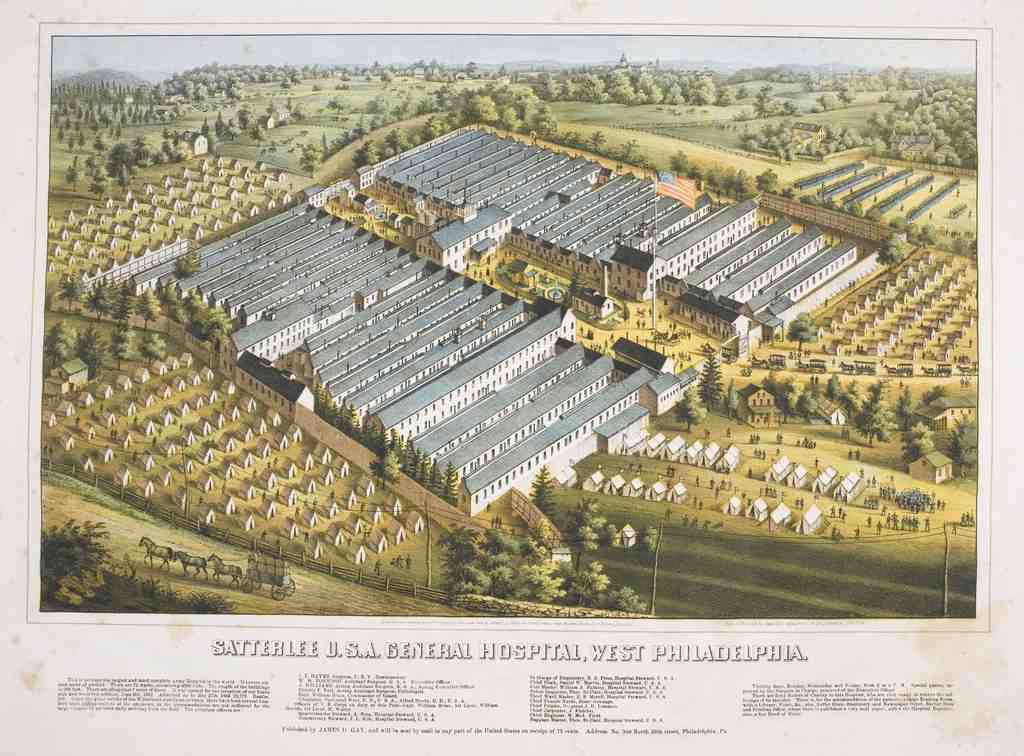
To spot the site of the old Satterlee General Hospital, look around for a wide open area, now mostly parkland, where Clark Park sits-imagine rows and rows of long, low buildings, and hundreds of white canvas tents stretching out across the grass all the way to the edges.
Now, let’s step back in time together-cue the marching boots and distant bugles! Picture it: the year is 1862, and you’re standing on what used to be the very heart of a wartime city-within-a-city. Satterlee General Hospital, once the largest Union Army hospital in Philadelphia, rose here almost overnight-built in just 40 days! The place was enormous: 34 sprawling wooden wards, hundreds of tents, and a fence so tall you’d need a ladder (or maybe a really, really ambitious squirrel) to get a peek inside.
During the Civil War, this was where thousands of wounded Union soldiers, and even captured Confederate prisoners, came to recover. By the time the battles of Bull Run and Gettysburg filled up the beds, Satterlee could house a whopping 4,500 patients. At its busiest, after Gettysburg in 1863, the hospital population grew to over 6,000 people-imagine a sea of uniforms, bustling doctors, and the constant push and pull of wagons loaded with medical supplies.
At the time, West Philadelphia was almost countryside, and the hospital’s 15-acre campus stretched from 42nd to 45th Street, filling up with noise, life, and sometimes heartbreak. The tough work of caring for so many fell to dedicated physicians and a group of heroic nurses, the Daughters of Charity, led by Sister Mary Gonzaga Grace. And let me tell you, these women were tough-they had to share just four utensils between all the sisters, and squeezed into a chapel so tiny they had to take turns!
The commanding officer here was Dr. Isaac Israel Hayes, a former Arctic explorer-talk about a cool head in a crisis. Chaplain Father Peter McGrane was there every day, giving comfort, taking confessions, and even conducting baptisms and burials. He was joined by visitors like Archbishop James Wood, who brought encouragement when spirits ran low.
By 1863, Satterlee was practically its own small city, complete with a reading room, post office, newspaper press, and even a barber shop. Over one year, the patients here ate 800,000 pounds of bread-just imagine the size of the sandwiches! Despite primitive conditions, the hospital’s team worked miracles: of some 50,000 treated, only 260 died-a jaw-dropping achievement for the time.
But, as all things must, Satterlee’s story wound down after the war’s end in 1865, and the hospital closed just a few months later. The wooden halls and white tents disappeared, replaced by homes and, yes-Clark Park itself. Look for the stone stele-Satterlee’s last standing memory-and listen for echoes of courage, compassion, and maybe a joke from a tired nurse about utensils in the wind.


