
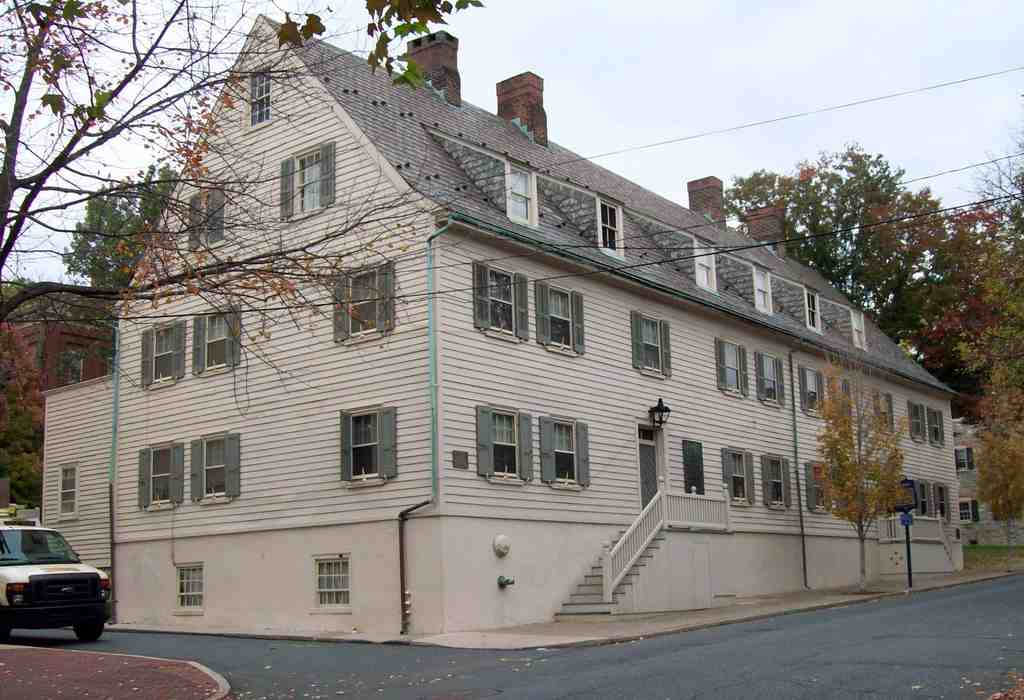
On your left, look for the long, white clapboard building with a steep roof, a row of little dormer windows, and several brick chimneys lined up like they’re standing at attention.
This is the Lewis David de Schweinitz Residence… though the building’s first name was the 1741 Gemeinhaus, which basically means “Community House,” and it took that job description very seriously. When it went up in 1741, Bethlehem was young, scrappy, and very Moravian-about 80 people trying to build a town with faith, discipline, and a lot of shared chores. This place wasn’t just a house. It was the house: where people lived, cooked, learned, got medical care, and worshiped… all under one roof. If that sounds cozy, just remember “cozy” hits different when the community starts pushing past 100 residents.
Take a second to notice how big it feels from the street-two and a half stories, stretched wide, with that orderly rhythm of windows. Underneath the clapboard skin is a log structure, and not a small one: it’s considered the largest surviving log house in continuous use in the United States. The building reached its current form by 1743, which is a polite way of saying they realized pretty quickly they needed MORE room.
Upstairs was the Saal, the earliest worship space in Bethlehem and the largest room in the building. Imagine that room filled with voices-Moravians were serious about music. They didn’t just sing; they memorized hundreds of hymns and could sing them in multiple languages. At one point there were as many as 13 languages spoken in the community… and yes, sung here, too. A spinet arrived from England in 1744, and a pipe organ followed in 1746-because if you’re going to build a utopia in the woods, you might as well have a soundtrack.
This building also held some of Bethlehem’s biggest moments. The first funeral took place here in 1742. The first wedding happened the same year… and then, in 1749, they hosted the “Great Wedding,” marrying 28 couples in one service. Seven clergy officiating. That’s not a ceremony, that’s an assembly line with vows.
And then there’s Lewis David de Schweinitz, born here in 1780, later one of America’s top experts on fungi. His 1831 work, “Synopsis of North American Fungi,” helped organize a field that was… let’s call it “wildly unorganized” before him. So yes: one of the country’s leading mushroom minds came out of this very building. History is strange and wonderful like that.
When you’re set, Kemerer Museum of Decorative Arts is a 5-minute walk heading southwest.




