
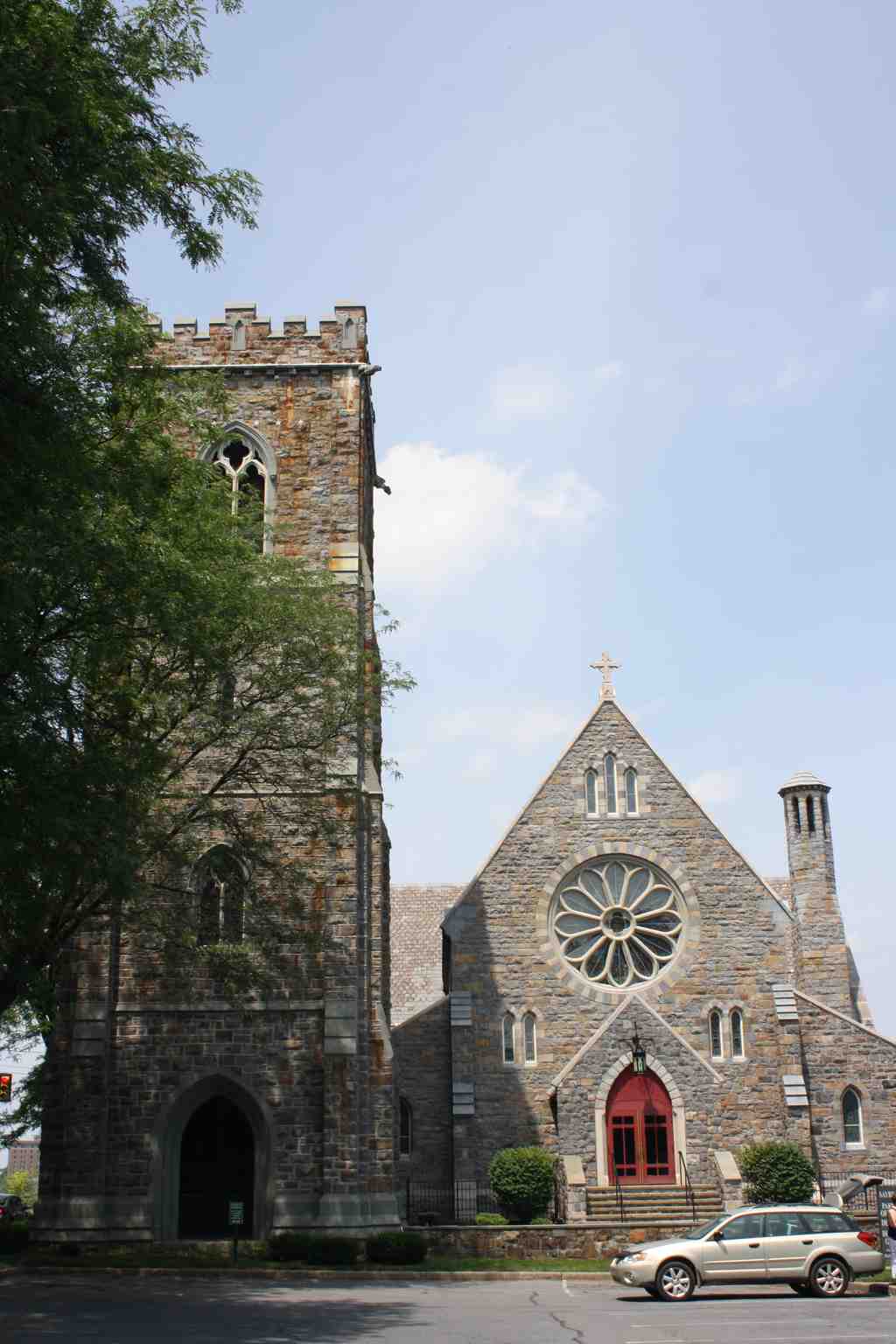
On your right, look for the sturdy gray-stone church with a tall square tower and a big round rose window above bright red front doors.
Now, even though you’re staring at stone and stained glass, this stop is really about a map… and how it kept getting redrawn. The Episcopal offices here represent a diocese that’s spent a long time figuring out what, exactly, “here” means.
If we rewind way back, Anglican worship in this part of Pennsylvania didn’t start in grand churches. It started in living rooms and small settlements-Perkiomen around 1700, with clergy riding out from Philadelphia to serve scattered communities. Picture muddy roads, long distances, and a minister who had to be part pastor, part travel blogger, part endurance athlete.
By 1701, help arrived from across the Atlantic-the Society for the Propagation of the Gospel in London, which helped pay missionaries in the American colonies. That support mattered because rural Pennsylvania didn’t exactly have a surplus of full-time clergy sitting around waiting for a call.
One of the more surprising twists: early on, Swedish and English congregations often shared space and cooperated. When Swedish support faded, some Swedish churches effectively “passed the baton” to Anglican leadership. A former Swedish church near Hopewell Furnace became St. Gabriel’s in 1753-and from there, new worshipping communities branched out, including one that met in homes in Reading before growing into a formal parish. Faith here spread the way towns did: slowly, socially, and with a lot of practical improvisation.
After the Revolution, the Episcopal Church in Pennsylvania got organized fast. In 1785, leaders met at Christ Church in Philadelphia-clergy and laypeople together, which was a pretty bold, not-very-England move. And in 1787, William White became the first bishop of Pennsylvania.
Then comes the bureaucratic soap opera. In 1871, a big chunk of Pennsylvania split off to form a new diocese. In 1904, it split again-Harrisburg got its own. By 1909, the remaining eastern section basically admitted, “Yeah, ‘Central Pennsylvania’ doesn’t fit anymore,” and renamed itself the Diocese of Bethlehem.
And the story keeps going: in 2024, the Bethlehem and Central Pennsylvania dioceses voted to reunify, becoming the Diocese of the Susquehanna on January 1, 2026, with co-cathedrals in Bethlehem and Harrisburg. Church history: all soul… and a surprising amount of admin.
When you’re set, Packer Memorial Chapel is a 15-minute walk heading north.


