
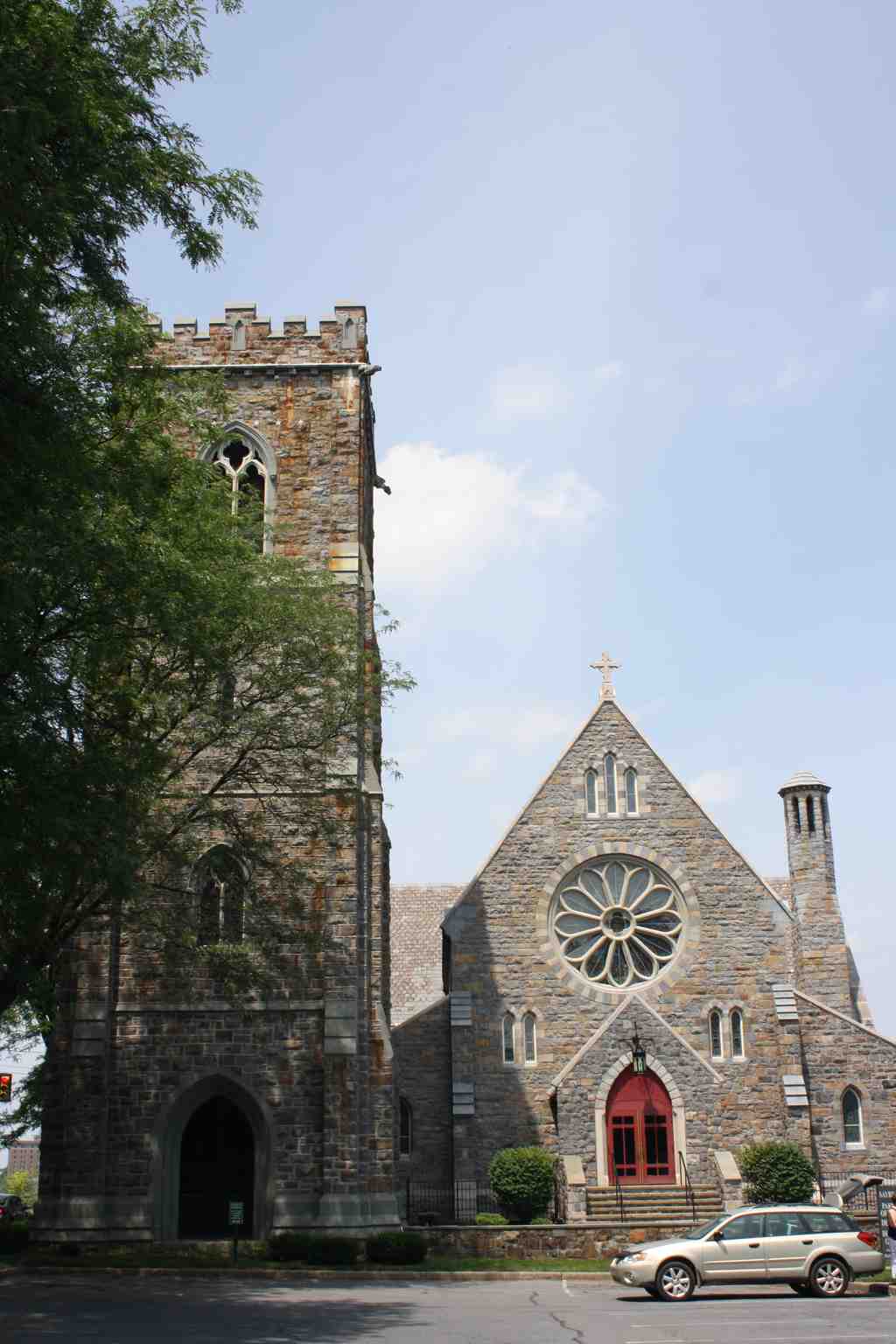
You’ll spot it by the big gray-stone church with a tall square tower on the left and a round “rose” window above bright red front doors-look up at the tower’s crenellated top, like a church wearing a little stone crown.
Welcome to the Cathedral Church of the Nativity, an Episcopal landmark that’s been quietly anchoring Bethlehem for more than a century and a half. What you’re looking at now is the result of a community that started out… pretty improvisational. Back in the 1850s, Episcopalians in Bethlehem didn’t have a home base, so they worshiped wherever a door was open: a hall near Broad and New, local inns like the Sun Inn and the Eagle Hotel, even the Central Moravian Church. In the early 1860s, services were held in Tinsley Jeter’s house-because when you don’t have a church, apparently you just use the living room and hope everyone wipes their boots.
A big turning point came on June 16, 1861, when the first Episcopal service led by a clergyperson in South Bethlehem took place in Robert Sayre’s parlor. Not a sanctuary… a parlor. And by 1862, they’d started a church school-52 students-inside the North Pennsylvania Railroad station. That is commitment, and also a bold choice if you like your lessons with a side of locomotive noise.
In 1863, they got organized: a vestry formed at Sayre’s home, and the Reverend Eliphalet Nott Potter arrived as missionary, then rector. The first purpose-built church here began with a cornerstone in 1863, designed in English Gothic Revival style by architect Edward Tuckerman Potter. It opened for worship on Christmas Day 1864 and was consecrated in 1865.
But Bethlehem was growing fast-industry, railroads, big ambitions-so in the 1880s the church expanded into the larger building you see now. The nave and that memorable apse were designed by E. M. Burns, and the older church became part of the new footprint. This place is basically a spiritual remodel with very good stonework.
Then came the details that make cathedrals feel like cathedrals: a dramatic rood screen gifted in 1899, a memorial font and baptistery honoring members of the Sayre family, and that tower-built in memory of Sallie Packer Linderman Wilbur. In 1900, nine Meneely bells rang out for the first time on Easter Day… the kind of sound that tells a whole town, “Yep, we’re here.”
Nativity also helped “plant” other congregations around town, including Trinity across the river and chapels that served changing neighborhoods and immigrant communities. And in 1988, it was recognized as part of the Fountain Hill Historic District on the National Register of Historic Places-proof that even federal paperwork can appreciate a good facade.
Today it’s still a cathedral-now a co-cathedral in the Diocese of the Susquehanna after a 2026 reunion of dioceses-because church governance, like family reunions, can be complicated but meaningful.
When you’re set, Fountain Hill Historic District is a 4-minute walk heading north.


