
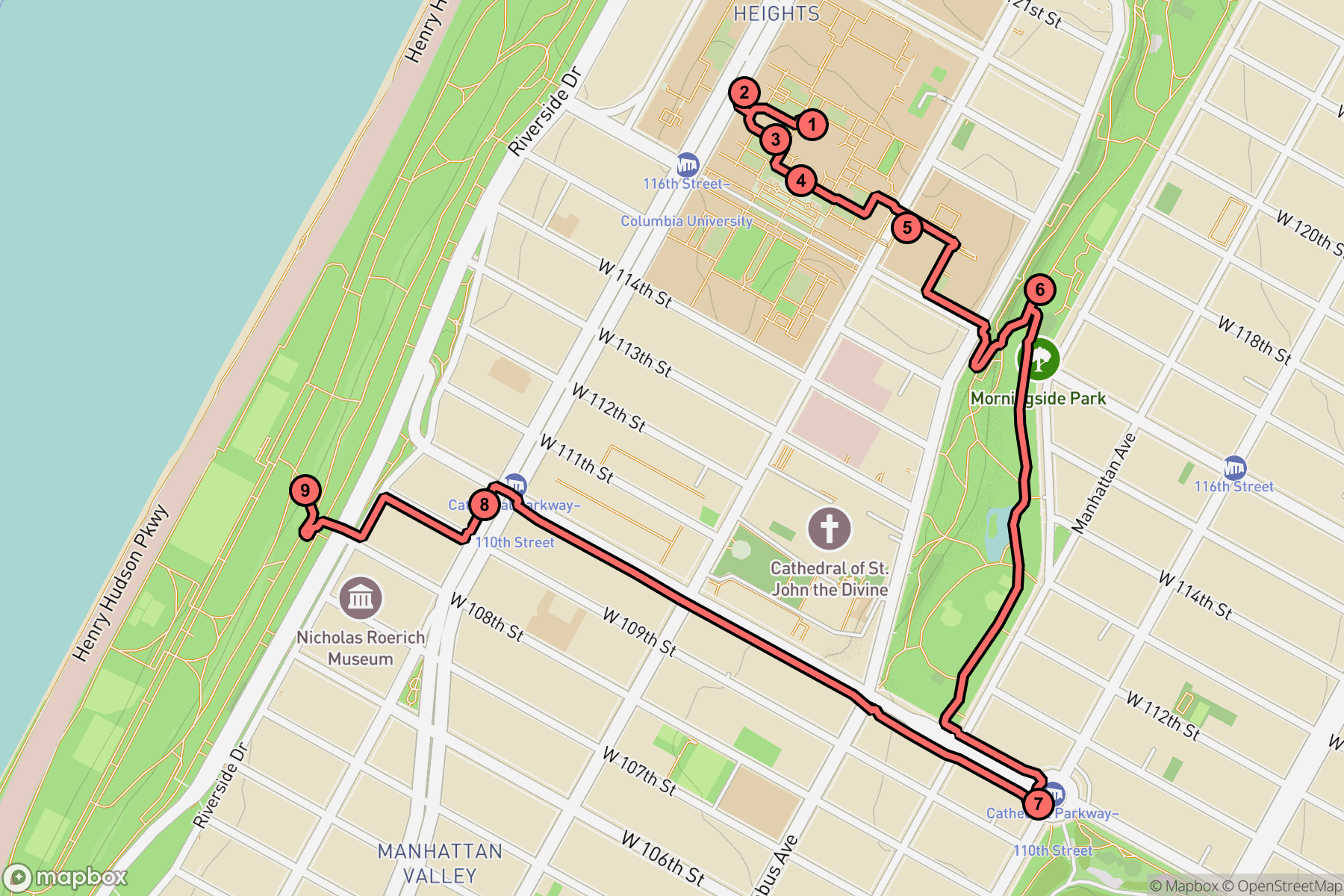
New York City Audio Tour: Columbia Campus Legends and Riverside Stories
A bronze goddess reigns over a campus where revolutionaries once debated freedom and a whispered legend still haunts sun-streaked stone. Manhattan’s northern streets conceal more secrets than even the subways know. On this self-guided audio tour, wander deep into the city’s intellectual heart. Unlock stories of hidden protests, dazzling art, and quiet acts of rebellion right where they happened. Encounter places that most visitors stroll by without ever hearing their echoes. Who once brought a national scandal to the steps beneath Alma Mater’s gaze? What secret societies held their rites inside Low Memorial Library after midnight? And why do commuters at Cathedral Parkway still speak of the mystery that vanished onto the tracks? Journey from grand domes to underground rails, tracing footsteps of students, visionaries, and underground legends. Rediscover Manhattan as a city of daring minds and shadows, where every block promises a new revelation. Press play and unravel the true stories behind these storied stones.
Tour preview
About this tour
- scheduleDuration 30–50 minsGo at your own pace
- straighten6.0 km walking routeFollow the guided path
- location_onLocationFairview, United States
- wifi_offWorks offlineDownload once, use anywhere
- all_inclusiveLifetime accessReplay anytime, forever
- location_onStarts at Low Memorial Library
Stops on this tour
To spot Low Memorial Library, look for a grand building with a huge dome on top, a sweeping staircase leading up to its entrance, and a line of tall stone columns-it's smack dab…Read moreShow less
To spot Low Memorial Library, look for a grand building with a huge dome on top, a sweeping staircase leading up to its entrance, and a line of tall stone columns-it's smack dab in the center of the campus, just off College Walk between Broadway and Amsterdam Avenue. As you stand in front of this imposing, almost temple-like structure, take a look around and soak in the energy of the place-Low Memorial Library is truly the beating heart of Columbia University. Imagine the year is 1895: New York City is buzzing with horse-drawn carriages and street vendors calling out their sales. At this very spot, workers are busy laying stone and brick, their hammers echoing across the rising campus. University President Seth Low, a determined man with a vision, stares up at the highest point of the grounds and thinks, "This is where we’ll build something unforgettable-a grand library, a beacon of learning for generations to come." Seth Low pours $1 million into the project, an amount so frighteningly huge in his day that it would make even today’s billionaires a bit queasy (that’s $38 million in today’s pocket change). He wants the library to honor his father, Abiel Abbot Low, so this building is not just stone and marble-it’s a monument to love and legacy. Charles Follen McKim, a young but ambitious architect from the firm McKim, Mead & White, takes up the challenge. He imagines a structure shaped like a Greek cross, aligned with the cardinal directions, crowned with a magnificent dome inspired by Rome’s Pantheon and Thomas Jefferson’s University of Virginia rotunda. There’s tension: should the outside be draped in marble, brick, or limestone? Seth and McKim go back and forth, but granite, limestone, and Vermont marble soon become the palette. As columns rise-some shipped all the way from Vermont, others carved from Ireland’s finest Connemara marble-rival architects from other universities peek with envy. "You don't get columns like those every day," one might say. When New York’s notoriously picky Department of Buildings slows things down over the dome’s engineering, rumor has it McKim’s hair starts to stand on end (not confirmed, but architects are known for dramatic hair moments). Eventually, the dome goes up: stone on the outside, steel and sky-blue plaster on the inside, forming a ceiling so high and bright it seems to reach right into the heavens. By 1897, Columbia’s gleaming new library is ready-well, mostly ready. The power plant isn’t working yet, but the collection of books needs a new home, so students and scholars climb these steps, hearts hammering with excitement and curiosity. The building smells of fresh marble, varnished wood, and just a hint of wet concrete dust. Inside, the octagonal rotunda is stunningly open, ringed with columns and topped by that massive blue dome. There are reading rooms, and-my favorite detail-a glowing globe meant to resemble the moon once hung from the ceiling at night, casting an almost magical light on late-night readers (though no one’s quite sure if the lights ever actually worked as planned, so maybe it was less "moonlit magic" and more "science experiment gone, well, dark"). Now, as you glance up at the frieze above those daunting steps, you’ll spot the inscription commemorating the university’s founding-a proud declaration that this institution, once King’s College, is devoted to the public good and glory of Almighty God. The columns themselves are so massive that you might feel a bit like an ant at the gates of Olympus. There’s even a little touch of superstition for the students: hiding in the folds of the Alma Mater statue’s leg is a tiny owl symbolizing wisdom, and legend says the first incoming student to find it will become class valedictorian. Of course, even the grandest library couldn't keep up with Columbia’s growing appetite for learning. By the roaring twenties, students were packed in tight, overflowing the reading rooms, calling books from the stacks with pneumatic tubes that promptly broke after two weeks (so much for high tech). Eventually, a new library-Butler-took over, and Low transformed into the university’s symbolic core and administrative hub. Still, these steps and columns have stood witness to generations of scholars, milestone speeches, and secret midnight traditions, holding a thousand stories in their stone. If you’re thinking the steps look perfect for lounging, you’re not alone-they’re a legendary gathering place for students, sometimes called "Low Beach." So, take a second to imagine all the laughter and big ideas tossed around here at sunset, when the shadows stretch long and dreams seem twice as possible. Yearning to grasp further insights on the site, architecture or the impact? Dive into the chat section below and ask away.
Open dedicated page →Right in front of you, look up toward the center of the Low Memorial Library steps to spot a majestic bronze woman sitting high on a throne, arms outstretched with a scepter in…Read moreShow less
Right in front of you, look up toward the center of the Low Memorial Library steps to spot a majestic bronze woman sitting high on a throne, arms outstretched with a scepter in her right hand and a large book on her lap. Now, let’s step into the lively world of the early 1900s, right here on Columbia’s campus. Close your eyes for a second and imagine the sound of footsteps and construction as workers complete the grand staircase in front of Low Memorial Library. In the middle of those steps is an empty stone pedestal, almost begging to be the star of the plaza. Some clever folks decide it needs more than just pigeons for company-so Harriette W. Goelet swoops in, offering a generous $25,000 to the university to create a tribute for her late husband, a Columbia graduate. And just like that, Columbia’s trustees hire Daniel Chester French, a sculptor already famous for works like The Minute Man and the John Harvard statue. French gets to work, but what to make? He wants his sculpture to be welcoming-a gracious host holding out her arms to students, saying, “Come on in, the learning’s fine!” His first plaster model shows her hands in her lap, but a couple of important folks politely say, “Maybe jazz up those arms a bit?” French listens, stretches out her arms, puts a scepter in her hand, and boom-his design wins everyone over. When the moment finally arrives in September 1903, students gather round as Columbia’s president and the seventh Bishop of New York give a prayer, and French’s creation is unveiled right where you stand now. Alma Mater-a name that means “nourishing mother”-is more than just bronze and careful sculpting; she quickly becomes the beating heart of Columbia’s identity. Sitting tall in her flowing robe, she’s crowned with laurel leaves, holds a scepter topped by the King’s Crown, and keeps an open book ready for new pages. That’s learning and wisdom right on her lap! The ends of her throne sprout little lamps-one for wisdom, one for learning, just in case late-night studying needs a little symbolic light. Oh, and tucked beside her left foot, hidden in those bronze folds, is a tiny owl. People once loved making up secret societies and mysterious meanings for that owl, but it’s really just a classic sign of wisdom-sorry, no hidden treasure maps! Alma Mater hasn’t just watched over Columbia-she’s been right in the thick of it all. In the wild days of protest, like during the 1968 Columbia demonstrations and the unrest of 1970, she became a canvas for messages about the university and the world. In 1970, a bomb went off right on her throne-don’t worry, she’s tough, but the explosion left her a little bruised until she took a quick trip to get fixed up and returned good as new. Students have found her a target for pranks, too: in 1928, her scepter’s crown mysteriously disappeared, only to be returned by a sheepish student. And in a classic college rivalry move, Cornell students actually stole the whole scepter and mailed it back in a shoebox. In return, the Ezra Cornell statue got a refreshing coat of Columbia blue paint-a little friendly chaos across state lines! But not all her days have been wild. Daily, students and visitors file by for selfies, traditions, or just a moment of calm on the steps. Critics praised her from the start-the news called her regal and inviting, the perfect host for new generations of learners. Some said she looked like she might just stand up and hand you a library card herself. Today, as you look up at the smile-well, maybe a slight Mona Lisa smile-notice the patina, a subtle blend of green and brown, the result of a century of rain, sun, and occasional efforts to spruce her up. She used to be coated in gold, can you imagine that? Sadly, the campus pigeons and New York weather took care of the glittering look, so now she proudly wears her bronze as a mark of age and wisdom. From her perch, she’s seen the city-and the whole world-change. And every September, as new students stream up the steps, she’s right there, arms open, ushering in the next wave of curious minds. So give a wave to Alma Mater! She’s the world’s most patient school greeter, the keeper of stories, and the ironclad mother of knowledge on Columbia’s campus.
Open dedicated page →Right ahead, you’ll spot a large bronze figure lounging on a rock between Lewisohn Hall and Low Memorial Library-just look for a relaxed, muscular half-man, half-goat reclining…Read moreShow less
Right ahead, you’ll spot a large bronze figure lounging on a rock between Lewisohn Hall and Low Memorial Library-just look for a relaxed, muscular half-man, half-goat reclining lazily and playing a small panpipe. Now let me invite you into the whimsical, world-weary gaze of Pan himself! Picture Columbia at the turn of the 20th century. This quirky, offbeat creature-crafted by George Grey Barnard-wasn’t always at home here on campus. Oh no, he’s had an epic journey! If you peer up at his tangled beard and goat-like hooves, you’ll notice: Pan looks nothing like the statuesque athletes or wise statesmen you might expect in a university courtyard. Instead, this is the Greek god of pastures-a lover of wild music, rustic mischief, and, well, just lying about. He doesn’t even have his horns or a tail, but watch out for those pointy ears! But trust me, it wasn’t always hammocks and sunshine for this guy. Barnard came up with the idea for Pan in 1894, hoping he’d brighten the fancy courtyard of The Dakota, a luxury Manhattan apartment building. Imagine: the pipes of Pan echoing off marble hallways, with upper-crust New Yorkers glancing nervously at his… let’s say… relaxed pose. Barnard’s biggest fan, Alfred Corning Clark, agreed-and paid for this massive statue to be made. But before Pan had his moment in the sun, poor Alfred died suddenly, and Pan became an art-world orphan. Clark’s family tried to get Pan a spot in Central Park instead, planning for him to star in a grand fountain. But elected officials just couldn’t decide. Months passed, arguments raged-some said Pan was too strange, some wondered if his, uh, brutish legs were a little unsettling. A cartoonist even mocked the rejected Pan alongside another racy statue. In the end, the Parks Commission gave a great big New York “Nope,” and Pan missed out on Central Park glory-not once, but twice! Luckily, Clark’s son stepped up. He paid for this enormous bronze to be cast-in one single piece! That was unheard of in America back then, and no French foundry dared try. But a determined bronze master in Mount Vernon, New York, worked for months on an absolutely giant mold, sweating over every curve and bumpy goat hoof. Finally, in a triumphant clatter and hiss of hot metal, Pan was born. If artistic medals are your thing, Pan did pretty well for himself anyway: a gold at the Paris Exposition, a gold in Buffalo, another at St. Louis-though in St. Louis, it was the foundry, not the sculptor, that took home the trophy. Even art has its share of heartbreak, I suppose! In 1907, after being snubbed by park commissioners yet again, Pan made his way here, a gift to Columbia from the Clark family. Originally he lounged on a plush Neoclassical base, surrounded by a fountain, lion-head water spouts, and curved granite benches-quite the upgrade from park benches and city debates! Students wrote poems to him, artists praised his vitality, and even critics found him hard to ignore (“The head is powerfully grotesque!”), but still, the people grew to love his gently mischievous grin. Even today, you can still spot traces of the water stains where he dangled his hoof above a fountain that’s now long gone. Over the decades, Pan has been moved and shuffled around campus for construction and expansions, but he’s always landed on his feet (or, well, hooves). Today-north of West 116th, between these beloved Columbia halls-Pan keeps his lazy vigil, his flute almost poised, as if daring anyone to blow off their next class. So, as you stand here, maybe take a moment and listen for the god of wild places… you never know, he might just inspire you to skip your next meeting and soak up the sunlight for a while!
Open dedicated page →
Show 6 more stopsShow fewer stopsexpand_moreexpand_less
- location_on4
Columbia University School of the Arts
Buy tour to unlock all 13 tracksNow, Columbia’s love affair with the arts began way back in 1881. Picture professors with extravagant mustaches setting up drawing classes for a handful of keen students, all…Read moreShow less
Now, Columbia’s love affair with the arts began way back in 1881. Picture professors with extravagant mustaches setting up drawing classes for a handful of keen students, all eager to sketch their way into history. Twenty years later, enter Brander Matthews, the sharpest drama critic in New York City, striding onto campus to become the country’s very first professor of Dramatic Literature - you might say he started the trend of “theater kid energy” on campus. You can almost hear the echoes of opening night jitters and the click of typewriter keys as Columbia became a birthplace for creative ambition. Jump to the Roaring Twenties: the Department of Fine Arts is born, offering architectural dreams alongside painting, sculpture, and scholarly arts. By 1936, the campus hums with the sounds of chisels tapping marble and pencils scratching across drawing pads. Two years later, the first graphic art classes begin - the seeds of visual experimentation that would blossom for decades. It gets even better after World War II. In 1947, the School of Painting and Sculpture and the School of Dramatic Arts unlock a new era of creative possibility. Fast-forward to December 1965, and Columbia’s Trustees, perhaps sitting in a very serious meeting under very serious portraits, decide to make things official: they establish the School of the Arts, a place to train both undergrads and grads in everything from brushstrokes to Broadway. But, as with all good art stories, there’s a twist - by 1970, only graduates remain as students here, probably because undergrads had begun using too much glitter and not enough theory. Step into the 1970s and beyond. The School moves into Dodge Hall and Prentis Hall, both of which now buzz with visionary debate, rehearsal spaces packed with sweaty actors, paint-spattered shoes, and the smell of worn paperbacks. In 1988, the legendary Miller Theatre is resurrected to become the epicenter of Columbia's live performances, where ghosts of every missed line and thunderous encore seem to linger after the house lights dim. Fast-forward again to 2017 and the School welcomes a glamorous, glass-wrapped neighbor - the 60,000-square-foot Lenfest Center for the Arts by Renzo Piano, which sparkles over the campus and hosts the cutting-edge Wallach Art Gallery. From charcoal sketches to experimental video, the School truly covers it all. Let’s talk about secret powers: Columbia’s School of the Arts isn’t just about raw talent; it’s about shaping superstars. The alumni list reads like a red carpet: Oscar-winner Kathryn Bigelow, “Guardians of the Galaxy” director James Gunn, “Frozen” screenwriter Jennifer Lee (who can probably show you how to let it go in under three minutes), incredible painters like Dana Schutz, and even Fleet Foxes’ Robin Pecknold. Not to mention playwrights, composers, artists, actors, and poets too many to count - all people who once nervously awaited their first reviews right where you’re standing. And the programs? Oh, they’re not for the faint of heart. The Film Division is legendary, earning a spot near the top in national rankings, and with a tough acceptance rate that makes getting in almost as hard as catching an ice cream truck in July. The Theater Division boasts Tony winners and Broadway headliners as both alumni and instructors. The Visual Arts division covers everything from printmaking to performance art. The Writing Division, meanwhile, hosts “master classes” with literary celebrities - imagine sitting across from Colson Whitehead or Zadie Smith as they dissect your latest story. If you'll pardon the pun, it’s a place where words really matter. But, like any good drama, there’s a bit of tension: Behind the glamour, the cost of becoming an artist here has made headlines-yikes, median debt at $181,000! Maybe “starving artist” was supposed to be a joke, but Columbia seems to have taken it personally. Still, within these walls, generations of creative souls have written plays, painted masterpieces, filmed blockbusters, and launched revolutions in art, music, and ideas. So, soak it in, take a deep breath, and remember: at the School of the Arts, every day is opening night, and the next great artist might just be standing where you are right now. Speaking of the next act, ready to discover a magical sculpture with a story all its own? Let’s keep moving! To delve deeper into the programs, deans of columbia school of the arts or the notable faculty, simply drop your query in the chat section and I'll provide more information.
Open dedicated page → - location_on5
Columbia Graduate School of Architecture, Planning and Preservation
Buy tour to unlock all 13 tracksLook ahead for a large, elegant brick-and-stone building with tall windows and arched doorways, surrounded by neat paths, benches, and trees-it's right in front of you, beyond the…Read moreShow less
Look ahead for a large, elegant brick-and-stone building with tall windows and arched doorways, surrounded by neat paths, benches, and trees-it's right in front of you, beyond the busy crossing of walkways. Alright, take a good look and imagine yourself stepping into a story more than a century in the making. The Columbia Graduate School of Architecture, Planning and Preservation-GSAPP if you want to sound cool-isn’t just a mouthful to say, it’s a powerhouse of design innovation, quietly humming with creativity inside these sturdy walls. Picture the scene back in 1881, when this whole grand adventure started. Before the invention of the skyscraper, and long before the word “WiFi” meant anything, William Robert Ware took a department nested in the Columbia School of Mines and said, “Let’s build something new.” That’s how this place became one of the very first professional architecture programs in America. You could say GSAPP was laying the groundwork (pun fully intended) before most of the world even knew what “urban design” was. Over the years, this school didn’t just grow, it exploded with ideas-opening new programs in urban planning, real estate development, and even historic preservation. If you’re into rescuing grand old buildings instead of just making new ones, this is the place to learn the ropes. But architecture still beats at the heart of everything here. You could call it the Hogwarts for future city-builders and skyline artists. Now, speaking of grand ideas, did you know this place is home to the largest architectural library in the country? The Avery Architectural and Fine Arts Library is a treasure trove of blueprints, sketches, and the oldest architecture books in the land-even ones written before elevators were a thing! It’s also where the famous Avery Index to Architectural Periodicals was started, a database so useful that scholars and dreamers everywhere rely on it. The buzz inside the school isn’t just about the past, though. Today, GSAPP spins out ground-breaking research through centers like the wild and experimental C-Lab, where they dream up how cities might look when they merge with the latest tech. Or there’s the innovative Center for Spatial Research, whose maps and data visualizations make city life seem like a puzzle waiting to be solved. Real estate pros huddle in the Center for Urban Real Estate, plotting how to make city life better for everyone. And then there’s the Buell Center, where people have heated debates about everything from housing policy to what it means to have a real neighborhood. GSAPP isn’t just about degrees or rankings-though, for a little “humblebrag,” it’s hit #2 on the national rankings of architecture grad programs five times in the last decade. But really, this is a workshop for the bold. Deans have come and gone, from Polshek to Jaque, each leaving their mark, but the mission is still the same: build a world where design changes lives. So, as you stand here among the brickwork and the breeze, you’re sharing the space where big ideas have been sketched, revised, and built-one draft at a time.
Open dedicated page → - location_on6
Morningside Park
Buy tour to unlock all 13 tracksTo spot Morningside Park, look right in front of you for a winding path that dips through a tangle of green trees and rocky outcrops-almost like nature’s own stairway down the…Read moreShow less
To spot Morningside Park, look right in front of you for a winding path that dips through a tangle of green trees and rocky outcrops-almost like nature’s own stairway down the heart of Manhattan. Now, let’s step into the story of Morningside Park-a place where Manhattan’s very bones peek out from the earth, where the land tells tales older than the city itself. Imagine you’re standing at the edge of a steep, glittery rock face known as Manhattan schist. This cliff isn’t just dramatic scenery; it’s what separates the grand perch of Morningside Heights behind you from the buzzing energy of Harlem just below. If you close your eyes, you might even feel the ghosts of glaciers that carved out this valley millions of years ago. Long before New Yorkers zipped through subways or hunted for the perfect bagel, the Lenape people called this patch “Muscota”-the place of rushes. And long before Columbia students dreamed up protest chants, British troops in the Revolutionary War made a frantic retreat right through here. The land changed hands from Dutch to British to early American, earning names straight out of a history textbook-Vredendal, Flacken, Montagne’s Flat. At one point, even cows got fined for munching on the local greenery! Here’s a quirky architectural twist for you: in the late 1800s, New York’s city planners realized it was way too expensive to lay flat city streets across cliffs and ravines. So they decided, “Well, let’s just plop a park down instead.” Enter Frederick Law Olmsted and Calvert Vaux, the dream team behind Central Park. They set out to embrace the wildness, not flatten it. Their plans called for meandering paths, a picturesque pond, rolling lawns, and wild rock faces to climb or simply admire. But, classic New York! As soon as the ink dried, an economic crash froze everything tight-construction dragged on for over 20 years, with stairs and embankments rising one slow step at a time. By 1895, when the park was finally finished, Camelot had nothing on Morningside-balconies, granite stairs, secret viewpoints, and only the occasional lost cow. Soon arose marble monuments like the Lafayette and Washington statue by the famed sculptor of the Statue of Liberty. Park-goers in those early years might’ve seen Civil War veterans setting up cannon-laden July 4th battles, or heard proposals for everything from Gothic-style outhouses to elaborate stadiums. This place had ideas! But the decades brought more than spring blossoms. Neglect crept in. Rain eroded the cliffs. Complaints echoed about crumbling paths and daring vandals. Plants died from lack of care, and in the 1930s, New Yorkers called it downright dangerous-a far cry from today’s stroller-filled mornings. There’s a dramatic plot twist in the 1960s. Columbia University wanted to build a fancy gym here. At first, it was pitched as a palace for athletic dreams, but with separate entrances for Columbia’s mostly white students up the hill and Harlem’s mostly Black neighbors down below, suspicion brewed. Students rallied, Harlem residents marched, and within a few wild weeks, university buildings were occupied and the city was in an uproar. The project was scrapped, and the gym site you see now turned into a peaceful pond and clip-clopping waterfall, a gentle reminder that protest can shape a landscape as much as a glacier ever did. By the late 20th century, the park had a tough reputation-locals joked they lived next to “Muggingside Park.” But the community never gave up. Neighbors organized cleanups, fought off bad development, and slowly brought the park back to life. Today, Morningside Park is protected as a scenic landmark, alive with playgrounds, sculptures, athletic fields, and hidden paths curling under a cover of trees. So as you stroll, listen for the crunch of gravel, distant shouts from a ball game, laughter at a playground, maybe even an echo of a long-ago protester’s voice-every stone here has a story. Welcome to Morningside Park-a place that stubbornly insists on growing back, year after year, no matter what history throws its way. To delve deeper into the geography and design, recreational features or the art, simply drop your query in the chat section and I'll provide more information.
Open dedicated page → - location_on7
Cathedral Parkway–110th Street station
Buy tour to unlock all 13 tracksLook straight ahead for a long, bright subway platform with dark steel columns labeled “110 Street,” the station name displayed on blue mosaic tiles along the wall, and the rumble…Read moreShow less
Look straight ahead for a long, bright subway platform with dark steel columns labeled “110 Street,” the station name displayed on blue mosaic tiles along the wall, and the rumble of arriving trains-this is your marker for the Cathedral Parkway-110th Street station on the IND Eighth Avenue Line. Welcome to Cathedral Parkway-110th Street station, where the hum of city adventure meets a patch of subway history-like a symphony composed by the clatter of train wheels and the echo of thousands of journeys past. Take a moment to imagine what stood here almost a century ago: not the smooth tiles or the USB charging ports, but a sprawling construction site filled with the dust, noise, and excitement of 1930s New York. Picture workers-maybe one holding a thermos of coffee, another trading jokes across the clamor-working hard to shape the future beneath the Upper West Side. Back then, everything must have seemed possible. The city was buzzing with big ideas, and no one was dreaming bigger than Mayor John Francis Hylan. His mission? To give New Yorkers a subway system all their own, rivaling the mighty IRT and BMT, and connect communities with over 100 miles of sparkling-new tracks. When you look around this station, think about all that went into it. The Eighth Avenue Line-down which you hear the trains roaring even now-was a marvel of planning and perseverance. In 1924, the city finally gave the green light to dig these deep tunnels, joining Inwood in northern Manhattan to Downtown Brooklyn, swooping right under the city’s skin. Amazingly, by 1930, the stretch between 81st and 110th streets was 99 percent finished. Just imagine, all those platforms sitting silent for a moment, gleaming but empty, like a secret almost ready to be revealed to the world. Then came September of 1932: the air buzzing with nerves, pride, and maybe the faint aroma of roasted chestnuts from a vendor up the street. At last, passengers were invited for a “preview ride.” For many, it was like stepping straight into the future. The trip from one end of Manhattan to the other, with stops at stations built tall and bright-like this one!-and, best of all, paid for by the city itself. The sleek mosaic signs you see-“110TH STREET CATHEDRAL P’KWAY.”-in crisp white letters against midnight blue, have quietly watched decades roll by; just think how many hurried footsteps and heartfelt reunions they’ve seen beneath the station’s fluorescent glow. Of course, the city never sleeps, and neither does its subway. By day, the B and C trains cradle passengers toward the promise of Columbia University, the wild green of Central Park, or the gothic towers of St. John the Divine. By night, with the city’s pulse a bit slower, the mighty A train rattles through-an express pulse always thumping beneath the pavement. But the station isn’t just practical, it’s a work of art, too. You might notice a touch of color amid the tiled walls: that’s “Migrations,” an ode in mosaic by Christopher Wynter. Since 1999, his art has watched over this place, joining the noise and movement with bright, enduring shapes-a tribute to the journeys, large and small, that pass through here every day. The station has evolved right along with its riders. It closed down for a few months in 2018, the kind of thing that keeps New Yorkers on their toes. When it reopened, it stepped confidently into the 21st century: wireless service, charging stations, digital maps. Grandparents who once paid a nickel for a ride would hardly believe it-you could even Tweet about your commute while waiting for the C train! Outside, the city swirls-Frederick Douglass Boulevard, the green edge of Central Park, and Morningside Park calling you to the open air. But spend a second listening before you go. Every rumble and rush here carries echoes of that day in 1932 when this station first opened-and of all the millions of people who have passed through since, heading off to class, a concert, or just the next chapter in their adventure. So whether you’re traveling far or just hopping uptown, remember: in this city, every platform is part of the story. And at Cathedral Parkway-110th Street, you’re standing right at the heart of it.
Open dedicated page → - location_on8
Cathedral Parkway–110th Street station
Buy tour to unlock all 13 tracksTo spot the Cathedral Parkway-110th Street station, look for the white-tiled subway entrance with “110” mosaics and classic green, gold, and salmon decoration along the platform…Read moreShow less
To spot the Cathedral Parkway-110th Street station, look for the white-tiled subway entrance with “110” mosaics and classic green, gold, and salmon decoration along the platform walls, right along Broadway at 110th Street. Welcome to the Cathedral Parkway-110th Street station! If walls could talk, these subway tiles would probably tell stories with a thick New York accent. Let’s take a moment to imagine ourselves in October 1904-horses clattering outside on Broadway, ladies in feathered hats, men peering at their pocket watches, and suddenly, the grand opening of one of New York’s first-ever subway stations! This place was the cutting edge of urban movement-people lined up, the crowd buzzing with excitement, as the brand-new IRT station doors swung open for the first time. Back in the earliest days, this line was the dreamchild of engineers like William Barclay Parsons-he and his team had to push through decades of political squabbles and legal headaches before finally breaking ground here in 1900. This station nearly didn’t have three tracks; originally, they thought just two would do, but halfway through, they realized New York never does anything half-measure. They tore up what was built, added a new track, and voilà-the station you stand in, with its quirky unused center track, was born. When it officially opened in 1904, 110th Street was instantly the pride of Morningside Heights and Harlem. Suddenly, a wave of real estate followed: grand rowhouses and stately apartments popped up between 105th and 109th Streets, all because the subway made living up here fashionable. The city was expanding, coming to life above and below ground. If you close your eyes for a moment, you can almost hear the rustling papers and shouted headlines-the world’s newest subway was now in motion! But things didn’t stand still for long. Through the decades, the station changed to fit the city’s hustle. In 1948, platforms got a big stretch to fit ten-car trains-much like New Yorkers squeezing into a packed subway, the platforms just kept expanding. And, because New Yorkers never just settle, the city kept tweaking and updating the place: entrances added, old kiosks removed because, apparently, pedestrians and drivers like to see where they’re going. That’s the thing-110th Street isn’t just a set of platforms. It’s a living record of city life. In the 1970s, it became a bona fide landmark, officially protected for its historic charm. Sure, you might miss the old wooden kiosks (imagine trying to navigate those with a modern smartphone in hand), but a glance around still reveals the station’s turn-of-the-century style. Look at the platform columns: those sturdy cast-iron Doric columns, decorated by Heins & LaFarge, the same architects who worked on breathtaking churches nearby. The color choices-a moody, Victorian palette-were actually inspired by the design of Columbia University’s Low Library, just a short walk away! Some subway stations have simple white walls, but here you’ll find buff-colored mosaics, green-and-blue faience plaques marked “110,” and intricate wreath motifs, all by master tile artisans. And it just keeps getting better. Fast forward to the 2000s, and you’ll find another big round of changes, when the MTA gave this station a major facelift for its 100th birthday. But here’s a twist-the community fiercely protected its vintage charm, rejecting plans for new artwork to avoid damaging those historic tiles. Sometimes you have to choose between new and old, and here, history won out. Even Columbia University got in on the action, pushing to speed up renovations but agreeing not to mess with what makes 110th Street so iconic. Today, the station continues to evolve. Soon, new elevators will rise as part of the next wave of improvements, finally making this landmark fully accessible to all. But even as things modernize, the bones of the original 1904 station will still peek through-for every person hurrying to catch the 1 train, there’s a century-old echo reminding us that the city’s story is always moving, much like the trains themselves. So, next time the doors open with a whoosh and the platform hums with life, remember-you’re standing in the middle of New York history, where marble dreams and iron ambition shaped an entire neighborhood, one train at a time.
Open dedicated page → - location_on9
Riverside Park
Buy tour to unlock all 13 tracksRight in front of you, Riverside Park stretches out as a broad pathway lined with wooden benches and trees bursting with pink blossoms-just look for the riot of color and relaxed…Read moreShow less
Right in front of you, Riverside Park stretches out as a broad pathway lined with wooden benches and trees bursting with pink blossoms-just look for the riot of color and relaxed bikers and walkers to know you’ve arrived. Welcome to Riverside Park-where the hum of the Hudson River mingles with laughter, barking dogs, and the creak of vintage bike chains. Imagine it’s the 1870s: you’re standing in what was once open farmland, patches of wild greenery, and dotted villas from a time when Manhattan’s grid was spreading like an overexcited net. The Lenape people once roamed here, followed by European settlers planting crops and hopes for a new life. The nearby villages had names like Bloomingdale and Manhattanville-hard to imagine now, but the city as you see it today was mostly dreams and dust back then. An early vision for a park along the river came from folks like William R. Martin and Andrew Haswell Green, who argued “Hey, why should the Battery have all the fun? Let’s make this majestic Hudson waterfront a people’s park!” Fast-forward to 1872: after a legislative roller-coaster and quite a few million dollars, the land was condemned for public use-a price that brought gasps then and would still raise eyebrows today. Early plans wanted the park to look like the lawns and gardens of the country mansions that rose along the bluffs, with curving roads, towering trees, and overlooks fit for carriages (or, as I like to call them, “pre-Uber”). Frederick Law Olmsted-the legend behind Central Park-was brought in to sprinkle some of that green-fingered magic over Riverside. He envisioned a meandering drive with stunning river views, but let’s just say his plans got “remixed” by city politics, challenging topography, and a stubborn railroad line that cut everyone off from the water. Owning a view here became a sign of status, though for a while few actual millionaires settled nearby. As late as the 1890s, the park had more garbage dumps and squatter shacks than garden parties. Riverside Park’s fortunes began to turn in the early 20th century with the construction of magnificent viaducts and monuments-like Grant’s Tomb (yes, that Grant!) and the Soldiers’ and Sailors’ Monument. Suddenly the park wasn’t just for strolls-it became a space shimmering with history and civic pride. Columbia University built a boathouse, playgrounds popped up, and the park was pushed northward, its grandeur growing by leaps and bounds. But beneath the beauty, trouble was brewing: pollution from coal trains, squabbles over railroad expansion, and the endless seesaw between industry and green space. The 1930s brought an avalanche of change, some of it literally-tons of earth and rock were poured in as Robert Moses, New York’s master builder, surveyed a bleak scrubland and exclaimed, “Couldn’t this waterfront be the most beautiful in the world?” His massive West Side Improvement covered the rail tracks, built playgrounds, pools, and an esplanade, and even shifted the river’s edge-a project so big it made the Hoover Dam look small by comparison. For a while, Riverside Park was Manhattan’s new backyard: emerald fields, blooming trees, and all the handball courts you could want. But like an old movie, the setting changed again. By mid-century and into the ‘70s, Riverside Park started looking a little tired. Vandalism crept in; funding dried up; the park lost its luster. Homeless communities moved in, dog walkers became guardians, and the original vision seemed almost as lost as the Hudson’s oysters. Through it all, the community rallied-a feisty Women’s League, later the Riverside Park Fund-planting trees, chasing away bad ideas, and organizing everything from playgroups to dog runs. Major restoration arrived in bursts: landmark status in the 1980s, a new bike path stretching the park’s length, and the creation of Riverside Park South-built out of a scuttled shopping mall proposal and Donald Trump’s dreams of skyscrapers tall enough to tickle the clouds. Every new addition was a negotiation between old ambitions and the needs of a new city, with quirks like lost monkey statues, Cherry Walk closures, and playground renovations making the news. Today, as you sit under these cherry blossoms or listen to the sizzle of bike tires on the path, you’re part of a living story that layers ambition, stubbornness, tragedy, laughter, and hope. Riverside Park isn’t just a pretty green ribbon along the Hudson-it’s proof that New Yorkers have never backed down from making the impossible possible… and that a little time outside, with or without a dog, never hurt anybody. Enjoy your visit-and don’t forget to come back in every season: the view’s never the same twice! For further insights on the geography and design, landmarks and structures or the activities, feel free to navigate to the chat section below and inquire.
Open dedicated page →
Frequently asked questions
How do I start the tour?
After purchase, download the AudaTours app and enter your redemption code. The tour will be ready to start immediately - just tap play and follow the GPS-guided route.
Do I need internet during the tour?
No! Download the tour before you start and enjoy it fully offline. Only the chat feature requires internet. We recommend downloading on WiFi to save mobile data.
Is this a guided group tour?
No - this is a self-guided audio tour. You explore independently at your own pace, with audio narration playing through your phone. No tour guide, no group, no schedule.
How long does the tour take?
Most tours take 60–90 minutes to complete, but you control the pace entirely. Pause, skip stops, or take breaks whenever you want.
What if I can't finish the tour today?
No problem! Tours have lifetime access. Pause and resume whenever you like - tomorrow, next week, or next year. Your progress is saved.
What languages are available?
All tours are available in 50+ languages. Select your preferred language when redeeming your code. Note: language cannot be changed after tour generation.
Where do I access the tour after purchase?
Download the free AudaTours app from the App Store or Google Play. Enter your redemption code (sent via email) and the tour will appear in your library, ready to download and start.
If you don't enjoy the tour, we'll refund your purchase. Contact us at [email protected]
Checkout securely with 


