
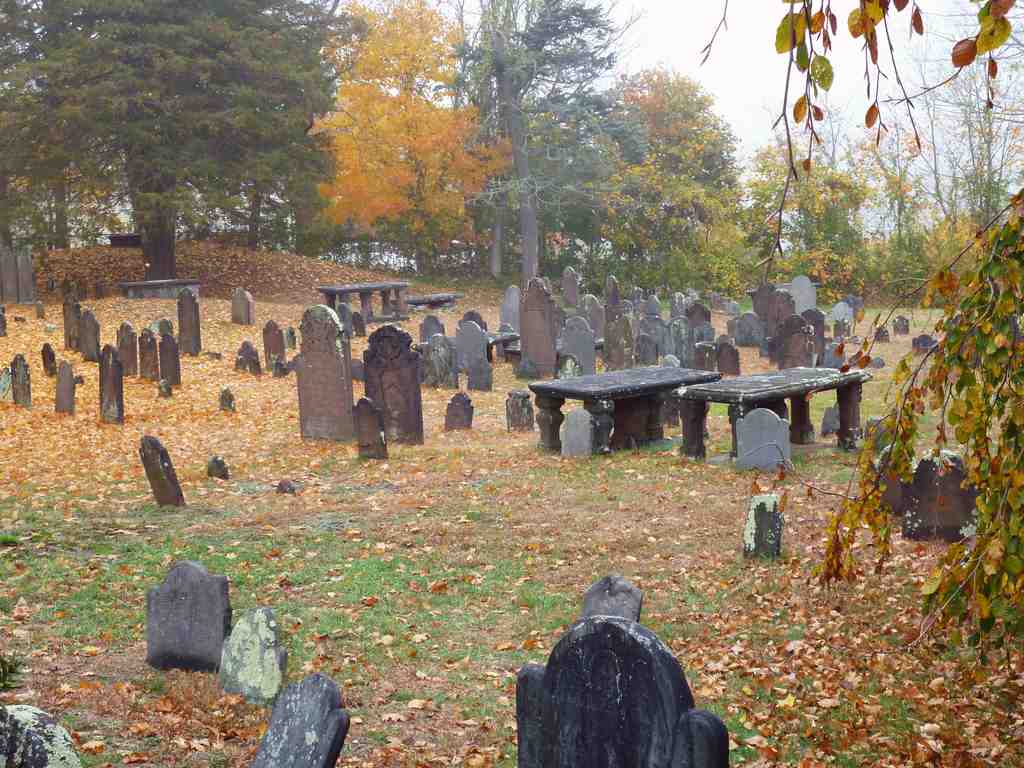
If you look to your right, you'll spot an open hillside dotted with tilting gravestones, some crumbling with age, surrounded by iron fencing and ancient trees-this is Ye Antientist Burial Ground, set just above the crossroads, with a wide view stretching all the way to the Thames River.
You’re standing next to one of New England’s oldest cemeteries, dating back to before New London was even called New London-back then, folks knew it as Pequot Plantation. This patch of ground has quietly watched over the city for nearly four hundred years. Imagine the year is 1645: the town is barely more than a handful of rough timber houses, and officials have just set aside this hill to be the “Common Buriall place.” Meaning, no one’s claiming this land as private turf, ever. And honestly-who’d want to?
Now, in the early days, burials here had a kind of stoic efficiency. There wasn’t much for fancy gravestones-remember, there were no local stonecutters, and the settlers weren’t exactly rolling in spare cash. Most graves were marked with whatever rocks could be lugged up the hill-back then, a granite boulder dragged with ropes to cover a grave meant, “Hey, someone important rests here.” For a proper grave, the town’s sexton got paid 4 shillings if it was an adult, or 2 shillings for a child-that’s about $35 and $17 in today’s money. Not much for a job description that covered grave-digging, sweeping the meeting house, and running off any stray dogs. Multi-tasking at its colonial finest.
Over time, things classed up-by the early 1700s, headstone carving had become a legitimate craft. You’ll spot stones from all over: local granite, regional brownstone, and imported slate from Boston and Rhode Island. Look for markers by carvers like the Lamsons, the Stanclifts, and the legendary Kimball, who really cornered the “urn-and-willow” market in the 1800s.
If you wander around, you might find the grave of Sarah Kemble Knight-she was an early travel writer, riding solo from Boston to New York and jotting it all down. Gurdon Saltonstall lies here too, a colonial governor whose name is still sprinkled all over Connecticut. Lucretia Harris Shaw is another worth visiting: she turned her house into an impromptu hospital during the Revolution, nursing soldiers who survived prison camps, only to catch a deadly fever herself.
Now, not every founding father or mother is marked-the oldest stones here date to the 1660s, but we know countless souls were laid to rest long before anyone could afford a carved epitaph. Some say the real population of this hill is hidden beneath its layers: generations of townsfolk, their stories now part of the soil itself.
And, if you stand quiet for a moment, you’ll catch that breeze up from the Thames and, looking east, see the heights of Groton-a view just about unchanged since those first burials. It’s a little slice of eternity in the middle of New London. Not too shabby for a final resting place, huh?


