
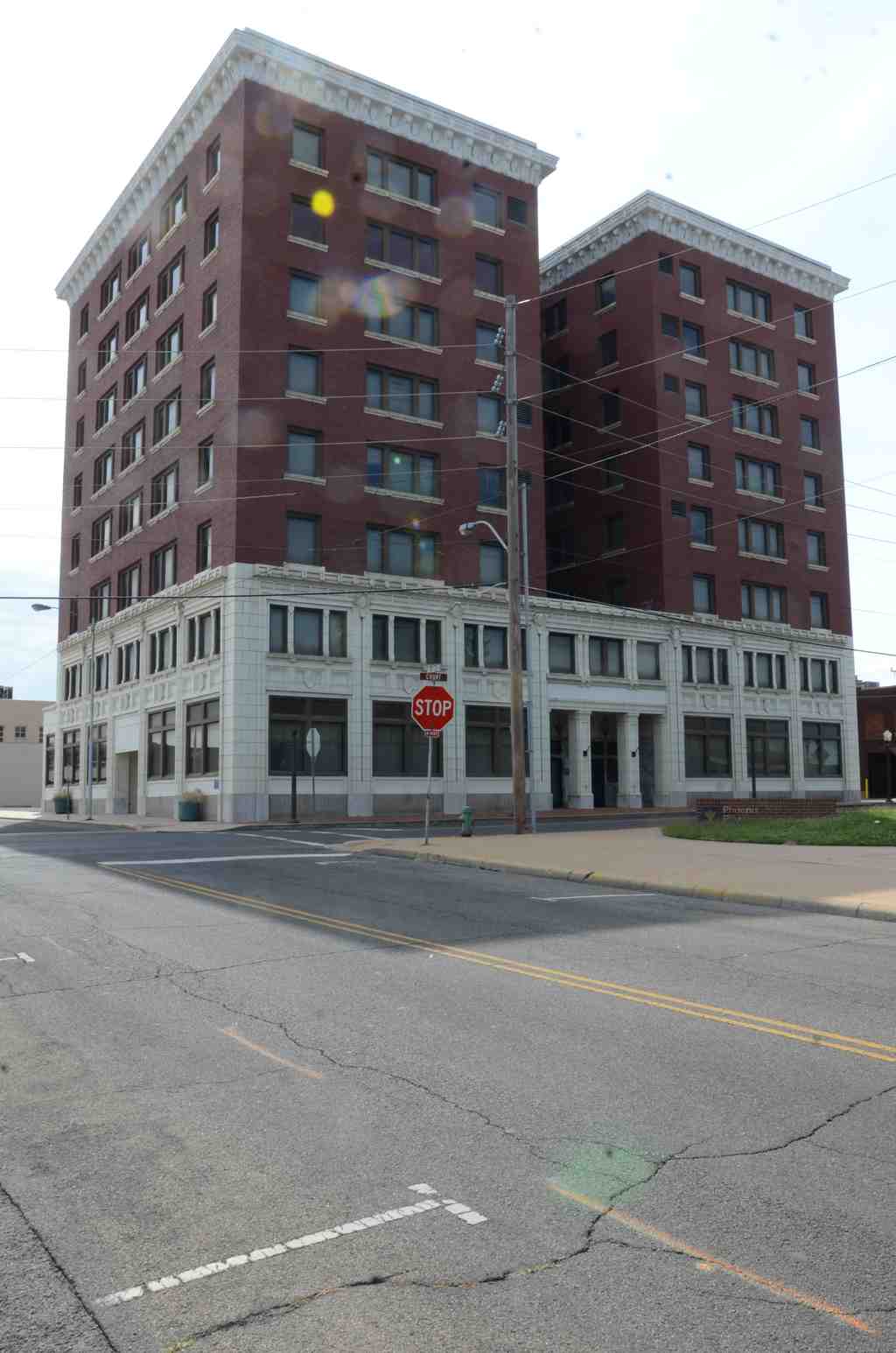
Look to your right at the tall, rectangular eight-story building made of red brick, distinguished by the vertical bands of masonry separating the windows and its flat, unornamented roof line.
This is the Railway Exchange Building. If it looks a bit like something you might see in a much larger metropolis, that is entirely by design. You are looking at the definitive example of Chicago Style Architecture in the city. Notice the stark, rectangular shape and that completely flat roof? That is the signature. It is a style that prioritizes business over decoration. The design emphasizes vertical lines, using pilasters-those flat, column-like strips between the windows-to draw your eye upward, making the building feel even taller than it is.
It was completed in 1912, right at the peak of the oil boom that was flooding this region with black gold and new money. Muskogee wasn't content being a rough-and-tumble frontier outpost anymore. It wanted to be a cosmopolitan hub. It wanted to be the Chicago of the South. So, they didn't just build big; they imported the architectural language of the big city to prove they had arrived.
But to build the future, they had to bury the past. The ground beneath this skyscraper has a story of its own. Before 1912, this corner held the old Federal Court building. Back in 1899, a massive fire ripped through downtown Muskogee. It destroyed almost everything in its path, except for that court building. Its sturdy brick walls actually stopped the flames and saved the southern half of the business district from incineration.
You might think a building like that would be preserved as a local hero. But in the rush for modernization, sentimentality is often the first casualty. They demolished the savior of the city to make room for this eight-story tower.
For a long time, the gamble paid off. This place became the nerve center of the region. It housed the Missouri, Oklahoma & Gulf Railway, run by J.J. Culbertson, the powerful developer who owned this building. Imagine the lobby in the 1920s... frantic telegraphs about oil prices, coal magnates from the Swift Coal Company negotiating deals in suite 704, and the constant rumble of a city on the make.
Decades later, the building found a second life as a downtown campus for Connors State College, filling these halls with students. But when the college moved its operations to a new bypass, the life drained out of the masonry.
Today, the building stands empty. Plans to renovate it were in the works, but in 2016, the state faced a budget shortfall. The tax credits needed to remove asbestos and bring the systems up to code were cut off, leaving the project in indefinite limbo. It is a sleeping giant now, waiting for a check that might never come. It serves as a stark reminder that while ambition can build skyscrapers, it cannot always keep the lights on.
We are leaving the skyline behind to explore a different kind of history at the site of the Escoe Building. Follow me, and let's head that way.




