
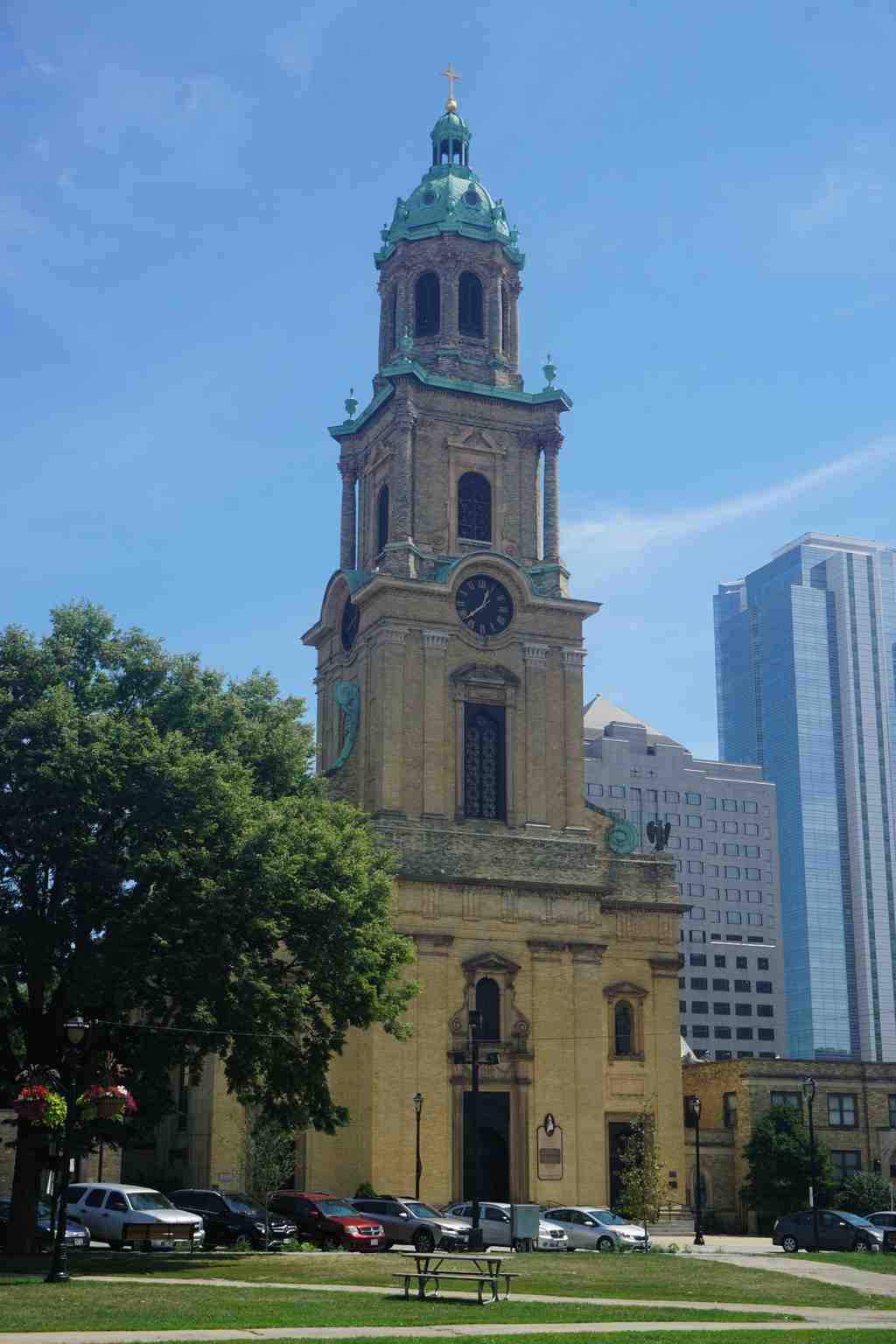
To spot the Cathedral of St. John the Evangelist, just look for the tall, creamy-yellow brick tower with a green copper dome and cross peeking above the trees across from Cathedral Square Park.
Now that you’re standing before this grand cathedral, let’s take a stroll down Milwaukee’s memory lane-no time machine needed, just your imagination and maybe a little neck stretch to take in that tower! Back in 1837, before the city even dreamed of skyscrapers, St. John’s parish became Milwaukee’s first Roman Catholic congregation. For years, the faithful squeezed into a nearby little church until Archbishop John Henni landed a prime slice of land right here in 1844. With $30,000 in hand-a king’s ransom at the time, if you didn’t spend it all on cheese-they began construction. Only five years later, in 1852, the cathedral was dedicated to John the Evangelist, and Milwaukee had itself a spiritual home as solid as they come.
Take a closer look at that creamy brick-it’s called Cream City brick, made right here in Milwaukee, and it gives the cathedral its sunny glow even on a cloudy day. The architect, Victor Schulte, clearly had a thing for the “Zopfstil” or “pigtail” style-a less showy German Renaissance Revival look, a little protest against those fancy Baroque churches that were all the rage elsewhere. It’s like they said, “We’ll take our faith strong but our buildings sensible!”
Look up at the three-story tower. The lower part is the original design from the 1840s-simple, sturdy flat columns marching up to the clock. Back in the day, it had a much shorter steeple, but after a few decades, someone declared it unsafe-probably after one too many anxious glances on windy days. So, in 1893, George Ferry and Alfred Clas designed the taller stages above the clock, giving it that dramatic domed crown you see now.
Disaster struck in 1935 when a fire consumed almost everything-stained glass, mural paintings, even a prized pipe organ. The flames got so hot, even the walls looked nervous. Only the tower, thanks to a determined fire chief, survived the inferno. But Milwaukee’s spirit was tougher than a Wisconsin winter, and by 1942, they’d rebuilt in time for Christmas Eve Mass.
Inside today are glowing stained glass windows, a tomb-like baptismal pool, and a controversial fiberglass crucifix that stirred a holy debate during the cathedral’s 2002 renovation. Modern touches and old traditions sit side by side-a reminder that Milwaukee’s landmark doesn’t just survive history, it keeps reinventing it!




