
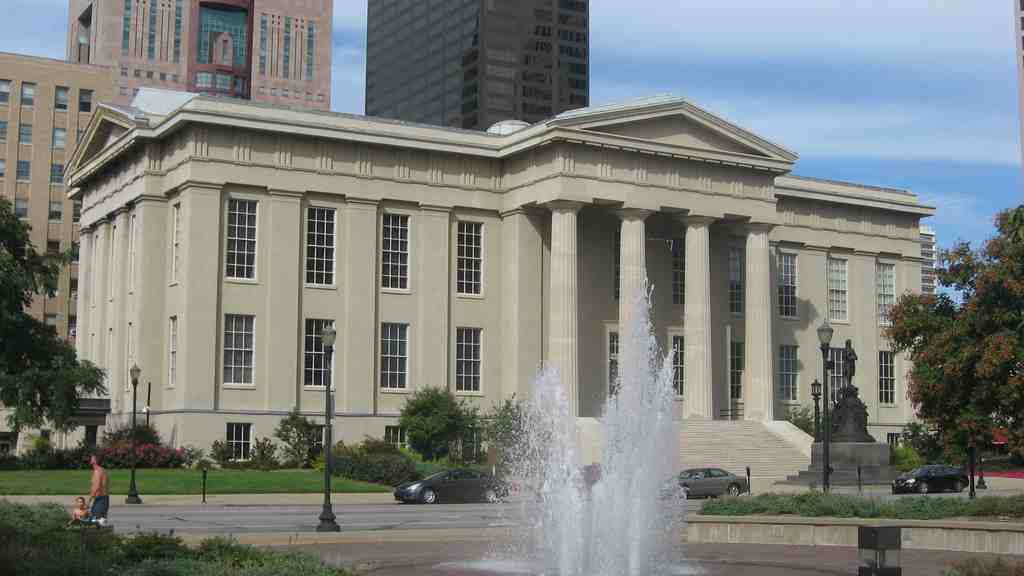
Directly in front of you stands a grand, pale stone building with towering columns and a triangular pediment at the top; to spot the Louisville Metro Hall, look for the massive front steps leading up past those impressive columns, right behind the splashing fountain.
Now that you’re standing at the heart of Louisville’s government, let your imagination wander back nearly two centuries. The year is 1836, and this spot is a noisy construction site, dust swirling around workers as hammers clang against stone. The city dreams big-architect Gideon Shryock envisions a courthouse grand enough to lure Kentucky’s capitol away from Frankfort. He pictures six Doric columns, a fancy cupola, and sweeping porticos. But like many ambitious projects, things don’t exactly go according to plan. Shryock resigns before seeing his dream finished, and when bridge engineer Albert Fink takes over, the building gets trimmed down-less money, fewer columns, no cupola. The end result? Let’s just say the Louisville Daily Journal wasn’t very kind when they called it an “elephantine monstrosity.” If only social media had existed back then!
Despite its rough start, the courthouse quickly became more than just a government hub. Imagine the city in the 1840s-raw and complicated, with slave trading and abolitionist speeches both taking place near these steps. There was a moment of political hope when James Guthrie, a powerful local figure, pushed to make this building the new Statehouse for Kentucky. But Frankfort kept that honor, and locals started jokingly calling the structure “Guthrie’s folly.” Now, it has a new name-Louisville Metro Hall-but the stories haven’t stopped.
During the Civil War, this building briefly became the center of Kentucky’s government while Frankfort was held by Confederate forces. Imagine the tension, the meetings, the hurried decisions echoing through these thick walls. Then, in 1905, a fire gut-punched the building, but like every good survivor, it rose again, thanks to architect Brinton B. Davis’s talents. Louisville loves a comeback story.
There’s more beauty-and a dash of international mystery-outside, too. Look to your left and you’ll spot a proud statue of Thomas Jefferson, a gift from 1901. But the true conversation starter is across the street: a marble statue of King Louis XVI, all 12 feet and nine tons of him. Given to Louisville by its French sister city Montpellier in 1967, this statue’s journey was nearly as dramatic as the king’s own story: hidden from angry mobs in France, gathering dust in storage, shipped across the ocean, and finally arriving here-minus, after recent protests, one hand.
The building and its statues have seen the city’s joys and pain, sometimes at the very center of it all. So, as traffic hums by, and the fountain bubbles cheerfully in front, take a moment to appreciate all the dreams, missteps, and bold personalities that helped create the soul of Louisville right here on these stone steps. And remember: even an “elephantine monstrosity” can become the heart of a city!
If you're keen on discovering more about the design, statues or the gallery, head down to the chat section and engage with me.




