
Lincoln Audio Tour: Legends, Landmarks, and Legacy in Downtown Lincoln
Beneath the roaring scarlet of Memorial Stadium and the calm gaze of bronze mammoths, Lincoln’s downtown keeps centuries of ambition, rivalry, and invention alive in plain sight. This self-guided audio tour leads you between icons and hidden corners where history is written in brick and bone. Unlock stories most visitors miss—moments where art, intellect, and sporting obsession collide. Who tried to rewrite Nebraska football’s destiny inside the stadium walls? What mysterious fossil once sparked a statewide science battle at the State Museum? Why do quiet shadows linger beneath Sheldon Museum's glass, keeping secrets from the 1970s art scene? Move through downtown, tracing bold footsteps from marbled halls to legendary fields. See Lincoln’s pulse change pace as politics clash, boundaries shift, and downtown’s original heart beats on. Are you ready to chase Lincoln’s secrets from roaring arenas to silent galleries? Press play and dig deeper.
Tour preview
About this tour
- scheduleDuration 80–100 minsGo at your own pace
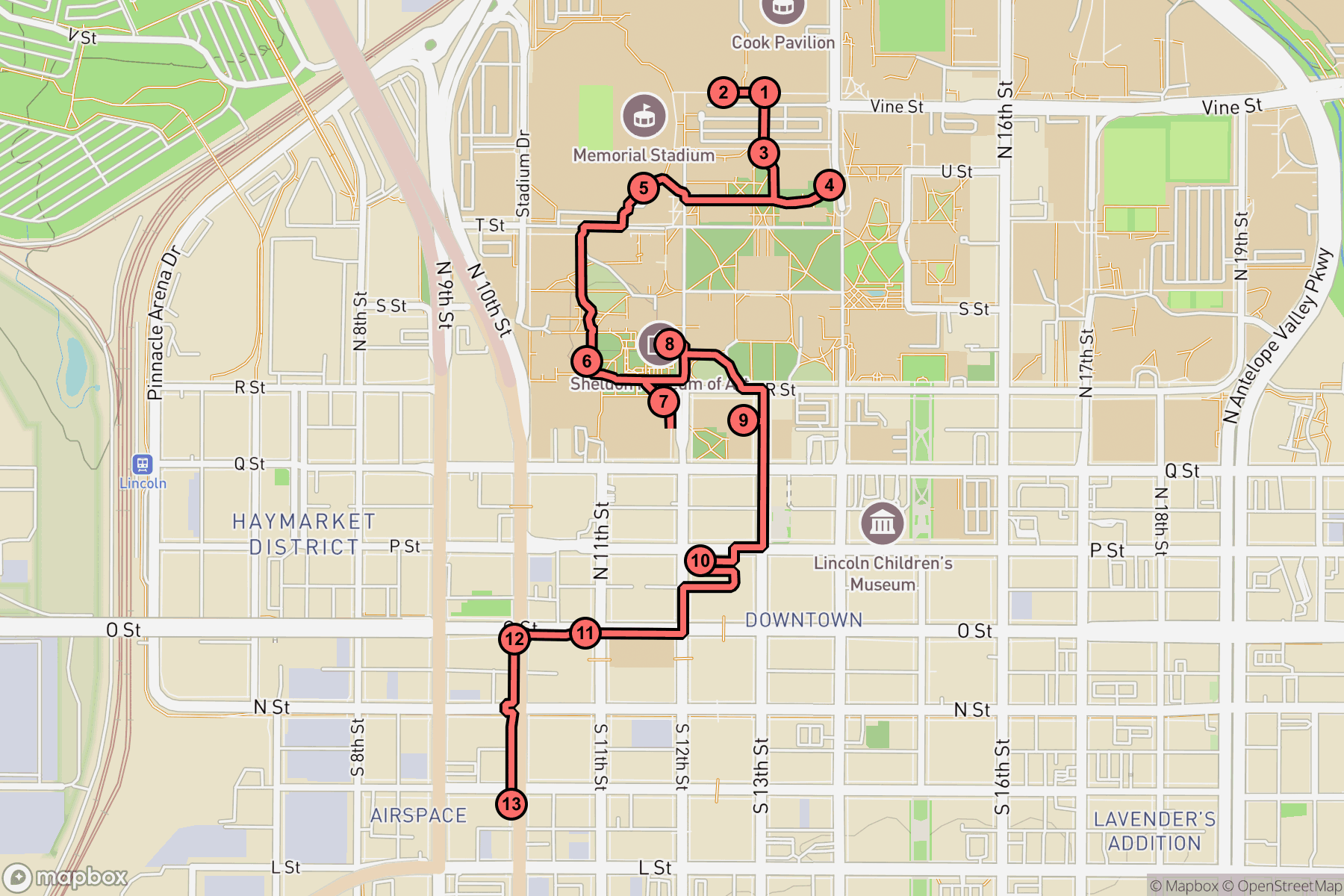
- straighten3.3 km walking routeFollow the guided path
- location_onLocationLincoln, United States
- wifi_offWorks offlineDownload once, use anywhere
- all_inclusiveLifetime accessReplay anytime, forever
- location_onStarts at Terminal Building
Stops on this tour
lock_open 3 free previews · 10 unlock with purchase
To spot the Terminal Building, just look up for a tall, white-glazed, ten-story office tower with a flat roof and huge windows, standing proudly at the busy corner of 947 O…Read moreShow less
To spot the Terminal Building, just look up for a tall, white-glazed, ten-story office tower with a flat roof and huge windows, standing proudly at the busy corner of 947 O Street-the white terracotta on its north and east sides almost glimmers in the Nebraska sunlight. Now, let me take you back in time, right onto this very sidewalk! Imagine it’s the roaring 1910s: horses clop by, shopkeepers fling open their doors, and brand-new streetcars chug past, their bells cutting through the morning air. Just then, this impressive high-rise-the Terminal Building-began rising from the ground. It was 1916, and Lincoln was buzzing with ambition. Designed by the talented Paul V. Hyland (or was it Joseph G. McArthur? The world may never know-architect mysteries are the best kind), it was built to impress. Back then, ten stories felt like touching the stars, and this shining white landmark anchored the skyline. But why “Terminal”? Well, picture crowds with suitcases, tiptoeing past the marble-floored lobby, a ceiling of fancy plaster moldings overhead, and polished mahogany storefronts gleaming under the lights. People bought tickets for sleek electric streetcars here, the engines that helped Lincoln hum. And while they waited, they browsed a snazzy appliance store set right here at street level. If the marble could talk, I’m sure it would gossip about office workers bustling up the stairs, or the ever-watchful “T” monograms on those fancy old French doors. The Terminal Building was headquarters for the Lincoln Traction Company-the big boss of local streetcars. Before that, transit was a little more... dramatic. Out-of-state investors raised fares, the citizens revolted, and a local company popped up to challenge them. Eventually, the two companies merged (think of it as a high-stakes transit soap opera!), and pretty soon, streetcars became as common as cornstalks. Over 12 million passengers a year zipped through Lincoln on tracks powered by the company’s own electricity plant. They produced so much juice, they sold steam heat and electricity around town! But change is always on the timetable. The First World War, cranky strikes, and the arrival of buses whittled away the company’s fortunes. By 1943, the clatter of streetcars had vanished-except for a few haunting rails unearthed during city projects now and then. The grand Terminal Building soldiered on, its marble lobby holding echoes of Lincoln’s streetcar past. There’s even more to this building’s tale. In the dark early hours of February 19, 2018, flames roared on the eighth floor. Firefighters rushed in, water rushed down, and smoke swaggered where office workers used to sip their coffee. Thankfully, the precious lobby with all its historical charm came through nearly untouched-a survivor, like the city itself. So, as you stand here looking up at that white terracotta shell catching the sunlight, remember: you’re gazing at a palace of progress, local drama, and one of Lincoln’s last links to its electric streetcar days. That’s quite a stop, isn’t it? And trust me, the marble is still eavesdropping. Shall we move on?
Open dedicated page →Picture this: it’s the late 1700s. The air is thick with the scent of tobacco and the sound of quill scratching on parchment. President John Adams picks up his pen and signs the…Read moreShow less
Picture this: it’s the late 1700s. The air is thick with the scent of tobacco and the sound of quill scratching on parchment. President John Adams picks up his pen and signs the Weights and Measures Law on March 2, 1799, giving rise to the national push: “Let there be one ounce, not forty different ounces!” From that moment, the United States begins its quest to avoid the chaos of every state using its own version of a pound or gallon. I mean, imagine buying a dozen eggs in Nebraska and only getting ten eggs in New York. Scandalous breakfast, right? Fast forward to 1905. The country’s growing, commerce is bustling, and folks are getting a bit antsy about the chaos of measuring things differently in every town. Representatives from all across the nation gather, debating how to unite their standards. Was there tension in the room? Probably! I like to think there were more dramatic gasps over measuring tapes than in most soap operas. But from this drama, an agreement is struck: every year, the brightest minds would gather to create and refine the technical standards for weighing and measuring devices. Thus, the National Conference on Weights and Measures was born, becoming the nation’s unsung referee for everything from deli scales to fuel pumps. For decades, these annual meetings were overseen by the Director of the National Bureau of Standards-yes, the same folks who would later become the National Institute of Standards and Technology. But in 1958, things changed. Someone must have said, “Guys, let’s try democracy!” and from then on, an actual weights and measures official was elected each year to take the helm as chairman. They kept on meeting, debating, and updating the rules-almost every single year, with only eleven years skipped since 1905. That’s dedication. I skip more Monday mornings than that! By 2008, the NCWM had found its brick-and-mortar home right here in Lincoln, Nebraska, opening their dedicated offices. In 2024, they decided to change the name to “National Council on Weights and Measures”-probably to clear up confusion for anyone who thought it was an endless meeting that never let you leave, like a hotel lobby with no check-out. If you ever doubted how serious this business is, listen to this: if you want to make a weighing or measuring device that’s sold in the United States, you need the official thumbs-up from the National Type Evaluation Program, or NTEP. Don’t mess with the NTEP! Real experts test, prod, and poke these gadgets to make sure they measure up-pun absolutely intended. And only then does NCWM issue the all-important NTEP Certificate of Conformance. No certificate, no business. It’s as if the Oscars judged scales, not movies. Every state relies on these national standards, which are all spelled out in three epic tomes: Handbook 44, which covers specs and tolerances; Handbook 130, with all the rules and regulations; and Handbook 133, which makes sure food packages actually contain what they promise on the label. Imagine the disappointment of opening a bag of chips and finding it half empty-NCWM is here for you! But it's not all drama and handbooks. The NCWM also runs on grassroots power. They work with regional groups all across the nation-the Central, Northeastern, Southern, and Western Weights and Measures Associations. Folks submit proposals on a not-so-glamorous-sounding but incredibly vital form: NCWM Form 15. Open hearings are held, regional groups weigh in, and then big decisions get made on a national level. Think of it as democracy by the ounce. Behind those doors, experts gather for meetings that might not make headlines, but their decisions touch every grocery store, truck stop, and fuel pump in the country. So next time you trust a scale or pump, tip your hat to the unheralded heroes of accuracy, right here in Lincoln. Now, are you feeling a little more weighed down by knowledge-or am I just measuring up to this tour’s reputation? For further insights on the organization, membership or the meetings, feel free to navigate to the chat section below and inquire.
Open dedicated page →To spot the Gold and Company Store Building, just look for the tall, castle-esque, white stone structure with striking vertical lines and large windows rising above the…Read moreShow less
To spot the Gold and Company Store Building, just look for the tall, castle-esque, white stone structure with striking vertical lines and large windows rising above the trees-plus, that huge “GOLD’S” sign makes it pretty hard to miss. Alright, take a good look-this grand building towering before you is the legendary Gold’s Building, and trust me, it’s got stories deeper than its six floors! Imagine the excitement on a cold November day in 1924: crowds in their wool coats, breath puffing like little steam engines, lined up outside as the newest shopping marvel in Lincoln swings open its doors. William Gold, the co-founder himself, might have been there to make sure every detail shined just right, his son Nathan waiting in the wings to take over and keep things golden for decades to come. You probably notice its bold vertical lines, those little finials along the roof, and that unique mixture of Gothic Revival and Art Deco. If this building could speak, it’d probably tell you it was built to impress and to last. Designed by Davis & Wilson, it looked like it belonged in a big city-maybe a place where you’d expect to see people selling magic carpets and fancy hats. By 1929, Gold’s had grown so popular that it just had to expand-like a favorite pair of jeans right after Thanksgiving dinner. And they weren’t shy about more space either, getting new additions in ’31, ’35, ’47, and ’51. Hey, when business is golden, sometimes even buildings need to loosen their belts. Generations of Lincoln locals came here to shop for wedding dresses, back-to-school clothes, or maybe just to people-watch from behind the glass. But in 1964, the winds of change blew in when Gold and Company merged with J. L. Brandeis and Sons, making for a super-sized retail adventure until Brandeis finally packed up shop in 1980. By the 2020s, the old building was in need of love-and, talk about a dramatic twist, in 2023, demolition crews started nibbling away at its south side. The plan? Transform the iconic original part into a hotel, giving it a fresh chapter in Lincoln’s downtown story. So take a moment, listen for echoes of laughter and old cash registers, and know you’re standing outside a building that’s seen style, struggle, and success-plus a lot of holiday shopping headaches.
Open dedicated page →
Show 10 more stopsShow fewer stopsexpand_moreexpand_less
Look for a sturdy, light-brown brick building with five stories, big rectangular windows, and a striking, decorative cream-colored band around the top-standing boldly on the…Read moreShow less
Look for a sturdy, light-brown brick building with five stories, big rectangular windows, and a striking, decorative cream-colored band around the top-standing boldly on the corner of 11th Street. Now, as you stand before the Lincoln Liberty Life Insurance Building, take a step back in time to 1906-the air smells a bit like fresh plaster and ambition, and the streets are bustling with horse-drawn carriages. Back then, this impressive five-story structure was the “Little Building,” and trust me, nothing about it felt little. Imagine businessmen in suits with tall collars and derby hats marching in and out, talking about booming railroads and the promise of progress. Things took an exciting turn in 1936. Picture Lincoln jazzed up with the jazzy rhythm of the Art Deco era-suddenly, the building is reborn with bold, geometric lines and stylized motifs adorning its top. The new owners, Liberty Life Insurance, put their stamp on it, and just like that, the Little Building became a symbol of confidence and resilience in uncertain times. Whispered secrets and big dreams swirled through its corridors. Today, it stands like a steadfast guardian of the past, watching as Lincoln changes all around it. So, give the building a little wink-it’s seen more life, and insurance policies, than most!
Open dedicated page →Look ahead for a bold red neon sign that spells out “Mary Riepma Ross Media Arts Center” in a blocky font-if you see a big “R” and bright red letters, you’re in the right…Read moreShow less
Look ahead for a bold red neon sign that spells out “Mary Riepma Ross Media Arts Center” in a blocky font-if you see a big “R” and bright red letters, you’re in the right place! Step right up, film lover-this isn’t just your average movie theater; this is where imagination and culture meet in the heart of Lincoln! Picture it: the mid-1980s, when most movie options were the popcorn-heavy blockbusters, and independent films were about as common in Nebraska as surfing lessons. But behind the scenes, Danny Lee Ladely, the University’s film program director, dreamed of a space where every frame, flicker, and foreign accent had a fighting chance. He knew the local cinephiles deserved more than reruns and big explosions, so he reached out for help. Enter Mary Riepma Ross, a New York City attorney with a heart for art and a passion for movies. Her rallying cry? “Lincoln should have access to independent and art films. They should have that out here as part of their cultural life!” If you want to know just how much she meant it, she kicked things off by establishing a $3.5-million trust-talk about showing your blockbuster support! Construction began at the corner of 13th and R Streets, hammers pounding and hopes high, and the center finally opened its doors in 2003, officially attached to the Van Brunt Visitors Center. Ross herself lived to be 102, and when she passed, her legacy lived on through a jaw-dropping $7.7 million donation that gave the Hixson-Lied College of Fine and Performing Arts a truly Oscar-worthy boost. Now, when you step inside, you’re greeted by two state-of-the-art screens-one seating 197 and devoted to American indie gems, the other holding 82 and perfect for documentaries and daring experiments. Thanks to Texas Instruments’ digital light projectors and Dolby Digital EX sound, watching a film here is like being pulled right into the screen. The best part? You could quite literally leave your mark: for $250, you can get your name engraved on a seat, so every bucket of popcorn comes with a dash of immortality. The Ross isn’t just a theater-it’s a celebration of vision, community, and those unsung films waiting for their audience. So, whether you’re here for a moody black-and-white mystery, a world-traveling documentary, or an indie comedy that’ll have you chuckling into your popcorn, just remember: you’re standing where passion flickers to life, and every story gets its chance at the spotlight. And hey, with the idea of a third “microcinema” floating around, the future might be even brighter!
Open dedicated page →To spot the Old University Library, just look for a stately red-brick building with a tall pointed arch over its wooden doors and a little clock perched up top-it’s framed by…Read moreShow less
To spot the Old University Library, just look for a stately red-brick building with a tall pointed arch over its wooden doors and a little clock perched up top-it’s framed by leafy trees and seems to stand proudly like it knows a story or two. Now, if the walls of this building could talk, they’d probably start with a deep sigh of relief-after all, it took more than just blueprints to build this place back in the 1890s! Picture it: the year is 1891, and the University of Nebraska is dreaming big, sketching out a new library while counting every last dime. The initial price tag made everyone’s wallets shudder, so they had to bargain down the cost, all during a time when the economy was harder to predict than Nebraska weather. Administrators, with names as grand as their ambitions-James Hulme Canfield, George Edwin MacLean, and Charles Henry Morrill-hauled themselves down to the legislature, probably hoping their best puppy-dog eyes would convince the government to fork over tens of thousands of dollars. Construction began in fits and starts-first the main building, then the reinforced north wing. The ever-watchful Canfield kept a close eye on those busy workers, not wanting the new library to end up being a pile of fancy bricks with a basement full of leaks like the last few campus projects. When they finally finished, they created a masterpiece in the Richardsonian Romanesque style: Colorado sandstone and red brick, chunky arches, grand skylights, and even an east-facing tower, which in 1895 looked out over the bustling campus green. Imagine walking inside back then-books everywhere, sunlight streaming through skylights, maybe echoes of students whispering about the latest discoveries, or someone from the art department lugging canvases up the stairs. There was even a whole floor for the Nebraska State Historical Society in the basement (I bet they had a few spooky stories down there). But as the years rolled on, the library’s shelves grew crowded and creaky, and soon they needed a new home for all those books. By 1945, the books and historic artifacts moved out, making way for the next chapter-the place even got a brief stint as “Navy Hall” after WWII before it became the hub for up-and-coming architects. Over the decades, it’s changed, with glassy additions, renovations, and all sorts of expansions, yet it remains the oldest building still doing its job for the university. So as you stand here, just imagine the generations that have passed through these doors-for research, for art, or maybe just to find a sunny reading nook. Who knows, maybe if you listen closely, you’ll hear a faint whisper from the old library shelves: “Read fast, the next class is coming!”
Open dedicated page →You’re standing at the crossroads of creativity! Welcome to the Hixson-Lied College of Fine and Performing Arts, where art, music, theatre, and design come together like a…Read moreShow less
You’re standing at the crossroads of creativity! Welcome to the Hixson-Lied College of Fine and Performing Arts, where art, music, theatre, and design come together like a perfectly orchestrated symphony-or a jazz band that occasionally forgets the key, but in the most brilliant way. Take a moment to breathe in: the southwest corner of the City Campus is known as the “Arts Quadrangle.” If you listen closely, you might just hear a distant violin, the echo of stage dialogue, or someone arguing passionately about abstract sculpture. This corner of campus wasn’t always this artsy, you know. The college itself is pretty young, born in 1993 as a union of all those artsy souls wandering through the University of Nebraska-Lincoln. It started as the College of Fine and Performing Arts, but in 2000, something big happened-an $18-million donation from Christina Hixson and the Lied Foundation Trust, enough to make even a starving artist faint. The name was changed to honor their generosity, proving that sometimes, art and a little “change” pay off. Now, the college is a constellation of vibrant schools and partners. Let’s start with the School of Art, Art History, and Graphic Design. Art at Nebraska goes way back to 1869, practically the Jurassic Age, but the School of Fine Arts wasn’t made official until 1912-located right where you might have found dinosaur bones, in the State Museum alongside what would become the Sheldon Museum of Art. The school took an abrupt intermission in 1930, closed down, then returned for an encore in 1937 under Arthur Westbrook, a man with vision and, I presume, remarkable patience. Since then, art students have found a creative home in Richards Hall, one of the oldest buildings on campus, which received a modern makeover in 2000. Imagine the buzz of brushes, the clatter of sculpture tools, and, of course, the existential sighs of student artists. And you never know when you’ll be standing next to future Pulitzer winners. Karen Blessen, who nabbed a Pulitzer Prize in 1989, roamed these halls dreaming up her next masterpiece long before she became a legend. Just down the path is the Glenn Korff School of Music, which began life as a music conservatory in 1894. It was led by Willard Kimball, a man imported from Iowa College-because even back then, Cornhuskers knew talent was worth poaching. The conservatory became an “independent artist” for a bit, then came back into university hands in 1930-and at a bargain price of $100,000. The current music complex includes the Kimball Recital Hall, still going strong since 1969, where up to 850 listeners can be swept away by everything from sonatas to full symphonies. The school’s present name honors Glenn Korff, a science grad with a passion for set design who donated a cool $8 million in 2013. His love of the arts made such a mark that, even in chemistry, he was known to leave a little sparkle. And just imagine the sound of the Cornhusker Marching Band warming up nearby: brass, drums, a clarinet or five-it’s all in a day’s rehearsal here. But the real star power lands in the Johnny Carson School of Theatre and Film. The Temple, a massive neo-classical gem, was raised thanks to a Rockefeller grant back in 1906 and has been home to dramatists ever since. Johnny Carson, the guy who mastered the art of the late-night laugh, cut his comedy teeth right on these stages. He never forgot his alma mater. Carson and his foundation donated around $38 million-now that’s what I call a standing ovation. Thanks to this, the department was renamed in his honor in 2005, and the shiny Johnny Carson Center for Emerging Media Arts arrived on the scene in 2015. If you’re dreaming of designing video games or making viral videos, this is your place. And the story doesn’t end here. The college partners with legends like the Lied Center for Performing Arts, opened in 1990, where a sea of nearly 2,300 seats await thunderous applause-or polite coughing between movements. You can also visit the Sheldon Museum of Art: a modern landmark since 1963 with over 13,000 works, including bold abstractions and classic American scenes. So stand tall, fill your lungs with inspiration, and remember: you’re in the heart of Nebraska’s creative storm. Who knows? The next Pulitzer-winner, Broadway star, or viral game designer might be rehearsing just around the corner, ready to make some noise.
Open dedicated page →Back in 1888, art lovers on campus banded together to form what was then called the Haydon Art Club-named for British painter Benjamin Robert Haydon. Their ambition was to bring…Read moreShow less
Back in 1888, art lovers on campus banded together to form what was then called the Haydon Art Club-named for British painter Benjamin Robert Haydon. Their ambition was to bring beauty, culture, and a bit of artistic chaos to the prairies of Nebraska. Over the years, the club morphed into the Nebraska Art Association, moving their ever-growing art collection from one university building to the next, almost like a traveling circus-though with less popcorn and a lot more oil paint. Finally, after decades of art roulette, a permanent home was built in 1963 with funding from siblings Mary and Adams Sheldon, visionaries who sadly didn’t live to see the doors swing open. Their gift combined to over $1.5 million, which may not buy you a single Banksy today, but back then? It was like winning the Mona Lisa lottery. That debut wasn’t just about the art, though. Renowned sculptor Isamu Noguchi-whose works looked so futuristic, you half expect them to double as spaceship parts-crafted “Song of the Bird” for the grand hall, setting the tone for a museum that’s all about soaring imaginations. Inside, you’ll find over 12,000 artworks, with specialties in nineteenth- and twentieth-century American masterpieces. The collection includes everything from sweeping landscapes and dreamy still lifes to bold pop art, minimalism, and abstract expressionist pieces that can make you ponder the color blue for far longer than is probably healthy. But before you get too comfortable, let’s talk about the sculpture garden. More than thirty sculptures-some taller than your neighbor's unruly sunflower patch-dot the lawns outside, from legends like Claes Oldenburg and Richard Serra. Of course, not everyone was thrilled at first; there was that one memorable phone call from a visitor who thought the modern art looked like “junk” and demanded that director Norman Geske be catapulted straight out of Nebraska. Art: always stirring up the best kind of drama. And speaking of drama, thieves have visited this museum in ways even Hollywood would envy. In April 1965, Benjamin West’s painting “Golden Age” was stolen by a university student and had to be recovered by the FBI. Then, in a 1998 twist worthy of a slapstick comedy, a legendary bronze sculpture called “Man in the Open Air” vanished-apparently during the wild celebration after Nebraska’s Orange Bowl win. Fans may have run off with more than footballs that night, but the sculpture turned up a week later, probably once the culprit sobered up and realized carrying around a $500,000 bronze man is not the world’s best idea. The museum isn’t just about displaying gorgeous works; every year it hosts about twenty different exhibitions, with everything from hands-on kids’ workshops to lively lectures. The curators make sure that what happens in Lincoln doesn’t just stay in Lincoln-many exhibitions tour the nation, sharing a slice of Nebraska’s creative spark from coast to coast. It’s also a museum that keeps evolving. The name changed from Sheldon Memorial Art Gallery to Sheldon Museum of Art in 2008, right alongside its supporting organization. Since its opening, a handful of leaders-like Norman Geske, George Neubert, and today’s director Susan Longhenry-have left their mark, expanding collections and nurturing its role in the art world. As you gaze at the Sheldon’s gleaming facade, remember that it’s not just a container for art; it’s a piece of art itself, rooted in stories, talent, adventure, and the occasional wild football-fueled heist. If you listen closely, maybe you’ll even hear the rustle of a canvas, the mutter of a surprised security guard, or the echo of Noguchi’s sculpture singing with the wind. The Sheldon invites you in not just to look, but to wonder. Now, are you ready to move on, or shall we let you try to spot the sculpture that sparked a city-wide debate? No promises, but I hear it’s better than an actual sunflower patch.
Open dedicated page →If you’re searching for Memorial Stadium, just look ahead for a massive arena wrapped in endless red, towering stands, and the unmistakable roar of a crowd-it's impossible to…Read moreShow less
If you’re searching for Memorial Stadium, just look ahead for a massive arena wrapped in endless red, towering stands, and the unmistakable roar of a crowd-it's impossible to miss! Right now, you’re standing before a true Nebraska legend: Memorial Stadium, home of so many dreams, more than a few heartbreaks, and so many red-clad fans, they’ve earned the nickname “The Sea of Red.” Imagine, back in the 1920s, the University of Nebraska needed a new stadium because the old wooden Nebraska Field just couldn’t handle the crowds-or the excitement. After World War I, energy and ambition ran high; people across Nebraska scraped together funds, some even following the campaign’s motto: “give until it hurts.” You can almost picture students and faculty running pledges across the state, county by county, everyone wanting to help build something extraordinary. Construction kicked off in 1923, sometimes amid rainstorms and even an August tornado, but nothing was going to keep Nebraskans from their football. On October 13, 1923, Memorial Stadium opened-though with a slightly unfinished upper deck and a field made of dirt, not grass. That first game? Nebraska blasted Oklahoma 24-0, with fans not allowed in the upper sections (you know, health and safety even in the roaring twenties!). Soon after, the stadium was formally dedicated, honoring those Nebraskans who fought and fell in the Civil War, Spanish-American War, and World War I. Powerful words by philosophy professor Hartley Burr Alexander, etched in stone on each corner, still stand: “Not the victory but the action; not the goal but the game; in the deed the glory.” The stadium grew right along with college football fever. At first, just two grandstands-the original east and west superstructure, still hiding in there under all that new construction. In the 1960s, the horseshoe design took shape, more end zones were closed in, bleachers expanded, and by the 1970s, Memorial Stadium could welcome over 70,000 fans. Press boxes were improved-bye-bye, shoebox-sized reporter cave!-and the stadium was illuminated for the first time with portable lights so Nebraska fans could experience the thrill of a victory under the night sky. Eventually, those lights were permanent, because, of course, the party never really ends in Lincoln. Through the decades, capacity swelled to a jaw-dropping 85,458-sometimes more with a squeeze! But if you’ve heard the phrase, “sold out game,” you’re at the place that redefined it: since 1962, Nebraska has sold out 406 straight home games-a record for any sport in NCAA history. People here are so passionate, I’m convinced if a stray ball lands in the bleachers, half the crowd will volunteer to give it mouth-to-mouth. The loyalty’s legendary. Even when times got tough, and the team wasn’t always on top, Nebraskans found a way to keep the “sellout streak” alive-sometimes giving tickets away to donors and sponsors just so every seat would have a cheering fan. But it’s not just football. In 2023, Memorial Stadium was home to Volleyball Day in Nebraska-92,003 fans showed up, the biggest crowd ever at a women’s sporting event anywhere on earth. Imagine the thunder of that many voices echoing off these stands! As for traditions, every home game starts with the famous “Tunnel Walk”-fans chanting “Husker” on one side, “Power” on the other, as the team storms the field to the Alan Parsons Project’s “Sirius.” (If you feel your heartbeat quicken, don’t worry, it happens to everyone!) And for decades, anytime Nebraska scored their first points, the sky would fill with red balloons-unless helium happened to be in short supply, or the environment needed a break. The stadium’s hosted farm aid concerts, comedians, and Garth Brooks-even making an appearance in movies and TV, like Tommy Lee going to college, or Jim Carrey rooting for the Huskers. Today, the field’s state-of-the-art synthetic turf, but rumor has it, grass is making a comeback soon. As for upgrades? Engineers keep busy-bigger seats, better Wi-Fi, new video boards, and luxury boxes-making sure the old bones of 1923 feel just as mighty today as they did at kickoff. If you stand here in the wind, maybe you’ll hear echoes of every pass, every touchdown, every heart-in-mouth moment. Soak it up-the stories and the cheers of a hundred years live right here in “The Sea of Red.” And remember: Not the victory, but the action; not the goal, but the game! Interested in knowing more about the planning and construction, expansions or the additional facilities
Open dedicated page →Take a look at this building right in front of you-the University of Nebraska Athletics Hall of Fame! If you listen closely, you might almost hear the echo of roaring crowds and…Read moreShow less
Take a look at this building right in front of you-the University of Nebraska Athletics Hall of Fame! If you listen closely, you might almost hear the echo of roaring crowds and the thump of a game-winning shot bouncing off the court. This spot is where the legends of the Nebraska Cornhuskers are remembered and celebrated. It’s more than just a hall, it’s a gallery of heroes-coaches, athletes, and even administrators who have brought excitement and pride to this city. Each spring, a select group joins this hall-not through a secret handshake, but thanks to their unstoppable determination and pure spirit. There’s no strict list to check off, just one golden rule: keep the tradition of excellence alive. The very first class back in 2015 was a powerful one, featuring twenty-two stars, each representing a different varsity sport. Since then, five to seven new names are added every year, carefully chosen by university staff and former athletes. I like to think the toughest part for the judges is making sure they don’t get caught picking their personal favorites-or spilling popcorn on their ballots. This is where memories are preserved, and every name inside has a story; maybe it’s a last-second victory, a comeback after injury, or simply a heart of gold. Stand here for a moment, and imagine the footsteps of greatness walking right beside you. Who knows? Someday, your own walk through here might just set off another round of applause.
Open dedicated page →Look up and straight ahead for a tall octagonal tower made of pale Indiana limestone, rising high above the trees-it’s hard to miss this solid, stately landmark! Now that you’re…Read moreShow less
Look up and straight ahead for a tall octagonal tower made of pale Indiana limestone, rising high above the trees-it’s hard to miss this solid, stately landmark! Now that you’re right here at the foot of Mueller Tower, can you imagine you’re stepping back to 1949, when this spot was buzzing with excitement and the smell of fresh-cut stone? Picture Ralph S. Mueller, a proud University of Nebraska alum and, let’s be honest, a bit of an electronics wizard-he’s the reason you’re seeing this magnificent tower. He wanted to give the university something extraordinary, something that literally rang with innovation. So, instead of traditional bells, Mueller funded a bell tower that sings electronically! That’s right-no bell-ringing monks here, just electric rods making beautiful music controlled from a hidden place in the basement of Andrews Hall nearby. Very high-tech for the ’40s! The day it was dedicated, about 2,000 folks filled the area. They craned their necks to marvel at this 84-foot, octagonal giant gleaming under the Nebraskan sky. There was music, there were speeches, there was probably someone trying to see if they could yell loud enough to echo to the top! But even heroes need a little TLC. By 2006, after so many years standing tall through sun, wind, and probably way too many squirrel parties, Mueller Tower needed some repairs-the limestone started crumbling! People worried Lincoln would lose one of its most famous shapes on the horizon. Thankfully, restoration began, with experts cataloguing each of the 1,700 stones. Today, the tower plays music by speaker-and get this, sometimes it’s randomly chosen from 50 different songs, so walking by could become a bit of a guessing game. And before big football games, a student would actually climb up and play! The next time the music floats down, just think: you’re hearing a mix of history, technology, and a bit of Nebraskan magic. Shall we see what tunes we catch as we walk on?
Open dedicated page →To spot the University of Nebraska State Museum, just look for the grand building with tall columns and the gigantic bronze mammoth statue waving its trunk right out front-hard to…Read moreShow less
To spot the University of Nebraska State Museum, just look for the grand building with tall columns and the gigantic bronze mammoth statue waving its trunk right out front-hard to miss, unless you’ve mistaken your own shadow for a prehistoric beast! Now, take a deep breath and imagine yourself transported back in time as you stand before this mighty museum-Morrill Hall, as it’s called by the locals. Picture the sound of boots crunching on gravel as dusty explorers unload crates brimming with mysterious bones at your feet. It’s 1871, and the University of Nebraska is only two years old-a fledgling institution clinging to life on the open prairie. The museum started humbly with Samuel Aughey, a passionate, if somewhat scatterbrained, scientist, who filled just two rooms with more bugs and rocks than you could shake a stick at (and trust me, he tried). Despite some questionable cataloging, Aughey helped keep the university afloat-imagine thousands of insects desperately hoping they won't be misplaced! As you gaze at the stately columns above, remember that this museum didn’t always stand so tall. The real adventure began when Erwin Hinckley Barbour took charge in 1891. Driven to fill empty shelves, he dragged the university’s only large fossils-a cow and a horse-on a wild chase for more impressive creatures. One day in the Nebraska Badlands, Barbour discovered a curiously twisted fossil he called Daemonelix, or “the devil’s corkscrew”-I hear even the earthworms spooked themselves silly over it! Regent Charles Henry Morrill, a fan of thrilling discoveries, donated money for more expeditions, fueling a fossil frenzy that would put even the biggest Jurassic Park fan to shame. These expeditions unearthed mammoth bones and mastodon skeletons, paving the way for the museum’s jaw-dropping collections. After a fire in the early 1900s threatened to undo years of work, Morrill stepped in again, calling for a grand new home worthy of Nebraska’s treasures. That home-Morrill Hall-was completed in 1927, its design inspired by the grand museums of Europe that Barbour had admired during his travels. Flash forward through the years-the museum grew, filling its halls with ancient bones, sparkling gems, and everyday wonders. The Bronze Mammoth statue out front, “Archie,” was installed in 1998 and is a favorite local celebrity. If you hear children giggling and stomping around, it’s probably because Archie still looks like he might just come alive and join your tour. Inside, each floor is its own time capsule. Wander through Elephant Hall on the main floor and you’ll meet the world’s largest fossilized Columbian mammoth (also called “Archie”) towering above you, surrounded by mammoth and mastodon relatives. Take a peek into Mueller Planetarium-since 1958 it’s dazzled guests both with star shows and, thanks to some creative directors, laser light displays that once had audiences seeing spots rather than constellations. You might say history comes with a side of rock ‘n’ roll here! The first floor also welcomes you to the Hall of Nebraska Wildlife, where you can tiptoe past dioramas teeming with bison, mountain lions, and even rare African wildlife. Maybe you’ll catch a glimpse of the Photo Ark: thousands of stunning animal portraits by Nebraska native Joel Sartore, all devoted to preserving wildlife for the future. On the upper floors, ancient weapons, samurai armor, and evolutionary wonders await. There are even interactive exhibits-so if you’re desperate to uncover a rhinoceros skeleton or build your own spacecraft, you’re in the right place. Through decades of challenges, budget cuts, and the near loss of its planetarium, the museum has always pushed forward. It’s now a renowned Smithsonian Affiliate, its artifacts cared for by seasoned professionals in climate-controlled rooms-in other words: fewer misplaced beetles, and happier mammoths. As you stand here, take a moment to imagine the footprints of all the scientists, schoolchildren, and curious travelers who have wandered in over 150 years. And if you listen closely, you might just hear the ancient trumpeting of a mammoth echoing down O Street, daring you to step inside and hunt for the next big discovery. Would you go digging for “the devil’s corkscrew”? Just watch out-sometimes the past is closer than you think!
Open dedicated page →To spot the Nebraska Coliseum, just look for a grand red-brick building with a Roman-style front, proudly displaying tall columns right across from Bessey Hall-it's almost…Read moreShow less
To spot the Nebraska Coliseum, just look for a grand red-brick building with a Roman-style front, proudly displaying tall columns right across from Bessey Hall-it's almost shouting “I’m historic!” at you from across campus. Take a deep breath! You’re standing before the Nebraska Coliseum, a place that’s been echoing with cheers, thundering footsteps, and the occasional bad referee call since 1926. Imagine this: It’s right after World War I and the University has big dreams-a million-dollar stadium complex, complete with a gym and museum. But then, the economy hits a bump, and they have to scale back their plans. So, they build Memorial Stadium first, then turn their attention to a stand-alone arena right here. Designed by two university alumni-Ellery Davis and Walter Wilson-the Coliseum took shape using Indiana limestone for those dignified pillars and classic red brick to match its neighbors. Now, close your eyes for a second and picture workers in the 1920s, shuffling materials, calling out, and building something to last a hundred years. The arena opens in 1926, even before it’s finished, hosting a basketball game where 5,000 fans squeeze onto temporary bleachers. Nebraska faces Kansas, and the Jayhawks snatch the win-an “oops, better luck next time!” kind of night. Over the years, this place witnessed history of all kinds. It didn’t just house basketball courts; it hosted dances, the smooth crooning of Elvis Presley in 1956, campaign speeches by a young Richard Nixon, and even a rally by Senator Robert F. Kennedy, just weeks before tragedy struck in 1968. You can almost hear the echoing strains of big band music at those early swing dances, the crowd’s laughter rising into the domed ceiling. For half a century, Nebraska basketball teams battled it out here in front of up to 8,000 rowdy fans. Now, truth be told, the teams weren’t the most successful in the NCAA, but wow, did the Coliseum deliver a showstopper in 1958-beating the mighty Wilt Chamberlain-led Kansas and then top-ranked Kansas State in a single, glorious nine-day stretch. Women’s basketball debuted here too, right before moving out to bigger digs. And for decades, high school athletes from all over the state felt their hearts race on these hardwood floors during championship showdowns. Then volleyball arrived, and the atmosphere cranked up to eleven. The Coliseum was transformed in 1991 just for the Lady Huskers, becoming one of only a few volleyball-only arenas in the country. The fans were so close to the action, the noise would rattle your bones. For nearly twenty years, Nebraska’s volleyball team almost never lost. They racked up an insane 511-36 home record and set an NCAA record with 90 straight home victories-talk about a home-turf advantage! If you cheered loudly enough, you might help reach the decibel levels of a rocket launch. Renovations in 1987 and 1991 kept this old giant relevant, fixing pools, adding offices, and even building an overhead jogging track. After volleyball moved out in 2013 to the sparkling Bob Devaney Sports Center, the Coliseum shifted gears-now it’s mostly for recreation and practice, with gymnastics teams flipping and vaulting through the halls. So, as you stand here, remember-this building has seen everything from breakaway dunks to beehive hairdos at Elvis concerts, political rallies, and championship dreams. It’s a place full of echoes, not just of balls bouncing or bands playing, but of thousands of young people, hearts pounding, feeling larger than life in the Nebraska Coliseum!
Open dedicated page →
Frequently asked questions
How do I start the tour?
After purchase, download the AudaTours app and enter your redemption code. The tour will be ready to start immediately - just tap play and follow the GPS-guided route.
Do I need internet during the tour?
No! Download the tour before you start and enjoy it fully offline. Only the chat feature requires internet. We recommend downloading on WiFi to save mobile data.
Is this a guided group tour?
No - this is a self-guided audio tour. You explore independently at your own pace, with audio narration playing through your phone. No tour guide, no group, no schedule.
How long does the tour take?
Most tours take 60–90 minutes to complete, but you control the pace entirely. Pause, skip stops, or take breaks whenever you want.
What if I can't finish the tour today?
No problem! Tours have lifetime access. Pause and resume whenever you like - tomorrow, next week, or next year. Your progress is saved.
What languages are available?
All tours are available in 50+ languages. Select your preferred language when redeeming your code. Note: language cannot be changed after tour generation.
Where do I access the tour after purchase?
Download the free AudaTours app from the App Store or Google Play. Enter your redemption code (sent via email) and the tour will appear in your library, ready to download and start.
If you don't enjoy the tour, we'll refund your purchase. Contact us at [email protected]
Checkout securely with 




